

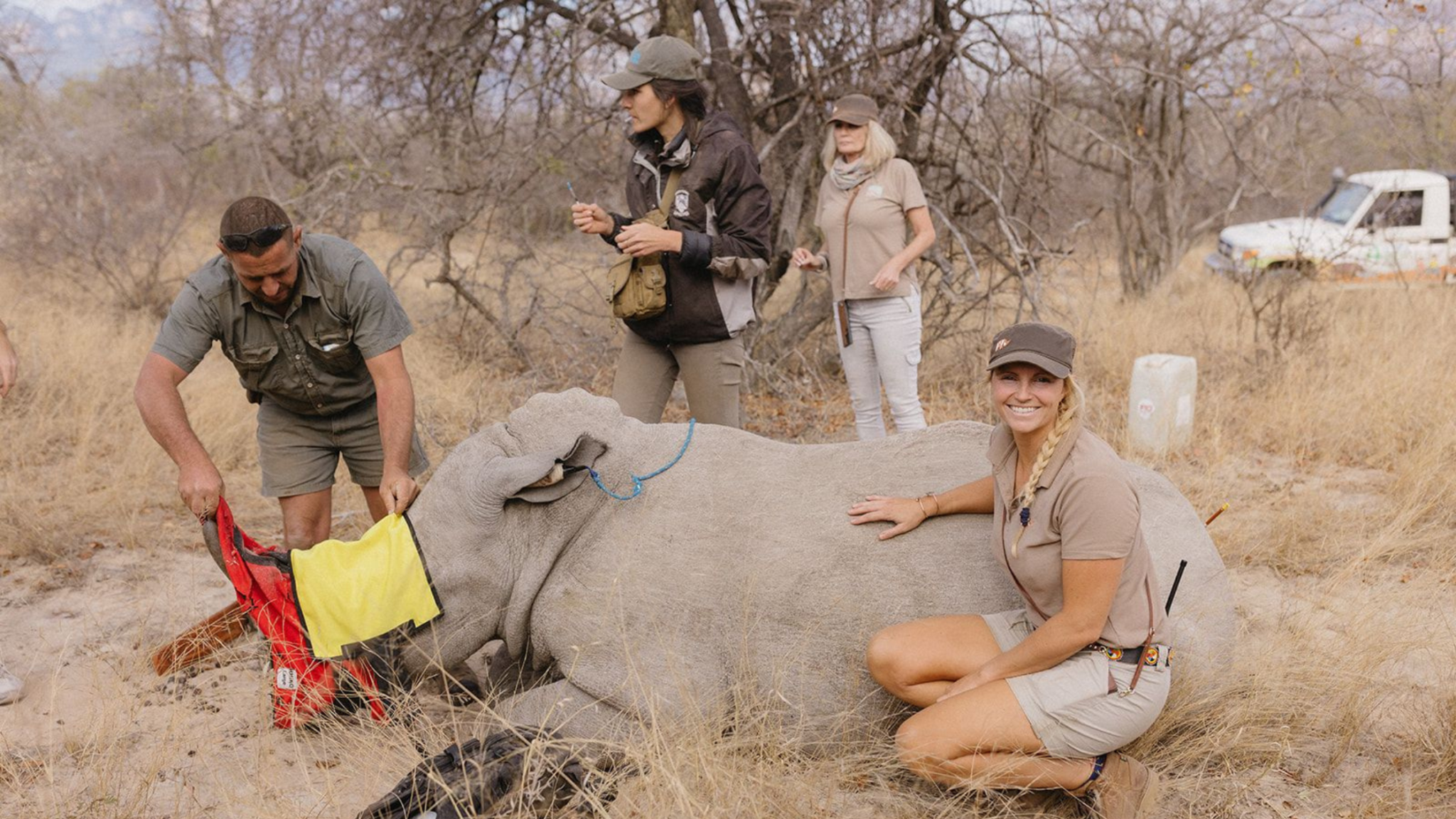
Join the revolution! With Rhino Revolution’s lawyer-turned-conservationist Sophie Barrett
“Everybody who cares needs to stand up, needs to try and make a difference.”
Born and raised in the UK, Sophie Barrett has lived and worked in South Africa since 2015. She originally qualified as a lawyer, but has since devoted her life to wildlife conservation. As of 2024, she divides her time between volunteering for Rhino Revolution, a non-profit rhino conservation organisation, and running her fieldwork education company, Goliath Training, with her partner.
In the beginning
“I don’t want to live in in a world that doesn’t have all of these animals.”
It began with a holiday to South Africa in 2013. Backpacking around as a tourist, Sophie Barrett was disheartened to see the decline of many animal populations. She has always been obsessed with wildlife and has a “lovely naïve world view” about moral obligations and responsibilities.
While Sophie was growing up, the plight of elephants and rhinos was frequently in the news, but on her travels in South Africa, she learned about other conservation battles.
One of the statistics she became aware of was that, at that time, it was estimated that giraffes would be extinct in the wild by around 2045.
“That really did shake me to my core. The way that we are living as humans is going to drive them to extinction in the wild within my lifetime. And I just thought that that is too far.”
Sophie realised she didn’t want to live in a world without wildlife: “And if I don’t want that, then my life needs to be about trying to prevent their extinction.”
Sophie had this epiphany while three-quarters of the way through qualifying as a lawyer in the UK, preparing to work for two years at a law firm that had paid for her university degree. She believed that a law qualification would provide valuable skills for many careers, so she continued on her path and spent her time at the law firm saving up for the transition into conservation.
Inspired by the late Lawrence Anthony, a bold South African conservationist and author, Sophie recalls: “I had a direction that my life needed to go in, but I didn’t know if I would be able to make a difference.”
“And I thought: even if I make no impact whatsoever, if I make it to a beautiful old age and at least I have tried, then it’ll be a life well-lived.”
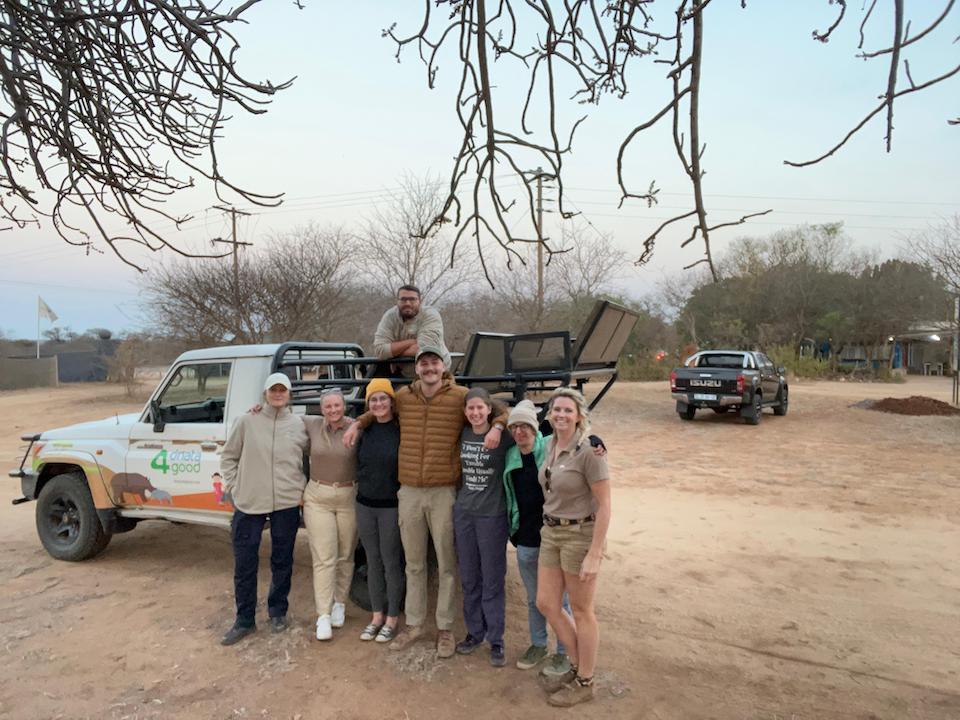
Sophie (right) with a Rhino Monitoring Experience group.
From law to conservation: The career switch
“It sounds strange. Going from law through to conservation sounds like a big leap, but it depends on the type of law you’re interested in.”
Sophie’s legal interests had always veered towards what she affectionately terms “bleeding hearts law” – law that is helping an environmental or humanitarian cause. She had always intended to work abroad and expected to have a limited salary, so the transition into conservation didn’t feel like a major leap.
After her two years at a UK law firm, during which Sophie focussed on saving money and “living on the bare minimum that I could”, she used field guiding (i.e. safari guiding) as her stepping stone into African conservation.
“I saw guiding as a huge opportunity to have an impact on people from all different parts of the world.”
Sophie found a field guiding school in South Africa and spent four and a half months living in a tent in the bush, “having all sorts of adventures”, including memorable encounters with a spitting cobra, baby puff adders, and a bizarre incident during terrible drought in 2015-16 when the guiding school helped raise some tiger cubs, which aren’t even native to South Africa!
“We ended up caring for a menagerie of animals that turned up on the doorstep of the school,” Sophie recollects. “There were racehorses and about 13 different dogs, a caracal, a bushbaby and a foal [who had lost its mother at birth]. It was this crazy Doctor Doolittle-style menagerie!”
Amongst all this chaos, Sophie achieved a basic guiding qualification for vehicle-based guiding and a qualification for trails guiding, otherwise known as walking-based guiding. She used these to enter the South African guiding industry.
At the time, there was limited female representation in guiding. Desperate for experience, on a number of occasions Sophie would just turn up at a luxury lodge and offer to work for free.
“I would do anything the lodge needed,” she recalls, “I was up before the guests up in the morning and doing everything that you can imagine.”
At one point she was attempting to repair a window at eleven o’clock at night to prevent unwanted animals getting in, with no maintenance experience. Neither she nor this blog post’s author recommend this.
A lot of paperwork is required for an international to be able to legally work for a salary in South Africa. Sophie completed a second field guiding course, because the school were able to help her with the paperwork. She explains that this was one of the biggest challenges of her transition into conservation.
Another significant challenge was the messaging Sophie received – that it was impossible for her to succeed in conservation.
“I faced a lot of: ‘Oh, that will never happen. Oh, but you’re not South African and you’re female and you want to do what? And you want to do it here in South Africa? No, that will never happen. It’s too difficult.” Fortunately, several of Sophie’s law colleagues counter-balanced this negativity.
“I don’t think people realise how hard it is to persevere when, at every turn, there are people saying, ‘No, that can’t be done’.”
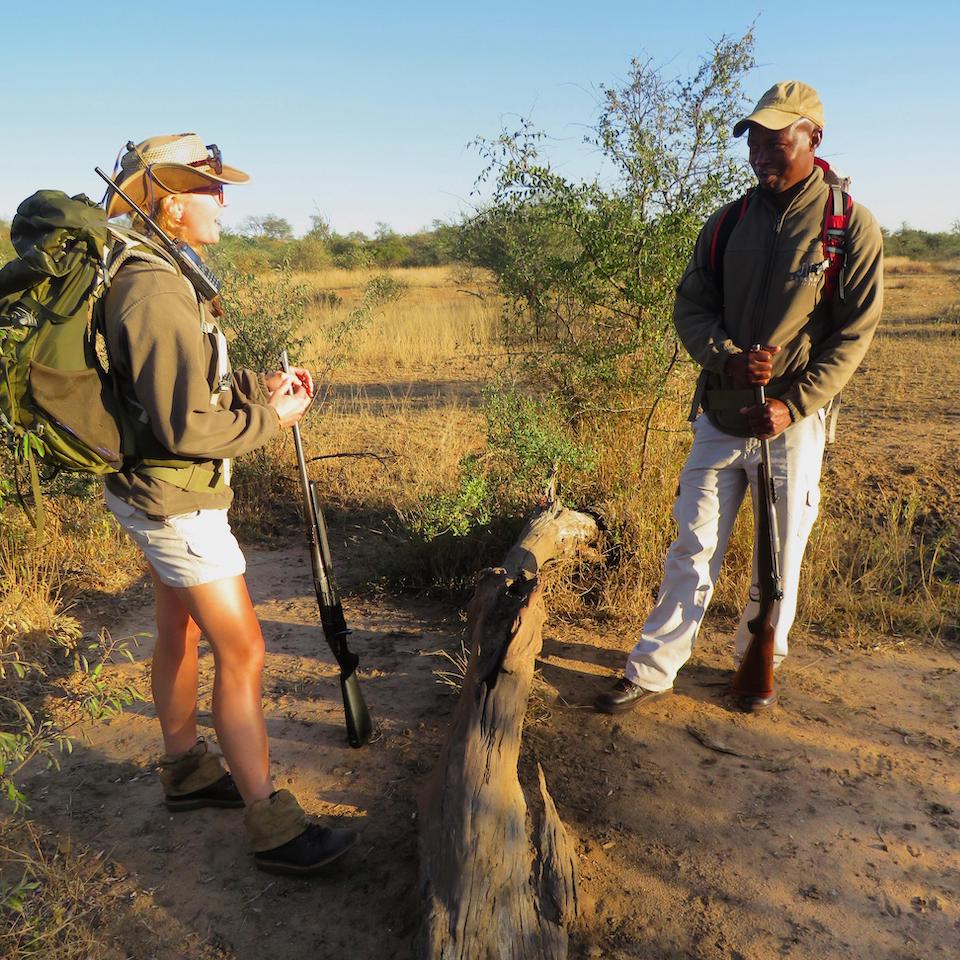
Sophie delivering some safari guide training.
Joining the revolution
“You get unbelievable opportunities to get close to these magnificent animals.”
Sophie first discovered Rhino Revolution during her second field guiding course. At the time, they had recently opened a pangolin rehabilitation centre – and Pangolins had always fascinated Sophie.
Rhino Revolution is a small NGO based in Hoedspruit, South Africa, whose focus is protecting Rhinos and working to ensure that there is a future for them in the wild. The charity has a small but dedicated team and the passion that they put into their work was a key factor in Sophie’s interest in joining the team.
Much like her approach to guiding for the lodges, Sophie contacted the charity in 2018 and offered to work for them, asking the centre to sponsor her volunteer visa in return. Happily, the Rhino Revolution agreed.
Sophie emphasises the importance of “doing the legwork”. From her experience in South Africa, you can’t go to organisations and ask where you can help them; you have to tell them where you can help them, based on your skills and experience. Otherwise, she says, the organisations are too busy to listen.

“You have to say: ‘I looked at what you’re doing and I can’t find anyone doing X. I can do X for you. These are my qualifications. These are my credentials. This is my experience. This is where I could really add value. What do you think?”
Thus Sophie transitioned from guiding, which she describes as a more educational conservation role, into being “actively involved” with wildlife. In this new capacity, she led research on wild pangolins and assisted with post-release monitoring of rehabilitated individuals, amongst other responsibilities.
Following the COVID-19 pandemic, Rhino Revolution moved away from working with pangolins due to the intense politics surrounding them, but by this time Sophie had established herself as a key member of the team.
Sophie’s official title at Rhino Revolution is simply ‘volunteer’. Her role can involve anything from running social media accounts and setting up volunteer programmes, to assisting with ‘rhino monitoring experiences’, fundraising events and hands-on operations like horn trimmings and relocations.
“Basically, I can be pulled in to help with anything the charity gets involved in!”
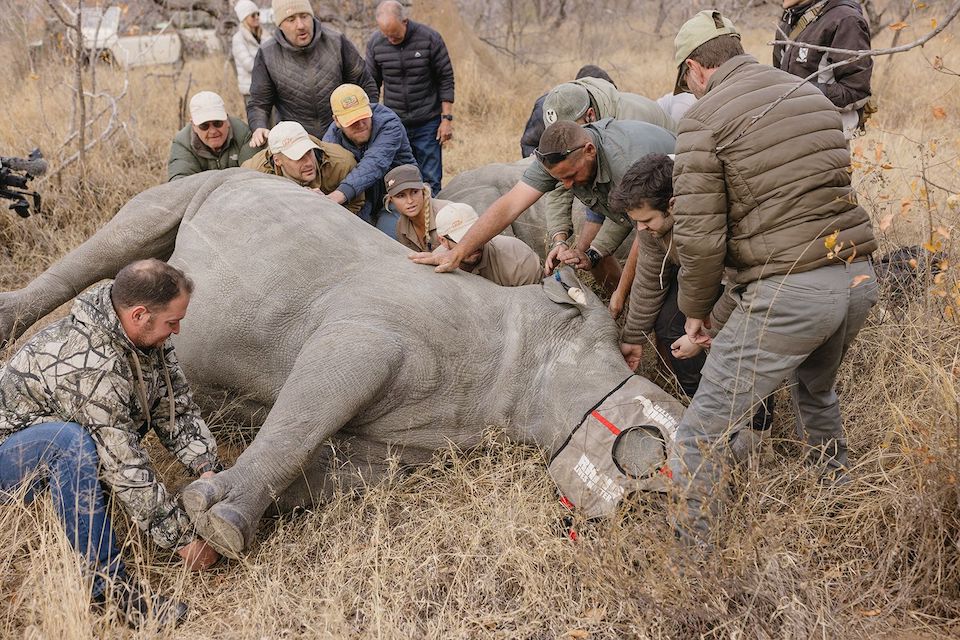
Sophie and the Rhino Revolution team at a horn trimming operation. Credit: Andreas Nusch.
Goliath Training
“Spreading the word is such an important part of conservation.”
In addition to volunteering with Rhino Revolution, Sophie runs a fieldwork education company called Goliath Training, with her partner. The company primarily focuses on educating people about the realities of wildlife conservation and researching and protecting biodiversity.
“People are often keen to do research in the wild, but not really sure about different safety elements or different factors that might be involved.”
Founded in 2022, Goliath Training began as a “passion project” for Sophie and her partner, both of whom had been involved in conservation, guiding and research for many years. Sophie is now a professional field guide, which is the highest level of safari guiding qualification in South Africa.
“We’re very passionate about how conservation and research are carried out, and about helping people get into whatever field they want, whether it be guiding or research.”
Sophie and her partner recognised that no other company offered the specific combination of skills training they envisioned – thus Goliath was born.
“The ability to channel our energy into the projects that we want to be involved with has been hugely rewarding.”
Sophie considers the most important skills in conservation and guiding to be good communication skills, good people skills and good listening skills.
“I would far rather hire someone for their personality, and then train them in the necessary skills,” she explains. Whether you are securing funding for a research project or guiding tourists through the African bush, you must be a good communicator.
“If you come on a safari, you’re paying to spend sometimes more than 8 hours a day in the company of one person. So it has got to be a person that you don’t mind spending time with, or that you enjoy spending time with.”
The name and logo for Goliath come from a species of beetle called the Goliath beetle, which is about the same size as your palm.
A note for the future
“I want this wildlife that I treasure so much now to be available for future generations; for future generations to be able to go to true wilderness areas and experience the absolute magic of uninterrupted nature.”
If Sophie decided to move away from Rhino conservation (which she has no plans to do at the moment), she would like to work with lots of other animals, including Pangolins (again!), Elephants, Lions and African Wild Dogs.
She jokes: “My favourite animal is probably whatever I’ve just seen, so I know I’m in the right career, because everything is incredibly special to me!”
Sophie’s advice for aspiring conservationists is wonderfully simple: “Never give up. Believe you can do it, and be creative.”
She suggests keeping an open mind to different paths, especially for career switchers. Many conservation jobs say they require various degrees, but Sophie believes practical experience holds far greater value.
“Take every single opportunity that comes your way. There’s no one route into conservation.”
Want to know more?
“If I talk to 100 people in a week and just one of them is inspired by what I say to actually try and help, I think that’s a massive impact.”
Check out Sophie’s Instagram (@barretsbushlyf), Goliath Training (on Instagram @goliath_training_), and Rhino Revolution (on Instagram @rhinorevolutionorg).
If, like Sophie, you’re inspired to “Join The Revolution” you can jump in and gain firsthand experience by joining Rhino Revolution’s Wildlife Conservation Volunteering Programme – a two-week programme in the heart of the wilderness where you will be immersed in the realities of Wildlife Conservation. You can contact Sophie and her partner, who run the programme, at info@goliathtraining.org for more information.
You can also read about South African conservationist and author Lawrence Anthony’s astonishing life and career.
Author Profile | Jasmine Santilhano
 Jasmine Santilhano is an Ecology student at the University of York, UK, and a volunteer Conservation Careers Blogger. She plans to work in wildlife conservation after she graduates.