

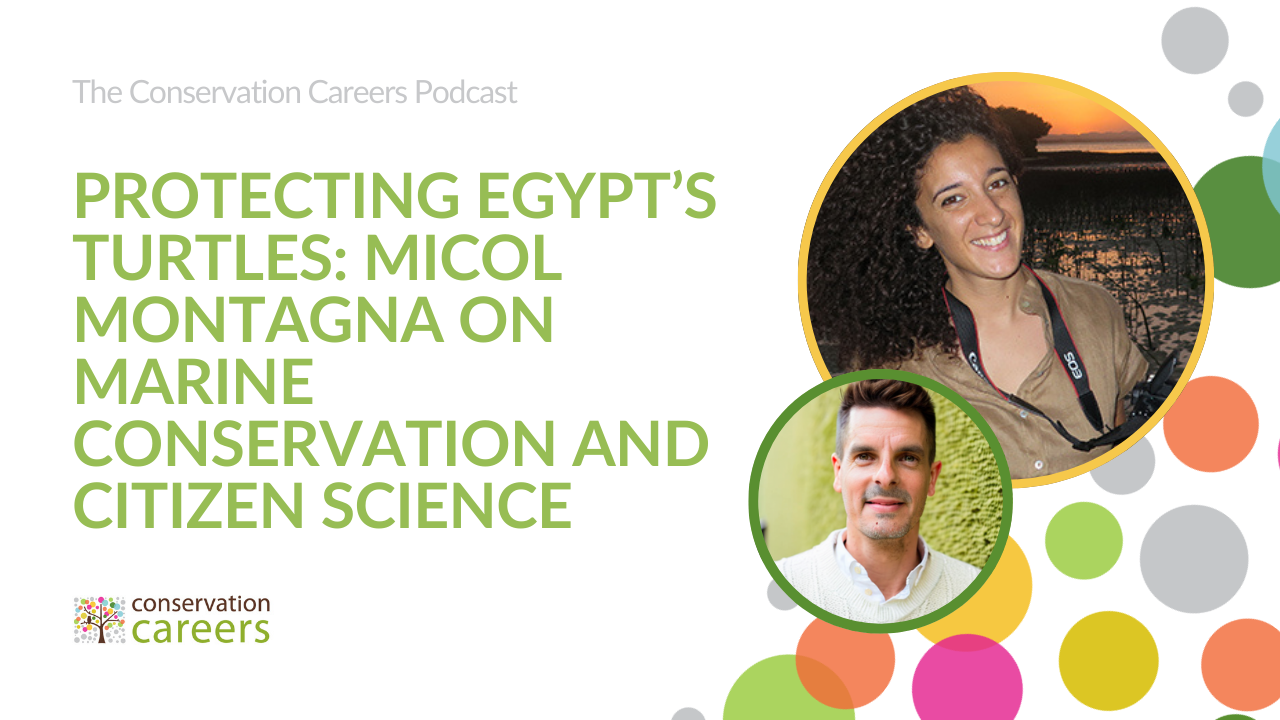
Podcast | Protecting Egypt’s Turtles: Micol Montagna on Marine Conservation and Citizen Science
How Turtle Watch Egypt Engages Citizen Scientists, Dive Centers, and Local Communities to Protect Marine Turtles, With Micol Montagna.
What’s it like to study and protect turtles in the stunning waters of Egypt’s Red Sea? How can citizen scientists and local communities play a key role in marine conservation? And what are the biggest threats facing sea turtles today?
Today’s guest is Micol Montagna, biologist and project coordinator at TurtleWatch Egypt 2.0. Micol has dedicated her career to marine conservation, using citizen science and innovative research to monitor and protect turtles along Egypt’s Red Sea coast.
In this episode, we explore the vital role Egypt plays in global turtle conservation, how TurtleWatch Egypt identifies and tracks individual turtles, and the importance of community engagement in marine protection. Micol also shares her career journey, insights into working in conservation, and advice for aspiring marine biologists.
It’s an inspiring, hands-on, and action-focused podcast.
Enjoy!
Listen
Watch
Subscribe
You can listen and subscribe to the Conservation Careers Podcast on iTunes, Spotify or Stitcher using the following links, or search for ‘conservation careers’ and you’ll find us!
Discuss
If you enjoy listening, please leave us a rating and review on wherever you get your podcasts, it really helps us to get in front of more people! If you can share with your friends, that would also be great. If you’ve got any questions or suggestions for the podcast please tweet them to @ConservCareers. We’d love to hear from you!
Resources
Join our live podcast audience!
All our podcasts are now recorded in front of a live audience who sit in and listen to the chat, and then after the mics are turned off get a chance to talk to the guest, share their thoughts and ask questions.
If you’d like to be in the audience all you need to do is join our CC Academy.
In the CC Academy you’ll get access to the world’s biggest conservation job board – listing over 15,000 jobs, volunteer and internships across the globe each year.
You’ll also enjoy access to our amazing CC Pro private members community with regular events, networking and support.
Plus you’ll get full access to our growing library of career-boosting resources, guides and templates.
And best of all it only costs a few dollars, pounds or euros per month to join the Academy.
To find out more please visit the CC Academy, or simply click the join button at the top of our website.
See you on the inside!
Transcript
My name is Micol Montagna, and I’m a biologist, and I’m the project coordinator at Turtle Watch Egypt two point zero. Wonderful. Well, really nice to have you on the podcast. Thanks for joining. I’m really interested to know more about Turtle Watch Egypt two point zero and the various other things that you’re involved with as well in your career history.
Yeah. We’re here to talk all things turtle, all things marine conservation. And I want to know a bit more about Egyptian conservation too, which is really interesting. But let’s let’s start with turtles, because that’s what we’re here to to discuss and the kind of thrust of of our discussion today. So, yes.
We you you’re the project coordinator for Turtle Watch Egypt two point zero. Tell me a little bit about turtles in Egypt. Let’s just start from there. You know, is Egypt important for turtles? What species do you find?
Sure. So, Egypt actually, is having the Red Sea and the Mediterranean Sea. So what we focus on is the Red Sea, actually. I’m Italian, so I’m supposed to be more into Mediterranean Sea, but I’m not. I’m here in the Red Sea since 02/2012.
So, this is where I’m, let’s say I’m more expert about the Red Sea. So marine turtles in the Red Sea, we have five species of turtles. Yeah. Around the world, we have seven species of marine turtles. So five means quite a lot.
So the Red Sea, in few words, is a very, very rich sea. High biodiversity. Not just about marine turtles, but also about coral reef, very resilient reef. So it’s a very, very precious place. And I’m I’m in love with it, of course, because it’s beautiful, but I believe it’s really, really, really important to underline how it’s important to preserve it.
It’s really one in my opinion, one of the best underwater places in the world. So we have five species of marine turtles, and along the coast, we mostly see two species, the hawksbill turtles and the green turtles. Here, where our offices and where I’m talking from is Marsalaam, which is located in the southern part of the Egyptian Red Sea Coast. And here we have a lot of very, very interesting and important feeding grounds for especially for green turtles. So, actually, when you go in the water and you go even just snorkeling for fun, you may spot several different individual turtles.
And we conduct several we call them regular surveys to check, how to monitor the marine turtle population. And in some places, we can spot up to 20 or 25 different individuals. Wow. So it’s Egypt is really, really important for marine turtles. We can see Yeah.
And what is sort of the kind of the threats to turtles? Are they thriving? Are they declining? What might be causing any changes? This is a very, very important question.
And, unfortunately, I don’t have a very clear answer because, actually, Egypt is data deficient. We don’t really have clear, solid scientific data here. It’s very important to underline that our project is a relatively small project. It’s well, we’re running since 02/2011, so we have a quite a good history, but it’s a citizen science project. So we don’t really, run active research.
We don’t have this solid data that can tell us what is the situation of the marine turtles here, neither what is the extent of the threats. What we can say is what we see from our project, and what we see as a threat, for example, is collision with speedboats, plastic pollution, which is pretty much everywhere, and, I would say, the third point, human disturbance. Okay? So this is what we can see. Of course, this is not just that, but this is what we can see with our monitoring, with our citizen science program.
Yeah. Okay? And the same for the status. We are not able at the moment to say if the population is declining or not. What we can see is that for I will give you an example.
In the last two summers, we got really, really high temperature during summer. Mhmm. So we could see a decline in the amount of, seagrass in the main feeding ground areas here. And, therefore, we also saw a little bit less individual turtles, but this is just an observation. I mean, it’s not something that it’s can be validated as, okay, now the population is declining.
This is just observations. So as citizen science, I don’t know if you want me to mention shortly what that means. Please do. Yeah. We’re gonna talk about, you know, your project, so feel free to describe it.
Yeah. Alright. So citizen science means that we involve non researchers, non scientists, non biologists, whoever actually can contribute to our, data collection. So any snorkeler and diver submit sightings of turtles to us, we, get the photographs along with all the information related to the sightings, especially the site site and date, and some extra for who wants to be the so called pro turtle watchers. And we analyze the photographs, and we use the photo identification technique, which is a technique in which we use the natural markers of the animals in order to identify them to the individual level.
So we receive the photos, We can tell the species, and we can tell the individual as well. So, oh, this is John. Oh, this is Maria. Oh, this you know? You took some names?
Yes. This is the other very cool part of the project. And this is how we actually get the people involved because this is part of the the trick. You have to, let’s say, convince the tourists to contribute, to our project. So we can monitor marine turtles in this way.
We can say, okay. Joe was in this bay in this day, and then he moved this on this day, or at least we know that this day was already in the in his other site, for example. So this is how we can monitor them. We don’t tag them. We don’t follow them.
We just use sightings provided by people. Okay? So photo identification is very, very, very, cool and powerful as long as you have a lot of people sharing their sightings, of course. So this is the fact. We try to expand our network as much as possible, and we our main partners are actually the diving centers.
We train diving center staff so that they can themselves train their tourists so that they can, first of all, share code of conduct how to behave when when you see marine turtles in the water or while nesting, and how you can, actively participate in the project. So any diver and snorkel going to find the Red Sea can actually become a turtle watcher and contribute to a, research project. So this is the main thing of the the activity. We have about 96 diving centers collaborating with us, and this is the clue part. So it’s very important.
So coming to the question you asked before, yes, we give names to the turtles. The first times I was, doing my own surveys, we do our own surveys to validate the data we received by the citizen scientist. I was just giving very boring codes as a names to the turtles. And then when we started to get more and more citizen scientists, then we were why not? We decided to invite them to pick the names, and then things became more interesting and more attractive to people so that that they wanted to find their own new turtle that they could register.
So this is the way how we actually keep people engaged, and we have some citizen scientists that they’re so happy to share their sightings that they come here three, four times a year, and they go they build their own little catalog, and they’re able even to identify the turtles themselves. That’s amazing. I love it. I love almost like the simplicity of it too, and how anyone can get involved and how the data is helping you to understand turtle behavior, presumably over time changes as well in dynamics, things like that. Loads of questions.
Well, one is like, how easy is it to identify an individual, and how do you do that? Are you doing that as a trained individual like yourself? You’re looking at photos. Are you using some software? Is AI getting involved?
Like, how good is that side of it? Good question as well. So the answer for the moment is we do it manually. Yep. This is how most of fossil identification based turtle conservation project work, actually.
The human eye is the most accurate thing you can use. The point is that it’s taking really a lot of time. We have, for example, received so far more than 10,000 sightings, and we have in our catalog eight more than 850 individual turtles registered, but then we have all the ones that are not completely registered. We know they’re different individuals, but they’re not registered. What means registered?
It means that for that very individual, we have both the head size of the turtle. I didn’t mention that before, but identification. But what kind of markers we use for marine turtles, I didn’t mention that. Mhmm. So we use the facial profiles.
So we use the size of the head. They have a very specific pattern, that they are unique for every single individual, and they never change over time. This makes marine turtles extremely good for the fossil identification. Like, with dolphins, for example, you’d know that, researchers use the dorsal fin, but the dorsal fins are, not really staying the same for all the, the life of the animal, and they’re looking really similar to each other. Mhmm.
So with turtles, it’s much easier, but as well, of course, it’s time consuming. I mean, you really need long time. So we are trying to, we we got some volunteers, involved. They are engineers. They are, people having better knowledge than what we have about such things.
They are trying to use artificial intelligence to develop an app that can actually help us to at least reduce the number of photos we have to check. Yeah. That’s alright. Yeah. Step would be to try to automate automate a little bit more the process of the photo identification because this would really help us a lot.
Yeah. And you mentioned that you’re working with was it 96 different dive centers? Like, how how open have they been to a project like this? Have they sort of do they do they view themselves as custodians of the marine environment? Do they think of themselves as conservationists?
Are they interested? Is this just an extra faff that they’d rather not do? But the tourist one what’s been their engagement? That’s another good question. I think about the diving centers, about our best friends.
Without the diving centers, we would not do anything. They are like our third, fourth, or fifth arms. Yeah. They are very different. There are there are some small ones.
There are some big ones. The depends also the ownership, who’s the owner. It depends also on the location, the area of the of Egypt. We are based in the South. There is not that much competition of diving centers here.
I can see much more involvement and, interest in participating our activities in the North, in Sinai, so Sharm El Sheikh and the hub. It’s very far from here. I don’t know if you can figure it in the map, but, it’s quite far. So last year, we went for the second time, but, since I’m the coordinator at the first time, to the peninsula, and we run a few training for the staff of the diving centers there. And everybody wanted to have a training with us.
They were super, super involved. So, for example, in this North, I see them more engaged. And even before going there, we were receiving a lot of sightings from diving centers. In the North, there is also more competition. There are a lot of diving centers in a very small area.
Sharm El Sheikh is quite small. So probably it’s also about, you know, adding something that make them standing out from the others. It’s just my opinion. I don’t know. Yeah.
There are some living centers that are super committed. They help us a lot. They provide us with whatever we need, and they run very often, training for their staff, turtle talks, for their guests, and they help us however they can also on social media. So there are others that they’re not that interested. When we started to run one of the latest round of training for diving centers in the last two years, we physically went to single diving centers with our fosters, employers, and manuals and say, hi, guys.
We will organize, training for your staff for free. And then if you like, we can, also run some turtle talks for your guests for free. Mhmm. And this is another new thing we started to, to develop. We would offer your skippers, so the speedboat captains Mhmm.
Quite short but quite, in intense workshops in Arabic for how to behave while driving boats in areas where marine turtles may be feeding because boats are moving there. They’re dropping customers and, you know, they need to know what they should do, what they should not do, and how to do it. Yeah. It’s also free. So just let us know.
We will come to you in and we will organize the events. Some diving centers were super happy and they do it almost every year. And some diving centers, they’re just not interested. And, I regret to say I’m sorry to say that actually the ones that are the most interested are already the ones that are behaving quite well. Yeah.
Yeah. I see. Yeah. Yeah. One thing we would really like to do in collaboration with the local authorities that are also supporting us quite a lot is to try to, make this kind of training, especially the ones, involve address to the speedboat captains mandatory for everyone.
Yeah. I think that would be something useful, but also quite quite difficult to get. It’s such a nice example of a kind of, a local conservation project. Some of the challenges that you face, how you’re overcoming them, how you’re learning about how to engage people, who are the key people to engage, how you might be able to change their behavior. There’s so much going on.
Two questions, jump in. I’d love to learn to talk more about you and your career and your work personally as well, Nicole. One is, you’ve mentioned it’s free to do this, it’s free to do that, it’s free to do the other. Like, how are you funding the project? Like, where’s the funding come from?
I’ll ask the other one separately. So, yeah, how how’s what’s the kind of the business model if you if you want to ask, you know, view it that way? Yeah. Maybe this is not how it should work, actually. This is a good question to maybe think that maybe this is not the way.
Okay. I will start saying that I’m not really, good at business. I really love, I really love marine life. I really love to work with the people. We also organize a lot.
So I didn’t mention that maybe we can talk about that later, but we work a lot with children. Okay. So we organize a lot of things for the local, children and family and schools and so. We have been, given, quite good, financial support since 02/2022 by Forgive, which is our current official donor donor. Yes?
Yep. It’s a Swiss foundation that is now building something very, very big here. In Marsala, it’s building the very first clinic for stray dogs attacks. Okay. So, before that, we received small grants.
I think you know from the Rafer the Rafer Foundation. CrossFit. Yeah. Yeah. So they were the very first one to support us.
Mhmm. But before that, when the project was founded in 02/2011 by my dear colleague and friend, Doctor. Mancini, under the umbrella of Hebkai, local NGO that was supporting the project for the very beginning of the project. So from ’11 to ’13, there were it was under HEPCA. Then the project stops, and then I rebuilt the project from 02/2015 till now.
But from 02/2015 till pretty much 02/2022, a part of this two small grants of Rauschor, we got no funding. So it was actually self funded. And it’s very important to underline that the project, was running just because we were volunteering. Yeah. Yeah.
So we were not running that many trading and turtle talks and things. All this was organized later on when we actually got the funds from the foundation. So the foundation is giving us the money to do all these activities for free to Yeah. Help local community to get the skills and the knowledge to improve the situation and to protect the marine turtles and all the the habitat they live in. Yeah.
Okay. Fantastic. Yeah. So right now, it’s a a the notion sort of charitable funding model. And there’s opportunity, I would think, into the future as you kind of grow and to think about other income streams and things like that.
I don’t wanna go down that rabbit hole, though, because I’d really like to talk before we talk about you, one final question actually, which we’ve not really covered is, you know, for all the images and photos and information you’ve gained about the various turtles, the 800 and so different names you’ve got now, what have you learned about turtles? Like, where do they go? Have you seen anything interesting? Or yeah. What’s been the result of of the, the information you collected?
That’s a very good question as well. Well, you can always learn from marine turtles. I really love them. I, I, I always feel a very, strong and interesting connection with them when I’m in the water with them. But a part of that, there are a lot of interesting facts.
First of all, marine turtles along the Egyptian Red Sea, they are, they show very high fidelity for the feeding grounds, which means we mostly see the same individual in the same spot. Okay? So we have turtle Mustafa that was spotted in 02/2003 in Marsa Buda, a bay nearby here in Marsala. Today, certain Mustafa, adult male green turtle, is still there. Wow.
Okay. You’re all sitting there. This is one thing. Hogsfield turtle also are famous to be as a species in general. They’re normally not big migrator, let’s say.
We always see them pretty much in the same spot or nearby areas. Something very interesting we have found in, like, about two years ago, we got the final, let’s say, results, is a migration pattern between Egypt and Saudi Arabia. So we use fault identification. We have colleagues at KAUST, King Abdulrah University in Saudi Arabia that are tagging marine turtles when they’re laying their eggs. So what happened first, that in 02/2016, I found one turtle with a tag and was not tagged was attacked from abroad.
Was not coming from Egypt. Was not we we didn’t know from where. So after a long investigation, we, found out it was coming from Saudi Arabia, from Riyadh. So this turtle actually, was feeding, in, Egypt, then went to Saudi Arabia and then, came back. Okay.
Then the other thing we found out and and this turtle was named by me, Osee, because at one point, everybody thought it was coming from Australia, but this is another story. It’s a fun fact. The other thing is the other turtle in another bay in South Of Marsala. We spotted it without tag before when we registered it as Milka, also another fancy cool name. Mhmm.
Then we didn’t spot it for three months, and then it came back with a tag again from Saudi Arabia. So she did the trick, and she came back to exactly the same day as before feeding again in Egypt. So this is these are just two examples. And it’s a very good example how different projects, different techniques, different, you know, ways how to study marine turtles can be put together to get a very interesting result. It’s the first time that there is a track of, this kind of migration pattern.
And the other thing that I think is quite important to underline is that we we are managing to monitor the injury, yeah, the injury and recovery rates of marine turtles in the wild. It’s something that normally who study marine turtles is not really able to do because, basically, who is monitoring marine turtles normally has a rehabilitation center where turtles are treated and they can recover and then they are released into the water. Of course, the our project is very small and, like, we we we run citizen science program. We try to do raise awareness, to work work on education and, you know but we don’t have that money to be able to build a rehabilitation center. So we have to monitor my turtles in the wild.
And what we found out is that they recover extremely well by themselves, not always, of course. But in most cases of the turtles we’ve managed to monitor along the years, we have seen really, really, really surprising recovery rates. So we have turtles that there is one that has a cross shaped, wound in the top of the carapace. When I spotted, I remember I could almost put my hand through the hole. And after two years, the carapace is completely healed, and you don’t even see a deformity in the shape of the carapace.
So that’s very, very interesting. We have, of course, remote support from specialized veterinaries in Europe that are helping us. We are not veterinaries. So it’s not just about not being able to to treat the animals and also not able to tell, okay, what is the situation here? So with the photographs, we get also this kind of information thanks to the remote support of, specialized veterinaries.
Yeah. Amazing. Yeah. So interesting. It reminds me a little bit of I’ve done bird ringing or bird banding as it’s called, where you would catch birds in missed nets or in the or in the nest even and put small rings on their legs, and then they’ll be released back into the wild.
At some point, they might be recaptured. And through that, you learn about movements, migrations, how long they live, all sorts, you know, just from those kind of simple mark, release, recapture. Yeah. Yeah. And I’d love to get to a bit same.
It’s the same model. Yeah. Yeah. Yeah. In terms of apply tags, but we use the the photo.
Yeah. Yeah. So interesting. Let’s talk about you, your career, your passion for marine conservation, and maybe we’ll start with that. Like, what sparked your interest in marine conservation or even turtles specifically?
Was there a a time or a moment, some of this grown gradually on you? Like, where does this come from? Okay. I’ve always been in love of the sea. I have a kind of old relative that was probably a kind of seaman and was the only one in my family.
I was raised in Milan, which is a city in the North Of Italy. There is no sea there. I was desperately looking for a sea for most of my time at school and the high school and university. At the time I enrolled at uni, there was no marine biology course in my city. Now there is, but at the time, not.
So, actually, I was studying I was studying biological sciences and biodiversity and biological evolution. I’ve been studying in Spain as well, my second year of universities, and I was studying molecular biology and medicine. I tried also, during my Erasmus to go move to the sea, but somehow I didn’t really manage during my academic career. I was really within the, let’s say, more, biochemistry and biology, pure biology. But but I’m happy about that now because I think that this is also a good base to start, and then you can learn after, more practical skills.
This is what I did. I’ve been studying WASPs in Spain for my, bachelor. Wasps? Wasps. Yeah.
Yeah. They didn’t say. And then I was really loved, with actual actually with animal behavior. This was really interesting for me. I was really fond of monitoring and observing animals in their, natural habitat rather than staying at laboratory.
And in Milan, in my uni at that time was mostly all about blah blah blah. I I know it’s very important, but my passion was to be in the nature, in the field. So my thesis in, for for my master was in the upper nine, something completely different. I was studying the red deer, habitat use in the mountains using photo traps and doing, observational, transit monitoring the deers. And, yeah.
So, actually, I was I had a lot of experience in the mountain with the snow. Then when I finished my university, I looked at, positions as a volunteer, as a research assistant, as jobs by the sea. And that’s where I went I I got my first, position in Egypt. I came here to work as a resident marine biologist in the hotel to lead snorkel trips and, to talk about the marine life and the mangroves and, you know, the the environment here in Egypt, to the tourists, it was something quite if I look at it now, quite simple, but at the time for me, it was very challenging because it was a big shift. And there is when I completely lost my mind for the sea.
Because I started to be in the water most of the day, and I studied a lot, of course, because I had to catch up with all the marine parts that was missing. And then I decided to get more, experience on the field work, with marine science. So that’s when I got, I went to Australia for one year, and I trained, in, more in field work. I work for, with the Murdoch University Mhmm. Collaborating with a PhD student that was monitoring dolphins in Perth Metropolitan water.
And then I went to Exmouth in Ningaloo Reef area, and there is where I was doing something similar. So it was a lot of time on the sea. I learned really a lot, and I learned a lot about spot identification. Mhmm. And then I came back to Egypt, and then, actually, I rebuilt the turtle watch project because I was working as a dive guide in one of the main places here.
It was a big bay with a lot of turtles. And, in my in my lunch break, that was about one hour, I was going in the water. I was establishing the transit. I was monitoring the marine turtles, and then I started to build my own catalog. And then I got in touch with doctor Mancini, with Agnese, that was the one who founded the project back in 02/2011.
She gave me the indications how we could actually restructure the project, and I started collecting a few divers from the diving center I was working with and then more and then more. And then this is how we relaunched TurtleWatch. That’s why it’s two point zero. It’s it’s really interesting, like, listening to your story how at the time, it probably did it might not have felt from your perspective that you’re maybe going in the direction you wanted to. But when you look back, there’s so many recurring threads and patterns through all that, like studying species behavior, whether it’s wasps or deer or something else, photo ID, photo traps up in the mountains in the snow, similar to photo traps in the sea and image recognition, then falling in love with the marine environment and sort of circling it.
And so it feels like you’ve brought it all together. Yeah. Now I can’t tell yet. I need understanding the dive sites. Sorry.
Just that connection to the dive industry and understanding that side of, yeah, that audience that you’re serving right now as well. Yeah. It was very important. My time working in diving center was very important as well because it made me really able to understand how things work in that business. I worked for five or six years, the diving centers, and that was very important, of course, because Yeah.
As I said before, they’re our best friends. Yeah. The diving centers. And you understand them. You can speak the lingo.
You can walk into a shop and yeah. And Yeah. Yeah. Get in the door. Yeah.
That’s that’s it’s brilliant. Yeah. When I was wondering which way to go. Yeah. So marine conservation, like more generally, just sort of expanding out slightly.
It’s it’s a it’s an area that’s of great interest to lots of people who are interested in conservation. It’s also a big area. I see it as like a theme of work, like a cause. You know, you care passionately about the sea and the species found in the sea. But then the jobs that you can do, are many and numerous.
You could be a project coordinator like yourself. You could be a fundraiser. You could be a communicator, an educator. You are many of these things, you know, in in your role that you’re doing. Just maybe paint your own picture.
Like, what does what does the marine conservation sector look like in terms of the roles and the jobs that are out there? Could you give me your view as to what are the main jobs? And even, like, what are the skills that are really valuable to to develop if if you wanted to work as in the marine conservation sector? From my perspective, but this is also my experience, is not just about preserving the marine life and their habitats, but also involving all the local communities that are, interacting with it. This for me is very important and as a kind of careers it’s really deep as you say it is so different and so wide so in even in the marine turtle conservation field, there are a lot of differences depending on where you are.
I mean, I’m in Egypt, so I have experience here, but, we all turtle, lovers or turtle nerds meet once a year in the International Sea Turtle Symposium, and we are going to join, the next one in Ghana soon. And there, it’s very, very interesting to, get together and to expand network, but also to see how different people are doing different places. And, actually, we are all all the same but all different as well because different places, different challenges, of course. But, yeah, as you say, there are a lot of different, positions you can cover. It’s not just you don’t have to be actually a marine biologist.
What we really like, as I mentioned before, yeah, I have to be also educator. I’m not an educator, but I’m trying to do my best. You need that. Fundraising. I’m really bad at it.
You need you need someone to do that. So that’s very important too. Also being into computer engineering. In our case, it’s very important. I I have knowledge too about that.
So different fields that could look like having nothing to do with our field can be super, super important. But being a veterinarian, for example, be could be a lot of different things. Being someone very good at, shooting and editing videos, for example. One of our colleagues, she’s the one editing the videos for our YouTube. She’s a biologist as well.
Okay? So either we have to reinvent ourselves as something different and learn different skills, or, it would be great to have other colleagues, other people that are actually very good at different, things. So you don’t have to be only marine biologist, of course. There are a lot of different or even someone knowing very well Arabic, for example, in our case. Yeah.
Yeah. Teachers, especially in conserve in my vision of conservation is very, very important. Education clue is very important. Mhmm. So educators, teachers.
Yeah. Love it. Absolutely love it. Yeah. It just shows the variety of skills, the variety of people that can help and be involved and try things forward.
By being instructor, professionals in our case because we do most of our activities, for sure you understood. Now it’s in the water. So we, we’re one of the few projects about marine turtles that are not studying marine turtles in nesting areas, but in the water in feeding grounds. So the in water part is vital. So diving structures, dive guides, snorkel guides are very important too.
Yeah. And skippers, actually, just to, yeah, sort of round it off, I guess, too. Yeah. If there’s someone listening, and they might be a student, they might be a job seeker, they might be a career switch, or doing something unrelated. They might be a teacher at school, you know, and wanting there’s a school right behind me, which I’ll point that way.
They might want to work and do something similar to you, or their passion is in marine conservation. They might be landlocked, and they want to be at the sea just like you were in Milan. What careers advice would you give someone like that to to just move them forward, point them in the right direction? What what useful things might they want to bear in mind or any practical steps they can take? Well, from my humble perspective, because this is just my path.
As I say, it’s marine tourism, it’s in Egypt, and then everything can be different. Yeah. There’s no other cases. But, if you’re really fond of this sector, you should never give up. So first is being persistent.
It is an advice my marine biology professor, the only course marine biology I managed to get in Milan, gave me when I was very young. And I was like, easy to say, but actually true. So, keep going. Try to get as much experience as possible. So get in the field.
Even if it doesn’t look like what you really are aiming at, this will come later. Yeah. At least I can say now because while I was doing all my different jobs or volunteering positions, I was not really managing to put all things together, but you will at the end at one point. Yeah. And trying to network as much as possible even if you think you are bothering someone, I would say.
I’m not like this, but I I think it’s important to to keep asking, to keep trying to connect with people that has already experienced in the field you like and volunteer. I think it’s very important. First, because you get the the experience. Second, because you got to know the people doing the job you want to do. And third, because it’s something, anyway, you enjoy and you like.
And for me, it was I’ve been volunteering for, like, ten years before I actually managed to get, like, a compensation for what I’m doing, let’s say. Yeah. So it takes a while. You have to be, very, let’s say, I it comes stubborn, but probably is not the right word. Sorry.
I’m in I’m Italian, so maybe some words are not really coming. But, I mean, keep going. Works well. I like it. Yeah.
Yeah. I think persistent, it comes back to that first word that you used. Absolutely. Yeah. Yeah.
And and using the passion to kind of keep that that going forward. Yeah. It pays off at one point, but you have to keep going. Yeah. Oh, wonderful.
What you really want to do. Yeah. As we sort of start to kind of wrap up, we got some list and we’re gonna hand over to them. They can ask any questions afterwards. I want to ask some more kind of open questions of you, Nicole, as well.
So, like, open, easy questions, but just to understand a bit more about you and your perspectives and, yeah, and your views actually on conservation too. The first one is a simple question, not perhaps so easy to answer. It’s like, if we could take you anywhere in the world and you could see one species, like, where would you go and what would you what would you look at? Very difficult question. No.
Know. It’s an easy question. In the world? Difficult answer. Yeah.
Because well, the the first place that came in my mind just because it’s it has beautiful landscapes and biodiversity is Australia, but I know it already. I’ve been there and I know it’s amazing. Lot of whales, sharks, those fields, turtles, of course, dugong and so. But of course, it would be nice also to see a place where I’ve not been before. So I don’t know.
I think as a marine conservationist, Australia is one of the top spots Yeah. Where to be because there is a lot of there there is a lot of wildlife Yeah. And also there are good chances to actually get a good job there. Yeah. I would say not Egypt.
Yeah. But and yeah. Yeah. I mean, balancing the two things, the how the place is beautiful, the biodiversity, and also the chances to get a good salary and a good job in this field. I think it’s, one of the best places where to be.
Interesting. Would you go Great Barrier? Would you go Ningaloo? Would you go somewhere else? Well, I’ve been in Western Australia.
I would like to visit, of course, the the Eastern Side. Yeah. And, yeah. Great. Well, I hope that happens for you.
You mentioned that actually, something to look back on. Like, what is conservation like in Egypt, like, specifically? Like, I don’t really know much about, like, the the conservation sector. Is there a conservation sector? Are there many charity?
What does it yeah. Is it strong? Is it weak? What’s your view? There are a lot of what I’ve seen in the last ten years that young Egyptians Yeah.
Are really interested in getting involved, and they’re really interested in preserving the marine environment. I talk about the marine because I’m in this field, but probably also, not not only the marine environment. I see a lot of young people very interested, and it was not like this ten years ago. I can say that because I was here and I was doing kind of the same job. But now I can see that a lot of people that is finishing universities, studying, not not it doesn’t have to be marine sciences.
It can be something else, but they’re very interested in helping the environment to to be preserved, you know, to get there are not many organizations. They are quite small, but, run by people that is really, really, motivated. Yep. And, of course, I mean, Egypt is not, a super rich country, let’s say. So, of course, there probably there is not that much money to, to sustain this kind of activities.
So for sure, when I’m looking for funds, I’m looking for for funds from outside Yeah. Yeah. Countries that probably are having more money to, help Egypt. Yeah. What I really like is that local authorities are very interested in getting involved as everyone has a different background.
So they see that we are active, for example, with the tourists and with the diving centers, and it’s very good to be together to also because the findings our findings then have to be shared with the local authorities so that actually can, things can change in the in the real world, let’s say. Yeah. So yeah. Okay. Brilliant.
There’s strong commitment, but, of course Yeah. We need more resources. Yeah. Yeah. Absolutely.
Yeah. And good to hear that young people are increasingly interested Yeah. Too. That sort of bodes well in it in the future. Yeah.
One question I often ask, and I’m really interested in the the different responses. No one’s got a personal opinion on this. No one’s experts, you know. But what when we look at at wildlife and biodiversity nature as a whole, as a as a global community, if you like, We do hear that, you know, nature is under threat that, you know, species are in decline, ecosystems are, degrading, coral reefs are bleaching, and so forth. Like, the global picture is pretty gloomy, to be fair.
What do you think, as a conservation community, we need to be better at or do more of like, how can we turn this around? Maybe one thing would be to be more unite, to be more, like, not a lot of different little organization looking at their own, we say, an Italian garden. Yeah. Yeah. But being more at all at once, doesn’t matter marine or, terrestrial altogether and trying to get better, better policies.
Maybe because we are we are a lot, but we are I I have always the feeling that we are always a little bit disseminated around. So maybe we should find, maybe it’s a bit you know, to be stick, find a way to get all together Yeah. And to be, like, all all as one big. Yeah. Yeah.
Yeah. Love that. Super clear. And you knew exactly what you wanted to say as well straight away. It’s coming together, working together, having clear policies.
Because I One voice is what I’m hearing. Yeah. A strong one. Yeah. Because I I have the feeling we are all very small and all disseminated around and this is not like but Yeah.
It’s quite basic and obvious, but at the same time, I think it could make a a difference. Make a big difference. Yeah. And then my final question, again, links back really to this. Like, you know, again, we hear and feel a lot of doom and gloom, but how do you feel about the future of we can talk specifically about marine conservation if you wish.
Are you optimistic for the future? Like, what are your thoughts looking forwards? I want to be optimistic because this is what I want to teach my son. I have a three years old son, and I I really want to pass on him the the message that things if we if we keep going, if we keep fighting, things are going to be better. It’s a little bit difficult, but I yes.
Absolutely. I want to be optimistic, and, this is why I keep going. And this is always what I say when we do our training and our turtle talks. We say, in the case of current turtle population, we do all this because we know that the population can recover. The trends can go up again.
We have seen this in a lot of different countries around the world. It takes time, but things can recover. So that’s why we keep going. Otherwise, we would stop everything, and I don’t know. I would open a bar on the beach.
But we keep the the fact that we keep running our projects and our conservation activities and reports is because we truly believe that things can improve. And I think we have to be optimistic. Otherwise, we we cannot man we don’t manage. No. Yeah.
Yeah. Okay. I love that. Yeah. All that possible.
A little bit yeah. In the last two summers, especially, I I’ve seen a lot of glitching here. And before, the corals were bleaching and then were recovering during the during autumn. In the last summer, I’ve seen quite a but still, we are still, we can still keep going and believe it will things will get better. Yeah.
Which really shows the links between biodiversity declines and climate change, doesn’t it? Like, the two big threats that the world’s chasing. You you you see that in coral reefs and marine so clearly, and you see that on the front line. Yeah. It’s been so nice talking to you.
Thank you so much for sharing your time, your story, your passion, and your advice with us. If people wanna find out more about your work and maybe specifically about Turtle Watch Egypt two point zero, where can they go? How can they help? What can they do? They can visit our website.
We’re also on LinkedIn, and we have our YouTube channel where we share the stories of single turtles, Facebook and Instagram. But on our website, we have all the information. If you want to join us as a volunteer, we have a section. You can fill up a form, and you can just fill it up, and we will receive, and we’ll get back to you. If you want to report the turtle sighting, we have also the section for it.
And if you want to help somehow else, we have a support of section. You can have a look. We can enroll in one of our marine biology courses. You can virtually adopt a turtle. Of course, it means that for one year, you are supporting our project and you are adopting one of the turtles.
And, yeah. And or just follow us. And if know anyone that are is happy to be a sponsor for Turtle Watch, just let us know. Yeah. One Otherwise, just drop us an email, and I will be happy to answer.
Yeah. And I can vouch for that. That’s great. So it’s turtlewatchegypt.net, isn’t it? Yeah.
We’ll drop that in the notes as well. Wonderful. Thanks. Nicole, so nice talking to you. Thanks again for joining the podcast.