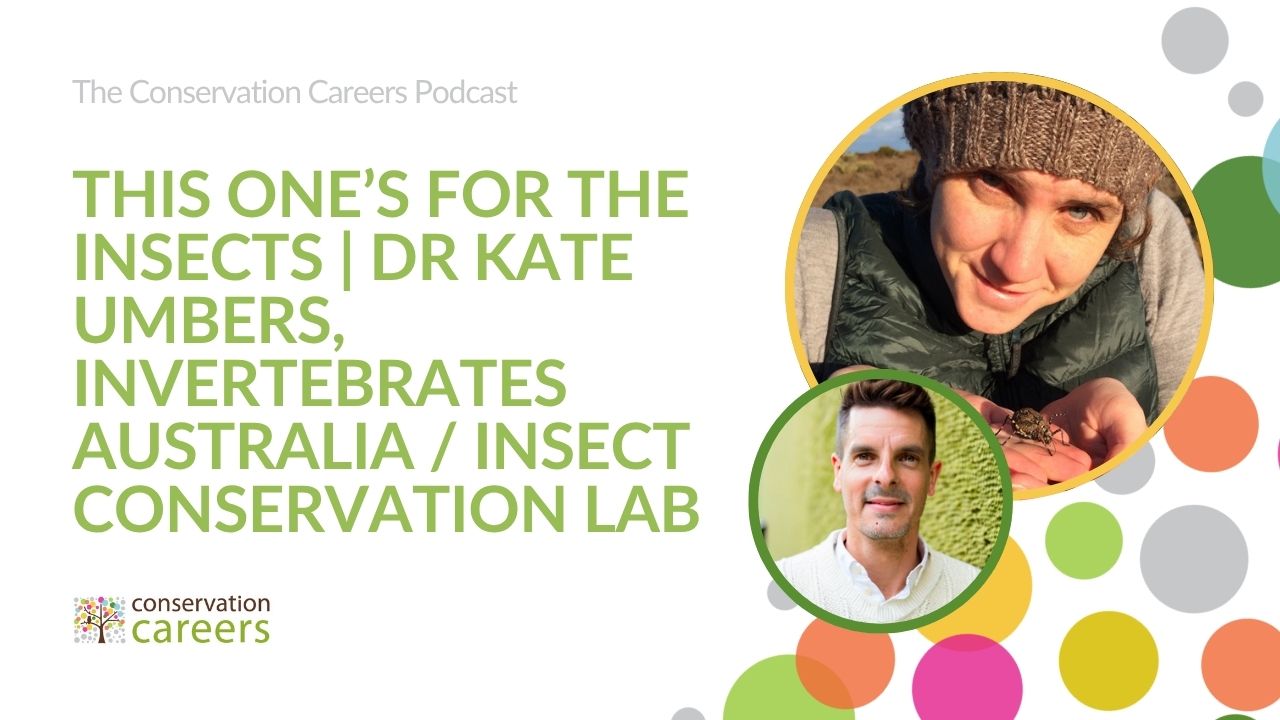
Podcast | This One’s for the Insects | Dr Kate Umbers, Invertebrates Australia / Insect Conservation Lab

What if we gave as much love to insects as we do elephants? In this episode, we’re joined by Dr Kate Umbers – Senior Lecturer in Zoology at Western Sydney University and Managing Director of Invertebrates Australia – for a passionate, perspective-shifting conversation about the beauty and importance of bugs.
Kate shares why insects deserve a central place in conservation, the inspiring work of the Insect Conservation Lab, her career pivot from policing to zoology, and her honest reflections on motherhood, motivation, and choosing hope in conservation.
From Glowworms to Christmas Beetles to the mighty Bogong Moth, this episode is packed with quirky facts, emotional truths, and practical career advice.
If you’ve ever felt overlooked, underfunded, or uncertain on your conservation journey – this one’s for you.
Listen
Watch
Subscribe
You can listen and subscribe to the Conservation Careers Podcast on iTunes, Spotify or Stitcher using the following links, or search for ‘conservation careers’ and you’ll find us!
Resources
https://www.kateumbers.com/kate
Join our live podcast audience!
All our podcasts are now recorded in front of a live audience who sit in and listen to the chat, and then after the mics are turned off get a chance to talk to the guest, share their thoughts and ask questions.
If you’d like to be in the audience all you need to do is join our CC Academy.
In the CC Academy you’ll get access to the world’s biggest conservation job board – listing over 15,000 jobs, volunteer and internships across the globe each year.
You’ll also enjoy access to our amazing CC Pro private members community with regular events, networking and support.
Plus you’ll get full access to our growing library of career-boosting resources, guides and templates.
And best of all it only costs a few dollars, pounds or euros per month to join the Academy.
To find out more please visit the CC Academy, or simply click the join button at the top of our website.
See you on the inside!
Transcript
So officially associate professor Kate Umbers from Western Sydney University, and the managing director of invertebrates Australia. I also have a couple of other roles, which is a biodiversity counselor, and I think I’m currently still a cochair of the, grasshopper specialist group for the IUCN.
So many hats you’re wearing. Yeah. It’s it’s great to have you on the podcast. Thanks for joining. And, actually, it’s a bit of a privilege for me because you’re also a listener, you were saying before, and you’ve mentioned that previously that Yeah.
You do. Listen. Yeah. It’s funny when you do these things, you rarely meet people who listen or get to engage with them properly. Properly.
So, yeah, thanks for listening, Gabouon, and thanks also for sharing your time. Yeah. And jumping on. Great resource. Yeah.
Thank you. Yeah. So, you you’ve got all sorts going on. Yeah. As you say, you’re the well, I’m reading from my notes.
You got the you’re the principal investigator of Insect Conservation Lab in Western Sydney at the university, the founding managing director of Invertebrates Australia too, among among many other things. We don’t speak to many people working in kind of invertebrate or insect conservation on the podcast. I can’t remember any off the top of my head actually out of a 50 plus episodes. So I’m really excited to be kinda talking about insects and the work you’re doing around it. Maybe we can start with that.
Like, you know, what what makes insects important or invertebrates important, and and why do you think that’s so overlooked? Because I think they are overlooked in conservation. Yeah. You know, it’s a really funny one. People often are open with that question of why are they important, which is typically not a question you might ask someone that works on elephants or tigers or koalas.
You know? Why are they important? You know? And so it’s an interesting kind of, like, I guess, narrative around insects that we hear a lot. There’s sort of a utilitarian argument that comes up.
So, like, definitely want to acknowledge that, yes, they are super important. They do lots of really important things in ecosystems but they really make us happy. You know like if you see a butterfly coming through your garden that’s a lovely thing. That’s a wonderful moment in your day. You know so there’s a lot of other things that insects are doing that I think we’re not we don’t immediately think about.
And, actually, that’s really important. It’s important to conserve them for their own sake, obviously. It’s important to conserve them also for our sake. So, yeah, lots of unpacking to do about kind of the the why of insect conservation and invertebrates more broadly. Yeah.
You’re right. I mean, we don’t have to justify other species or other groups like we do insects, do we? Yeah. And yet they are so important for so many functions within ecosystems apart from their beauty, yeah, and everything else that they bring. So yeah.
And they’re a lot of fun. I mean, gosh, the diversity of insects too. Some crazy insects out there. Right? Yeah.
I mean, in Australia, we’ve got we think I think we might have something around 80,000 species of insects. Jeez. Of course, they’re not named. Whether or not that’s important might be something we talk about, during our chat. But, yeah, there’s heaps.
I’ve got that into perspective. Bird wise, I’m guessing about 500 species of bird in Australia, give or take. So Yeah. I think I think there’s, like, six or 700. But yeah.
It’s like apparently, it’s, like, roughly the same as, Panama, which is totally cool. Right? Like, there’s hyperdiverse Central American countries. Ours Australia has roughly the same number. Yeah.
It’s it’s you could ignore them and carry on with conservation and do lots of great work. Not that I am condoning that but it is one possible action. You know, there’s just so few species. Of course, everybody loves them and they’re beautiful and they’re important for engaging people but, you know, when you think about the bulk of biodiversity and what we should be, you know, trying to focus on and maintain, both diversity and abundance and ecological function and all those beautiful things we see in our garden and all that sort of stuff, you know, insects are a are a really important part of that. Yeah.
Yeah. And you’re right with butterflies too. I mean, it is a real moment every year for me when the spring comes and I see the first butterfly in the garden, which is for us, it’s always a brimstone. It’s bright kind of yellowy green butterfly, like a new penny kind of flies through. It’s like, yes.
Spring’s here at last. It’s it’s it’s wonderful. And then they all start coming back one after another from there. So it’s a it’s a kind of turning point in the year I look forward to. Yeah.
And and certainly in, you know, very seasonal countries like The UK and most of Europe and North America, that that really strong effect of spring arriving, I think, has a profound impact on people’s, kind of psychology and and, yeah, seeing the first I mean, the first butterfly and also the first birds and things like that. Yeah. We don’t get that really strong seasonality in most parts of Australia. So we sit in that weird sort of subtropical temperate warm temperate sort of thing where we don’t see it as strongly. So it’s not as prominent here, but it is certainly, I think also because our trees don’t lose their leaves and, you know, all that kind of stuff, that it’s not not not quite so strong.
But, but there’s a challenge in there for us working in Australia is to get people to notice despite that being more subtle. Yeah. Yeah. And I guess sort of linking then to threats and the status of invertebrates, around the world and thinking through, like, you know, it’s easy to see the first of something like my brimstone in the garden. It’s you can define that.
It’s an absolute moment. That’s the first one I’ve seen this year. That’s the first one or whatever it might be. That’s the first of the species we’ve seen and and and described. But it’s really hard to say for certainty when you’ve seen the last of something, isn’t it?
Because you may see another. Yeah. And it’s sort of, you know, it’s a sort of strange quandary, really, that I sort of hang on to as to, you know, when when is that last swallow? You might see another one. It’s the same with species two.
When when is that species officially gone? I was wondering if you can just, like, talk to, like, how are invertebrates into however you want to describe them, whether it’s in Australia or globally or whatever, like, how are they doing as a as a group of of animals on this planet? Are they under threat? Like, what’s their status? Yeah.
Yeah. I love that concept of the lost lasts. It’s great. We don’t necessarily notice, the last time that something happens. Yeah.
Look. You know, it’s probably not a surprise to find out that, Australian invertebrates are, you know, facing the same threats, the same major threats as everywhere in the world, climate change, land clearing, you know, lots of different toxins going into the environment, invasive species, all that kind of stuff. You know, those central themes, you know, regularly reoccurring conservation stories around the world. You know, in Australia we have, the oldest continuing living culture in the world. Indigenous Australians have this incredibly deep history, but of course, colonisation has destroyed a lot of their knowledge.
And so there’s a big job there to repair knowledge, repair indigenous peoples’ connections to country, facilitate that and, you know, so that we can, we can manage the country in a really, in a much more kind of, I guess, clever way. Yeah. Yeah. And then, you know, the European history of Australia is only very short. It’s only a couple of hundred years.
And so there’s this really interesting, like, I guess, disjunct between, you know, we should have literal literal millennia of knowledge, you know, that’s that’s been taken. And then on top of that, we have this layer of, like, really short term European, knowledge that it is very little of and that the, relative to the relative to the, diversity of the country and the landscape and things like that. So we know a lot, you know, and we know enough certainly to act in conservation and to look after, you know, there’s lots of sort of iconic species that we can work on and lots of lots of opportunity for conservation. I mean, there’s a thousand invertebrate species, that you can find in Australia that are listed. Whether it be the IUCN or in Australian legislation or wherever, but there’s a thousand invertebrate species listed, that occur in Australia.
You know? So there’s plenty to be going on with even though there’s a lot of knowledge gaps, and a lot of work to do to repair knowledge. So tell us about your work then at the insect conservation lab. Yeah. So you’re the principal investigator there.
Yeah. What what paint us a bit of a picture. What is the insect conservation lab, and what are you and the other members of the team kind of doing to help conserve insects? Yeah. I don’t know how many times other lab leaders change their lab name.
But we we became the insect conservation lab, I don’t know how many years ago now, maybe seven years ago or something like that or eight. Before that, I think it was, you know, the ecology and evolution lab or something like that. So I guess even just the name of my kind of, you know, research group, you know, talks a lot about the history of, my, career and where I’ve where I’ve kinda come from and going to. But, yeah, what we what we’re doing at the moment is we’re working on, an iconic species in Australia called the bongong moth, which is, a really long distance return migrant, that moves through, well, possibly up to 4,000 kilometers across the country. We we still have work to do to figure out if that’s happening, but over really massive distances, from low country, when it gets too hot, they move up into the highest mountains in Australia and spend the summers there.
And they’re really important to indigenous people across the Alps. They’re really important important food source and all kinds of things. And then they, are thought to kind of move back into the lowlands to breed. And they are endangered. They’re listed on the IUCN red list because they’re Australia has really short mountains.
You know, we’re not exactly known for our alpine regions. Right? But we do have these treeless, you know, these little treeless bands at the top of our mountains where it’s too cold for trees to grow and we have snow all winter and all that sort of stuff, but they’re heating up really rapidly. They’re really short. Maximum elevation is 2,228 meters at the very highest of the highest mountains.
So this the places where the bongong wants to spend their summers are shrinking really fast. And so they connect the lowland to the high country and do all these really important things that migratory critters do. And, they’re really important nutrients for the critters in the Alps that eat them when they get there. They also have obligate nematodes. They are only in these little alpine caves.
They probably they certainly visit flowers all up and down the country, and maybe they’re moving pollen through the system as well. So they’re really interesting and really important, creature. We’re trying to understand where they come from. We don’t understand their migration at all. So we’re trying to map their migration.
Where are they breeding? You know, where are they where are the different the ones in the different caves across the mountains? Where do they come from? Different places, the same places. You know, all of this is completely unknown.
So there’s a lot of work to be done there to map their migration. The other things we’re working on is reintroducing previously thought extinct snails into Norfolk Island, which is, way off the coast of Australia and is officially part of Australia, but is very independent, has its own identity. Absolutely. So, yeah, some of my students are figuring out what sticks to a snail shell to make sure we can see if it’s one we’ve released or if it’s one that’s new and all those sorts of really complicated questions that you have to get. Turns out it’s really hard to get things to stick to to tiny little snail shells.
Right. So there’s a whole lot of different, different things. But those are the two major projects that we’re we’re focused on at the moment. Yeah. Amazing.
How do you how are you just drilling into, like, one bit of that with with the moth that you’re working on? How are you, like, plotting its migratory rate? How are you figuring out where it’s going? Have you got, I don’t know, public sensors that are mapping them? Are you in integrated with moth groups?
I’m assuming they’re nocturnal. I mean, if they’re moving that far over such a huge country, how are you collecting that data? And how do you know even if in do you know if individuals are going from a to b? Can you can you track, you know, individual moths and their and their movements? Yeah.
Look. I think, so this project is sort of funded for four years, and I think what this project will do is we’ll actually set the foundation to answer all of those questions. Yeah. We we are really starting at the start. Yeah.
So when we’re we’re using all of the all of the things you may you’ll you’ve mentioned in more. So we’re using, you know, isotopes to try to look at the chemical signature of the wings of the moths and see if we can link that to a place in Australia where there were caterpillars because they maintain, even through metamorphosis, these these chemical signatures, these isotope signatures of what they were eating when they were caterpillars. There’s there’s eDNA type techniques to see if you can detect whether moths were in soil in different people’s, on people’s farms or in conservation lands, those sorts of places. We are absolutely working with, an organization called Zoos Victoria, which is sort of the, the umbrella organization for all of the zoos in Victoria, hence the name. Yeah.
But they’re running, a great citizen science program called Moth Tracker, which just encourages people to take photos of bongong moths and upload them. We’re also encouraging people to take photos and put them on iNaturalist because that’s a fantastic tool. And then we’re developing a tag to try to tag get, you know, get people tagging bongong moths and, looking for them, on route and up in the high country and those sorts of things, to emulate monarch watch. Yeah. So, yeah, like, a a real range of different, different approaches.
Like, we sort of feel like we need all of them, you know, to try to get things going and and, you know, I guess that’s conservation all over. Right? You’re trying to you feel like there’s there’s about five or six different avenues that you need to, try to pursue, try to prioritize, but kind of do a lot of them at the same time as well. Yeah. And because, I guess, they’re understood like many insects, you’re having to be really innovative at the very beginning, and it sounds really exciting.
There’s so many different ways in which you’re trying to tackle and answer a simple question of, so how are these animals moving through a landscape? So many techniques and new techniques as well you’re kinda bringing to the table. I guess so. Yeah. I mean, some of these things haven’t been done in Australia because the research infrastructure isn’t there.
So, like, for for example, like, some of the you need, like, an isoscape, which is like how the isotopes isotopes are distributed across the landscape before you can map a moth onto that thing. So you need to build the infrastructure. So those sorts of things. But it it is really exciting to work with bongong moths because it’s it’s an insect that Australians have heard of. It’s very famous here, and I think it’s it’s it’s, a lot to do with the fact that they show up at on people’s like, in major cities, like in Sydney and Melbourne and places like they show up in huge numbers, or at least historically they have.
They, you know, they find their way into Parliament House in Canberra on their way to the mountains and kind of there’s some fantastic parliamentary records of them of the of the of the ministers saying, like, excuse me, speaker. We have to adjourn. I have moths up my sleeve. You know, these kinds of things. So they they really not like, not only are they important in indigenous Australian culture, but mainstream Australian culture as well.
They have this sort of folklore attached to them. So they’re really so when you’re talking to people about them, people go, oh, yeah. I know what you’re talking about. You know, which is not all that common with insects. So it is really exciting from that perspective.
And people are interested in them and they care about them and they know that they should be in big numbers and that and they’re concerned when they hear that the that the, you know, the caves are empty and things like that or that the bushfires came through when the, you know, when the moths were there in summer. They know it’s so it’s it’s it’s wonderful to work on a species that is both really important, really cool, but also, you know, there’s already people caring about it. Yeah. Yeah. And I guess that’s why you chose it as a study species among the other species you work on.
It is it has that charismatic public appeal. Yeah. It’s certainly part of it. You know? The reason I mean, the reason I wanted to pursue it is because I have been working for so long in the Australian mountains and, it’s a really important species and a really amazing species there.
And, you know, just wanted to to figure out what was going on with it. Yeah. And what I mean, one very famously, what had been happening is that, a marvelous colleague of colleague of mine, Eric Warren, who’s based at Lund University in Sweden had been doing has been and continues to be doing some incredible work on their navigation and their their biology. And so I knew I knew about that, but the question started to rise, you know, but they rely on these cold alpine caves. This is not good.
What’s going on? You know? And and, yeah, and then the population sort of spectacularly crashed in 2017 where whole whole caves that should be filled with millions and millions of bongol moths. Like like, around 4,000,000,000 moths should arrive every year in the mountains. Yeah.
It’s it’s an it’s an enormous number of kilojoules. You know? An enormous, enormous number of kilojoules. There’s something like 30%, forty % fat, these things. Yeah.
And there was just whole areas empty, that should should have been just teeming walls of the caves lined. Like, the stat the stats from the fifties are, like, 14,000 moths per square meter kind of densities, you know, huge, huge numbers of these things. And when you and and when people went in there expecting to count them and, you know, see how this season’s going, and there was whole areas with just nothing. It was very alarming. So it kinda kicked off, you know, that that new research project for me.
And before we kinda turn to your career journey actually and hearing more about the work you’ve been doing outside of this, how I was wondering if you could speak to, like, how easy was it to get funding for the work? Like, particularly with the Bogomoff or with others as well. Is that are there funders out there interested in this? Was that an easy ride? You’ve got a four year project.
That’s great. How did that arise here? Yeah. I think, an easy ride. No.
No. Certainly not. I mean, you know, we we talked right at the beginning about, you know, insects being seen mostly as, as something functional. Yeah. We’re talking about ecosystem services and, you know, what what what can your, you know, what what can these insects do for my crops?
Or how can I get rid of these pests? And and, you know, and those sorts of things. And so reminding people that they love insects is is what we is what our job is to really get funding behind these critters. So to a colleague and my, Tanya Laddie, at University of Sydney, you know, and with invertebrates Australia, we started this, this Christmas beetle count where Tanya’s been chasing, trying to understand what’s going on with Christmas beetles. And the reason we started that was because we would get called by the Australian media, you know, every December, like, where are all the Christmas beetles?
And we’re like, I’m like, I don’t know. I work on grasshoppers. She’s, I don’t know. I work on bees. I don’t know.
We don’t know. Yeah. They kept you know, we’re thinking, well, okay. Well, they’re literally you know, they’re figuratively knocking our door down here. You know, we really should, jump onto them.
So I guess I guess the that’s the long answer, but the short answer is really that there’s been so little done in Australia that that that their opportunities there’s their opportunities are there to get interest and resources to these really charismatic groups at the moment. So getting, you know, getting some resources behind the boggling moth happened quite quickly. But typically speaking, you know, and when we talk about having a thousand, you know, listed species in Australia, there’s that’s a tiny fraction of the way any conservation work is happening at all because there’s no funding put towards it. Yeah. So does that answer you?
It it does. It also shows got that right? Yeah. The kind of tension between accessing funding for underrepresented species like insects and also the need to kinda jump on the charismatic species as a kind of gateway or flagship almost to kind of open doors. Yeah.
Yeah. Sort of a pragmatic Yeah. A pragmatic approach to, well, you know, let’s start here. Yeah. Exactly.
And try to expand out. Yeah. Yeah. Let’s talk about you then, your career so far. Where did your interest in kind of the natural world start?
Is there a moment or an instance or an individual where this kind of this this this spark was ignited? I don’t think for my natural for the natural world, I don’t think there’s a a spark moment. Yeah. I think it was more around, like, all of my family holidays kind of on the South Coast Of New South Wales, snorkeling and at the beach and all that kind of stuff in combination with visiting my grandparents’ kind of hobby farm for most of my childhood. And being connected, you know, to those kinds of places and feeling a sense of my identity being wrapped up in those sorts of places just, yeah, it just it was just all normal to be in nature and to be in with these kind of, you know, animal systems.
So, yeah, I’m not I’m not entirely sure, when it started, but that certainly was a really prominent part of my childhood was being exposed to those sorts of things. When you look back at your career so far, like, what have been some of the kind of key steps or milestones or moments that have helped to get you to where you are today? Like, yeah. What what’s happened? Yeah.
When I was when I was in high school, I was like a real sporty person. So, like, I was pretty well completely removed from, this kind of this world, I guess. But I was always I played a lot of netball, and I was always the kind of the weird one that would get the beetle off the netball court while we were training. You know? Like, oh, Kate’s gonna touch it.
You know? Just get out of the way and I’ll move. You know? So, you know, that sort of thing. So there was always kinda there in the background.
But, yeah, then I I left school and went to university, and I’d studied a bachelor of policing, which was which was an interesting one. But I was I was interested in, like, the I found myself mostly interested in the biology surrounding this stuff, the sociology, you know, the psychology, all these sorts of things. But I got towards the end of it, and I was just really like, this is not for me. I don’t know what’s for me. But the coolest job I can think of is to be a marine biologist.
You know? This is the coolest thing I can think of. And then I was thinking, well, what was I? Like, 2021 or something like that. ’21, ’20 ‘2.
Well, maybe I should go and enroll in a bachelor of marine science, you know, and see what happens. I was always because I was into sport, I didn’t really work very hard in high school, and I was slacking off quite a bit. And I remember very clearly the chemistry one zero one, the very first chemistry exam I ever took at university, and it was it was like a midterm exam. It was, you know, worth, like, 15% of my mark. I was so scared that I was holding the desk, and the desk was shaking because I was so worried that this was gonna be the moment where I found out that I couldn’t do this.
You know? I wasn’t capable of it. And I did okay. You know? Like, I got, like, 70 or 80% for the exam, and I thought, okay.
If I can do this, maybe I can do the other stuff. But but I remember in biology that same year feeling like this incredibly strong feeling that I had come home. It was really strong. Like I was sitting in a lecture theatre, listening to this, you know, like first year biology and just never ever wanting to be anywhere else. And it was really, really strong.
So it was great. So I knew I knew then that I was where I was supposed to be. And what what was it about biology that really kind of spoke to you that you felt was just right? I don’t know. I don’t know.
I just I the only thing I can say is that it’s something about being a living thing and understanding living things. Yeah. Yeah. Yeah. It doesn’t really make much sense, but I don’t have any other way to really articulate it.
It just, it just clicked for me in that moment. And I just was, yeah, this is it. This is great. This is where I need to be. So you found your place.
You built your confidence through exam results that you weren’t expecting. You know, you got this. What happened next? Yeah. Then I then I guess it was just, going through, you know, the sort of recommended undergraduate, classes and realising, like having, you know, this profound realization that, oh, if you wanna have big adventures and make big discoveries and learn really cool stuff in biology, it’s the invertebrates that’s where it really is.
Uh-huh. Because all the other animals have got roughly the same number of eyes, roughly the same number of legs. You know? Like, it’s all pretty samey. But if you want to, you know, really, just have a deep dive into the weird and wonderful, that’s where it is.
Yeah. And that was, you know, through some great lecturers working, you know, teaching around, those subjects. Yeah. So it would just became really clear that that’s that was the exciting part. Yeah.
What’s really interesting, like, you know, as a biologist and I’ve had a similar path myself, I guess, really, is, like, a lot of people think it’d be quite cool to identify a species, like, yeah, to describe a species new to science. I guess we’d all like to do it, but very few of us have done it. But you hear about people, they go to the Amazon, they lift a rock up, there’s a load of beetles, and one of them is new to science, and insects are where it’s at. Yeah. Have you identified a new species to science?
If you haven’t, how would you go about doing it? Like, what should someone do? What’s the easiest way to go and find a new species? I know what you mean. Like, that sort of the species discovery or I think nowadays we’re more using species description just to acknowledge that, you know, most of these species are probably known by humans other than Europeans for a long time.
It it is very tantalizing when you’re, sort of new to the to the area. And I remember I also remember, you know, first learning about, like, you you know, probably half the species in your backyard, a new species, and kind of being blown away by that that idea that, you know, we we don’t know. I I taxonomy is not great. Me and taxonomy are not a good match. Oh, right.
Yeah. There’s a lot of meticulous, careful illustrations of this. Pouncing of lake hairs and yeah. Oh, this this is not my strength. But I have accidentally done that anyway.
So the the I get some of the work I’ve done previously in the mountains, in the Australian mountains, I’ve been working on these grasshoppers that change color depending on what temperature they are and do all this groovy stuff. And, you know, when was looking at them in New South Wales, I was like, oh, yeah. You know? That’s what they look like. And then drove, you know, 500 kilometres down to the Victorian Mountains and was like, no.
This these guys, well, they have blue here and orange there, and they’re, like, the wrong shape here. And so it was really clear. And so, you know, the, the five species did some genetic work. Yeah. It’s probably the 15 species, of those grasshoppers.
And then started working on some katydids that do some cool displays showing their, abdomens by revealing their their wings and all kinds of cool stuff. I thought, oh, they live all the way from Cairns to Hobart. That’s 4,000 kilometers and across a, you know, a rather rough little ocean, the Bass Strait, whatever it’s called. I don’t know what an ocean, but, yeah, body of water. Yeah.
That’s Tasman Sea maybe? I don’t know. Yeah. It is. Beautiful.
Wet stuff. And, yeah. And that’s probably 10 eight or 10 species. You know? So you just kind of Yeah.
I mean, it’s partly just working in Australia. You know? Yeah. It’s they’re just there. But then but yeah.
So so I guess so. I guess I have. But it’s not that bit that I find exciting. It’s it’s what they do and and and, you know, and and how they’re built and and, you know, all all those sort of, interesting behaviors and physiologies and those sorts of things that are the most fascinating of all. Yeah.
Yeah. Which leads me perfectly to my next question, which is what what do you kind of love about your your job, your role? Yeah. And and, also, I’m gonna extend that. Like, what does your job typically look like sort of day to day, week to week?
Soon as never met you before, how would you describe what you actually do? Yeah. I guess well, I guess what I I mean, maybe what I did or what I do now because, like, when we’re talking about sort of, you know, my my my university years where I was always thinking about ecology, evolution and behavioral ecology and those sorts of questions. And it wasn’t and then I made a shift into conservation quite deliberately. So which one would you like me to answer?
Well, that one, actually. Yeah. Yeah. Let’s let’s let’s keep going with your career story. You’re right.
So you’ve left university, and you’re shifting towards conservation. You started off in policing, so there’s been quite a bit of change come through. What happened next? You found you found your area, insects. Yeah.
Like, I’ve been working on those grasshoppers in the mountains and doing all that sort of stuff. And and, you know, and life goes on. And, and I had, my daughter in 02/2018. Yeah. And you know when people say, like, you know, you asked me before, did you have a moment?
Was there one of those key moments? Yeah. Like, it’s it’s a little bit stereotypical, I guess, in that it’s related to one of my kids. But, I had sort of a transformative experience when I went to Borneo when I was, like, in my early twenties and kind of, you know, had this amazing, you know, experience with biology. And I I’d always thought, you know, if I ever have kids, I’d love to bring them back here.
And I remember watching her when she was one playing with a toy orangutan. And I thought, oh, it’s gonna be so great. When you’re bigger, I’m gonna take you to Borneo and show you the wild orangutan that I saw. And then I realized, you know, in twenty years, that may not be possible. There may be no wild orangutan left.
They may not be there. I mean, it’s a real possibility. Right? We’re talking about these these areas on Borneo that are being destroyed for palm oil. Yeah.
And, yeah, and I I just went from this, like, really happy moment to this really just reality check. Right? And yeah. And so it was sort of obvious that from then on, it was gonna be pick a side. You know?
Working in ecology and evolution of behavioral ecology is wonderful, and it indirectly contributes to conservation in all kinds of really wonderful ways. And it provides important stories, and it does all this lovely stuff. I mean, you know, there’s so many wonderful documentaries made because of the because of the discoveries that behavioral ecologists have made and evolutionary biologists, all that stuff. But I wasn’t comfortable to sit there anymore. Yeah.
Yeah. Yeah. It’s it’s when you’re working in sort of science and research academia, you can sort of you can answer interesting questions because they’re intellectually stimulating, or you can choose to answer questions that are gonna help that species, aren’t they? And it feels like that that’s the side you feel like you’re you’re picking. Yeah.
Yeah. I I felt like I had to I had to choose and I had to stand for something. Yeah. Yeah. And, you know, working in the world’s shortest mountains with climate change and snow dependent species and all that stuff is not as exactly like a difficult leap.
Right? Yeah. Yeah. Yeah. Oh, I wanna I wanna ask, what do you stand for?
It’s a really nice question. I think I stand for looking after nature. I think that’s all it really is. Simple as that. Yeah.
Yeah. It’s all listening to this, and they are they they they love what you’re doing. It sounds so interesting. Yeah. And you’ve sparked an interest in insects and insect conservation and studying them and helping them like like you’ve done in your career and continue to do brilliantly.
Like, what careers advice would you give them? They might be at university. They might be a career career switch. They might be working in the police force. You know?
Who knows? Yeah. What what are the kind of the main things to sort of bear in mind that, you know, these things might might help you? I mean, I know you talk a lot about mentoring and things like that, on your podcasts on on on your on episodes of your podcast. But I think, it’s it’s more than that.
It’s about not being afraid to ask really amazing people for advice. Yeah. You know, it’s really intimidating to ask big cheeses in your field. Yeah. Like, you know, hey.
I was thinking about doing this. What do you think? Or, you know, do you can you tell me how you got to where you got? Whatever. So I think maybe there’s a little bit of, you know, there’s a big bit of vulnerability there and, a lot of bravery sometimes to ask people.
But, yeah, that that one, I think, is an important one. That certainly got me a long way to just to ask people that I admire, for help or direction. How did you go about doing that practically? Were you sending emails, writing phone calls? Were you just bumping into people?
Like, just talk about that experience, please. Yeah. Yeah. No. I think it’s all of those things, like, just depending on what you’ve got available to you.
Yep. You know, maybe you’re at a conference and that that person is over there or something and you you say, like, does any can anyone introduce me to that person? Or or just really awkwardly go over and say, hello. I don’t really know how to talk to you about this, but I would really like to ask you. Yeah.
You know? And, I mean, if someone’s a jerk about that, when they can see that you’re very vulnerable and, you know, then you probably don’t wanna hang out with them anyway. Right? Yeah. So it’s a good filter.
Most of the time, people are gonna be absolutely lovely and be like, yeah. Sure. But yeah. So that like, in person, probably the scariest one. Sending someone an email, getting an introduction, like an eintroduction via someone.
Yeah. I you know, any way you can. I don’t know. I find that LinkedIn is actually really good for this kind of stuff these days. So, yeah, I I don’t really think it matters how.
Yeah. It’s more important that you do it. So if there’s one way that you feel comfortable, then that’s the way to do it, I guess, is maybe the Yeah. The way forward. I’m not really sure exactly, but, yeah, that’s important.
But also, I don’t know, just having a go, with whatever resources you have. Like, it you know, it’s easy for me to kinda say so, you know, I I was in I mean, academic career, I find myself with, a continuing position where I have total freedom over my research choices, and I go, hey. I don’t wanna work in the evolutionary biology anymore. I wanna be a conservation scientist now, and I just choose to pursue different projects. And that’s a super easy transition for someone like me, and it’s absolutely not like that for others necessarily.
Right? Yeah. But yeah. You know? And and and, you know, loathe to encourage people to to volunteer just because it’s so hard for some people to volunteer.
But, of course, if you can, it’s a great great thing. But, yeah, I think, just trying to find those mentors, trying to find people that that can help you or that we will help you and, yeah, not be ashamed of of that. Because it’s not about you. It’s about the cause. And that’s the key thing.
It’s if you it’s you have to take yourself out of it. You have to stop worrying about how you’re gonna come across and what’s, you know, what’s gonna happen if they think you’re silly and all that sort of stuff. It’s not about you. It’s about the cause. And if you’re both if you and the person you’re trying to talk to are both pursuing the same cause, then things are likely to work out.
Yeah. Yeah. I absolutely feel that. Yeah. There is something about conservationists that it it it links and connects us because you have that one thing in common.
You both care. Yeah. You both care about your species, nature, or however you want to frame it. Yeah. Yeah.
And it’s funny, like, as someone who does these sort of chats quite a lot, and I enjoy them and find them sort of quite comfortable, particularly remotely. Yeah. In a conference setting, I would be really nervous walking up to someone, yeah, today. Yeah. And saying, oh, hi.
Yeah. I like your work, and can I chat to you about it? Whatever. That is daunting, so I absolutely get it. And a lot of this comes down to the word confidence, doesn’t it?
It’s like Yeah. Backing yourself and giving it a go and finding ways that fit. I really like what you said there as well. So for me, I would probably send an email beforehand saying, you know, I’m going to this conference. Could we make can I Yeah?
For a quick coffee and, like, tee up so the ice is broken? Do you know what I mean? They’re expecting me. Yeah. Yeah.
I try and make it a bit easy somehow because I I would totally would feel that that nerves as well. Yeah. Yeah. Absolutely. I mean, I think the other thing is probably have something to talk about.
Yeah. You know, like, the worst thing to do would be to go like, hi, and then be just like, like, you gotta have a few kind of I wanted to ask you about this paper or, you know, or just something to for the conversation not to just be, totally stalling or it it on the other person’s shoulders. You know, try go in with with something even if it’s, you know, goofy or silly or you think the other person might think is is silly. Like, it gives you something to to fall back on other than like, oh, how are you liking the the conference? Or, you know, how’s the weather like that kind of stuff?
I mean, I I I believe in some parts of the world, talking about the weather is actually so similar. It’s really interesting. So it’s a little more awkward than you might expect because why on earth are we talking about the weather? It’s just what it always is. 25 degrees and sunny.
You know? So, we talk about it all the time on this end. Well, that’s that’s important too. Just have have a couple of ideas up your sleeve. Yeah.
But yeah. Yeah. It’s hard. It’s hard, but you yeah. It’s I I think yeah.
The key thing is just that it’s about the cause, and everything else kinda falls into place. Yeah. Yeah. Wonderful. Before we wrap up, we’ve got someone sat in our audience who might want to ask some questions after our recording finishes as well, which we love doing.
I want to ask you, Kate, some some sort of more open questions, you know, about how you kind of think about your work and the field and everything else. Yeah. The first one you’ve heard before probably if you listen. If we could take you to one place on the planet, yeah, you’re nodding away, and you could see one species, Where would you go? What would you hope to see?
Okay. So I want me to take me in a in a submersible, and I wanna see a colossal squid. Oh, wow. Yeah. That’s new.
Have they ever been seen underwater? I don’t think so. I don’t know. I don’t know about a colossal They get pulled up, don’t they, by fishermen? Like, they’ve been found dead, and I’ve seen them in a tank in Wellington and places like that.
But I don’t think anyone’s ever seen one before, so that would be cool. Yeah. I mean, I would be absolutely terrified. Yeah. I’d like to like to go in one of those submersibles, you know, with all the pressure and the, like, that would be pretty scary, experience.
But, but, yeah, like, imagine seeing that thing, like, whether they got, like, a 30 centimeter diameter eye. Like, these these things are big critters. Everyone always talks about invertebrates being small, and I always like to remind people that that includes the most gigantic squids. And Yeah. Yeah.
Yeah. So, that would be very cool. That would be cool. My word. Okay.
Yeah. If, yeah, if we could make you a global czar for the day, you know, you could be a global ruler, rule of all humanity, and you can act one law, one decree, make one change, and make it stick to try and help the environment, nature, wildlife. Yeah. What what would you kind of wave your magic wand if that’s not mixing the metaphors too much? I would love to.
Yeah. Yeah. I I would like to I don’t know if this should require making all human cyborgs or whatever, but I it might be too intrusive, so just stick with me. I would like to do something to, have people notice the cool things about the everyday things, To just not take the little ants walking on the path or the the, like, the kind of plainish brown beetle, not take them for granted, but just have a look at them for a little while and check out what their life includes. Yeah.
I just yeah. I guess it means that I’d like people to retain the curiosity of a child. Yeah. It’s exactly what I was thinking as you were saying, and that’s sort of going back to childhood, isn’t it? It’s about you getting a little beetle off the the netball hoop or you know?
Yeah. Or, like, for me, like kids, yeah, sort of watching insects and small things, which we lose. Yeah. And if we had that connection, we’re far more likely to care. And if we’re more likely to care, we’re more likely to do something.
Yeah. We’d notice that our gardens had fewer critters. You know, we’d notice, we’d notice these things. We noticed, you know, our windscreens being cleaner. Yeah.
We don’t have someone having to point it out. Yeah. Because I I think it would give people a great deal more happiness. Mhmm. And it would make, you know, it would it would make the world a better place in terms of it would make nature more secure.
And it I don’t know. I can be kind of, painfully optimistic about things, but I do feel like that it might actually be possible to get a lot of people, back there. Certainly when people have kids or have grandkids, I think that is reawakened and those appreciations do kind of come back. But, I don’t I don’t think we have to just put it all on the kids’ shoulders to to lead us back there. I think we can do it ourselves.
Yeah. Yeah. You said that you you can be painfully optimistic. Like, are you optimistic for for the future of wildlife biodiversity? One of my, you probably feel weird about me saying this, but one of my heroes, Leslie Hughes, professor Leslie Hughes, who’s a very big cheese in climate science, but also happened to be one of my second year undergraduate lecturers.
Sorry about my numerical exercises, Leslie. They were a bit rubbish. I’ve only wanted to tell her that for years. She says that, hope is a strategy. And I think, I think that kind of fits for me too in terms of just hope is not a strategy.
Of course. We must do things. We mustn’t just simply sit and hope. But the choice to feel hopeful Yeah. Is a strategy that I think we need.
Because I think the honest answer is no. I don’t always feel optimistic Yeah. About the future of nature and things like that. But I the the painfully optimistic bit is around, like, the belief that people will do better Yeah. Will come together behind a cause that will see the the beauty and the importance and do the things that we need to do.
Yeah. And I hope I’m right. Yeah. Yeah. I love that.
Hope is a choice. Yeah. And it enables, doesn’t it? Yeah. It’s an enabling choice.
Yeah. Rather than retreating and bearing and ignoring, we’re proactively doing something, but it’s hard. It’s painful. Yeah. Yeah.
You often don’t feel that way, but you can choose to be that way. Yeah. You can choose to yeah. So maybe maybe you can’t choose to feel it, but you can choose to act Yeah. As if you are hopeful Yeah.
In a strategic way to continue. And you can apply that to almost anything, actually, as well. I’m thinking about when I left university and I graduated, and it was New Year’s Eve. I’m really clearly standing outside with some friends. We were sort of banging pots and pans as we weirdly did at midnight.
I don’t know why. And I remember thinking, this time next year, I have no idea what I’ll be doing. I had no job in front of me. I didn’t know what it was. And there’s like two choices.
I can be worried and scared about that, or I can be hopeful and excited. Like, what if? And I remember consciously choosing the kind of the hopeful, optimistic and and embracing that feeling. And it it feels like if you’re in your career and you’re not sure what’s next and there’s uncertainty in front of you, this kind of hope, yeah, it can lead you. It can fill you with energy.
Yeah. If you choose it. Yeah. Yeah. I think we do have to choose it.
Yeah. Yeah. Yeah. A final link question then, and I’ve really enjoyed our chat. Thank you, Kate.
If we know that biodiversity is in decline. I don’t wanna kind of labor that too much, but, yes, we are seeing insects and other animal species, yeah, going down year by year, and the reports can be quite worrying. What do we as a kind of conservation community, as a movement, as a sector, what should we be doing more of? What should we be better at? Like, what to really kind of, yeah, to to move the needle as quickly as we need it to move.
Making friends, bringing more people in Yeah. I think. Yeah. Gosh. I’m I’m gonna loathe to suggest anything in a way because everyone in the conservation sector is working so bloody hard all the time.
Yep. You know? Like, it’s, it’s everybody’s putting their their whole selves towards these causes. You know? So and and and all different kinds of people are doing it.
And so we have this great diversity of approaches and and all of those sorts of things. So, yeah, I mean, the things that kinda came to mind as you were talking were things like, you know, being brazen to ask for more money, you know, to to ask ask the the very the very top philanthropist, not just like the the fiftieth philanthropist on your list. Go to the top. You know, why not? Those kinds of things.
Perhaps we need to be a little bit more bold, here and there. You know, everyone says communication and, of course, it’s always true. But, yeah, it’s it’s hard to sort of pinpoint any one thing. I think that’s another thing that Leslie said. Like, no one thing is likely to do to be, you know, incredibly transformative.
So, sticking together and chipping away and being bold and brave as we go is probably, my greatest hope for conservation. Yeah. I love it. I love it. Kate, thank you for sharing your time, your wisdom, yeah, your expertise with us.
I really appreciate it. Yeah. If people wanna find out more about you, your work, the Insect Conservation Lab, or Invertebrates Australia, where should they go? Where should we send them? Yeah.
Www.insectconservationlab.com or www.invertebratesaustralia.org. You know, all the different social media and all that kind of stuff, and very happy to receive emails, out of the blue from people that might be feeling a little bit awkward. Yeah. This lead with you said it was fine for me to email you as an awkward As the title. Yeah.
I’ll be owning it. Yeah. Yeah. That would be lovely to people. That’s really kind.
Thanks again, Kate. It’s been lovely to chat. Thank you, Nick. Lovely.