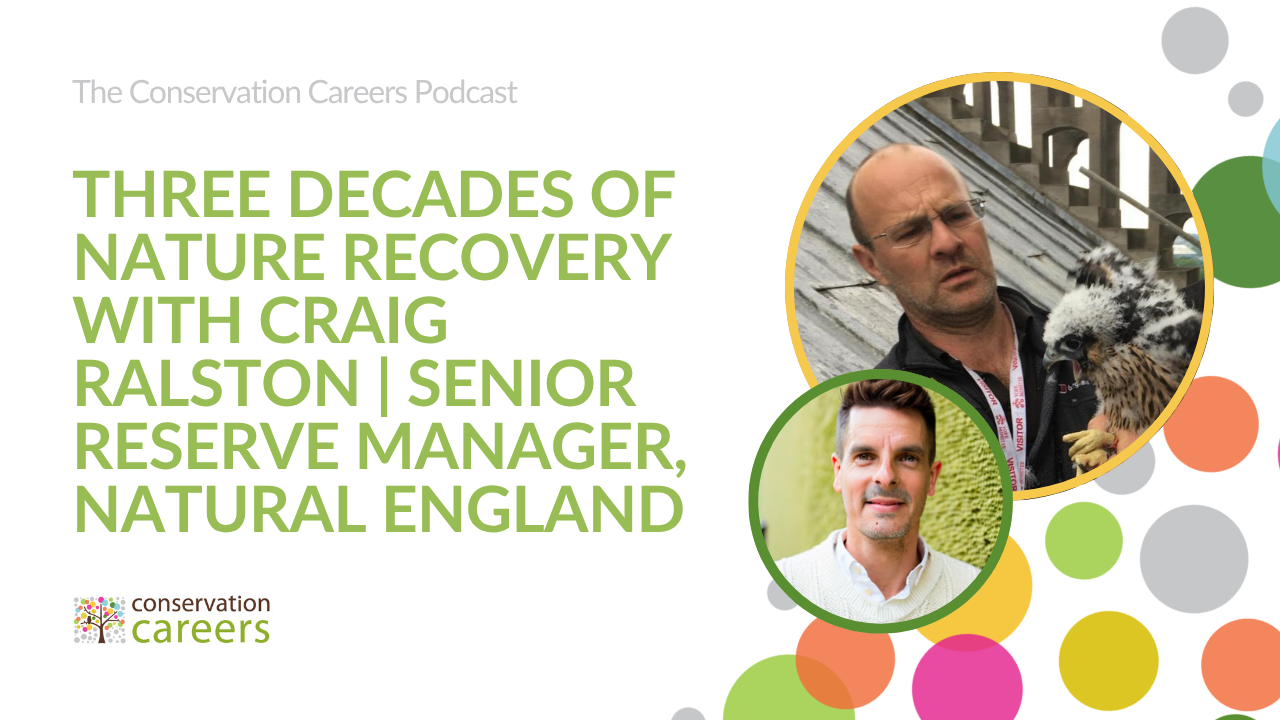
Podcast | Three Decades of Nature Recovery with Craig Ralston | Senior Reserve Manager, Natural England

What can three decades in one wild place teach us about conservation? In this episode, we sit down with Craig Ralston – Natural England Senior Reserve Manager at Yorkshire’s Lower Derwent Valley National Nature Reserve – to explore his remarkable 30-year journey of restoring landscapes, inspiring communities, and navigating change.
Craig shares his reflections on the importance of long-term thinking in conservation, and why reconnecting people with place is at the heart of his work.
Whether you’re just starting out or decades in, this episode offers powerful insights into what it means to hold the line for nature.
It’s a reflective, real-world, and deeply inspiring conversation.
Enjoy.
Listen
Watch
Subscribe
You can listen and subscribe to the Conservation Careers Podcast on iTunes, Spotify or Stitcher using the following links, or search for ‘conservation careers’ and you’ll find us!
Join our live podcast audience!
All our podcasts are now recorded in front of a live audience who sit in and listen to the chat, and then after the mics are turned off get a chance to talk to the guest, share their thoughts and ask questions.
If you’d like to be in the audience all you need to do is join our CC Academy.
In the CC Academy you’ll get access to the world’s biggest conservation job board – listing over 15,000 jobs, volunteer and internships across the globe each year.
You’ll also enjoy access to our amazing CC Pro private members community with regular events, networking and support.
Plus you’ll get full access to our growing library of career-boosting resources, guides and templates.
And best of all it only costs a few dollars, pounds or euros per month to join the Academy.
To find out more please visit the CC Academy, or simply click the join button at the top of our website.
See you on the inside!
Transcript
I’m Craig Ralston. I’m Natural England’s senior reserve manager for the Lower Derwent Valley National Nature Reserve in Yorkshire. Great.
Well, Craig, it is a real, I don’t know, honor and a pleasure having you on the podcast. Thanks for joining. I should probably for full disclosure, if anyone that’s listening, say we’ve got kind of a long history together. And I I it’s no underestimate, so I don’t think I’d be working in conservation if it wasn’t for you. So yeah.
So thanks for joining. I’m happy to Thanks for inviting me. It’s, it’s lovely to be here, and it’s kind of, pretty special to kinda complete that circle in a way. So, I followed what you’ve done, and, yeah, it’s great to be here. So thanks for inviting me.
Great. Well, it does feel like complete the circle, doesn’t it? Yeah. Right. Well, let’s get stuck in then.
So so you’re senior site manager for, Natural England at the Lower Derwent Valley National Nature Reserve, a place very close to my heart and, obviously, even close to yours. Let’s start with the Lower Derwent, which is, yeah, just outside of York. Paint us a bit of a picture if you can, Craig. Like, where is the reserve? Why is it special?
Yeah. What what does it look like? What does it feel like for people who haven’t been there? Yeah. So okay.
To set the scene of where we are, we’re about six and a half kilometers Southeast of the City Of York. And, actually, where I’m sitting at the moment in the reserve base at Weldrick, we’re actually within the City Of York boundary. So we’re actually partly in the City Of York, and then we’re running south along the floodplains of the River Derwent. Mhmm. The River Derwent itself rises next to the sea at Scarborough on the North Yorkshire Coast, but instead of taking that short route to the sea, it’s cut a long meandering route through the Vale Of Pickering, the Vale Of York to join the Ewes and go back out into the Humber into the North Sea.
So you’ve got a river that’s doing a very long journey for the route it’s taking. Therefore, you’ve got a very shallow gradient. It drains a large proportion of the North Yorkshire mowers, so huge catchment. And therefore, the River Derwent in Yorkshire has one of the biggest variable flows of any British river. Mhmm.
So to paint the picture of the Lower Derwent Valley, which is essentially a thousand hectares over 17 kilometers of the River Derwent’s floodplain in its lower reaches, it’s incredibly variable. So at the wintertime, you’ve got a thousand hectare, 17 kilometer lake with vast flocks of wintering waterfowl. So big flocks of wigeon, teal, lapwing, and golden plover all wheeling around in a kaleidoscope of color and panic as they’re being chased by the peregrines and the marsh areas, replaced by the kind of evocative calls of curlew and drumming snipe and breeding birds, ghostly barnails that you’ll be familiar with drifting around the sides of the meadows with the plop of an otter disappearing to a ditch, and then acre on acre of fantastic summer hay meadows. So in a nutshell, it’s kind of all the English floodplain meadows. That’s the landscape.
Which, I mean, beautifully described. Kinda takes us right there. Yeah. And the old English is is sort of how it feels. It feels like sort of stepping back in time, actually going to the lower we do.
And in terms of the landscape, although it’s not stood still, it still harks of, you know, how things used to be back a 100 plus years ago. Right? It’s not been overly intensified agriculturally, and the the diversity of the meadows and the the wildlife that that, supports is still there. Absolutely. I’d describe this as a living, breathing farmed landscape Yeah.
More than a nature reserve Yeah. In that that’s what it is. You know, it’s been shaped by a thousand years of flooding, but also a thousand years of summer haircutting followed by aftermath grazing. Yeah. And it was probably that original strip farming setup that we had here, which, you know, each little local farm had a strip of the Ings land.
So the Ings being the Norse word for kind of wet meadows. So they all had a strip of the flood plain. And it was probably that strip farming that safeguarded what we now see as the National Nature Reserve in the you know, it it allowed nature conservation bodies to be able to get involved and buy strips at a time rather than having to buy a whole thousand hectares. But that strip farming also meant that the haircutting was staggered. The grazing was staggered.
How the, you know, the whole speed of the farming operation across the whole site was kind of staggered and slow, which probably benefited lots of the species that we now consider to be the kind of specialties. You know, your curlews, your breeding snake, you know, the odd curlew, the quail, all of those sorts of things. But I think the other thing that’s really important on a landscape level, if you like, is the fact that we have these wonderful meadows set in a wider arable landscape, but with a kind of transitional zone that takes us from, Hay Meadow to Fend to Scrub and then back into Arable. And for a site that floods twice a year or gets cut twice a year, that’s really important. Having that space for nature to move and the habitats for them to take refuge in twice a year that they need to.
Mhmm. So it’s almost like the connectivity of the habitats allows species to move across the landscape. And also what I’m hearing, which resonates with me, is that it’s not a place where humans are excluded and kept out and, you know, wildlife is fenced off and protected. It’s very much this living landscape. You know, people are involved in that.
You’ve got farmers, you’ve got volunteers, you’ve got site managers like yourself, you’ve got members of the public. It’s a place that you can go and enjoy and for nature to be thriving at the same time. Absolutely. And I think you’ve you you know, you’ve hit one of the nails on the head there about, you know, what are national nature reserves. You know, the they’re great places for nature, obviously.
You know, that was one of their core purposes, but we have lots more kind of key objectives with them now and that kind of health benefit, recreation, access to the countryside. You know? And we need people to engage and be reconnected with the natural environment to care about it and then to actually go on from there to take action. Because this job of nature recovery and halting the claims, is too big for, you know, any one conservation body to do or all of us together. We need the whole of society to deliver this ambitious nature recovery we also want.
Yeah. So who’s who are the different you might call them stakeholders, but there are different types of people involved in the management of a site like the Lower Derwent? Like, just give us a bit of an idea of the different, yeah, types of involvement that people have. So, I mean, we’ve got the conservation players, if you like. So we’ve got Natural England.
We’ve got the Wildlife Trust. So here it’s the Yorkshire Wildlife Trust, Carstairs Countryside Trust, which are a a local organization. And more recently, we’ve got our charitable friends of group that have been operating about ten years and are now inquiring land and delivering projects out there. Mhmm. You’ve got the environment agency that own the flood banks and kind of manage the river throughout the site.
So you’ve got those typical kind of statutory conservation bodies. Mhmm. I would then add on to that about a 125 individual owner occupiers, the local farming community. Mhmm. Those that own some of these strips still, because we don’t have all of the site in conservation ownership.
Mhmm. So the bits that we do own have agri environment schemes, and are managed in a kind of larger partnership. But we’ve got, you know, those people making hay, aftermath grazing. That’s all part of the the way that this system works. So it’s very much a partnership landscape.
And then like you say, a big push on community involvement. So lots of volunteers from local villages. They might be doing kind of general warding activities. There might be local bird watchers that are doing some of our monitoring work or lepidopterists or other specialist groups. We might have the practical volunteers that come and help us actually practically manage the site, whether that’s scrub clearance or footpath maintenance or managing hides, whatever that might be.
A whole range of activities that, you know, without them, this whole kind of system, and everything that we do here just wouldn’t function. And and corporate support as well. Mhmm. Increasingly, you know, the last few years, more and more corporate organizations given their staff team to do volunteering events. Mhmm.
That’s a huge help to us. But it also opens up doors for, you know, grants and corporate sponsorships. So really is a very wide and mixed partnership. There’s a lot a lot of people involved there. Really complicated in terms of its setup and the relationships, the networks.
Like, how big is the core team then, Craig, that you manage as site manager? There’s you. Who else is there in the court? Is it a big team? Are there a number of you?
Is there just a few of you? Like, just give us an idea as to who’s who’s actually involved from a a natural England standpoint, who’s employed to manage the site. Well, from a natural England standpoint, there are three members of staff, senior reserve manager and two reserve managers. But but but the the answer to your question is probably is probably closer to a 100 people, because there are volunteers and some of the local kind of alternative education providers that we work with that engage young people back into education through working on the NNR with us. There is no difference here between the employed staff and all of those people that are part of this team that make make this site work.
That’s so important. Yeah. What’s so what’s your job then? So you’re a site manager. You’ve been there for thirty or so years.
I was just really young when I started. Yeah. Exactly. What what does being a site manager actually mean? Then you’ve painted the picture of the reserve, all the people that are involved, yeah, on all different types.
But what’s what’s your job, Craig, as site manager? Like, how would you how would you describe someone who doesn’t know you or understand what a site manager is? And, you know, can you even give us an idea as to what a typical, you know, weekday, month overview you want, like, looks like? Like, what what’s your job actually like? So what’s and all?
Gosh. That’s a great question, isn’t it? What what do you actually do? Yeah. That’s right.
A lot of people have been asking that. So I think the first thing on a site like this where it’s multiple ownership and it’s complex ownership and there’s lots of different partners as I’ve just described, I see my job here and the job of the team as being, an enabler, I think is probably the way I would put it Mhmm. To the whole site. So I’m not worried about whether it’s, you know, Natural England’s National Nature Reserve or the Yorkshire Wildlife Trust National Nature Reserve or a private individual strip. It’s it’s how do we make the whole protected site, whether it’s SAC or SPL or various triple SIs, work and function to get the best out of it.
Mhmm. So that’s how I came to see the job, if you like, of of the conservation organizations in natural England here. What does that look like on the ground? I I guess if I have to describe it, it’s a bit like being your own chief exec of your little mini organization. Mhmm.
So you’ve gotta deliver the strategy, which, you know, kind of breaks down to delivering the site’s management plan. Mhmm. And we have a shared management plan here, so it’s, you know, kind of written by Natural England, but with the other partners involved, with local communities involved, with the volunteers, given their inputs. Because this is a national nature reserve. You know, it’s for the nation.
It’s for the benefit of the nation. We want local communities to go. This is actually what we wanna see out of this. Mhmm. We might not be able to deliver all of it, and we’ve got our statutory duties to deliver and protect, but, you know, let’s get a shared approach.
So you deliver the strategy, the management plan. Mhmm. You’re also managing the fleet of vehicles, managing buildings, your people management. And, again, that’s not three people that work from that for England. That’s, you know, the 100 people that volunteer, that are part of the wider team.
Mhmm. And I’m really, really kinda of keen on the fact that this is a team. And we work together as a team. We, you know, kind of embrace our successes equally as a team. So so you’ve got all of that.
You’ve got finance, you know, kind of managing budgets. But I think my job has probably gone away from delivering within the boundaries of the National Nature Reserve to being much more holistic over the last ten years. So how does this National Nature Reserve enable nature recovery more widely in the local area? How do we target our green environment or use the other tools that are available to us to deliver niche conservation and niche recovery? So BNG.
That’s part of us. The net gain for people. Sorry. Yeah. Sorry.
Yeah. How do we influence those local nature recovery strategies? Mhmm. How do we take the tools that we’ve got, to actually make wildlife succeed on the NNR, brim over, repopulate the surrounding landscape, and how do we really kind of deliver those law and principles of bigger, better, more and more joined up? So I think that that that’s kind of the the the kind of you know, and some of that includes, you know, leading the the kind of development around science.
What information do we need? Who do we get to deliver it? How do we collect it, and how do we feed that back into the management plans? So that’s the kind of general general quick summary of what I see the job to be. Yeah.
Yeah. And so important and interesting that you’re thinking much wider than just the reserve itself. You’re thinking more the the landscape scale. You’re understanding the national significance of the site and, therefore, the national responsibility too. Loads of questions I could ask.
One, like, what are some of the challenges you’re facing as you’re asking some of these kind of bigger questions? Are you managing the reserve? You’re the CEO of this site and the responsibility that brings with it. Like, what are some of the kind of biggest challenges or or barriers that you face to really getting done what you wanna get done? Oh, another good question.
You know, I think it’s about resource to a degree. Yeah. You know? And I guess if you spoke to most nature reserve managers, whatever they are, you know, resource is always there. I don’t mean that in the typical way of, neat, more budget.
I need more stuff. I need more vehicles. I don’t mean that. I I mean, how do how do we or how do I enable other people to increase the capacity that we’ve got here? Mhmm.
I often joke that austerity was one of the kind of best things that happened to us here. Mhmm. And I need to be careful how I can rephrase that. But but, essentially, rather than looking at our reserve budget allocation every year and going, okay. How much have I got?
Here’s my management plan. How much can I afford to deliver of that plan? I think we had us kind of it’s only a small shift in thinking, but we kinda went, okay. Here’s a management plan. Here’s a budget allocation.
Where do we find the rest to deliver everything that we need to do or want to do? Mhmm. And that’s quite empowering in the you know, we can, you know, have mechanisms that allow us to download grants of external funding that might not be ordinarily available to us. Mhmm. How do we increase our volunteering kind of capacity and therefore the amount of work that we can get done?
So I think that’s one of the biggest challenges, but equally one of the biggest opportunities and perhaps some of the things that, you know, I’m kind of most impressed with the team here in how they’ve embraced that. Yeah. Yeah. And and one thing that strikes me as well linked to that is something you mentioned earlier that you you don’t have to be paid to be a core member of the team. Everyone shares in the successes and the challenges faced, you know, on the site.
You’ve you’ve and I’ve seen this and felt this firsthand. You know? You build a strong team. It’s got really good, yeah, bonding, you know, and are really empowered to kind of deliver and get stuff done. They’re really motivated.
Like, what do you think as a kind of as a leader, you know, how do you keep people motivated? What’s important in terms of, yeah, really empowering people to get more done, you know, work day to day, whether they’re volunteer or, yeah, a member of staff or whatever. Like, what do you see as the kind of the secrets for, yeah, yeah, for, you know, getting people out there and and keeping them on side and on track? I think I think one of the first things is everybody comes with their own set of skills. Yeah.
And, you know, thirty years ago when I started this job, the skills you might have looked for were ecological, practical land management. Yep. I think that’s very much changed in the sector. Yeah. But but I also think that, you know, here, we recognize that, you know, having people who can communicate to local farmers, communicate to the local villages.
You know, communication is a key one, but, also, you know, we’ve got those people that are really keen bird ringers. So they want to go out and deliver good quality science. So that’s great. How do we empower them to do that because that’s the best use of their skills? So everybody’s bringing something slightly different to the team.
And I think just, you know, in terms of your second point is, you know, how do you keep them motivated? You know, they get to see all the benefits that their work is bringing as part of a team. Mhmm. And I and I say I’ll say this to anybody that, you know, comes here from the rest of Natural England or the rest of Defra. You know, I’m really lucky.
I get to sit in the office overlooking those vast flocks of wintering waterfowl I just described to you as the game hassled by the the local raptors or, you know, the barn owls drifting over the meadows or the hobbies hawking dragonflies in early May. Whatever it might be, I get to see that on a daily basis. And the the look on the kids’ face when we show them the moss trap or we let them let a baby blue tick go when we’ve ringed it. But that only happens because of, you know, lots of other people doing their jobs, whether it’s health and safety, whether it’s finance, whatever it might be. So it’s very much, you know, taking that step back and that shared appreciation of, you know what?
We’re doing some really good stuff here. How do we do more? Yeah. It’s it’s it’s really, yeah, it’s really inspiring to hear. I mean, I guess you’ve got some first hand experience of that from when you were studying Barnell’s for your PhD here, and you know how important that was when we used to take, you know, the local farmers’ kids around and show them the the Barnell chicks.
And that inspires, you know, the next generation to be interested and connected and, you know, hopefully, go off and, you know, do some actions themselves, help these things. Yeah. It does. Absolutely. Yeah.
And with my own kids nowadays, you know, it’s about getting them involved and showcasing them what’s out there and and feeling that connection as well. I’m interested. You mentioned, like, you just you sat at your desk, and you do get to see the hobbies and the peregrines and the barn owls and everything else that goes on right in front of you there, you know, at Well Drake. Does it do you ever get tired of that? Do we ever do you ever sort of does that does that passion always still there when you see a hobby or a peregrine or something?
Do you always have that spark or is it just another but another day for you as someone who’s been there for thirty years? Yeah. How how do you feel about that? No. It it doesn’t.
I still get that same buzz pretty much every day that I come in here. You know? It it it it’s great. It’s a buzz for me, and, you know, it’s a shared buzz that, actually, the the team are delivering that and that we can share it with other people. You know, I think some days you kind of find yourself kind of checking yourself, really.
You know, we’d never take it for granted or I never take it for granted. But you do have to take a step back and go, you know, not everywhere’s got as many barn owls as here. Not everywhere’s got as many curly chicks as we’ve got today. But, no, still a a huge buzz. And it it’s constantly changing.
Mhmm. You know, probably when you were here, if we saw a buzzard, you know, once or twice a year, we’d be really excited. You know? We’ve we’ve got 35 pairs around the valley this year. You know?
The same with red kites. You know? Little egrets now outnumber gray herons. So it’s that really interesting thing that the National Nature Reserve may well become important in future years for things that aren’t even here yet. And and how how do we deal with that on a landscape scale?
How do we start thinking about what’s coming next and how climate change might impact and how we adjust our management to kind of accommodate all of those things? Yeah. Yeah. It’s an ever shifting face, isn’t it? Yeah.
And it’s something, again, with restoration and rewilding, these really popular terms nowadays that you see that actually nature can adapt and change really quickly. If you get conditions right, it can flourish. If you get it wrong, it can diminish rapidly. But it’s yeah. For me, it’s a constant source of hope about, you know, about how nature, given the right circumstances, can really, yeah, look after itself very well.
But I think there’s, you know, there’s also that that thing of, you know, we all talk about nature recovery and, you know, being one of the most depleted, countries in the world and and all of those things. So so we’re really focused on on nature recovery and stopping those declines. But what does that look like for the average person? Mhmm. Is that coming somewhere like here and seeing 60,000 ducks spectacularly as it is?
Mhmm. Is it somebody coming here and seeing and, you know, an incredibly rare plant, greater water parsnip, or some bleak, or an even rarer, more obscure beetle on its only British site? Or is it actually about how do we take a reserve like this and link it with all the road verges into the local village of Weldrick to get the people there putting up swift foxes, getting more butterflies in the garden, getting more hedgehogs in the garden? You know, how do we use the National Nature Reserve to influence nature recovery that, you know, perhaps wider society thinks about? Yeah.
Yeah. And it’s that the word I’m hearing is, like, almost like leverage. You’ve got something. How can you make more? You’ve got more.
How can you make it even more? Yeah. And sort of the growth of everything that you do. I wanna I wanna touch on something you’ve mentioned there a couple of times actually in passing is about bird ringing. They call it banding in The States, don’t they?
It’s about catching birds, fitting each bird with a unique ring with a number on it. And then if it’s ever caught again or seen again, it helps you to understand where it’s gone, how long it’s lived, and and look at all sorts of life cycle patterns and things like that. You’ve been doing that as part of a team and collecting data at the Lower Devon for thirty plus years. Right? How how have those data been used to help guide, you know, the management of the sites?
Or what lessons have you learned through those process of ringing what must be, what, tens of thousands of birds now? 103,000. Oh, there you go. I can tell you because we’ve just summarized the results from ringing the hundred thousandth. Wow.
That’s astounding. Yeah. What have you learned? Like, what stands out from you? Well, you know, at the moment, up until relatively recently, we’ve been doing the standard VTO ringing of fitting a metal ring on its leg.
You send it off, and then, you know, one in ten, one in twenty get recovered somewhere either by another ringer or it’s picked up dead or whatever. So that’s given us, you know, an idea of, I guess, how globally connected this site is in that we’ve had birds from this reserve recovered in 28 different countries. You know, draw a 5,000 kilometer radius, you know, round the the Lower Derwent Valley, round this little bit of York, and that’s where our birds are coming to and coming from. So, you know, instantly, it puts into a a a kind of global context. Mhmm.
Mhmm. It’s obviously given information on where some of our birds move to more locally, you know, within The UK or even within Yorkshire. So, again, that starts to build up the networks of sites, the law and principles. How do we join this reserve to the next one? Those sorts of things.
But more recently, modern technology is allowing us to really kinda get fine scale data on some of these birds. Mhmm. So a lot of my work now is focused on fitting GPS trackers, for example. Mhmm. So the birds that spend the day on the reserve, but then go out into the surrounding farm landscape outside the flood plain during the night, we can get good data on those.
So, actually, we can put the right conservation tools in agri environment, whatever it is, to make sure that those feeded areas are still protected. Mhmm. And and likewise, you know, the other way around, we’ve got birds that are out there feeding during the day that come on to the the the site and roost at night. Mhmm. So it’s really understanding that.
And I think that’s twofold. It’s it’s great data for me because I can then feed that into my management plan. How do I manage the site for some of these birds? How do we target, you know, as I’ve said, the tools in the surrounding landscape to kind of make more space for nature? Yeah.
But it’s also an incredibly good engagement tool. It allows us to tell stories about these birds to local communities or or international communities, if you like, about the amazing journeys these birds undertake and why it’s so important that we protect the four fields that they need to get them from Africa to Iceland every year. Yeah. Yeah. And on that bird, I was gonna actually ask as well also.
You’re talking there about the whimbrel, aren’t you? Which is I was. Yes. Yeah. A bird that passes through quite similar to the curlew, but these does these long migratory passages right from Africa right up to, let’s say, the Arctic Circle.
And through studying them, you found that the donor is particularly important, but you’ve uncovered some things about birds and where they’re going locally as well, which you maybe won’t wouldn’t have known otherwise. Absolutely. We we’ve kind of unearthed the kind of feeding sites that they have during the day. The the the birds are coming into the protected sites of the SPA, the National Nature Reserve, the Triple SI, during the night to sleep. So that’s great.
You know, the habitat’s there. It’s protected. They’ve got that that refuge. But during the day, they’re feeding about two kilometers away outside the protected site on seminatural grassland, lightly cattle grazed, like scattered hedgerows, but on a very specific soil type. So interestingly, that becomes, you know, really important to do because we can protect those areas.
We can work with the local farmers to get them into schemes. We can try to declare some of those or buy some of those or Mhmm. Look at whether they become mitigation for solar farms or development, whatever that might be to make sure that those fields for those windmill are still there. And we now know that those birds are basically coming to feed on those fields and roost on the reserves so they can double their body weight in an average of eight days Mhmm. To fuel that migration.
So without those those fields, you know, it’s the same as what would happen if you were, you know, on a plane and you needed to refuel somewhere, but the airport’s closed or the airport’s run out of fuel. So it makes it very tangible for people to see what the the impacts are of doing nothing. Yeah. And and amazing to think of a journey like that that just a few fields literally can be sustaining, you know, a whole population that are passage own passage up and down its flyway. Yeah.
And and Yeah. Binding that through GPS tags and other means is Yeah. Has proven so vital. Yeah. And and and some of your your work on Barnell’s radio tracking, understanding habitat use back in the the kinda late nineties and early two thousands.
That was some of the work that then fed into the prescriptions of agri environment schemes Mhmm. And how grass margins were to be managed in order to help small mammal populations and the barn owls that feed on them. So I’m really kind of you know, I like bird ringing. You know, it’s a privilege to handle birds in that way. That’s not lost on me.
But it is a conservation tool Mhmm. To deliver results that we can then deliver conservation strategies from. Yeah. Yeah. But but but also a great way to engage people with the stories that that that gives us.
Yeah. Fantastic. I got so much I wanna talk to you about. One thing I want to talk about, it just spills over when I talk to you and you’re sharing it today, is your passion, your knowledge, and how that’s not diminished even on a day to day basis, the birds you see regularly, that to us to many of us are really special for you. They’re very common.
Where did your passion for nature start, Craig? Like, you know, I know it started at a young age, but was there a moment or, you know, how did you sort of how did you get into nature and wildlife and particularly birds? I think it was family. I think it was my dad mainly. Yeah.
You know, my my first bird that I’ve got on my list, is a great spotted woodpecker on the back garden fence, probably about aged four or five. Yeah. And that just really caught my imagination. We were always outside. I was always kind of practical.
I always wanted to help with the garden or building a new pond or planting a new hedge. And then I think when I was there, we moved from Newcastle where I was born down to York, and we lived in one of the local villages. Mhmm. And I discovered the reserve, although it wasn’t a national nature reserve then. It was a couple of small little local wildlife trust reserves.
Mhmm. I was just blown away by the place. There was something about those big open landscapes with all of the wildlife I’ve described, those big flocks of wintering birds. And and one particular night as the sun was setting and the mist was kind of rising off the ground, there was a herd of hooper swans came bugling in from the meadows from the north. Obviously, fresh in from Iceland, and they just glided down and landed on the floodwater.
And and just that one moment really kinda thought, wow. These birds set off yesterday from Iceland. They’re here now. I’d love to work in a job that looks after them or helps collect information to look after them. And I think that’s that’s that’s the journey that that that started it, really.
And thirty years or more later, yeah, here you are doing the job that is very much designed for you, really, or you’re designed for it. What when you when look back at your career so far, you know, thirty odd years, what have been well, first, let’s start at the beginning. So how do you go from that, you know, passion as a child into your first role in sort of paid conservation work? Like, what was that transition? What did you do that helped you to get there?
So I I got in touch with the local warden Mhmm. Having met him a few times on-site, Tim Dixon. He was incredibly supportive, so he got me doing survey work and volunteering as a kinda 15, 16 year old. I ended up going to York University Yeah. Even though I lived in one of the villages.
My mom and dad moved away. So so make of that what you’re doing. Yeah. That’s right. So so I still got to kind of go to university, but still my local patch, I guess.
Mhmm. So I got the chance whilst doing an ecology, conservation, and environment degree at York with some of my kind of, you know, kinda heroes, I guess, you know, names like Alastair Fitter whose plant books I had, you know, these great lecturers, to take a year away in industry. The the reserve manager senior reserve manager at the time, Tim, said, well, why don’t you come and have a placement with us for a year with English nature on the National Nature Reserve? So that’s what I did. Tim somehow managed to get the money and keep me going for a a year or so.
And then I kinda stayed on after that, went back to university, but finished my degree, kinda took annual leave for exams and lectures and that sort of thing, and, you know, that was the start of my career, if you like. So I’ve been really lucky. I’ve I’ve worked hard, I guess, you know, as a volunteer. I tried to make myself as indispensable or as useful as possible. Mhmm.
But I knew, you know, some people, the right people that gave me a break, and gave me a leg up, and that’s where I’ve got to do. And I find, you know, great pleasure from hopefully paying that forward again with giving other people the break of the leg up that, that I was lucky enough to get. Yeah. Yeah. Which I can say personally you have, and I’m sure you’ve helped hundreds of other people through volunteering through their careers over over your career so far.
When you look at, when you look at your entry into the field, you did a degree at York. You also got lots of practical experience. What do you think is more important to people nowadays if they wanted to follow in your footsteps into practical site management? Is it to get a good academic qualification? Should they go and get a degree or a masters or something else?
Or is practical experience much more important? Is it volunteering? Is it training? Or is it a bit of everything? Like, where would you throw your effort?
I think it is a bit of everything. I think you need that kind of academic kind of baseline understanding, perhaps even if you don’t realize it at the time. You know, some of the lectures I was sat in thinking I’m surely not gonna use this, but it’s surprising what I have pulled on over the years even if I can’t remember some of it now. But I think that kind of volunteering practical background is really useful and helpful as well. Mhmm.
But above all, I think when I’m kind of certainly looking through you know, people are coming to me, is it I’m kind of looking for that that first, that that enthusiasm, that drive, that, you know, this is what I really want to do. Mhmm. In terms of, you know, what subjects to study or, you know, what skills you might look for, you know, as I kinda mentioned before, I think the skills now are so much broader than they were thirty years ago in the you know? Yes. It could be practical, ecological, but it could be, you know, a focus on comms or science or mapping or a whole range of, you know, different things today that were probably different years ago.
Yeah. It almost feels like the the sector has opened up a lot the last year, ten, twenty years, and the the skills we need are more diverse and varied than ever before. And and therefore, there’s almost a place for everyone as well in their skill set too. Yeah. I mean, on one level, you know, what we’ve got here, we’re managing a national nature reserve floodplain system with lots of special wildlife.
Yep. But, equally, you know, the site itself is delivering great ecosystem services. Mhmm. But in the past, Wales, we might have sold, you know, how many we’ve got or how many great pass parsnips we’ve got. You know?
Now, you know, a large part of my job may be to work out what the natural capital benefits of the site are, and can we put those into an accounts? Can we demonstrate public value for money? All of those things which is very different to what I started out doing in my career. Mhmm. So you’re trying to put a financial value on the benefits that nature is generating through being protected on the site?
Yeah. Potentially. Yep. Yeah. Yep.
Trying to demonstrate the added value that this isn’t just about nature and a few birds and a few plants and a few beetles, but this is about, you know, health and well-being of society that it’s, you know, preventing people’s houses from being flooded in the winter because the water’s got somewhere to go. All of those things, you know, we’re producing food, livestock, you know, all the rest of it. How how do we kind of measure that and sell the kind of whole plethora of benefits that a healthy natural environment delivers? Yeah. Yeah.
And that’s it. It’s sales pitch, isn’t it, really? Yeah. As you say. Yeah.
Yeah. And and going back to one of the earlier questions you asked me when you said, what is my job? I guess the large part of it to me feels like I’m the salesperson for the rest of the team. They do the hard work. They do the stuff on the ground.
It all works really well as a team. I bring it all together and kinda pitch it, I guess. Yeah. As we sort of start to sort of wrap up, there’s a few questions I still wanna ask. What is, around volunteers?
Again, like, around the sort of practical experience, and you have a lot of volunteers go through the site. I was one of them back in the day. You’ve seen lots of people in volunteer roles. Some on some go on to do, you know, and have jobs in conservation. What do the successful ones tend to do right?
What do the volunteers who really stand out and go on and, yeah, do have success in their careers? What what is it about those individuals you think that really help them that others can learn from? Well, that’s a really good question, isn’t it? You know, I think a lot of it comes from drive. Mhmm.
And that that desire to learn, you know, those volunteers that that wanna come as a sponge and go, okay. Tell me what I need to know about, you know, managing wetlands or wet and dry heaths or ancient woodlands, that you then see, you know, wanting to put the boss trap on or study shield bugs or whatever it might be. I think there’s there’s that personal drive that is is really key, and they tend to be the ones that drive themselves on a lot more. Mhmm. And I think, you know, really taking the opportunity of volunteering, you know, on any reserve with any reserve manager or any organization, you know, make the most out of it.
Mhmm. You know, we like to try and train people up, whether that’s on, you know, brush cutters or chainsaws. You know, if if we can get that investment back onto the reserve, it it it’s worth my while investing in training those individuals. And if those individuals get that trade in and can carry that forward, then, you know, that that’s great as well. Yeah.
Wonderful. What does the future look like for the Lower Derwent, Craig? Like, what’s your vision for, let’s say, the next thirty years? You know, where is it going? We’ve talked about how it’s never static and nature’s always moving on.
Yeah. What do you want the site to look like? I know you’re building an incredible new sort of volunteer and sites that tend to at the moment, but, yeah, paint us a picture as to where you think things are going. Ecologically on the ground, I’d like to see a much bigger site. Mhmm.
So we want to, extend this reserve into the heart of York. Mhmm. So kind of breaking away from, you know, kind of, I guess, the traditional NNR or the traditional reserve of high quality, biodiversity. But, you know, can we link this site up with, you know, local grass merges, local green spaces, local parks, meeting up with triple sis into the heart of York right to the bottom of York Minster. So you’ve got an NNR that stretches from here right to the foot, you know, of York Minster with its peregrines on.
That’s the dream. Mhmm. Because that makes nature and nature recovery and access to green space accessible to all. We’ve got, you know, room for nature to move. We’ve got the benefits that that’s gonna provide to society to counteract, you know, the the kind of effects of climate change.
So in terms of on the ground, that’s the dream. Mhmm. I also like to think that the new building that we’re getting here, which is a kind of volunteer community nature recovery science hub with overnight accommodations so we can host students and university researchers and, you know, kind of run courts. As you know, I’d like to see this as a kind of center of excellence in the local area for nature recovery. Mhmm.
So local groups having access to the building, having access to tools so they can go off and deliver nature recovery in their own little green spaces and, you know, get advice on, you know, how we track things through the landscape to actually make the decisions and put the money in the right places to get the best returns. Lots of opportunities. Yeah. Yeah. Loads.
I mean, I talk about, like, squaring the circle, if that or completing the circle will probably be a better turn of phrase. Like, the first time we met, you probably don’t even know that we met at this point, but you were giving a talk at York University. And you were talking I was a student, and you were talking about how you can see Barn Owls just out the back of the university on, I guess, it’s called the Naze Meyer. And there is this there is this green finger, isn’t it, that goes all the way from the lower That’s right. Car all the way into York.
And it does create that corridor. It’s naturally there. So the opportunities for doing it kind of make my hair stand on end. Yeah. It’s wonderful.
Yeah. Few final questions if I may. If we could take you to one place on the planet and you could see one species, where would you go? What would you have to see? That is difficult.
I’ve never been abroad. I’ve never left The UK. I rarely leave the Lower Derwent Valley. So so part of me wants to say the Lower Derwent Valley and pick a species that I’d like to see here. If if it was outside of that and I want it to be more ambitious, you know, I do fancy going to some of the places where our birds go to.
So, you know, to see some of those super swans in Iceland, to see some of those whimbrel feeding in the salt marshes of Senegal, that’d be that’d be pretty special. Just make it happen. Sounds good. If we could make you, like, a global leader for the day, like a czar for the day of of humanity. Gosh.
Yeah. And you could enact one new law that would help to save wildlife across this planet, help to conserve the environment. What what law might you enact? Can I have two? Yeah.
So the first one is let’s just have swift bricks and hedgehog holes in every single new build. It’s so easy. You know? A lot a lot of these things are are kinda really easy. So I think I would do that one, being cheeky if if I’m having to.
I think I think the one I’d really like, and I don’t know what the law would be and what it would look like, but the outcome would be to kind of effectively take a step back and and how do we reset where we’ve got to. So we know that investing in the natural environment, you know, would actually save in the long run money, you know, we spend on the NHS because people would be kinda healthier. We’d have better health and well-being. We know that the ecosystem services that a good natural environment would deliver would offset some of the cost of flood damage and all of those things, food resilience. You know, it’s fundamental to the growth agenda as well.
You know, if we want growth, we’ve gotta have a natural, you know, healthy natural environment. Mhmm. So I would have some sort of law that reset that so we could start that process forward because it seems so important, but actually getting to the point where we reset seems quite tricky. Amazing. Love it.
And yes to both, particularly Swift boxes as well. Like, what? That’s that’s probably easier to achieve in the first Yeah. It’s just a few quid, isn’t it, per build and get them done? Yeah.
Last question. Are you hopeful for the future of wildlife and the environment? You know, we hear lots of doom and gloom. You know, we see the global picture. We see wildlife biodiversity in decline, whatever you want to call it.
We see lots of local wins as well and calls for hope. But how do you feel about the future of wildlife? I I am hopeful. Genuinely, I am. There are some big challenges.
I’m a big believer that, you know, challenges are just opportunities dressed in a different way. Mhmm. My favorite quote is that one. Not quite sure where it’s come from, but it’s it’s they didn’t know it was impossible, so they carried on and did it. Mhmm.
I think it might be Mark Twain. And I think that’s that’s really, you know, powerful that if you don’t actually think that, you know, it’s impossible, then just get it done. Carry on. So I I am hopeful. You know, I think things are improving.
I think, you know, we’ve turned a corner in terms of, you know, people’s perceptions on these things. So yeah. Amazing. Well, on that hopeful note, Craig, thank you so much for jumping on the podcast. It’s been really fun talking to you.
Thanks to you. Nice to catch up again. Yeah. Yeah. Yeah.
Likewise. Yeah. And if people wanna find out more about your work or the Lower Derwent or indeed Natural England, like or people wanna get involved and help them support your work, like, where should they go? Where should we send them? If you I mean, specifically about the Lower Derwent Valley Mhmm.
Give it give it a Google. Lower Derwent Valley or other search engines are available. But we have, you know, a blog, a Facebook. We’re on Twitter. You know, you’ll find out lots of information about the work that we’re up to and, you know, the recent sightings and all of those sorts of things.
So that’s a great place to start. Yeah. Wonderful. Okay. Thanks again, Craig.
It’s been great. Brilliant. Cheers, Nick. Wonderful.