

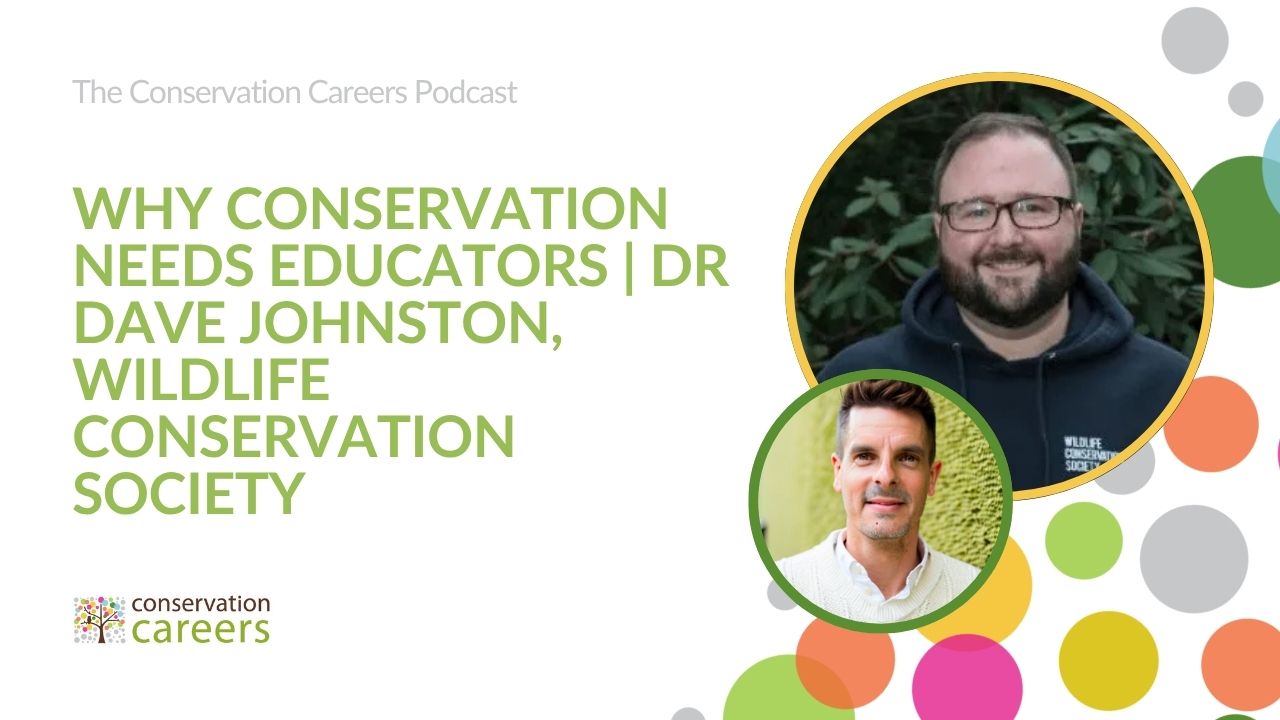
Podcast | Why Conservation Needs Educators | Dr Dave Johnston, Wildlife Conservation Society
Explore how conservation professionals, educators and career-switchers can use education to scale their impact, with Dave Johnston, Director of Professional Development at the Wildlife Conservation Society, based at the Bronx Zoo in New York.
Dave shares a passionate, inspiring perspective on why education is fundamental to conservation – and how zoos, aquariums, and teachers can be powerful agents for change.
He also talks about his career path from zookeeper to teacher to conservation educator, the importance of humility and lifelong learning, and the joys and challenges of leading adult education at one of the world’s most respected conservation organisations.
It’s a thoughtful, practical and empowering conversation.
Enjoy.
Listen
Watch
Subscribe
You can listen and subscribe to the Conservation Careers Podcast on iTunes, Spotify or Stitcher using the following links, or search for ‘conservation careers’ and you’ll find us!
Resources
Join our live podcast audience!
All our podcasts are now recorded in front of a live audience who sit in and listen to the chat, and then after the mics are turned off get a chance to talk to the guest, share their thoughts and ask questions.
If you’d like to be in the audience all you need to do is join our CC Academy.
In the CC Academy you’ll get access to the world’s biggest conservation job board – listing over 80,000 jobs, volunteer and internships across the globe each year.
You’ll also enjoy access to our amazing CC Pro private members community with regular events, networking and support.
Plus you’ll get full access to our growing library of career-boosting resources, guides and templates.
And best of all it only costs a few dollars, pounds or euros per month to join the Academy.
To find out more please visit the CC Academy, or simply click the join button at the top of our website.
See you on the inside!
Transcript
Hi there. Nick here from Conservation Careers and welcome to the podcast. Now today I’m joined by Doctor Dave Johnston who’s the Director of Professional Development at the Wildlife Conservation Society based at the Bronx Zoo in New York. Dave shares a passionate inspiring perspective on why education is fundamental to conservation and how zoos, aquariums and teachers can be a powerful agent for change. He talks about his own career path from zookeeper to teacher to conservation educator, and the importance of humility and lifelong learning, and the joys and challenges of leading adult education at one of the world’s most respected conservation organisations.
It’s a thoughtful, it’s a practical, and empowering conversation. Enjoy. Hi. I’m Dave Johnston. I am the director of professional development for the Wildlife Conservation Society.
Welcome, Dave. Yeah. It’s really nice to reconnect. Thanks for sharing your time here on the podcast. Yeah.
I’m excited to hear your career story, hear about everything you’re involved with, education, WCS, and and more. So it’s good to have you here today. Thanks so much. I really appreciate the getting the opportunity to come and talk about conservation education. It’s really exciting.
So it’s it’s it’s great that you gave them the space for that. Yeah. Great. Well, it’s important stuff. Let’s start with WCS.
Yeah. I’d love to hear for those who haven’t heard about WCS, the Wildlife Conservation Society, like, what is it? How does it work? Just introduce the organization you work for, if you could, please. Sure.
Yeah. So the Wildlife Conservation Society is, an international global conservation organization. We’re based out we’re headquartered out of New York. So we are best known in the New York region as the organization that operates five of the zoo and aquarium facilities in the city. So we operate the Bronx Zoo, the Central Park Zoo, the Queen Zoo, the Prospect Park Zoo, and the New York Aquarium.
And we do education programming across all five of those, facilities. But, we’re better known internationally as an organization that’s in over 60 countries around the world doing conservation research. We have field teams doing kind of boots on the ground conservation research around the world focused in a variety of habitats, a variety of focal species, and focal, you know, areas that are are highlighted for us. So it’s all about protecting wild places and wildlife around the world. That’s really what we do.
Yeah. And it’s it’s kind of unique in that way, isn’t it? That you have that kind of two strand approach. You’ve got the zoos and aquariums where people can visit, and you’re practically in situ helping or etcetera, say, you know, in in a kind of zoo environment helping species. That that helps to fund and support the conservation work on the ground.
It’s a really interesting balance. Yeah. Actually, that’s that’s one of the things that I really enjoy about WCS so much is that exact piece, which is, yeah, the work that we’re doing in our zoos and aquariums, not only is that helping to fund the work that’s happening globally, which is so important, that field research that’s happening globally. But there’s a really fascinating flow of information between those two kind of wings of the work that we do. So we’re utilizing the work that’s happening in that global, context to tell those conservation stories in really practical, really exciting, really interesting ways to our local audiences in the New York region, which makes conservation so much more accessible, so much more practical when you really can hear the stories.
You can hear the reality of what what it means to be out in the field and really and not only can I tell those stories, but I can bring those colleagues in? It’s as easy for me to get a colleague of mine from, you know, the WCS Mongolia team to, you know, zoom in and provide expertise in one of our programming as it is to get a colleague from the aquarium to do it, which is just on the other side of the city. It’s it’s just that easy, and that’s really exciting to be able to just bridge that gap and and really make that accessible and tangible for people. Yeah. And it must be a nice moment as well where people are in a zoo aquarium environment.
They’re close to nature. They’re looking at nature, whatever the species might be in front of them. It’s a great moment to be telling a story and delivering a message and raising support and converting more people to care about wildlife. Yeah. Absolutely.
And, you know, we’ll we’ll talk a little bit about the work that I do, but my work is is really focused on adult learning, professional learning in that way. So I’m working with graduate students. I’m working with teachers who wanna come in and be able to tell those stories to their students. So there’s really there’s really some great opportunities for collaboration, for connection, for communication, because these are these are adult learners who are just, you know, chomping at the bit to get that, you know, inside view on what conservation looks like, and and it really does situate us uniquely to be able to kind of tell those stories in that way. Yeah.
Yeah. I love it. Absolutely love it. Before we kind of talk about you, your job, the work that you’re involved in, or or your passion for, for education professional development. And just give us a bit of reviews, like, what happens in the field as well.
Like, take us out into WCS in the field. Have you got any example projects or programs or something that that might bring the work across those 60 countries to life? Yeah. So, one of the things that I do right now, I’m working on a project that’s called WCS presents field site. It’s a really exciting project.
So, it’s a it’s a privately funded, an initiative that we’ve been running for, you know, about twelve years now, and it’s all focused on telling conservation stories through digital media for educators to be able to use. So through this project that I’ve been working on, I’ve actually been able to partner with about 20 different field teams around the country to be able to bring those stories to teachers around the world. It’s not just it’s not just local teachers in New York City. These are teachers. This is this is free to access.
There’s no barriers to get into it, and anybody can use it. So, the story that we’re telling right now is actually with our WCS Mongolia team, which is why they were so fresh in my mind a moment ago. But, they’re working with, Hulan, which are the Mongolian wild ass, and they’ve been working with that species for, for a while now. You know, as infrastructure is increasing in, Mongolia, as you’re seeing more and more extractives industry and mining industries coming in, and you’re seeing rail national railways starting up. We’re seeing increased human wildlife conflict.
We’re seeing increased habitat fragmentation for these hulan species, and WCS has really been at the forefront of helping to, one, just build national recognition, which in October, we’re going to have our first, national Hulan day in Mongolia, which is really exciting coming from the government in Mongolia, but also to be able to, you know, work on getting those species back to their historic range and that’s really the story we’re telling with field site this time. It’s all about how are our field researchers tracking, how are they using digital means to track those species, how are they tagging them, how are they working with the local infrastructure, engineers to make sure that there are safe passageways for species to be able to cross those roads, those railways, all of those things as the hulan move more and more back into their natural eastern grassland environment where now they’re kind of more in the arid desert areas than where they’ve been pushed. So we’re going to be telling that story and not just telling that story with the Mongolia team but also writing a curriculum that allows teachers to bring those really tangible constructs to their classrooms and and and teach students using data from Mongolia, data actual data on the Houlan, and students can really problem solve and think about if you were a conservationist, how would you make recommendations?
Where would you pick the passageways on this railway based on the data that we’re seeing on where they naturally are occurring? How would you make those recommendations? So that’s the kind of work that we’re doing with our field teams, and and I think it’s really cool to be able to bring that and tell those stories to teachers and students. Yeah. It’s kind of again, it’s such a unique position you’ve got.
You’re working in country in Mongolia on a threatened species. You’re working with the government at that level. There’s gonna be a national day, which hopefully is gonna obviously raise a lot of awareness in country. But then you’re taking that message elsewhere, educating educators to then work with kids in schools and engage. And Yeah.
You know, there’s a lot going on there. It’s gonna be all fits together really nicely. Yeah. And I think that’s one of the and my work is really in teacher education. That’s what my doctoral work is.
That’s Yeah. That’s, you know, where where I really have kind of honed my work in on. But what I love about teacher education is the piece that you just talked about, which is the magnitude effect. Yeah. I can teach thirty fifth graders about habitat fragmentation, and 30 people have learned that.
Or I can teach 30 teachers Yeah. About habitat fragmentation. And then every year, 300 students are going to learn about or 3,000 depending on how many they have in their class are going to learn about habitat fragmentation, and that’s gonna have a year after year effect as these teachers bring this content into their classroom. And it just allows such massive reach and such interesting ways to bring conservation, to make to make conservation the lens through which science learning is happening in classrooms. Yeah.
Yeah. And, actually, it it kinda reflects what we do at Conservation Careers quite nicely because, you know, again, I made the decision fifteen years ago. I can be a conservationist and do my thing, or I can help others. And it’s a sort of similar sort of journey that we’ve been on ourselves, actually, is let’s help hundreds of other people work in the sector, and that multiply effect comes from there. Yeah.
That’s, like, yeah, that’s exactly it. And and I think that’s a really core piece to the work that we do at WCS in education. We work with about one and a half million people a year in our zoo and aquarium programming. So we have massive impact in the New York region, but also from, you know, tourists that are coming in and visitors to the con or to the city that are coming in and learning about this. You know, we have a sign network, which is all about empowering youth, and we’ve got, you know, over 1,100 youth that are working in early career, internships with over 60 different internship types at eight different institutions in New York City.
So it really is about building capacity. It’s really about education as a way to excite people, get them to understand these opportunities that are out there that they don’t think of. Because when so many people think of zoos and aquariums, they think of zookeeper and vet. Right? And there’s all of these other opportunities, and education can really kind of help pave the way for people to just understand for them and to give them, you know, a a nice entryway into this work.
Yeah. So before we talk about your role, your career, and everything there, I wanna just unpick what you just said there a little bit more as well. Like, the different roles within zoos and aquariums, people think vets, people think keepers. Just unbox it. What other things can people can be doing within that area of work?
Yeah. So, you know, it’s it’s again, it’s a really interesting topic. So we I had another, project that I was working on a couple of years ago, which is called our conservation heroes program. And, again, that’s another one that’s totally digital and free online, and anyone can use it. You could just Google any of these things and see them really easily, or I can give you links, that you can share out as well.
But conservation heroes focuses on this exact thing, which is to recognize that conservation heroes come in a variety of different career options. So, yes, we highlight, it’s a career exploration curriculum that teachers can use with their students that’s focused on science through the lens of conservation. And, yes, we highlight keepers, and, yes, we highlight vets, and, yes, we highlight field researchers, but we also highlight conservation educators who have backgrounds in science and and also love working with people and teaching people. We highlight exhibit designers who have really strong artistic background or engineering background and wanna design exhibits or or, you know, build the the infrastructure that you can find within exhibits for animals. We highlight the data analysts that come in and, you know, are just on the tech side, just creating technology for us and analyzing data for us.
We highlight, you know, things that every industry has. We highlight the accounting people, the HR people. Like, we can’t do any of this work without all of that. So there are people out there who are like, I love conservation, and I really wanna get into it. But, man, I just do not wanna take another science class.
And there’s other opportunities where it’s like, yeah. You don’t need to, actually. You know? You can be a chef, and and work at a zoo and aquarium and bring amazing food to it’s sustainable food practices to zoos and aquariums. So I think that’s again, it’s just a really kinda cool aspect to be able to do in conservation education is to tell those stories and just get people excited and thinking about conservation in new ways.
So broad, isn’t it? Yeah. And you could Yeah. Design the website. You can Yep.
Yeah. Run the shop. There’s I mean, just in microcosm, it shows just the diversity of there, and you expand that across the sector. There’s there’s a role for every person. I I believe that.
Yeah. Yeah. Yeah. So you’re the director of professional development here at WCF, Dave. Yeah.
Tell me, like, what does it mean to be the director of professional development? What are your main responsibilities? Yeah. If you met someone in a pub or in a bar and said I do this, what do you do? Yeah.
So, basically, my work is all adult education. It’s professional education, but kind of the simplest way to get people to really understand what it is is, you know, imagine university professor, but at a zoo and aquarium. That’s very similar to the kind of work that I do. So we work with about 1,700, adults a year in a professional learning setting. And when I talk about professional learning, what I’m really talking about is not just, you know, going to the zoo and having a great time because I know a lot of people think about zoos and they think, you know, they’re really just for kids.
But, you know, we have we have hundreds of thousands of adults that are coming through every year and having a great time and learning as well. So it’s not just about having a great time and learning about conservation, but it’s about learning about conservation in practical professional ways. So how do I apply this into my professional learning? And I mostly do that work in two different ways. So I I have two main audiences.
Well, let me take that back. I have three main audiences that I really work with. And I do this work across all five of the parks in in, New York, but also through these digital programs that I’ve shared, we’re working with a global audience and really teaching people around the world about it. But the first audience are really teachers. You know, and, again, we’ve talked about the magnitude of effect of working with teachers, but also teachers are, you know, they’re they’re they’re hungry for knowledge.
They love to learn. That’s why they got into teaching. And and when they find something that they get excited about, then, you know, they really wanna dig their hands in, and they really wanna get creative, and they really wanna do really cool stuff with their students. And they come in with just the most excitement and the most like beautiful intention about how they’re going to apply this with the work that they do. So we work with teachers to not just tell them conservation stories, but also to tell them how they can build that into their curriculum.
And we’ve kind of shifted how we’ve done that in the past decade or so where we used to do a lot of curriculum development, where we would write curricula and then give them to teachers, and then teachers could use it in their classroom. But we’ve really shifted away from that. It’s kind of the give a man a fish, teach a man to fish approach where, sure, I can give you a curriculum and then you’re gonna do that. But isn’t it more exciting for you to learn about conservation and then for me to sit with you and look at your curriculum and think about where does this fit into what you’re already doing in your classroom. So this isn’t an additional new thing that you have to learn how to do, but instead it can be like, oh, I can use that example in this unit that I already do with my students, and then we help teachers think through what does that look like.
And we do graduate level programming for teachers so they can earn, hours towards their certification or they can earn credits that help them, get higher differentials for salaries towards their their graduate degree programming. And, you know, that’s that’s really the work we do there. We also do through our teacher education work, do a lot of partnering with schools where we are the provider for services for schools, throughout the year, and we’ll provide teacher professional learning. We’ll provide programming for students. We’ll provide family programming, and it’s all packaged in this, like, thematic approach to conservation where it’s all connected and it’s all helping them really kind of see how that all fits together.
So so that’s kind of one of the audiences. The second audience is the more traditional university audience where, you know, all of the higher education programming that we do at WCS is part of the work that I do. And we actually have a formal partnership with Miami University of Ohio, and we run a graduate degree program because of that. It’s called the advanced inquiry program, through project dragonfly at Miami University of Ohio. So we’re one of the 10 sites that graduate students can come and learn at the zoo from zoo professionals and really and it’s an applied conservation degree, an MA in biology or an MA in in, teaching of biology, and it allows them to really understand in practical ways, get hands on.
We’re around the zoos. We’re out around New York City. We’re in marshes. We’re we’re doing conservation work, but through, through the university and and through that partnership. And and, and yeah.
So I work with about 60 graduate students a year on that program, which is really exciting. And then the third area that I do my work in is really in staff learning and staff capacity building as well. So doing internal learning, not just for education staff members, and although that’s certainly a big part of it. Again, my background is in teacher education and teaching people how to teach well. So education is a big part of it, but it’s not just with education.
I push out into other departments as well and provide support for other departments around the zoos and aquariums to understand how does their work tap into conservation, as well. So you talked earlier about how, you know, yeah, you could run the gift shop at the zoo. And part of my role is to work with those audiences and say, yeah. And here’s why what you’re doing is actually conservation work too. Mhmm.
And here’s how you’re helping move this mission forward in the work that you’re doing to kind of help build not just excitement, but also, like, a real commitment to our mission. You’ve got so much going on. Yeah. You know what? I’m not, I’m not tired or bored.
Yeah. So that’s good. You’re in the sweet spot. Yeah. Yeah.
I see the energy in the flow. How many how big is your team? Like, how many people are involved in the work you just described? Yeah. We’re we’re a fairly mighty team.
We there are 10 of us that work on it. It’s it’s eight full time people and two part time staff members. Yeah. And that does everything that I said. So running a graduate degree program, teaching about, to do about 35, graduate level teacher programs, doing staff development, and creating all of that digital content that we do as well.
So Yeah. Yeah. It’s great team. I couldn’t do it without them. So Yeah.
It’s really great. Yeah. It’s really interesting. I think we sort of find the sweet spot of what their their their next is, what they’re really interested in. You know?
You can and you can really get into the kind of the flow and the passion of of delivery, yeah, and and create more impact, which is what I see and feel and hear from you. What does a typical day or week look like for you, Dave? Like, what yeah. And what and I’m gonna tag another question. I’m like, what do you love and what do you find challenging about your role as well?
Just just paint an honest picture as to what what it’s like to be you at work. Yeah. What, what it’s like to be me. Highly caffeinated. That’s number one.
Yeah. Yeah. But, no. So, a day day in the life, I I what I love about this job so much is that there isn’t a traditional week. Every week looks different.
Every week is is, you know, tomorrow I’m gonna be out on a on a whale watch boat working with, you know, adults and teaching them about the conservation work we do out there. And then, you you know, later this week, I’m gonna be teaching a graduate course at the Bronx Zoo and and working with them there. So, you know, it all looks very different, but, you know, it’s a it’s a big combination of classroom work. I develop a lot of curriculum. I write lessons for all of the things that I’m teaching.
I support my staff in writing their lessons so that they are developing and delivering really high quality work. So there’s a lot of typical teacher work. I do grading. I’m gonna be grading later today. I’m gonna be going through papers and giving feedback, typical college stuff.
Yeah. But then I’m also doing a lot of, work with our you know, I’m on our leadership team in education. So I’ll be I write grant reports and, you know, meet with donors and really kind of tell them about the amazing work that we do in conservation. And then I do research on top of that. I’m I’m an active researcher too.
So, you know, I do work on I’m I’m a social scientist by by trade, and I really look at the impact of all of this work that we’re doing on teacher learning specifically. So not not on my only am I doing this work, but, like, are teachers actually learning? And if they are actually learning, which spoiler they are and I’ve got a beautiful p value that shows me that they are, but more interesting to me, what do they do with that? When they go back to their classroom, how do they enact that learning? How do they bring it to their classroom?
What are the stories that they’re choosing to tell? So I’m also actively working on that kind of work, too. And then one of the things that I think brings me so much joy in the work that I do is I’m really fortunate to be involved in the International Zoo Educators Association. So, you know, most of the listeners will, you know, have a vague understanding of the of the structure of zoo and aquarium organizations and how Waza, the World Association of Zoos and Aquariums, kind of oversits them over that. Izetty is the education partner for Waza.
So we are made up of, it’s a volunteer board, but we’re we’re made up of educators around the world, zoo and aquarium educators around the world that are providing networking professional opportunities, standards, professional standards for our industry and really, you know, just making sure that, you know, not only are we doing this amazing work, but there are support networks and also consistency in the way that we’re doing this work globally. You know? Because these conservation stories, while they are local in many ways and they are in an enacted in a local way, these are really this is a global community, zoo and aquarium educators. So, we we have the Waza conservation education strategy, which was released in 2020, which really provides very concrete, professional standards for what does it look like to do conservation education in zoos and aquariums around the world. So I think that’s also something that I I just really love doing that kind of work as well.
So that kinda gives you a sense of of what my work is and and kinda how I do it. I am a I am a an extroverted introvert. I put it on. I we’ll we’ll stop this, and then I’ll go and dissociate for a while, in a dark room. Right?
And, I think that’s one of the things that I you know, that’s that’s that’s my big challenge. This is a big energy job, right? Like, if you’re gonna be inspiring people, teaching people, being in front of groups of people, sometimes I’ve got three, four, 500 people in front of me that I’m teaching. Man, that can drain you. I love it.
It’s so incredibly rewarding, but it is something that, you know, it’s it’s it’s, it’s a skill in its own right to be able to do that too. Yeah. Yeah. And just say I share that too. Yeah.
Exactly. So yeah. I can switch it on, but I don’t need to turn it off and go lie down in the bathroom room for a while. Yeah. I get it.
Refill the tank. Yep. Yeah. That’s right. Yeah.
Yeah. Yep. We’re talking a lot about education. Like, why do you see education as important in conservation? Like, why why should anyone care about education?
What difference does it make? Yeah. Well and, you know, the way that I always say it to people who who ask me that question is, you got if you’re in the conservation world, if you’re asking me that, if you’re a if you’re a an executive at a zoo or aquarium or or, you know, a fundraiser who’s looking to talk to donors and is like, well, why should we pitch this? My my response is always, well, you got here somehow. You learned about it somehow.
You didn’t just, you know, blindfold yourself and land in the middle of a zoo. You got here because you cared about it. And you only care about it when you know about it. And you only know about it when you’re taught about it. So that’s the role that zoo and aquarium education plays.
It’s really about building empathy. It’s really about making people aware of opportunities, and it’s really about inspiring people to care about conservation. You know? Conservation is one of the most important global issues. And if we’re not teaching people really thoughtfully about it, it’s more than just exposing them to it because, yes, I might be somebody who went to a zoo and made eye contact with a gorilla and it changed my life, but for a lot of people, that’s not enough.
For a lot of people, you have to understand why. You have to understand more about it. You need to know the challenges, and you need to know the avenues and pathways to get into it. It’s it’s not as easy to get into the field if you don’t really know where to start. And, you know, we’re nonprofits for the most part, so we’re not doing it to get rich.
Yeah. So, you know, getting into it, you’ve gotta you’ve gotta care. You’ve really gotta love it. And every generation is here because they were taught by the generation before them. So without conservation education and without zoos and aquariums, which are so well situated.
We did a study at WCS, a few years ago. A colleague of mine, Alex Beauchamp, did a study where she looked at warmth and trustworthiness Yeah. In science institutions. And trustworthiness is how well do I trust that you’re giving me like really good science? And she plotted them kind of scatter plot wise.
She looked at you know science natural history museums, national parks, universities, zoos, aquarium, you know all of the science institutions and plotted them and up at the very top were zoos and aquariums high on both scales. People like us for the most part, and they trust us for the most part. So it really situates us in a place that who else should be delivering this? Zoos and aquariums are a great organization to be delivering the science content and getting people to really care about the work. Yeah.
Gosh. I bet they had a sweet p value as well, like you were saying. Sure did. Yeah. Sure did.
What staying with the theme of education then. Like, what does effective conservation education look like? Like, hints, tips, like, what really works? What have you learned? Yeah.
So one of the one of the studies that I just worked on was really focused on teacher education, but I think it can apply in a wide variety of audiences. I don’t think it’s exclusive just to teachers. Yep. I wanted to speak to teachers because there’s a bit of a gap in the literature on teachers right now in zoos and aquariums, but I think this is broadly applicable. What I really found was, four kind of main big themes of what people really got out of taking programming through zoos and aquariums.
And one of them was really around understanding science content in ways that made it feel accessible and reachable. And that is really through that storytelling piece that I told you about earlier. Right? You can meet researchers. You can meet zoo professionals.
You can really put a face and a lived condition to these very fairly abstract concepts. Right? Like climate change, people, you know, they think of a polar bear on the melting ice cap, and it’s and but you can tell that story in such different ways when you have climate experts meeting the people who are taking programming. Right? It just it it really humanizes the work.
Another thing that people really took away from it was the, interdisciplinary nature of conservation, and I and I think we talked a little bit about that earlier with the careers. Right? I maintain conservation is as much a social science as it is a natural science because the the natural science is so important into the work that we do. But if we’re but it’s about working with communities. Yeah.
It’s about empowering communities. It’s about, providing support and resources where we can, and it’s really about the human piece of it. And if we’re not really thinking about all of the aspects of conservation, so not just the natural science, but also the, you know, geopolitical background, the fundraising aspects of it, the history behind it, the, you know, social science, the psychology behind it. All of these pieces play a role in effective conservation, and you can learn about that really nicely through zoo and aquarium programming. And, you know, the the final thing that I’ll talk about is really this idea.
This was a really interesting thing that came out of the the the study that I just did, which I wasn’t expecting to see. I shouldn’t say I wasn’t expecting to see it. I wasn’t thinking it would show up Yeah. Was really around this idea of respect for our audiences. Mhmm.
And I think it speaks back to that study that my colleague did where we’re a warm and welcoming and, you know, we want you to come and learn because we love this so much. So there’s not a condescension. There’s not a, oh, you don’t know this. And it’s really about like oh my god I’m so excited about this but sit with me and I want to tell you all about this and like going off on tangents and talking about all the really cool things that we do. There’s an excitement and a professionalism that we have when we’re working with audiences that makes learning fun, accessible, and it’s something that people wanna come back and back and back more and more to do.
So I think those are the things that I really recommend for people who are thinking about, like, how do I continue to build in my conservation education program? Those are the main things to really be thinking about. How accessible is it? How are you bringing in those stories? How are you exciting people?
How are you treating them with respect? And how are you just building that capacity for them to just take this and run with it beyond just learning science facts? Like, it’s great to learn a man what what characteristics make a mammal. It’s so much more than that that what we do in in conservation education. Yeah.
And when I hear you and think about it also, it just it’s so connected to communications, isn’t it? It’s it’s all about understanding the audience, the person you’re speaking to, delivering messages that really resonate. That’s right. You know? And, again, like, just reflecting back what you’re saying about it’s all about people.
I mean, a lot of conservation people come to conservation because they love animals, and then they realize it’s all about people later, you know, and you’ve absolutely made that connection so clearly. And a zoo is the perfect metaphor for that, isn’t it? Yeah. Yeah. Yeah.
I love that. Let’s talk about your career. Sure. Changing gears ever so slightly then. So, yes, you’re director of professional development, but when you kind of look back at your career so far Yeah.
What have been the key key steps or moments or people, or what’s been important to you on reflection in terms of getting you to where you are? Yeah. So I think I think there’s kind of two two things about it, which is I’m I think I’m I’m exactly the person who I was talking about earlier when I said people don’t know what opportunities are out there. I had no idea, Dia. I grew up very working class.
Nobody in my family had gone to university. I had no idea what was out there. So, you know, I’m going to to school, and I’m like, well, what jobs are there? Well, I’m gonna I’m gonna be a teacher, I guess, because, you know, I I don’t really know. And, you know, short version of it is I was I was like, I’m gonna teach history because that allows me to also teach environmental stuff because there it was tied together in the state that I lived in.
There was an environmental add on certificate to the the social studies one. And through that process, I I found anthropology, which I had no idea. I didn’t even I’d never even heard of it before, at that point and found physical anthropology, You know, really the evolution of human species and human behavior and looking at primates, and that got me just really excited about this idea of, oh, I didn’t even think that I could do that. So on a wing and a prayer, I switched over and became a physical anthropology major and was like, this is what I’m gonna do, and just kinda made a leap and went with it. And that got me into zoos and aquariums.
You know, that was kind of my foot into zoos and aquariums. And, originally, I did animal care, and it it is, an incredibly rewarding and important career, and it is not it was just not for me. I I wanted just a little bit more variety in my day to day base. I, you know, I wanted a little bit of an interaction with people and more variety. I didn’t wanna be on a set routine quite as much.
So got myself into education that way. So that’s kinda how I got into it from there. However, as I was doing and I did the typical zoo educator career. You know, I was, teaching field trips and doing birthday parties and doing summer camp and all the things that you think about. Yeah.
And I did it for about a decade. And towards the end of that time, I started working with teachers as an as a growth opportunity for myself, and I loved it. I loved being able to work with adults and really dig in in really kind of high level content ways with audiences. But what I kept finding was that they kept saying, this is really cool, but that won’t work in my classroom, and you don’t know because you’ve never been a teacher. And I was like, you know what?
You’re right. Actually, I I have never been a teacher, so I don’t I don’t know how to speak to you. So I made the very conscious decision to leave the zoo and aquarium world to get started I got a master’s degree in science education. I taught for years in New York City in a public high school. I taught science at a in a public high school Yeah.
So that I could gain that experience with the ultimate goal to come back into zoos and aquariums and be able to be better situated to be specialized as a teacher educator in zoos and aquariums. I saw Elaine for myself there. So what did you learn in your time at the high schools in New York? Like, when you took that route and went off the proactively educating came back, like, what did you learn for that? So I think one of the things that I think is is fascinating about education, education is one of those fields that almost everybody has had years of experience with as a learner.
Yeah. Yeah. So you think you know Yeah. What it means as a learner or or as a parent or caregiver to a learner. So you think you know education really well, and it turns out you don’t in many ways.
That’s what I learned. I learned that I knew nothing about how thoughtful and purposeful good education is with thinking about how you’re going to go from your ultimate learning goal back to what kind of evidence do I need to see, back to how do I assess that evidence, back to well, then what do I do with them to get that evidence, to know the assessment, to see the learning? Right? It’s it’s like research in a lot of ways. It’s about trial and error.
It’s about looking at data. It’s so much more rigorous than I think most people realize. And when it’s done really well, I should put a a little asterisk on that. When it’s done really well, it’s so much more rigorous. And that is basically what I’ve built the entire foundation of the work that we do at WCS on is really understanding teachers’ lived experiences, understanding what it means in reality to not just have to hit that standard in your in your curriculum or get a certain percentage of your students to pass a standardized test, but also the lived reality of, well, what does it mean when you don’t have time to prepare your lessons?
What does it mean when you don’t have any free periods because you’re covering for other teachers? What does it mean when you, you know, are, you know, given, three extra classes and no extra teachers and all of these other barriers that get in the way of good education? And I think we have done a really nice job of hearing and listening and building that into the work that we do, and I wouldn’t have known that had I not gone back to the classroom, done that for several years, built that experience for myself, and then reapproached teacher education in zoos and aquariums in a much more informed way. Yeah. Yeah.
I love that. Yeah. Have you got any careers advice for people that are listening who, yeah, might be interested in doing something similar to you working in conservation education or professional development or yeah. What what hints or tips might you give to a graduate job seeker, maybe even a career switch? There might even be a teacher out there right now in New York who’d love to do what you’re doing.
Like, what what would help them? Yeah. So I think one of the things that I I love about how WCS frames this. So a lot of, places talk about a career ladder. We don’t talk about a career ladder because a ladder has one rung above the next, and it’s a very linear approach.
We talk about a career lattice. And if you think about latticing, you can go up, you can go down, you could go sideways. And I think that’s the thing that I always tell people who are looking to get into to conservation or even specifically conservation education. It’s a this job is amazing, and people love doing it. So there’s not a lot of opportunity for the demand.
So sometimes, you know, it it’s worth taking a step in the left in the left lane Yeah. To move forward a bit, to move back over. Be open. Be, you know, be open that you’re not gonna get your your perfect career right away necessarily. Most people don’t.
You’ve gotta kind of play around a little bit, and I am a better educator having been a zookeeper. I’m a better educator having been a classroom teacher in zoos and aquariums. Right? And I wouldn’t have had those experiences if I would have just got into zoo and aquarium education and just stayed in that. So thinking about, you know, what what are explore, try other things.
You you you don’t know what aspect of conservation you might fall in love with. Or even if you do have a very like, I was very purposeful. I’m gonna not retire from the department of education. I’m I’m gonna go back to zoos and aquariums. Even if you’ve got that goal, those things you bring with you are really gonna strengthen the work that you do.
So, so I say be open, be tenacious, recognize that it is a very small community. So, you know, make friends, network, get to know people. I know, again, as as an extroverted introvert, man, I hate networking sometimes, but, you know, it’s worth it. It’s really worth it to meet people and, like, you know, Nick, you and I now have known each other for years and there’s been other opportunities that have now come up. We’ve been able to bring graduate students to your program and and, you know, those things wouldn’t have happened had we not just, you know, networked and gotten to know each other.
So those are really the big things that I say for people. Just, you know, be open to the idea, get some experience, be open to other other ideas, and, you know, stick with it and network. And and that’s where you’re gonna you’re gonna, you know, see some dividends down the road. So Yeah. Career lattice.
I love it. Yeah. And and also, I like the framing of networking, and I use it myself as making friends. It’s so much softer, isn’t it? Yeah.
You know? We are a small community. I totally feel that, you know, conservationists very quickly meet another conservationist. You’ve usually got two or three friends in common, and Yep. Away you go.
So yeah. Yeah. Yep. We’re we’re warm and welcoming. Yeah.
As well. Yeah. Yeah. Yeah. We we’ve got about five minutes left.
We’ve got a few people listening as well that after the recording, we’re gonna hand over and ask their questions, to you. So I’m looking forward to that. In the last five minutes, I’m gonna ask some more open sort of general questions of you currently. First one’s a short one. If we could take you to one place on the planet and you could see one species, where would you go, and what would you hope to see?
Oh, species, I don’t have a great answer to. Place, without a doubt. So I am I am not a hot weather person. Okay. I would I would take, you know, almost freezing over mild any day of the of the week.
Right. So I would 100% I’ve never been to Antarctica. I will get there at some point in my life. I would love to do some conservation education around, you know, what what are the big conservation work that’s happening down there. That would really be that would be my my big bullet where I would wanna go.
If you could just snap my snap your fingers and make that happen, I I would take that in a second. Amazing. So maybe some penguins, maybe some albatrosses. Who knows? Totally.
I’m excited. Yeah. Yeah. I hope that that happens. If we could make you like a global leader for the day, sir Dave Johnston, right, what what law or decree might you enact to help us all to to save and protect more wildlife?
I mean, it’s it’s gonna sound cliche, but for me, it’s all about protecting and prioritizing education. Mhmm. Period. Mhmm. Even even if it’s not around conservation specifically, even if it’s just protecting education at a global level, making sure everyone has access to education, making sure that those that access to education is enshrined because a an informed public will make wonderful conservation decisions, I would like to think.
So Yeah. That is that is what I I I think education is something that I I could not prioritize more in the work, and and it doesn’t always get prioritized, in in ways that I think makes it accessible to everyone. Yeah. Yeah. Which is why you’re here banging in the room like you are.
Yeah. Brilliant. And then, I guess, final question is around the challenges we face in conservation. Yeah. Yeah.
We see species, wildlife, habitats, ecosystems, however we want to look at it, biodiversity in decline when we measure it, you know, at a global scale. Are you hopeful for the future? Are you optimistic? Like, how are you feeling about that where you sat? Yeah.
You know, it can be hard sometimes to be optimistic. There’s a lot of doom and gloom, in the last couple of decades, around conservation. But I think that hope has to be there. I and as a and look. I’m I’m I’m coming across as real positive, right now, but, like, hey.
I’m a Gen Xer. I’m cynical. I get it. I I I I love a good snark here and there. But, you know, you you’ve gotta have that core of hope that things are going to to move in the right direction, and you see glimmers of it.
Right? Even in even in the in the shadows, you see glimmers of really good people doing really good work, really inspired young people speaking out and advocating and saying just because it has always been, it doesn’t need to always be. That’s the kind of stuff that really gives me gives me hope and and and keeps me on this path. If I can even play a small role in getting people in that direction, then I feel like I’ve done my part, and I can feel pretty good about my time here, you know, knowing that that my work has led to some really great outcomes. So that’s what kinda keeps me positive.
And and and, you know, yeah, I have moments where I, you know, look around and see what it is, but, you know, it’s just taking that moment to just a metacognitive moment to just be like, yep. That’s bad. But, also, you saw this other thing the other day, and don’t forget about it because that Mhmm. Was really cool and really important, and that’s what’s keeping you going. So stay positive.
Keep your nose down, and keep get keep plugging away on this work. So I I am hopeful, and maybe it makes me sound a little idealistic, but I’m I am hopeful that we’re gonna we’re gonna right the ship on this, and we’re gonna get ourselves in a really great place with conservation. In in my lifetime, I’m gonna see that. Yeah. Great.
I love that. Yeah. And on that really hopeful, positive message as well. Dave, thank you so much for being on the podcast. It’s been a real pleasure talking to you about your work.
I feel enthusiastic and infused by everything that you shared. Yeah. You’re full of passion and energy. I really appreciate that, man. Thank you.
No problem. Thank you for having Yeah. I’d say people wanna find out a bit more about your work, perhaps WCS, perhaps get involved or support, like, where should they go? Where should we send them? Yeah.
So you should go to the WCS pages. You can find us at wcs.org. Or if you Google WCS professional development, you’ll find all of my work from there. The one that I would really love to plug for everyone is WCS presents field site. It is, a phenomenal program.
We’ve worked with, zoos and aquariums around the world to help develop content. We try to we translate every single story into multiple languages. If we’re highlighting a country, then we’re present we’re translating that work into that language. We want it as accessible, and and it’s free. It’s got videos.
It’s got curriculum. You don’t even have to create a login. I’ve made it as easy as possible for you to get into it. And the more eyes that are on it, the more people looking at it and using it, the more I can make an argument that this work needs to continue. So WCS presents field site.
Please take a look at it and, and, you know, and also reach out to us. You can contact us through that and give us ideas. I am kind of flying the plane as I’m building it around that. So if you’ve got ideas on what you want stories you want me to tell, send it to me, and I’ll work I’ll see if I can make that happen. It’s it’s very much a living, program in that way.
Amazing. Amazing. Yeah. I hope many people do. We’ll link to it and share it.
It sounds wonderful. Doctor Dave Johnson, thank you again. No problem. Thank you for having me. Okay.
I hope you enjoyed that, everyone. If you did, then please do hit the subscribe button to get notified of new episodes as they drop. And also please give us a rating or review because it really helps us to get in front of more people, and we really enjoy reading them all. As you’ll have heard, our podcasts are now recorded in front of a live audience who sit in and listen to the chat. And then after the mics are turned off, they get a chance to talk to the host, to share their thoughts, and also to ask questions.
It’s a really great format. If you’d like to be in the audience, all you need to do is join the conservation careers academy. Now in the conservation careers academy, you’ll get full access to the world’s biggest conservation job board, listing over 15,000 jobs, volunteer, and internships across the globe each year. You’ll also enjoy access to our amazing CC Pro private members community with regular events, networking, and support. Plus, you’ll get full access to our growing library of career boosting resources, guides, and templates.
And best of all, they only cost a few dollars, euros, or pounds per month to join the academy. Now to find out more, please visit conservation-careers.com/academy, or simply click the join button at the top of our website. See you on the inside.