

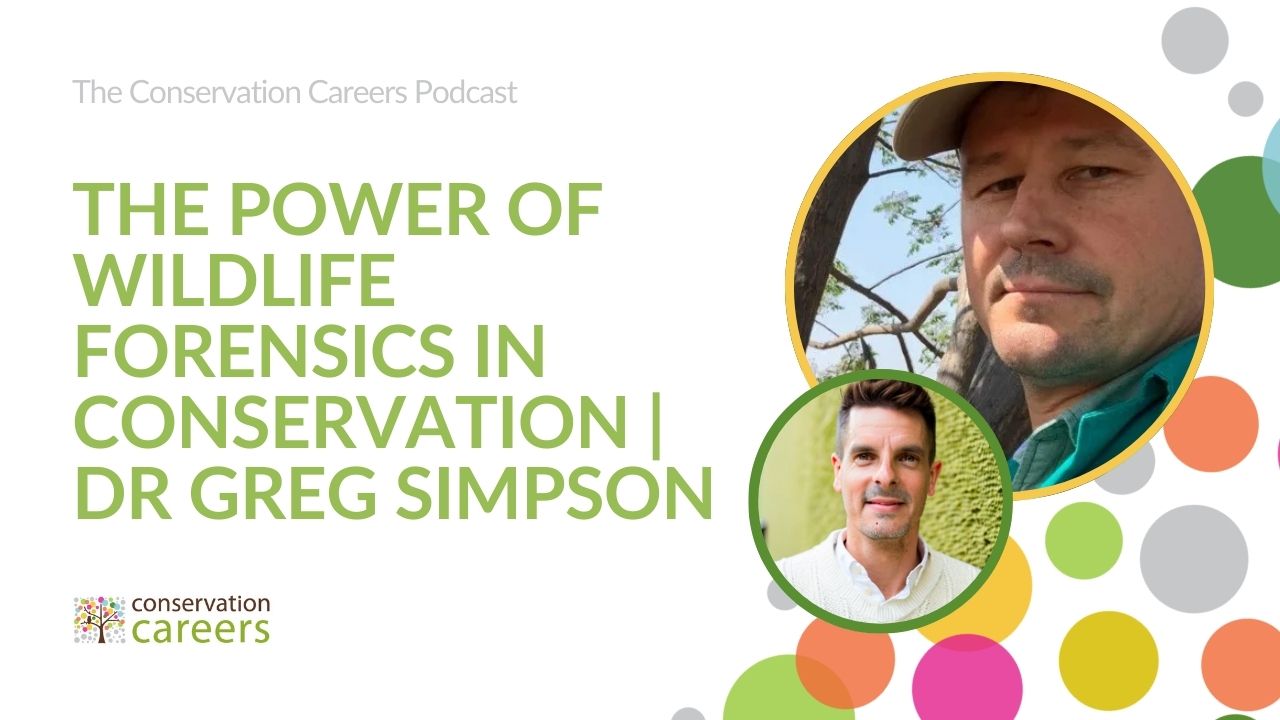
Podcast | The Power of Wildlife Forensics in Conservation | Dr Greg Simpson
How the Wildlife Forensic Academy is training the next generation of crime scene investigators for nature, with Dr Greg Simpson.
Hi, Nick here from Conservation Careers and welcome to the podcast.
Today we’re exploring a lesser-known but vitally important side of conservation: wildlife forensics.
My guest is Dr Greg Simpson — a vet, public health specialist, conservationist, and Managing Director of the Wildlife Forensic Academy in South Africa.
Greg brings a fascinating blend of experiences — from veterinary clinics and public health to conservation education and wildlife crime scene investigations.
In this conversation, we unpack what wildlife forensics actually is — and why it’s becoming such a crucial tool in fighting wildlife crime and protecting biodiversity.
We also explore the work of the Wildlife Forensic Academy — the world’s first institution of its kind — which delivers hands-on, field-based training for students, rangers, researchers and professionals.
You’ll hear about the Academy’s unique approach, its growing global partnerships, and how you can get involved.
Finally, Greg shares personal insights into his role, career journey, advice for aspiring wildlife vets or forensic scientists — and his vision for scaling the Academy’s impact across the world.
Before we get started, I wanted to give you a quick heads up that whether you’re just beginning your journey in conservation or looking to progress further, we’ve built three membership levels designed to support you at every stage.
CC Free gives you full access to our library of career guides and templates, along with bespoke job alerts from the world’s biggest conservation job board here at Conservation Careers.
For deeper support, CC Pro unlocks access to all listings our website and adds our private members’ community — a friendly, career-boosting space with training, events, expert guidance, and even the chance to join these podcast interviews live and put your own questions to our guests.
And coming soon, CC Pass will give you full access to all our premium training courses. That includes programmes such as the Certificate in Rewilding, Project Management & Design, Fundraising, Communications, Community-Based Conservation, Marine Conservation, and our career development courses — with more added over time.
If you’d like to explore any of these options, everything is available here.
Righty, let’s jump into today’s podchat with Greg.
Enjoy.
Listen
Watch
Subscribe
You can listen and subscribe to the Conservation Careers Podcast on iTunes, Spotify or Stitcher using the following links, or search for ‘conservation careers’ and you’ll find us!
Resources
Join our live podcast audience!
All our podcasts are now recorded in front of a live audience who sit in and listen to the chat, and then after the mics are turned off get a chance to talk to the guest, share their thoughts and ask questions.
If you’d like to be in the audience all you need to do is join our CC Academy.
In the CC Academy you’ll get access to the world’s biggest conservation job board – listing over 80,000 jobs, volunteer and internships across the globe each year.
You’ll also enjoy access to our amazing CC Pro private members community with regular events, networking and support.
Plus you’ll get full access to our growing library of career-boosting resources, guides and templates.
And best of all it only costs a few dollars, pounds or euros per month to join the Academy.
To find out more please visit the CC Academy, or simply click the join button at the top of our website.
See you on the inside!
Transcript
Dr Greg Simpson: [00:00:00] Hi, my name’s Dr. Greg Simpson. I’m the managing director of the Wildlife Forensic Academy.
Dr Nick Askew: Welcome, Greg. Thank you for joining the podcast today. It’s great to, great to meet you actually to get, know a bit more about your work and to share some of the work that you are doing down there in South Africa and more globally, actually with the Wildlife Forensic Academy.
Dr Nick Askew: Um, where to start? Well, so I, I, I’ll be honest and I wonder if most listeners to the same, I dunno much about wildlife forensics, so I want to kinda start with like, you know, a little bit of a 1 0 1. Like what is wildlife forensics? Uh, what does it involve? Yeah. Uh, and why is it important to wildlife conservation?
Dr Nick Askew: Just kind of just paint, just bring us up to speed. Like, you know, what is this really interesting thing that you’re doing down there?
Speaker 3: Oh, Nick. Um, it’s, it’s, it’s gonna be a bit tricky bringing you up to speed in a, in a very quick thing with everything that’s happening in the world.
Speaker 4: Yeah.
Speaker 3: Uh, but in essence, wildlife forensics is using forensics on a wildlife crime scene.
Speaker 3: So, as you know, we all know about. [00:01:00] Human CSI and, um, forensics that can be used on a human crime scene. And of course there are crimes that occur with, with, uh, wildlife. And so we will focus on the forensics part related to wildlife. Got it. And that can be re ridiculously broad. It can be from your stereotype of a rhino being shot, but it also can be from someone pulling a plant out of the ground, um, where they, in a place where they shouldn’t be.
Speaker 3: Um, and it can be people, um, catching fish that they shouldn’t catch that are the wrong species or something like that. So it’s really diverse and the forensics part is looking. At collecting evidence that hopefully you can use on investigation to strengthen investigation so that when you, it, uh, if it does go to court, it, uh, you have, um, a, a, a strong case and hopefully you end up with a prosecution.
Speaker 3: [00:02:00] So it’s all about collecting evidence, strengthen investigation, better prosecution, and not thrown outta court because insufficient evidence.
Speaker: Got you. Okay. That’s really, that’s really clear. Thank you. Yeah. So almost like you’re acting like a police investigator at a wildlife crime scene. Yeah. Um, maybe could I ask, like if, let’s say you were out in the bush, you’re in Kruger, I know a place you know well, and you come across a potential wildlife crime, maybe there’s a rhino that’s, that’s been killed and it’s horns being removed.
Speaker: Like what, what typically are the kind of key steps you would go through as an investigator of that scene? Like, you know what, what, just like briefly, like what does it, what does it actually look like on the ground? Were you to investigate a scene and is there any advice for if people kind of come across something, what they should do?
Speaker: Probably stand back, leave it alone, but like, yeah. Take us through what you would do as an investigator and what the public should do.
Speaker 3: Sure. Yeah. Nick, uh, you, you, you’re quite right when you first come. Across a crime scene, um, you [00:03:00] do stand back and, and, um, and protect it. So that’s actually the most important thing, is to protect the crime scene.
Speaker 3: And for most people, that’s, that’s what they need to do. Avoid the space and don’t have yourself contaminating or putting your DNA into a space that you don’t really want it to be.
Speaker 4: Yeah.
Speaker 3: Um, so a lot of the, the training we actually do is. Protecting the crime scene. So, and people understanding what, what could be on the crime scene and then, and then how, how to protect it.
Speaker 3: And it’s not necessarily that complicated. It is just, uh, putting a perimeter on the crime scene. Um, but there are other things that one can do. One can look for entry and exit points, and then also protect those so that if you have, um, an anti-poaching team or a tracking team that have come in and they know where to start, uh, with their, with their tracking, if they’re gonna try and find people.
Speaker 3: Um, then there there’re people that are trained and allowed, or mandated, I should say, [00:04:00] to, to conduct investigations. And they will then go and further and have a look for evidence. Um, it can be footprints, it can be, um, DNA, it can be Marks left behind, like tool marks. Um, can be nice evidence like digital evidence.
Speaker 3: Um. For cell phone or, or something like that.
Speaker 4: Yeah.
Speaker 3: Um, and then they would, would, would collect that and document it in an, in an accurate and appropriate way that it can be used, um, as an investigation. And they would have to have had some training and. Being be allowed to do it. Normally it’s the police services in most countries.
Speaker 4: Yeah.
Speaker 3: In, in some places. Um, there are other people allowed to do it. You have specialized units that go in and then, and then collect that evidence. Um, then some countries you are also as, uh, you can actually collect something and, and, uh, and [00:05:00] Lynn, um, to investigating authorities and obviously how you do that.
Speaker 3: Um.
Speaker 3: You know, how do you do that? Has to be done appropriately depending on the country. Um, yeah.
Speaker: Yeah. It sounds like such an important part of, um, of wildlife conservation. But something that’s not really widely spoken about really is like the actual crime scene itself and how information is collected and then how that is used for prosecution and the whole chain of events that can then help to support in terms of.
Speaker: Conserving wildlife conserving, threatened species like illegal poaching, trafficking, things like that. Um, and I was wondering if you can just sort of bring it to life a little bit more. Like maybe paint a, a, a picture as the sorts of things that wildlife forensics actually helps to support in terms of conservation activities on the ground?
Speaker 3: Uh, that’s a great question. Uh, I think it is overlooked for a variety of reasons. One is, in many areas, wildlife crime is, [00:06:00] is sort of more recently become a, a bigger problem. So historically it hasn’t possibly been, uh, as big a problem.
Speaker 3: There’s reasons for that. There’s globalization. Um, increase appetite, increase money, or for these products in certain parts of the world. Um, so your demand’s gone up. Um, also, um, you know, it’s easier for us to get in and out of areas, uh, talking to someone, uh, who’s working South America and, you know, nowadays they can make roads into, into the Amazon, cut down trees.
Speaker 3: Collect, whatever wildlife they can find. It’s a lot easier to do some of these things than a few decades ago. So, um, I think the ease of, of committing a crime, we can ship a rhino horn across the world, you know, within one to two days, um, which, which, which has, um, sort of facilitated the crime a bit. Uh, also our means of communication are a lot better, um, than, [00:07:00] than they used to be.
Speaker 3: So it is in a way kind of a, I think. Um, a crime that has grown, um, and, and conservationists somehow seeing that. Also, another reason I think we kind of just weren’t aware, uh, of, of what was going on actually, um, and it’s wildlife crime is, I think human related crimes are kind of easier to classify, but wildlife are, are, are quite broad and you can have.
Speaker 3: You can have someone that’s upset because a lion comes in and kills their livestock and then they, they kill the lion. And, um, you can understand that obviously, ’cause they’re trying to protect their assets, their livelihoods, but it’s still a crime. And in the past we may have let that go. And now we have to, you have to work on how to deal with that.
Speaker 3: Um, you have people that historically have been, um. Going in and, and taking resources from the wild, be it an, uh, an antelope or plants or something like that. And now [00:08:00] we are realizing that these things are threatened. We have to actually do something about it. We can’t just let people go in and take whatever they want.
Speaker 3: So that’s, that’s a livelihood. People used to survive on that. And it’s free. It’s difficult, you know, we’ve got a growing population, a plan that seems to be getting smaller and smaller. Um, and, and now we’ve gotta deal with issues that I think decades ago there were less people, less access to all these areas.
Speaker 3: So, so wildlife crime has increased ’cause of that. Also, I think some criminal organizations have realized that there’s money in it. You know, if you can, um, um, yeah, and so, and it can be seen as being, um, easy to do. Um, there aren’t always, you know, there’s not CCTV cameras and lots of witnesses in these areas, so it can be seen as a bit attractive.
Speaker 3: Um. And that obviously then increases the amount that happens. I also feel though, that we are, we are more [00:09:00] aware of the problem than we have been. Um, some, there’s some great NGOs out there and government organizations doing really good work trying to increase the awareness. We understanding now that our resources are finite, we understand that more than ever.
Speaker 3: So now we are trying to protect them and, uh, as conservationists. Um, in, in the past that wasn’t necessarily, um, something you thought about and the training often was more on, okay, how do we manage these species? How do we, how do we manage the land and, and the animals? But now you’ve actually gotta. Be aware of how to protect them.
Speaker 3: Um, and it was something we saw certainly on the east of the country initially, that you had ranges that were trained in conservation. So they’re more like, okay, this is this species and this is that species and how do you tell ’em apart kind of thing.
Speaker 4: Mm-hmm.
Speaker 3: And all of a sudden they had to be involved in anti-poaching, so they actually had to protect themselves, uh, and possibly.
Speaker 3: Shoot back at people that were trying to kill them.
Speaker 4: Yeah. And
Speaker 3: that wasn’t part of [00:10:00] their training. Um, and that created a, an immense emotional stress on, on a lot of people working in conservation. And it, it wasn’t something they initially signed up for, um, and now they were having to be dealt with it. Yeah.
Speaker 3: So, yeah, I think I, I think there’s a, there’s a few drivers, um, and that has resulted in, in more wildlife crime happening, but also more. Uh, people trying to prevent it and, and, and deal with it. And, and if you are gonna be in conservation, you do need to know about these things. You do need to know about what, what crimes are happening.
Speaker 3: And I mean, we involved in or chatting to people all over the place. We are recently involved in our project in the eu and there there’s, um. People that come and catch sturgeon and then milk the caviar, you know? So it’s, um, and that’s very valuable. And that gets sent off when you’ve got rangers that are now trying to protect fish, swimming up rivers.
Speaker 3: You know, I, I, I don’t think they would’ve [00:11:00] ever thought, uh, you know, that they would have to do, do that. Um. We also, I think we also man looking at wildlife slightly different in certain areas. So we trying to say, okay, how can we coexist? You know, how can we, can we coexist with wolves and bears in Europe?
Speaker 4: Yeah.
Speaker 3: Uh, how do we do that in, in the past I think we’d probably just shoot them a lot of wildlife. Is seen as pest and, and or was seen as pest. Now we are trying to say, okay, these are assets and we actually appreciate them. How can we, how can we do this better? We don’t just necessarily shoot them. Um, how can we try and coexist?
Speaker 3: So then you end up with conflict as you, you, we, we’ve relaxed a little bit our con our control mechanisms and I mean, that’s something we’ve seen here in the Western Cape in the past. We have a, a baboon species here. And, um, they are on the periphery of, of Cape Town, and in the past I think there was quite aggressive control if they came into the human areas.[00:12:00]
Speaker 3: Now we trying to be more nuanced and okay, how can we, how can we stop them from coming in and how can we push them back if they come in? So we’ve come up with some quite novel ways, like using a paintball gun. And we actually have ranges that have paintball guns now, and they walk and
Speaker 4: yeah, and
Speaker 3: they keep their baboons off.
Speaker 3: Human areas, they, we try to change our dins, we try to educate the humans so that they don’t leave food and temptations around.
Speaker 4: Yeah.
Speaker 3: Because they’re very clever primates and, um, and they learn quickly. So yeah, I, I think in, in summary, it’s all of those drivers and, um, I think as conservations it’s, it’s fundamentally important.
Speaker 3: But also what’s really valuable about a crime scene is. If you don’t do it right at the beginning, then you may as well give up. You know, Uhhuh, if you go in and you mess things up, you contaminate the evidence, you don’t document the evidence properly, then you, you may [00:13:00] as well give up. So it’s that, that first moment when you arrive, that’s really, really important and you, and you have to get that right.
Speaker 3: Either you leave it, leave it alone.
Speaker 4: Yeah.
Speaker 3: And you know, make sure professionals come in and do it properly or you. You, um, know, you know what you’re doing and you collect it properly.
Speaker: Yeah. Oh, I love that. Yeah. Um. So there’s more wildlife crime happening than ever before. You say that’s on the increase and also that, um, there’s more awareness of it as well within the community and hopefully more people working on it too.
Speaker: Before we kind of talk about the academy itself and what you’re doing and why it was set up and how people can get involved as well, like, I was wondering if you can just speak to briefly, like, you know, what, how has the detection changed over time for wildlife crime? Do you think people are detecting more crimes than ever before?
Speaker: Are we better at detecting crimes? Do most crimes go unnoticed, unseen? ’cause they’re so remote? I mean, what, what’s your sort of sense of that?
Speaker 3: Uh, it’s very difficult to generalize. Yeah. And when, when I say there’s more crime, I think there’s more awareness of crime. Mm-hmm. And there’s [00:14:00] certainly some crimes are, are more, um, others are better.
Speaker 3: Uh, and there’s less. In some areas they’re less because there’s less actually animals to poach, which is a bit sad. Um, so they’ve been cleaned out in a way. So then you have less. Incidents. Um, on the general, I think it’s, it’s quite hard to say, you know, there’s, it’s very diverse. There’s marine crime where a lot of it goes undetected.
Speaker 3: It happens in the sea. Um, it’s very hard to police, very hard to detect. There are organizations doing detection and, and, and, and picking in and yeah, and picking it up and working, um, on an investigation site. And, and that’s fantastic. In remote areas, it is tricky. We, we pick up. Through, um. If during, during trade if, if, um, uh, uh, uh, a product is apprehended, apprehended in, in a, in a port, um, and then it gets, gets picked up.
Speaker 3: So that’s quite a, that gives us an indicator of [00:15:00] what’s, what’s going on. But obviously that’s only an indicator of, of. Um, product that is moving, if it gets utilized within the country or within the area, you’re not necessarily gonna pick it up. And if no one’s actually monitoring how many, um, fire mats are killed in the forest because they’re being locally consumed, then you, you, you’re not, you’re not gonna know.
Speaker 3: I think, I think it’s quite hard to generalize. We certainly are more aware and there’s, there’s organizations actually trying to follow these things. It is sensitive. Some countries don’t want to know or don’t want to report. Mm-hmm. Um, uh, ’cause it makes, might make them look bad. Or maybe there’s, you know, it’s not, not a product from their country, so.
Speaker 4: Mm-hmm.
Speaker 3: Maybe it’s then I don’t see it as a prior, as a priority. Um, I, I think what, what is hopeful though, is. We, we are talking about it a lot more, and wildlife crime is seen as the fourth most lucrative form of crime, uh, on the planet. [00:16:00] And so it, it really is something we, we need to focus on. It’s also seen as the second, uh, most damaging, uh, uh, well, the most detrimental cause to biodiversity.
Speaker 3: So,
Speaker 4: yeah.
Speaker 3: Um, negative cause to biodiversity after, uh, habitat destruction. So I, I think that’s, that’s helpful and we certainly see it. We get a lot of students coming to the academy for training and initially we had forensic science students, so they’re more trained down the human line. In fact, that’s the training they get.
Speaker 3: Yep. And they, they hadn’t heard of wildlife forensics and now we are finding that. More and more universities, uh, are including actually wildlife forensics in their training. So, um, it becomes part of their, their forensic training so that they have awareness about it. Um, and I, I think that’s really fantastic.
Speaker 3: We are also seeing more conservation students coming. Um, [00:17:00] and I think it is a, is a staple if you’re gonna work in protection, which is in essence what. A significant part of conservation, um, you need to be aware of, of the laws and what people can and can’t do, and if they break the laws, then how to deal with it.
Speaker 3: Um, yeah.
Speaker: Right. Yeah. Really interesting. I hadn’t realized it was such a big source of income and also such a huge threat actually as well within conservation. Yeah. So let’s talk about the Wildlife Forensic Academy then specifically then, you know, what is the academy, um, you know, why was it created and who’s it for?
Speaker: You’ve already touched on that a little bit, but yeah, sort of brings us up to speed about what the academy is and, and how it works.
Speaker 3: Oh, so. Uh, years ago I was, uh, working for University of Peturi training veterinary students. Yeah. And they started, um, touching rhinos in that area. So I would go with veterinary students and we would, stereotypically, we would try and find the bullets and work out why the animal died.
Speaker 3: So you could say the [00:18:00] animal died because a bullet went through the heart or the head, uh, the brain. And that was valuable for the investigation. Um. And while I was doing that, I bumped into someone from the Netherlands Forensic Institute and um. He’s actually, uh, the CEO and he was chatting to people in the area about, um, um, by, uh, about forensic training.
Speaker 3: And we realized that there was a gap. There isn’t actually, um, specific crime scene training, uh, institutionalized at the moment. There’s training that happens and there are people that obviously do the investigations, but there was certainly. Need, um, uh, for some kind of training.
Speaker 4: Mm.
Speaker 3: So we looked at creating the Wildlife Forensic Academy and, um, we’ve done that just outside Cape Town, in the Western Cape in South Africa.
Speaker 4: Mm.
Speaker 3: And what our focus is, uh, um, or at least maybe more of our, our mission is to improve skills, knowledge, and [00:19:00] awareness around wildlife crime and how to manage a wildlife crime scene. So we get. Quite strongly, um, to the first responder, the person who arrives on the crime scene, what to do and what not to do.
Speaker 4: Yeah.
Speaker 3: Um, and we’ve got all these little, it looks a little bit like a Hollywood set. We’ve got, um, all sorts of crime scenes and we can build nice scenarios and we will put them into those scenarios and then teach them, um, how to behave. What to do. So that’s our, our, our core mission. Um, as part of that we also train, uh, students, so students from many disciplines from around the world as well.
Speaker 3: And, and the idea also just to improve skills and knowledge, uh, and awareness in, in those students. So we get a mix. We get professionals coming in. That’s, um, rangers. Um, other types of law enforcement officials. Um, we [00:20:00] also want to actually do a bit more training in the judiciary. ’cause we feel that that’s, it’s lacking a lot of, often if a wildlife crime ends up in court and there’s a murder and the, you know, um, theft and something else, the wildlife crime is not seen as as important and it gets.
Speaker 3: Um, uh, a low penalty or dismissed. So we also wanna actually try and bring in, um, education around that. You know, if you have a, a crime scene and there’s 20 vultures that have been poisoned from a carcass, it may be 20 birds, but that species might only have 300, uh, birds. So it’s, it’s, it’s significant and you really have to focus on that.
Speaker 3: Um. So we, we, we built the academy and I think we probably the only one in the world that’s has institutionalized it quite like this. Um, and there is, um, a training that does happen in other places around the world, but we’ve kind of built kind of a, a [00:21:00] solid structure. We also have a, a courtroom and a, a lab.
Speaker 3: So we do a bit of, um, forensic training in the lab and um, the courtroom. Each scenario will end in a courtroom. And of course that’s, that’s where it gets, uh, a little bit stressful for the delegates. ’cause then they have to have to be a witness in the stand, and that’s where they get a bit grilled. And occasionally we see tears.
Speaker 3: But, uh, it’s a good learning experience. So you make them understand in the courtroom that what they did right at the beginning is so fundamental. Um, and we, we roll ’em through this. This crime scene courtroom scenario more than once. Normally in a course.
Speaker: Yeah. So you really bring it to life for people.
Speaker: You really kind of take them into a scenario and work it right through from very first principles right through to courtroom to the end. What does a typical experience or course look like? Like for someone who might come to you or, or what are the different courses that you offer and what, what does that sort of cover?
Speaker 3: [00:22:00] Yeah, so we have, um. One week, two week, four week courses. Mm-hmm. Uh, our standard crime scene management is, is one week. Mm-hmm. And that’s, that is more for people that are in the field. Um, they often contact more than one week off. Um, so that we, we have to package it quite, quite intensely into that one week.

Speaker 3: And that is, that is mainly crime scene management, so we have. We very experienced trainers. One, um, is an advocate who used to run an environmental crimes court. Now there’s an ex-police captain who ran a forensics division and, um, they, they lead the training. Um, we have other trainers that have, um, had special forces and, um, environmental experience also good myself, who’s a vet, and, um.
Speaker 3: Uh, we other forensic, uh, lecturers that we bring in. So the first week though is more crime scene management. The second week, [00:23:00] if you, on the, on the two week course is a bit of veterinary. So I’ll talk about, um, how to deal with animals, uh, particularly if they’re alive and how to deal with them. Also, if they’re dead, we normally end up doing an autopsy or a postmortem.
Speaker 3: Uh, on the animal to look for forensic evidence and also just grab some kind of fam familiarity with what, what looks normal on the inside of an animal, um, and how to, how to take, um, samples correctly.
Speaker 4: Mm-hmm.
Speaker 3: Um, we then also spend a bit of time going into the field chatting to NGOs and government organizations working in the field, so trying to protect animals, dealing with investigations, and we, we try to get an understanding from them.
Speaker 3: What’s happening and, and what are the, the problems and the, and the priorities. So, and that’s the, the second week we have some cool things. We go into the mountain at up Table Mountain, we go to Cape Point, we go and spend time behind the scenes at the aquarium and, and learn about marine crime.
Speaker 4: Mm-hmm. [00:24:00]
Speaker 3: Um, and marine protected areas.
Speaker 3: And then if you stay for a longer course, which is a four week course, then we go east and we go into different landscapes and we look at, um, bigger landscapes from a protection point of view. And how do people manage those landscapes? How do they deal with the threats? Um, how do they, uh, you know, with regards to anti-poaching intelligence, um.
Speaker 3: Uh, prevention of, of people incursions and so forth. And also how do they manage it from, uh, conservation perspective. We also, we also bring that in, so park management, um, and um, yeah, we get to see. Different part of the country. South Africa’s quite nice in that we have a lot of variety.
Speaker 4: Mm-hmm.
Speaker 3: Because we quite far south, we’ve got different climates and two different oceans and because of that we’ve got quite a bit of, um, different climates and then [00:25:00] great biodiversity.
Speaker 3: So it’s nice to go east and see a bit of a different part of the country and different biodiversity.
Speaker: Sounds like really impactful, but a lot of fun and a great experience as well, actually. Yeah, really interesting. Um, I wanna change gears. I’m just kind of conscious of time and I wanna talk about your work as well, actually, Greg, and particularly your career.
Speaker: So on the podcast, we often kind of just speak to like, and try and understand what it’s like to actually do the job of the person we’re speaking to. So as managing director of the Wildlife Forensic Academy, like just. Spring to life a little bit like what’s it like to be you and to do your work like day to day, week to week, however you want to, to sort of share it and Yeah.
Speaker: If, if someone’s never met you before, doesn’t understand what you do, like what does your typical Yeah. Role look like?
Speaker 3: So I, I. It’s quite hard to answer that because my every day is kind of different, but, um, uh, and I actually still do a little bit of clinical work, so I’m still involved [00:26:00] in with animals too. Yeah. And, uh, occasionally, um, crime scenes as well. But yeah, most of my work is training and managing the academy. So it’s, it’s, uh, there’s some boring stuff sitting behind the laptop.
Speaker 3: There’s some great stuff when I’m actually working with students and, uh, we are doing postmortems or in the field. Um, occasionally we, we catching animals or I generally get involved with animals that are injured, um, hit by cars, or they’re being shot or injured by another animal, uh, or caught in a snare.
Speaker 3: That’s a really big problem we have, and it is actually also a form of crime is people make a wire snare normally and then an animal goes through it and gets caught and then we have to come and obviously try and save the animal.
Speaker 4: Mm-hmm.
Speaker 3: Um, and we have quite a nice snare response unit Yeah. Um, in the Western Cape.
Speaker 3: And so I get involved with that occasionally.
Speaker 4: Mm.
Speaker 3: Um, uh, that. [00:27:00] I think that’s, that’s probably about it. I kind of though I wear a few hats by being, being, managing, so that’s people. But, uh, we’ve got a great team on the academy and they, um, I don’t have to manage them too much, um, training and I really enjoy that.
Speaker 3: Working with students and then of course working with animals is, is really fantastic and being in the field. Um, and I like to do that as much as possible.
Speaker: Yeah. And when you talked about your team, you’ve already explained the sorts of people that are involved in your team, but when you seek to recruit and bring people in who know what they’re doing and are skilled and you don’t need to mention them too much, like what type of person are you looking to bring into the academy?
Speaker: What skills or character traits are you looking for when you hire? Specifically
Speaker 3: self motivation. Mm-hmm. Um, I mean, that’s easy to say, but. If it really helps, if you’ve got someone that’s because we are small, we are a bit of a startup. Uh, we’ve [00:28:00] started in COVID, we had to start very lean. Um, uh, the work we are doing is, I mean, conservation, it’s, it’s, it’s not an always an easy space.
Speaker 3: There’s not always funding. This can be, can be. Long hours, it can be, um, difficult environments you’re working in. Um, so you really want someone who’s like, enthusiastic and keen and this is where they want, you know, they just, they motivate themself. Um, yeah. And, and I know, I know that’s a soft skill, but it’s, um, I’ve, uh, yeah.
Speaker 3: Although I get, the more I realize that the soft skills are really important. Um, the technical stuff is, is great. Um, but actually often people are on their own, you know, you, you, you can’t micromanage them. So they’ve gotta be motivated. They’ve gotta. Decided when to ask for help, when, when to just go off and do something.
Speaker 3: Um, they’ve gotta be able to [00:29:00] work with, with all sorts of people, um, their strong personalities in conservation. Um, so you’ve gotta be able to get on with people. I think those for me are, are probably. It’s the most valuable. We obviously, strong technical skills are great, and we have some, some good people that are really detailed orient orientated people and I, those are immensely valuable and, and you need them for sure.
Speaker 3: Um. But I think ideally you get a combination of both. So some nice soft skills with, with good technical knowledge.
Speaker: Yeah, really useful. Yeah. And when you look at your career to date and all the kind of steps you’ve taken, like what have been like the real key career moments for you? What, when you look back have been really important actually to get you to where you are.
Speaker: Just give us a bit of a, an idea of your journey.
Speaker 3: Yeah, I mean, my journey has been a zigzag. Um-huh. In some ways I en interview my friends that have like, they qualified as vets and they’ve been [00:30:00] working their whole life as that. And um, so I think it’s a lot simpler, but I’ve had a, I have had a fun life. It has been, uh, you know, a lot of zigzags, key things are conversations.
Speaker 3: It’s quite. Interesting how you can have a conversation with one person at, at one moment in time and that’ll change your life forever. Yeah. Um, so I think being open to conversations, like I ended up going, I was working as a vet in Northern Ireland and I went to a talk and there were people talking about doing development work in Stan and I’d never, I’d never heard of Stan.
Speaker 3: Um, and I’m like, whoa, I want to go to a country I’ve never heard of. Okay. And, and that, that took me in a path of development, like, uh, and then I studied a master’s in public health at the London School of Hygiene and Tropical Medicine, where I ended up meeting a lot of interesting people from around the world.
Speaker 3: Um, and, um, yeah, I think that that was a key moment, me realizing I quite [00:31:00] like development. I quite like, um, making things better in places where there’s a need. Um, my conversation with, with Under Force, our CEO was, I think also fundamental. It’s the reason we created, uh, the academy. Um, I’m also involved with veterinary clinics and there’s some, some great key people there, you know, that, that are, that, that are motivated and, and just the conversations we’ve had around like, should we, should we take on this project?
Speaker 3: Should we take on that? Um, yeah. I think I’ve chosen a bit of adventure and I have really enjoyed that. And I think the world is now that you can do that. And there’s many, I mean, I look at the younger people not as they, I mean the opportunities and, and what they’re doing is fantastic, you know? And now you can connect with different parts of the world.
Speaker 3: Yeah. Really easily. Um, you can go and work in some remote [00:32:00] area. I look at some of the people coming to work for us and they. I mean, the other day we had the other day, um, someone picked up a snake off the road, down the road from the academy and opened the bag, thought the snake was dead, and they picked it up from the bag.
Speaker 3: The snake popped its head up. And, and these were, these were interns from the Netherlands. Um, they got element fright. Uh, but they, I was just thinking that, you know, they’re doing cool things. They forensic science interns working at the academy, really motivated, fantastic people. Um, and, uh, but they’re having a great time because they’ve, they’ve taken the risk and they’ve gone out there, they’ve been willing to come, um, to South Africa or to a, you know, a country that’s very foreign to their own.
Speaker 3: Yeah. They’re having a, a fantastic experience. So I think being willing to do that is, is really good. And in conservation we’re so lucky. There are so many really amazing, interesting things. I mean, [00:33:00] you can go and, you know, research turtles in Belize. You can go and, I don’t know, watch, like I looked after chimpanzees in in the Congo.
Speaker 3: It’s just like incredible stuff that you can do. You don’t always get paid so well. And that is something you have to factor in, but you, you can find a path and if, if you’re passionate you, you must just. Keep going down that path. Yeah,
Speaker: extending that further. Then if someone’s listening and they want to either become a wildlife conservationist and we’re talking a really broad sector, loads of different jobs there, as you were already kind of referencing, or if you want, more specifically if they’d like to work as a wildlife vet or in wildlife forensics, like what advice would you give someone who’s listening to us and thinking, yeah, I’d love to do that.
Speaker: What’s important for them to, to bear in mind?
Speaker 3: Most importantly, I think, is putting yourself in the space you want to be
Speaker 4: Uhhuh,
Speaker 3: uh, if you wanna be in this, that space, and you don’t always know at the beginning, you might have [00:34:00] to be there before you work it out, but, um. So volunteer for something and then you spend time, you build relationships, you build trust with people.
Speaker 3: They trust you. They’re like, oh, this person’s actually quite valuable. Um, I actually really want them to stay. Uh, you know, I think that that. That’s key. Obviously creating a good background with a good, with a, a good, um, tertiary qualification or mm-hmm. Whatever it is you need for what you wanna do. I think that’s really good.
Speaker 3: Doing well at that is, is always valuable. Being interested, um, and enthusiastic, uh, uh, uh, I think are fundamental.
Speaker 4: Mm-hmm.
Speaker 3: Um. I mean, I, that is, and it’s hard. I, I get a lot of requests, particularly on the veterinary field. You know, veterinary field is not, a lot of people want to come to Africa and do wildlife veterinary stuff, and that’s great.
Speaker 3: Um, but it is, it is quite a, a hurdle. It’s quite a big hurdle. You’ve gotta [00:35:00] do more exams, you’ve gotta find a way in, et cetera. Um, it is very rewarding. Um, it can be romanticized. You know, people romanticize the work and it’s actually can be quite hard. You’ve gotta deal with people, you’ve gotta deal with people that don’t wanna pay you money.
Speaker 3: You’ve gotta deal with whatever government that takes long. Um, so it can be a bit romanticized. So just be aware of that. You might be being a bit romantic, but that doesn’t matter. You can still push forward. Um. Yeah, you’ve gotta, you’ve gotta cover the hurdles, whether it’s a degree, um, or some kind of, yeah, some kind of qualification.
Speaker 3: And then I think just put yourself in the space, uh, or create the space. Mm-hmm. If you need to, like we created the space for the Wildlife Forensic Academy and. I could never have imagined the path that we’ve taken. We, the other day, we were sitting in Washington or on that security investigations meeting [00:36:00] and I was meeting people from South America and I don’t know, all over the place, and I was like, there’s no way I could ever have imagined I’d be having this.
Speaker 3: This, these interactions. And we work with so many motivated people. Particularly I think because we work with wildlife people, it’s, you know, it’s not a personal, doesn’t belong necessarily to someone, although it can. But, um, it’s, uh, it’s more of a public good in many places. So you get really passionate people, um, uh, in, in, in that space.
Speaker 3: And it’s, it’s really been incredible dealing with them. Um, yeah. Different universities around the world.
Speaker: Yeah. What have you, what have you learned about, um, starting an organization yourself, then? You started it in COVID. It is five years old. There’s two questions. I’ll just ask them both now. One is like, yeah, what lessons have you learned that if you were to do it again or that would’ve helped?
Speaker: I’ve, I could have sped this process up, like just mm-hmm. Yeah, share that and I’d love to know also like, what’s your [00:37:00] vision for the future? Where do you hope the academy’s going? Like, you know, 10, 20 years from now, what do you hope you’ll achieve? So lessons learned and future vision,
Speaker 3: I think. Sure. Lessons learned.
Speaker 3: One of them is do not predict too much. I mean, you, you predict, but. I look at once again, conversations we’ve had. You know, we went to a meeting in Atlanta and then that lent to another conversation, to conversation that that’s possibly gonna link to creating an academy in the us. It’s you. Yeah. So you could, it is hard to predict, um, what’s gonna happen.
Speaker 3: So be op open, um, to opportunities.
Speaker 4: Yeah, I
Speaker 3: mean we, we did it probably, I wouldn’t say we did it the easy way. It would’ve been very nice to have had a big grant and a big organization behind us, but we [00:38:00] started pretty lean and I think that’s important. If you don’t have that, then start lean. Yeah. Be, be, and we should have actually been leaner, um, in terms of what we spent and, and who we brought in, but also also do dream big.
Speaker 3: Mm. You know, because that’s important. You, you need to have, have big dreams. Um, and I think Andre r is, is, is, is, is, is, is good at pushing big dreams. Um, but yeah, dream big. But at the same time, be conservative in how you get there. So be cautious. Um. Be open to conversations and you dunno where they’re gonna go.
Speaker 3: Um, we did, we did marketing. I wouldn’t say we were very good at it. Uh, looking back, I remember chatting to someone who said like, your most important person is your marketing person. I’m like, okay, but I don’t have money for marketing person. So, but looking back, it would’ve been really nice. That probably would’ve been more important actually than, than anyone else.
Speaker 4: [00:39:00] Yeah.
Speaker 3: Um, so we should have done that better. Um. Yeah. Uh, I think that’s, that’s probably about it In terms of going forward, ideally what we’d really like to do is have an academy on different continents, so one in South America, one in Asia, um, Europe, north America. And then we could utilize what we are learning on both, on all the continents, um, and.
Speaker 3: Integrate them so we could learn from each other and we could share knowledge and uh, we could really create a, an amazing e experience for people coming through. And I think we could make a difference that way.
Speaker 4: Mm-hmm.
Speaker 3: Um, so that, that would be ideal. But, um, that’s quite a big goal. Um, we also want to go more into the, um, sorry, that illegal.
Speaker 3: Customs training. So looking at, uh, uh, training people that work at ports and so [00:40:00] forth because they think that that’s quite a big need. Uh, how to detect the items going through, through a port and what to do about it. Um. We are doing some exciting things on in ai, which is hopefully will, will be, uh, rewarding.
Speaker 3: Um, trying to use AI to improve, you know, one of our issues is in conservation is resources are limited. So how can you use AI to, to focus, you know, where your hotspots, how can you use AI to collect evidence quickly, uh, and efficiently? And, and, and. You know, make sure it doesn’t get, uh, destroyed. Um, so we are looking at sniffer like electronics, roba dog type thing.
Speaker 3: Mm-hmm. Um. We are looking at using AI to identify worms and that, and flies that, that arrive on a, on a caucas. And then you can work on how old the caucus is, depending on the entomology around the caucas.
Speaker: Yeah.
Speaker 3: Um, and we want to go more into [00:41:00] those kind of, uh, interesting spaces.
Speaker: Exciting in Times Ahead.
Speaker: Yeah. And the big vision that you sort of painted as being important, you can sort of see where things might be going and perhaps you’re already starting to take those steps with conversations in the States. So yeah, exciting times for you. Um, as we start, start to wrap up, I just wanna ask some sort of more broad questions if I can of you, Greg.
Speaker: Let Dick kind of here what you think’s important how you think and feel about conservation. And my first one’s a simple question, but it’s not always easy to answer, which is if we could take you anywhere on the planet and you’re a well traveled man, and you could see any species. Where would you go and what would you hope to see?
Speaker 3: That is a, a, a simple question. Um, I would like to go to Asia. I haven’t spent much time in Asia. Your and I quite like primates, so it’d be nice to go and see orangutans in the environment. Mm. Um, any, any other primates in that area? I was lucky recently to go to South America and I had a look at the [00:42:00] river dolphins and um, wa curry monkeys and the sloth.
Speaker 3: I loved seeing the sloths there. Ah, fantastic. Such great animals. I really enjoyed. Just watching them is lovely. Um. I also, I do have a bit of a passion for, for marine stuff, living in Cape Town. We’ve got two oceans here, which is great. So, and once when I was quite young, I was walking the west coast on my own.
Speaker 3: I spent a few days on my own on the coast and, uh, there was a whale, like just off the beach, I swam out to the whale.
Speaker 4: Oh.
Speaker 3: And, and, um. That was a really great experience. Obviously I didn’t get that close to the well, but I got fairly close. I’m pretty sure I could see its eye and that they was looking at me, so that was very cool.
Speaker 3: Wow. Um, I would, I would love, I know in some places you can swim with killer whales. I’d love to, you know, wild killer whales. I know that’s. It’s, well, I’d love to be in the same space as them. Yeah. I, I don’t wanna be, like, I think we, obviously we make wildlife t [00:43:00] touristy and, um, take a photo next to wildlife, but I, I think just being in the same environment with them I think would be quite a remarkable experience.
Speaker 3: Um, I was lucky enough to see man rays in Mozambique, uh, while diving and handmade sharks and, uh, fantastic.
Speaker: Mm-hmm. Just being in presence. Yeah.
Speaker 3: Yeah. Just being in presence. Yeah.
Speaker: Amazing.
Speaker 3: Yeah.
Speaker: And when we look at kind of conservation and wildlife more generally around the globe, I mean, you talk about wildlife, um, illegal hunting, being like the second.
Speaker: Threat to, to conservation and wildlife globally, we are seeing wildlife in decline. Like many global reports. Point to the fact that, you know, effectively we’re losing the battle to conserve wildlife. Yeah, yeah. Increasing rate. Um, what do you think we as a conservation movement need to do more of or be better at to try and turn that decline around and really actually see wildlife being restored at a global level?
Speaker 3: Part Protect habitat.
Speaker: [00:44:00] Mm-hmm.
Speaker 3: I mean, I think habitats, you know, the rhinos are really important, but actually the habitat, the rhinos in is the most important. So you, your plants, your soil. Without those, we, we can’t have anything. So just preserving, um, habitat really, um, that I think is the most important.
Speaker 3: The second thing is, is protection. You know, we don’t. We have many countries have great laws, but we, we don’t enforce them. We can’t enforce them. We don’t have the resources. We, we may not have the desire. So I think that is, is fundamental, um, to actually give people the resources to protect the wildlife and have consequences for, for not, um, yeah, for not obeying laws and, and protecting our, our wildlife.
Speaker 3: And it is, it’s easy, very easy to say. You know, I mentioned earlier in the marine areas, it’s really hard [00:45:00] to protect marine areas because of the nature of things. And as humans we focusing on so many other things. Um, we’re focusing a lot on drugs and, and that’s understandable and it’s actually linked with wildlife prime.
Speaker 3: So one of the reasons why we’ve seen a, a bigger. Focus on wildlife crime is ’cause people have realized it’s linked to all the other forms of crime. Um, and if you can control one, you can control the other. So, um, there’s actually been, that’s also been, in some ways that understanding has been beneficial to us.
Speaker 3: Um, yeah, so those two things I think just. Protecting habitat. And then, uh, really increasing our, our, um, our, our training and our resources around, around protection and law enforcement in essence.
Speaker: Yeah. And in the context of that then, you know, in the context of declines, in actions that we should be taking more of.
Speaker: Are you hopeful, optimistic for the future? Like what’s your, what’s your feeling right now? [00:46:00]
Dr Greg Simpson: It’s a mixed bag because it’s not the same around the world. So some parts of the world are doing a good job, others are not. Yeah. Um, in Africa we worried. We’ve got, uh, strong population growth. We’ve got much more, you know, there’s a lot of resource extraction that’s happening.
Dr Greg Simpson: There’s a lot of valuable assets that, uh, people after. Um, yeah, we are worried. Some, some people are, are some places and countries are, are doing a good job. Um, but it, I. I mean, I’m obviously hopeful because I’m an optimist and there are people doing great stuff. Um, and there’s organizations that are focusing on this more and more.
Dr Greg Simpson: I am really worried, um, that we are gonna lose, you know, we’re gonna, we, you know, we’re just gonna keep losing species.
Dr Nick Askew: Yeah.
Dr Greg Simpson: And we’re gonna end up with a lot of regret. There are some. In the future may, we are gonna probably bring back certain species thanks to SC Science, uh, which is, which will be great.
Dr Greg Simpson: [00:47:00] You know, the northern white rhino will probably return in time if we can protect the habitat thanks to, um, thanks to our reproductive, uh, technology. Um, so there is hope in certain ways. Yeah, I’m, I’m neutral. Yeah.
Dr Nick Askew: It’s good and bad.
Dr Greg Simpson: It’s hard to put it in in one night. I’m always up for, and I, I, I think, um, the world is, realizing, realizing that is, it’s kind of a final frontier.
Dr Greg Simpson: We have to, we have to make a choice when we have to, have to be a bit bold now, so we must do it. But we’ve been saying that for years, so.
Dr Nick Askew: I’m gonna ca, I’m gonna say you’re an optimistic realist. Yeah. Optimistic, but also a realist at the same time. Yeah. Look, Greg, it’s been such fun talking to you and to get to know you today.
Dr Nick Askew: Thanks for your time. Um, if people wanna find out a bit more about you or specifically the Wildlife Forensic Academy, like where should they go? Where should we send them?
Dr Greg Simpson: Sure. So we have a website, wildlife Forensic [00:48:00] Academy. And, um, it’s the same in, in, um, the socials. So Instagram, uh, Facebook and TikTok.
Dr Greg Simpson: So we are there. Uh, we also have on the Chinese platform, uh, du so we are there also. Um, and we have also, yeah, so we’re in English and Chinese in essence. Um, and yeah, you can find us there. It should not be complicated. Actually, one thing I would like to mention is we also have a foundation and, um. That Foundation Wildlife Forensic Foundation is for people that want to sponsor Ranger training or training in, in, in, in general.
Dr Greg Simpson: So, uh, we have, um, a 5 0 1 C3 in the US and we have, um, one in South Africa. So there’s opportunities also for people that wanna support, um, the training that we do, which is most of the people that we train in the field, we have to support in some way we find. So that is, would be much appreciated.
Dr Nick Askew: Great.
Dr Nick Askew: Wonderful. Well, [00:49:00] again, it’s really nice to talk to you. We’ll drop the links into wherever people are listening, sort of below this chat. So yeah, thanks for coming on, Greg. It’s been great to get to know you.
Dr Greg Simpson: Thank you very much, Nick. It’s, uh, great chatting to you and fantastic, uh, work that you’re doing, so keep it up.