Certificate in Marine Conservation

Gain the knowledge and practical understanding needed to work in marine conservation – from ocean ecosystems and key threats to real-world projects, careers, and skills – in a flexible, online course.

Build the Skills to Protect Ocean Ecosystems

This course introduces you to the world of marine conservation and how it operates in practice. You’ll explore key concepts, threats to marine ecosystems, and global policies before diving into how conservation projects are designed, delivered, and funded.

By the end, you’ll understand not just what marine conservation is – but how to apply it, and where you fit within it professionally

By the end of this course, you’ll be able to:

  • Understand what marine conservation is – and how it differs from terrestrial conservation approaches
  • Explore the key principles, ethics, and global frameworks guiding marine conservation
  • Examine real-world case studies, from coral reef restoration to marine protected areas
  • Assess the ecological, social, and economic benefits – and trade-offs – of marine conservation
  • Gain insight into how marine conservation projects are planned, implemented, and evaluated
  • Discover your own role in marine conservation – whether as a student, practitioner, researcher, or advocate

How it works:

  • Self-paced learning over 6–10 hours.
  • Split into six engaging modules + final assessment.
  • Includes interactive quizzes, real-life case studies, and curated resources.
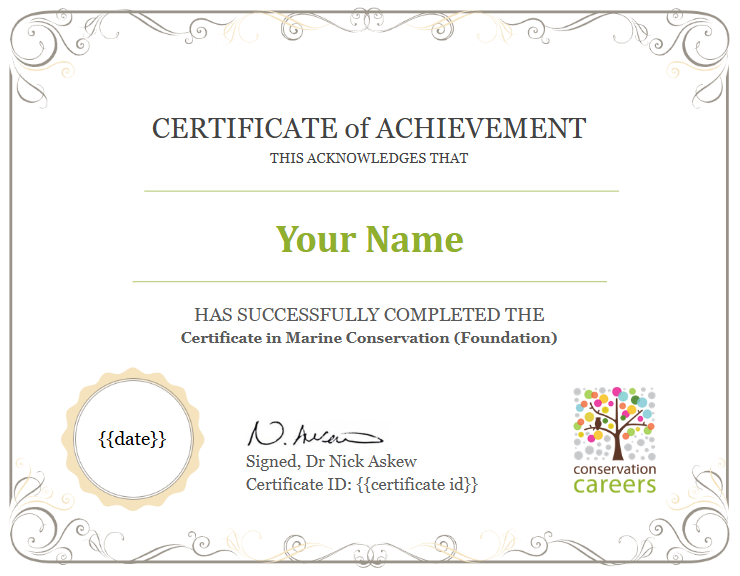
  • Earn your Certificate in Marine Conservation upon completion.

Marine Expert in Residence | Dr David Shiffman

“Our oceans are facing unprecedented challenges, but there’s never been a more important – or more exciting – time to be part of the solution,”

Dr David Shiffman

Dr David Shiffman is a marine conservation scientist, policy expert, and science communicator with extensive experience working at the intersection of research, policy, and practice.

He holds a Ph.D. in interdisciplinary ecosystem science and policy and is an alumnus of the prestigious Liber Ero Postdoctoral Fellowship in Conservation Leadership.

Dr Shiffman has worked as a Science Officer for the Society for Conservation Biology’s Marine Program and now runs an ocean conservation consulting firm based in Washington, DC. His work supports organisations tackling some of the biggest challenges facing our oceans today.

Alongside his consulting work, he teaches ocean conservation policy at Georgetown University and is a widely published author and science journalist, helping to communicate complex marine issues to global audiences.

As Expert in Residence, Dr Shiffman brings practical insight, real-world examples, and current industry knowledge into the course – helping you understand not just the theory of marine conservation, but how it works in practice.

Inside | The Certificate in Marine Conservation

Six Step-by-Step Modules to attack at your own pace. You’ll learn not just what marine conservation is – but how to apply it, and where you fit within it professionally.

Support from the experts. You’ll have support from us in our private CC Pro community. We’ll be with you every step of the way.

Go at your own pace. With our self-paced flexibility, you’ll have access to the course for a full year. You can work entirely at your own pace and around your busy life and work commitments. You don’t need to stick to a schedule. 

CC Pro community. You’ll be welcomed into our new private online community. Get answers to burning questions, enjoy regular live events, participate in growth challenges, share your coursework, celebrate your successes and more.

Certificate. Everyone who completes the course and passes our final quiz receives a certificate.

Rock-solid guarantee. Try it for 14 days. Not happy for whatever reason? We will refund 100% of your money.

Training Outline

Module 1: Foundations of Marine Conservation

Get clear on how marine conservation works – from core science and policy to the systems that shape our oceans.

You’ll explore:

  • The foundations of marine conservation science and policy
  • Essential marine biology for conservation practitioners
  • How marine ecosystems function and respond to change
  • Ocean systems, including currents, climate processes, and environmental dynamics
  • The principles of marine resource management and environmental law

Real-life example: The Ocean Conservancy’s Coastal Cleanup.

Module 2: Understanding Marine Threats

Understand the biggest challenges facing our oceans – and why they matter for conservation.

You’ll explore:

  • The major threats impacting marine ecosystems globally
  • Overfishing, bycatch, and the pressures on fish populations
  • Habitat loss, seafloor damage, and the risks of deep sea mining
  • Marine pollution – including plastics, chemicals, and industrial spills
  • Climate change, warming seas, and ocean acidification
  • Emerging and lesser-known threats shaping the future of ocean health

Real-life example: The collapse of Grand Banks cod fisheries.

Module 3: Marine Conservation Solutions

Understand the biggest challenges facing our oceans – and why they matter for conservation.

You’ll explore:

  • The major threats impacting marine ecosystems globally
  • Overfishing, bycatch, and the pressures on fish populations
  • Habitat loss, seafloor damage, and the risks of deep sea mining
  • Marine pollution – including plastics, chemicals, and industrial spills
  • Climate change, warming seas, and ocean acidification
  • Emerging and lesser-known threats shaping the future of ocean health

Real-life example: The California network of marine protected areas.

Module 4: How Marine Conservation Works in Practice

Discover how conservationists respond to these challenges – and design solutions that work.

You’ll explore:

  • How marine conservation priorities are identified and set
  • The design and management of marine protected areas (MPAs)
  • Ecosystem-based management and how it is applied in marine systems
  • Approaches to recovering threatened marine species
  • The role of the ocean in climate solutions and decarbonisation
  • Additional policy and management tools used in marine conservation

Real-life example: CITES/Convention on International Trade in Endangered Species.

Module 5: Careers in Marine Conservation

Explore the different career paths available – and how people are building impactful roles in the sector.

You’ll explore:

  • The range of careers available in marine conservation
  • Real-world career journeys from leading professionals in the field
  • The skills, experience, and pathways needed to enter the sector
  • Career planning tips and actionable next steps

Real-life marine career case studies:

  • Professor Brendan Godley
  • Dr Alasdair Harris
  • Dr Stacy Jupiter
  • Francesca Trotman
  • Dr David Shiffman

Module 6: Final Assessment & Certification

Reflect on what you’ve learned and earn your Certificate in Marine (Foundation). You’ll complete:

  • Take a short final assessment (multiple-choice). 
  • You’ll need 80% to pass …
  • … but don’t worry, you can retake it if needed.
  • A downloadable certificate of completion

Become a Certified Marine Conservationist

Save 33% on our latest training and become a certified marine conservationist. Offer ends 5 July.

The course comes with a full 14-day money-back guarantee. No questions asked.

Simply choose your preferred currency option below, to enrol.

Contact us

If you have any questions please don’t hesitate to get in touch by mail@conservation-careers.com.