Podcast | Community-Based Conservation in Action | Helen Gibbons

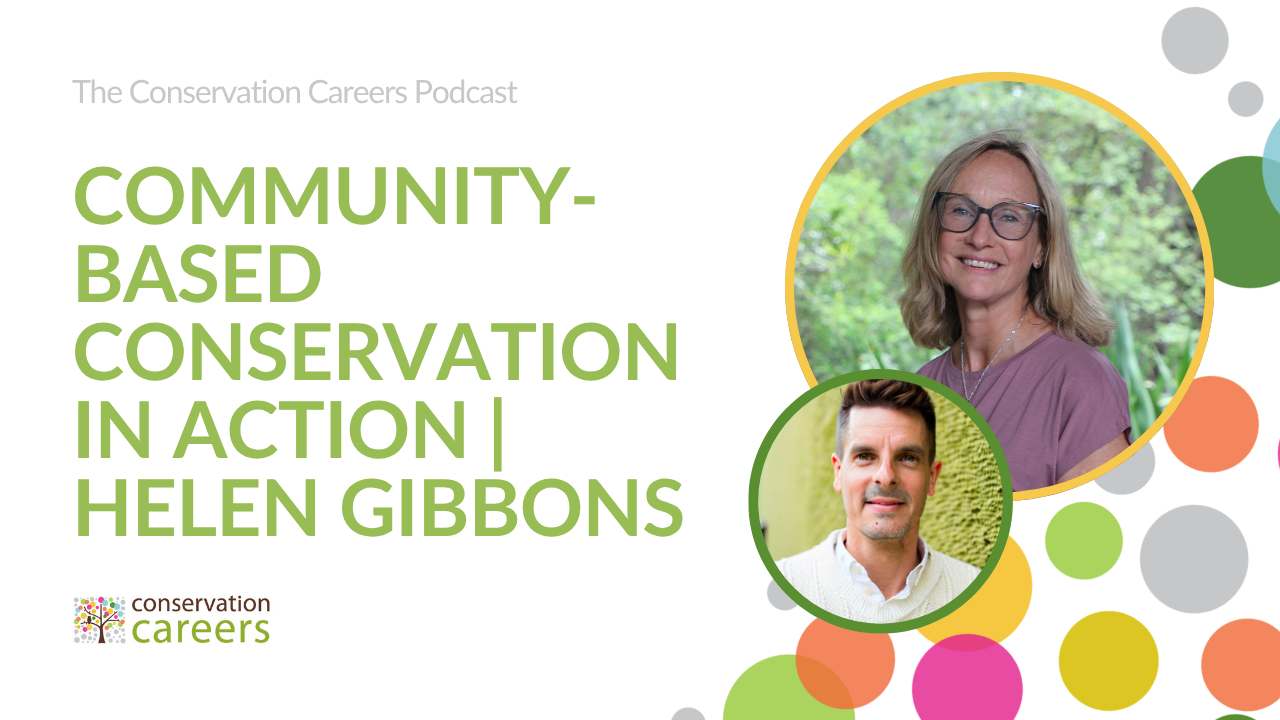
If you’ve ever wondered how conservation can be truly inclusive, collaborative and community-led — this episode is for you. Today I’m joined by Helen Gibbons, an expert in community-based conservation and our current Expert in Residence at Conservation Careers.
With over 25 years of experience working for leading organisations like the Gorilla Fund, WWF, Greenpeace and the Maasai Mara Conservancies, Helen brings a wealth of insight into how conservation can and should work with people at its heart.
Together, we explore what community-based conservation really means — not just in theory, but in practice. We talk about trust, respect, and partnerships — and why supporting communities to lead their own conservation efforts is often the key to lasting impact.
Helen also shares stories from her incredible career, along with advice for people looking to work in this space — including the skills, experiences and mindset that really matter.
It’s a conservation, community, and career episode.
Enjoy.
Listen
Watch
Subscribe
You can listen and subscribe to the Conservation Careers Podcast on iTunes, Spotify or Stitcher using the following links, or search for ‘conservation careers’ and you’ll find us!
Resources
Join our live podcast audience!
All our podcasts are now recorded in front of a live audience who sit in and listen to the chat, and then after the mics are turned off get a chance to talk to the guest, share their thoughts and ask questions.
If you’d like to be in the audience all you need to do is join our CC Academy.
In the CC Academy you’ll get access to the world’s biggest conservation job board – listing over 80,000 jobs, volunteer and internships across the globe each year.
You’ll also enjoy access to our amazing CC Pro private members community with regular events, networking and support.
Plus you’ll get full access to our growing library of career-boosting resources, guides and templates.
And best of all it only costs a few dollars, pounds or euros per month to join the Academy.
To find out more please visit the CC Academy, or simply click the join button at the top of our website.
See you on the inside!
Transcript
[00:00:07] Hi there, Nick here from Conservation Careers, and welcome to the podcast. Now, if you’ve ever wondered how conservation can be truly inclusive, collaborative, and community led, this episode is for you.
[00:00:18] Today I’m joined by Helen Gibbons, an expert in community-based conservation and our current expert in residence at Conservation Careers. With over 25 years of experience working for leading organizations like Gorilla Fund, WWF Greenpeace and the Masay Mara Conservancies, Helen brings a wealth of insight into how conservation.
[00:00:40] Can and should work with people at its heart. Together we explore what community-based conservation really means, not just in theory, but in practice. We talk about trust, respect, and partnerships, and why supporting communities to lead. Their own conservation efforts is often the key to lasting impact.
[00:00:59] Helen also shares stories from her incredible career along with advice for people looking to work in this space, including the skills, experiences, and mindset that really matter. It’s a conservation community and career episode. Enjoy.
[00:01:16]
[00:01:23] Helen Gibbons: my name is Helen Gibbons. You can probably hear from my accent. And I’m British. I have a very adventurous spirit. I’m passionate about the diversity of life on Mother Earth and doing my bit to conserve and sustain wildlife and nature.
[00:01:38] Dr Nick Askew: Wonderful. Great. Well, Helen, it is great to kind of to talk to you. We’ve been getting to know you a little bit over the last couple of months. You’ve been helping to build our new community-based conservation course. You’re an expert in residence. I’m really delighted to talk to you to get to know a little bit better, uh, and also to share your story through the podcast today.
[00:01:55] So, yeah, so welcome. Yeah. And you say you are Bri.
[00:01:58] Helen Gibbons: Thank you. My.
[00:01:59] Dr Nick Askew: But you are currently in Kenya, right? You are. Are you actually in the Masai MA right now or whereabouts are you?
[00:02:03] Helen Gibbons: No, I’m in Nairobi right now. So it’s a bit cooler than the Masai Mara. I was there last week, um, for a workshop that I was supporting, uh, but back in Nairobi right now.
[00:02:12] Dr Nick Askew: Right. Great. Okay. Well, let’s start with, um, let’s start with your current work. I, I want to just, okay. We’re here to kind of talk about your work to share some of the exciting work you’ve done throughout your career and right now as well. And then we’ll talk a bit more about community-based conservation.
[00:02:26] You know, what is it? How does it work? Um, and then we’ll hear about your career journey advice as well. But let’s start about, yeah. With your, your current work. Tell us about the project or many projects that you’re currently involved in. Just paint us a bit of a picture as to who you are and what you’re doing.
[00:02:41] Please.
[00:02:42] Helen Gibbons: Yeah, sure. I mean, right now I’m an independent contract, so at other times in my life I have been an employee. But, um, at this point it’s a contract or consultant you could say. Um, I mainly, I’ve been mainly doing contracts relating to nature, wildlife, and predominantly in Africa for the past couple of years.
[00:03:01] Um, so being a consultant is, the experience is quite different from being an employee in terms that people kind of expect the best service from you and kind of the best thought leadership, and you’re really there to provide guidance and direction. And, uh, and support them with whatever project you signed up to do.
[00:03:21] So, as I mentioned, I was supporting a workshop in, uh, the Maasai Mara last week that was to do with developing or designing a program of work relating to what’s called Mara East. I’m also supporting another NGO in that area to kind of think through what their strategy and what their priorities are gonna be going forward.
[00:03:41] And then, um, I’m currently, yeah, being asked to submit a proposal, um, to develop kind of a strategic framework of work for, um, Pan-African. Um, nature-based organization. So yeah, as you can hear, I kind of support people, um, undertake specific items of work and then provide guidance.
[00:04:04] Dr Nick Askew: And what are your kind of core skill sets?
[00:04:06] Like what are you, what sits underneath the work? What, what do you deliver for people? Like, yeah. What, what, what sort of, what do you think you sort of bring into the table at your stage of your career?
[00:04:16] Helen Gibbons: Yeah, I mean, if I put it down in kind of three things. Yeah. So one is certainly, uh, program design. So looking at an area, you know, a geographical area.
[00:04:26] Um, often with specific wildlife species within it, and obviously a whole array of different, um, communities. And, um, I’m looking at, okay, what would a theory of change look like? So that’s kind of how do we get from where we are now to where we want to be, what needs to happen from an economic or social and an ecological perspective, and then working with, um, different communities or stakeholders.
[00:04:51] Kind of to support them, to think through what that program work looks like, IE what that strategy could be, um, to help them, as I say, go from where they are now to where they want to get to. So that’s one area of work I do. A second area is probably more around fundraising proposals. So often that, that kind of design of programs that then feeds into a fundraising proposal, albeit obviously a fundraising proposal, has a different feel about it in terms of the tone and the target.
[00:05:19] Audience. Um, but that would be a second area where I turn, um, areas of work into fundraising proposals. And then a third area is more around coaching, facilitating, and mentoring. So I have a couple of mentors, uh, mentees I should say at this point in time that I’m supporting them to think through their, um, career in conservation and the practicalities of what they’re dealing with each day.
[00:05:43] Um, I also did do a bit of coaching for various parties as well, kind of leaders. Uh, within the conservation sector, and then I facilitate workshops or meetings, um, to help people Yeah. Work through whatever issue it is, you know, for that specific meeting.
[00:06:00] Dr Nick Askew: Really interesting. Yeah. And, and such kind of core skillset.
[00:06:03] It’s something we talk about a lot. On the podcast too and says like, what are the core Yeah. Skills within conservation. So project management or program development, as you might call it. Yeah.
[00:06:13] Helen Gibbons: Mm-hmm.
[00:06:13] Dr Nick Askew: Uh, fundraising is so key. Like once you’ve designed and developed that project or the program that sits above that, how do you then get that off the ground?
[00:06:20] And where do those funds come from? How do you, who do you pitch it to? How do you pitch it? How do you develop that proposal? Yeah. And then supporting the growth of individuals as well, kind of through your coaching work as well.
[00:06:31] Helen Gibbons: Yeah.
[00:06:31] Dr Nick Askew: What I found really interesting when you were talking about that kind of program development was the kind of three strands of work you were talking about.
[00:06:36] So you talked about ecological at the end, actually, social and economic, and how you’re looking at all those three things within, within a kind of program of work. So it’s not just just focus on wildlife, it’s focused on the people and the communities around that as well, which is really what we’re. Here to discuss today.
[00:06:53] Yeah. Um, how do we, and I’m, how do, and sorry. I mean,
[00:06:56] Helen Gibbons: and I’d add onto that the political as well. Yeah. When I kind of say the economic, I’m actually referring to economic, political, you know, it’s, it’s so much more than purely environmental, as you say, purely wildlife. You’ve really got to, um, have a comprehension or understanding of the complexity and be willing to kind of lean in to bringing it all together and work with people and support them to kind of think through it.
[00:07:19] Dr Nick Askew: Yeah, and so many people, we, we come into conservation because we’re really passionate about wildlife or nature or biodiversity, or whatever you wanna call it. But actually the maturity of conservation nowadays, and you quickly realize actually to really conserve wildlife, it’s all about working with people and it’s all about working in partnership, whether that’s at the local level, the regional level, the political, you know, governance level, whatever that might be.
[00:07:43] Maybe could you try and sort of bring that to life to us a little bit? And if you want, you could talk about your work in the East Mara or, or elsewhere. Talk about a, a, a project if you could please. Where. You know, you are there with a, a view to helping conserve wildlife as an issue, but actually to do so you’ve worked with or developed a wider program or project, like what does that look like?
[00:08:03] And if you want to like talk through the steps that you might go through, sort of landing on the ground day one to, you know, what do you do? What’s the method or the approach, what does it look like? So if you could bring it to life. Yeah.
[00:08:14] Helen Gibbons: Yeah, I think what I’ll do is I’ll talk to a past position. So when I was heading up the Mara Conservancies Association, because I think that would be a good example.
[00:08:22] So I mean the Greater Mara ecosystems about 6,000 square kilometers, but it’s got different types of management approaches you could say. So you’ve got the protected area.
[00:08:33] Dr Nick Askew: Yeah.
[00:08:33] Helen Gibbons: Um, the government protected area. Then you’ve got what would call conservancies, and then you’ve got the area between the conservancies and the government protected area.
[00:08:43] So the conservancies are actually, these days are actually more area that is protected, um, through community conservancies than actually through the government protected area. So it’s about 70, 1700 square kilometers. Um, and in that you’ve got about 24 25 conservancies and there’s about 15, 16,000 landowners.
[00:09:05] So you can already hear some of the complexity in terms of the size of the region, the number of conservancies, and then the, yeah, the volume of landowners. And then you’ve got about 40 to 50 tourism operators across all of those conservancies.
[00:09:19] Yeah.
[00:09:19] Helen Gibbons: So when I was heading up the Mara Conservancies, you know, it is an umbrella me.
[00:09:24] Organization and you are really kind of navigating and negotiating between, on the one hand, tourism parties, on the other hand, landowners, and then on the third hand obviously wildlife and nature itself. Yeah, because that, that’s why the conservancy, what a major reason why the. Seventies exist is in order to con conserve and sustain that nature and that biodiversity.
[00:09:47] And of course we, we know it’s an iconic landscape with some of the largest numbers of populations of, you know, different wildlife species. Not least the wilder base, but also the predators as well, like the big cats. Um, so, you know, kind of doing that type of work, you know, I was working, I’m working very closely with, with the Maasai themselves.
[00:10:06] All my colleagues were Maasai. I’m working very closely with the Maasai landowners and, and you are really kind of leaning in to understand what are their needs, what are their desires, what are their preferences, how do they see. Community-based conservation model working, what do they need to get out of it?
[00:10:24] You know, what’s in it for them? What are the benefits that they need to get? On the one hand, the tourism parties are renting the land from the landowners, and so the landowners are making their land available for rent. So the tourism actually parties are actually paying for the model. And they do this for a co, for a conservancy management. Body in the conservancy.
[00:10:44] Mm-hmm. And then in terms of my role in the, the umbrella membership organization was to really bring these conservancies together to look for cross-fertilization, to look for how can we improve the quality of the conservancies to ensure that the conservancies are actually monitoring and tracking, you know, the wildlife and, and the habitat within it.
[00:11:03] And it, you know, it’s real kind of elevating standards. Real kind of quality control. It’s real bringing people together. It is really like kind of communicating about what is the model, why does it work for different parties, you know, what are the benefits, what, what’s in, um, in it for different parties, et cetera.
[00:11:20] And kind of navigating all that complexity and, um, yeah, and kind of really having to support that community-based conservation model to be successful in, in the medium to long term.
[00:11:31] Dr Nick Askew: And how has that developed within the Maasai, like within the kind of the, the, the Maasai American services area? Like when did it start and, and what does it look like now?
[00:11:42] Like what, what changes happened over time having kind of formed this umbrella and, and managed across this huge complexity that you kind of de described there.
[00:11:50] Helen Gibbons: Yeah. I mean it started in the early kind of naughties you could say. Yeah. It really took off and, and the main reason why it really took off is because there was a mass subdivision of land.
[00:12:00] So it went from communal land ownership
[00:12:03] Dr Nick Askew: Yeah.
[00:12:03] Helen Gibbons: To mass subdivision of land, which meant that thousands of male household heads actually owned title deeds to the land. Mm-hmm. And, um. And on the back of that, it was like people were like, it was the first time that the Maasai had actually, you know, owned land in this way.
[00:12:19] Dr Nick Askew: And that was a political shift. Was it? Did something happen?
[00:12:21] Helen Gibbons: Yeah, it was a policy shift. So it was a policy decision to change the land ownership and um, I. So on the back of that, it then became a conversation about what are we gonna do, you know, this land has been available for wildlife, it’s been available for, for, for habitat and for kind of livestock as well.
[00:12:39] All the, all this time. And now we’ve all got these title deeds and we don’t really know what to do with them. And so basically a tour is, you know, a chief of the local Maasai started to talk with a tourism party about this kind of new age you could. Say in land rights management and started to kind of look at different models and um, and that kind of, that’s really started to get traction.
[00:13:02] So more and more people started to talk to more and more tourism parties about what are we gonna do here? And therefore like two or three or four core conservancies formed in like central areas. Yeah. And, um, and we could see that this was get, gaining its own momentum. We, we could see that, you know, it was gonna be a, an important movement.
[00:13:22] And that’s when I started to get engaged. I started to be contract to, to help and support NGOs actually to kind of act as a conduit and bring the different parties together from the, you know, as I said, the tourism parties or the major, um, donors together with, with, with the landowners. And, um, I started to kind of facilitate the workshops, had kind of started to help them think through it.
[00:13:44] Uh, it was agreed, you know, everyone agreed we actually need a membership organization to help us here. This is, you know, this is kind of new management approaches. We’ve never done this before, and it’s a whole new way of kind of managing land and enabling livestock and wildlife to kind of coexist when we’re in a landscape.
[00:14:02] And, um, and hence in about 2013, the ra conservancies was formed, and then I was asked to step in and, and, you know, become the CEO and worked very closely with. The chair of, of the Maasai landowners. And it was really the two or three of us alongside our, um, our board that we had, which was mixed of tourism parties and landowners, um, who kind of just moved forward at a very strong pace.
[00:14:28] I worked ridiculous hours, we had crazy commitment and we could really kind. See this vision of having conservancies across the whole landscape of having a really kind of gold standard set and having a new way of doing, doing community-based conservation in Kenya.
[00:14:45] Dr Nick Askew: Yeah. And is it working? And I can feel the energy in the, there’s an opportunity that was created.
[00:14:50] You’ve, you’ve, um, you’ve been in there to support at the right time, right place. Um, you’ve brought people together as a decision to form a membership. You’ve got a governance of all the different stakeholders there, that, that’s really interesting how that’s been formed and here and 2013 to now we are, what, 12 years later?
[00:15:07] Something like that? Yeah. Yeah. Like how, how, where has it got to, is it working? What, what are you, what are you learning about that whole process that this could learn
[00:15:16] from?
[00:15:17] Helen Gibbons: I’m proud to say it is working. Yeah. I’m proud to say I stayed with it for about four years until I hit burnout, unfortunately. Yeah, right.
[00:15:24] Um, but fortunately, you know, I had mentored my colleagues, um, you know, I designed a whole bunch of programs that had a number of years to continue. You could say we had a solid governance structure, which was key. We had a, a lot of. Port and a lot of goodwill from, you know, the key parties. And, um, so yes, it sustained itself very strongly and it sustained itself strongly for a number of years.
[00:15:48] And the number of conservancies have grown in terms of bo well, both in terms of numbers, but also the area of land that they’re covering. Yeah. And, um, so that, that’s kind of all part of the success story. Um, in terms of. The quality of the habitat as well is also improving. It’s a little unclear in terms of what’s happening with the different populations of wildlife because they move, they’re micro two animals, and therefore it’s not always straightforward to be, to be, um, kind of have a concrete understanding about numbers, et cetera.
[00:16:19] The challenge that it has had most recently this year was the changing U-S-A-I-D. Funding. Mm-hmm. So U-S-A-I-D was a big funder of conservancies in Kenya and have very much supported the growth of this type of community management model. And of course with those funds being suddenly pulled and also decisions by other, um, aid institutions or kind of yeah, UK aid or kind of foreign policy decisions across Europe, it means the amount of funding available from.
[00:16:50] Government institutions is much less than it was only 12 or 24 months ago.
[00:16:56] Dr Nick Askew: Mm-hmm.
[00:16:56] Helen Gibbons: Um, so that is a challenge, you know, still looking for funders to kind of substitute and step in, um, where government funds once were. And, um, and consequently, you know, the organization has had to reduce its down south, down in size quite significantly because they lost about 60, 65% of their funding.
[00:17:16] Dr Nick Askew: Mm. It’s
[00:17:17] Helen Gibbons: huge overnight, I might add.
[00:17:19] Dr Nick Askew: Yeah. It’s been a huge kind of funding shock, hasn’t it? The, the withdrawal of funding, particularly from the states, as you say, and Yeah.
[00:17:25] Helen Gibbons: Yeah.
[00:17:26] Dr Nick Askew: I guess an aspect of community-based conservation that is important to the sustainability long term is about kind of livelihoods.
[00:17:36] It’s about income generation itself and, and sustaining itself into the long term. And, and what you’ve got really nicely within the Masai Mara is ecotourism, isn’t it? It’s, it’s a real. Focus of tourism that clearly generates income that is clearly linked to wildlife. People come to want see the wildlife.
[00:17:52] They pay for that. That generates, you know, income, it generates jobs and everything else.
[00:17:57] Helen Gibbons: That’s absolutely fundamental to the business model. It’s one of the reasons why the conservancies in the Ma Mara are sustainable.
[00:18:03] Yeah. And it’s really important to acknowledge that because. Understandably. You know, many other places might wish to copy the model, but you’ve really got to figure out how are you gonna pay for it. Yeah. You know, conservancies have a range of different costs involved, not lease the actual management of the conservancies, you know, the ranges, the infrastructure, the equipment, et cetera.
[00:18:22] And, um, and therefore when you know you’re doing your business model, it’s like how are you gonna pay for it? You know? Even in the Mara it can take five plus years to hit a break, you know, to get sustainable. Yeah. Despite the, the sheer numbers, the sheer volume of tourists coming in and the support of the tourism operators for it, so, you know, is absolutely key when you are looking at conservation that you think about the business model and what is the economics of it.
[00:18:46] Dr Nick Askew: I love that. Yeah. And thinking about it like a business. Absolutely. With a business,
[00:18:50] Helen Gibbons: well social business, but yes.
[00:18:52] Dr Nick Askew: Yeah, yeah. Absolutely. Yeah. A business for good. Yeah. Mm. What, what are the other business models? I mean, ecotourism is such a clear one. It’s such black and white. It links so clearly to wildlife, it does generate income.
[00:19:03] And places like MAs MA are perfectly set up for that. Are there other kind of income generating activities that communities can look at as well, if perhaps ecotourism isn’t an option or we need something alongside ecotourism.
[00:19:15] Helen Gibbons: Yeah, I mean, for sure it, to some extent it depends on the habitats in which you’re working.
[00:19:20] Yep. So, you know, um, non forest timber port. Non timber forest products, for example, for forest ecosystems varying from coffee to cocoa and, and other kind of shade based, um, plants. Yeah. Um, but then if you are looking at more of a grassland habitat, then I mean, you can look at, you know, I’ve already already referred to life.
[00:19:41] Stock and you can very much look at, um, a mixed system of wildlife and livestock to get living together. It needs to be a sustainable approach. You know, often you get a challenge of cattle going in and overgrazing. Um, so it’s really key that you think through like some type of more collective approach or some kind of more that gave very clear about.
[00:20:02] Zoning and where livestock move and where, um, where they need to move, where their roots are, and therefore where livestock, livestock can be grazed in terms of grass banks as they’re called. Mm-hmm. Um, but thing that, that is a very, that can be a very sustainable one for a grassland habitat, for example.
[00:20:18] But then you’ve also got activities that the communities around. These areas, these are kind of biodiversity hotspots that they’re already engaged in.
[00:20:27] Dr Nick Askew: Mm.
[00:20:27] Helen Gibbons: So, you know, many communities, for example, the, you know, the Maasai will be very engaged in jewelry or bead work on behalf of the women or other types of art craft.
[00:20:36] And therefore, it’s really about working with what activities people are already doing because they already have a high familiarity. There’s already. Cultural acceptance. And so it’s really important to build on that now, you know, so some of those products by some of the kind of the standard jewelry they do, might be less interesting to someone who’s coming from Europe.
[00:20:55] Mm-hmm. But then you can do, you can do fusion base. So you can kind of, you know, bring in somebody to. Port them to think through their designs and to kind of improve the, the quality of the products they’re providing so that they can be sold in Europe, for example. Mm-hmm. And, um, so you’ve got, you know, you’ve got activities like that, but then of course you’ve got more kind of ecosystem based activities.
[00:21:15] So, I mean, honey’s a kind of a classic one. Yeah. How do you change honey from being a more kind of ad hoc. Collection to being a more systematic production that you can guarantee a supply chain and, um, and provide that kind of honey from the Mara, for example. Or, you know, or, or another one that’s often quoted as kind of medicinal plants because often.
[00:21:39] Local communities, indigenous people will have very, um, solid understanding about what plants are used for, what conditions, and, um, you know, and over time that that can be more commercialized, that that is a more difficult one. You know, this is a very important propriety knowledge. By, by the, the indigenous people or the local community.
[00:22:01] So you have to be very mindful of that and you have to kind of honor that this is kind of tradition and history of the people and therefore, you know, it is often quite a slow process to work with them. Yeah. To kind of, um, support them to take that knowledge and, and make it more commercialized, you could say.
[00:22:18] And therefore kind of deliberately grow those particular plants or harvest specific ones sustainably. And then, um, support them to take it to market.
[00:22:27] Dr Nick Askew: Yeah. Yeah. So many different ways of, of generating so many examples there. That’s brilliant. Mm-hmm. And that last thought about connecting and taking it to market and helping people to market.
[00:22:36] Yeah. What they’ve created. Yeah. It feels so important as well. Yeah. Um, let’s change gears ever since slightly. Let’s think about and talk about you and, and your career as well, if we can. Then, Hannah. Okay. So we’ve heard a bit about the work and the amazing community work you’ve been doing in, in Kenya, I’m sure elsewhere too.
[00:22:51] Um, what has been your career journey? Like when you look back at the various roles that you’ve played, like walk us through what you see as like, been the key steps, like Yeah. I’ll let you answer that as you wish.
[00:23:04] Helen Gibbons: Yeah. It’s not a straightforward question and the reason why is my career path has probably been a bit more dynamic and less linear
[00:23:11] Dr Nick Askew: Yeah.
[00:23:11] Helen Gibbons: Than some of my peers and colleagues.
[00:23:13] Dr Nick Askew: Yeah.
[00:23:14] Helen Gibbons: And um, so for example, you know, I started studying economic. Yeah, and PE and that often surprises people, you know, immediately. And, uh, but for, from my perspective, it was, you know, a global kind of related subject. I enjoyed, and it’s actually served me well in terms of giving me a very kind of clear management approach.
[00:23:32] Being able to, you know, think, you know, immediately kind of look at what’s the business model, et cetera. So, you know that in itself. And then also, you know, I don’t, didn’t grow up with any background in living in the global south, for example, you know, I grew up in the south of England. Yeah. Um, but yet I developed a passion for going to work in places all over the world.
[00:23:52] And, and I would say that’s partly because I have an adventurous. Spirit and it’s partly ’cause just my curiosity and, and, um, wish to explore. Um, but it’s also partly ’cause of fate. You know, one of those crazy things that can happen in your young life. And, and in my case it was watching the film out of Africa, which is a completely romantic film.
[00:24:12] Um, but it’s. Full of colors and textures of East Africa. And it just made me kind of put my backpack on and go out exploring. And um, and then on the back of that I thought to myself, alright, you know, I want to come back and work here. So then I spent a number of years kind of pursuing that dream. You could say it was like a north staff for me, which has kind of continued to be honest.
[00:24:33] And um, so then I got, I’d got a master’s in environmental management. I, and I, I, and, but, but at the same time I took a very. Simple job in terms of, I, I went, I got a job as an office manager for a wildlife charity in London. And uh, ’cause I just had to get a step on the ladder. And I think it’s really important to remember that, you know, your first job doesn’t necessarily dictate what your career, your rest of your career is gonna look like.
[00:24:58] Dr Nick Askew: Mm-hmm.
[00:24:59] Helen Gibbons: And uh, for me it was. About getting a step on the ladder. It was about positioning myself. It was about understanding what the sector looked like and figuring out what I might want to do and where I could fit into it. And of course, this, this is a long time ago. This is like 20, 25 years ago, and so there was lot less options then.
[00:25:16] These days you can do almost anything you want within conservation. Uh, you know, there’s so many different specialisms and expertise, but then it was more. It was more traditional in terms of you kind of did program or you did fundraising, uh, or you might do project management or if you were lucky or you kind of did general operations.
[00:25:35] Um, but then things started to speed up quite a lot. So I kind of went from being an office manager to operations manager. Kind of, um, through pestering my, my colleagues at, or my bosses at that time.
[00:25:48] Dr Nick Askew: What was
[00:25:48] Helen Gibbons: the charity?
[00:25:49] Dr Nick Askew: Just out of interest, who were you working
[00:25:50] Helen Gibbons: for? Um, it was then called the DFOs Gorilla Fund.
[00:25:52] Oh yeah. I think it’s now called the, um, gorilla Organization or something.
[00:25:56] Dr Nick Askew: The Gorilla Fund maybe? Yeah.
[00:25:58] Helen Gibbons: Yeah, something like that. Yeah. Um, so I, so I kind of pestered them and got myself an operations manager role and got myself out on regular trips to Central in East Africa. Um, I then moved across to East Africa and got myself a program management role that was very much through my network, you know, and it kind of speaks to the question you’ll be asking me about, you know, what do you need to practice, et cetera.
[00:26:22] And it was really through my network that I got my kind of CV presented. Forward and then kind of convinced them I’d make a good program manager and therefore kind of moved over to Kenya actually at that time. Yeah. And so, you know, that was kind of my first experience of really implementing managing programs and this was kind of what’s called the southern rangelands in Kenya and, and yeah, and the equivalent area, the Northern Rangelands in Tanzania as well.
[00:26:48] So that was like a baptism by fire. It was really on my, my, my formative years of managing and implementing conservation programs. Um, but then that, but then again, as I mentioned, it wasn’t linear. So then I kind of went off on a tangent almost, so it might look like a tangent, but I was very clear at the time that what I knew wasn’t gonna be enough, that it was much more complex than what I had thought.
[00:27:13] And things like leadership and performance and campaigning and, and. Organizational growth were fundamental to the success of an organization that people engaged and therefore the work that they were doing. Mm-hmm. So I kind of went off looking for what were the skills I was missing, and that’s when I dived quite deep into what does leadership development look like and what does got myself accredited as a coach and what does campaigning look like?
[00:27:41] And kind of, yeah, went, went off on this trajectory towards H how do I. Support organizational development and growth, and who do I need to do that? How do I support leaders, et cetera. And, and that kind of took me into working for Greenpeace actually, where I spent a number of years doing kind of organizational development and support in Greenpeace.
[00:28:02] And it was a very privileged period because there was a lot of travel involved. I was working with a lot of different offices and different continents with a lot of very impressive leaders. Hmm. And, um, and I got to kind of support them and their boards and, and work with the offices to support the offices as well.
[00:28:21] And, um, and so, so that was an, you know, an amazing experience and it kind of culminated in, in doing an interim change management work with Greenpeace, Australia Pacific, um, to support them to kind of be a much more stable, um, office at that time.
[00:28:37] Dr Nick Askew: Mm-hmm.
[00:28:38] Helen Gibbons: And then, um. And then I went back to East Africa. I kind of decided I want to get, wanted to get back into, um, conservation again into East Africa.
[00:28:47] And this time I went back in a more of an entrepreneurial role in terms of, I went back as a consultant, so I was under my own steam.
[00:28:55] Dr Nick Askew: Mm-hmm.
[00:28:55] Helen Gibbons: And, um, I really kind of had to navigate the conservation sector and find where I could offer value and, and therefore get contracts to do work. And on the back of that and just kind of, again, kind of positioning myself and developing that personal brand.
[00:29:12] Um, I, as I’ve already touched on, I was recruited to be the, the founding CEO of the Mara Conservancies and, um, and yeah, and build that organization for a number of years. And then, and then I hit burnout, I think I mentioned. Mm-hmm. Went back to the UK and, um, and it was kind of an, an obvious development for me to go and work for the Worldwide Fund for Nature.
[00:29:36] Um, in the UK it’s, you know, the largest global conservation organization. So it was a kind of a natural evolution for me to go and work for them. And um, so then I joined the New Deal for Nature and People, which is more of an advocacy kind of program. It’s now the Nature Positive Initiative. And because I was kind of comprehending the complexity of an organization the size of WWF within the conservation sector.
[00:30:01] Mm-hmm. And before long I kind of gravitated back to conservation and became their director. Of global conservation programs for WWF uk. Um, but it is, you know, it’s very different obviously, sitting in, in an office in Europe, in Europe, in my case, uh, rather than kind of being more on the front line and kind of being more with, with and in the, the biodiversity hots.
[00:30:25] Spots you can say. And actually working with the communities, it’s, you know, it’s a very different experience. And before long I was like, Hmm, I kind of have to get back with my, my history, you could say. Mm-hmm. Kind of get back with working directly communities again and having the freedom to move, um, you know, kind of get like I am now kind of being Kenya like I am now.
[00:30:46] Mm. So the first, you know, so therefore for the past couple of years I come back to consultancy and, um, and kind of I’m a little bit in the situation of contemplating what next, do I continue with the consultancies or do I see if I can kind of, um, identify a role that kind of now. Allows me to move between where I live in, in the UK but also, you know, back in East Africa or maybe other countries where I can directly support communities on the front line.
[00:31:14] Who, you know, who are, who are the stewards, who are very much aiming to protect that nature.
[00:31:19] Dr Nick Askew: Hmm. What an amazing, exciting career you are having.
[00:31:22] Helen Gibbons: Yeah, it is a bit long. Well, so far, and I say it hasn’t, hasn’t been, hasn’t been linear. It’s, it’s been quite a dynamic process and that, which often surprises people.
[00:31:31] ’cause you know, as I mentioned, a lot of my peers, they might stay with an organization for much longer period of time, or they might just do a, a more natural kind of. Program manager to director, director to CEO, and then they stay at being CEO. Whereas I’ve kind of stepped sideways a number of times, but that kind of speaks to me having a bit more, probably having a bit more of a, a adventurous or kind of exploratory approach.
[00:31:54] Dr Nick Askew: Yeah. And I, people often talk about squiggly careers and it sort of feels squiggly when you describe it. Yeah. I also think there’s something about, there’s very few careers that are really linear. You have this goal that is there in the future, 10, 20, whatever year it is, and you just work laser targeted towards it.
[00:32:10] It feels more like what you are describing, which is you take a role, you move forward, you learn, you pivot, you move, you learn, you pivot. Yeah. You know, and it’s these moments of learning and almost like strategic either opportunities through networks and happenstance and taking opportunity. Yeah. Or creating or making those opportunities.
[00:32:28] Yeah. And what I liked about what you said, many things, but one was about. How you learn, you retrained, you know, you went almost back to school. Yeah. And you learned some
[00:32:36] Helen Gibbons: kind four skills. No, I did. And, and I’d say I’ve done quite a bit of that in terms of, you know, because you know, when you’re developing strategies, which are complex things to do, you know, often you do need type, different types of methodologies.
[00:32:48] Yeah. Um, you know, so I, I go to, I still do quite a lot of training and learning because also. Things are developing so, so quickly, you know, in terms of how do we design things? There’s so many different approaches. And of course with ai that’s a whole different learning in itself because that’s taking over so much, um, so many tasks and therefore it’s really important to kind of be on top of what’s the latest thinking about how we can do this.
[00:33:12] Dr Nick Askew: Yeah,
[00:33:12] Helen Gibbons: absolutely. Especially when you consider, you know, the rate of, um, sorry to make it more negative, but when you consider the rate of destruction Yeah. Of nature and wildlife, you know, if you don’t kind of hold yourself to high standards and constantly kind of keep pushing the curve mm-hmm. For how are, how are we ever gonna create that success that we, that we’re all looking, all looking for and wanting.
[00:33:33] Dr Nick Askew: Therein sort of almost lies the tension and where you mentioned burnout a couple of times. Yeah. And you know, you’ve got to be driven, you know, do you have to be driven? I don’t know. But we’re all here because we’re passionate and we’re committed and we want to make a difference, and we’re fighting a huge battle.
[00:33:48] And yet at the same time, we need to kind of look after ourselves and, and get that balance right.
[00:33:53] Helen Gibbons: Yeah, yeah. Wellbeing is key and you know, and when you do care about something and you are committed and there’s a lot of demands and a lot of expectations on you, yeah, you can hit, but you know, you end up working ridiculous hours.
[00:34:07] Mm-hmm. And um, and it’s taken me a long term, long time to figure out what does wellbeing look like for me? What do I need to do to take care for myself? And I think I’m still figuring it out, but I’m definitely better than I used to be.
[00:34:18] Dr Nick Askew: Yeah. Yeah. That’s good to hear. Yeah. What’s it like to work as a freelancer?
[00:34:23] You’ve worked in so many different types, organizations, types of roles, from kind of global directors to local leaders. Yeah. And, and to admin officers and everything in between, you know, working for yourself. Yeah. Which means an element of hustle, you know, and sales and selling yourself and, yeah. What, what would you like to kind of share about, um, yeah.
[00:34:42] What it’s like to be a freelancer? Any hit tips or secrets of success or lessons learned?
[00:34:48] Helen Gibbons: Yeah. I mean, you’ve gonna be very proactive.
[00:34:51] Dr Nick Askew: Mm-hmm.
[00:34:52] Helen Gibbons: You’ve gotta be very organized. You’re gonna be very able to kind of pitch what, what you’re offering, but also you can be very clear about what do people need? Mm.
[00:35:02] You know, what, what will make the difference for them? Where, where are the challenges or the issues that they’re struggling to deal with or don’t have? Capacity to deal with or don’t know what it looks like to do something around it. You know, so you’ve gotta identify those gaps almost. And, and then kind of think through, you know, can you offer a service which is really valuable for them or, and do you need to partner with someone who can, you know, do it with them?
[00:35:28] And, um, and then put yourself out there. So you’ve gotta be more. Bold in that way. And you’ve gotta be a lot more entrepreneurial. Yeah. And you’ve gotta just be on top of things. You know, you kind of gotta be on the ball most of the time. And you know, in talking about, well, wellbeing, you know, you have to make a call if you think Right.
[00:35:45] I’m just not in the right space right now. So now it’s not the best time to do it. So you’ve gotta be very aware of your energy, you could say, and very aware of your wellbeing. Yeah. So that you can manage it around the assignments that you’re doing to ensure that you can always deliver excellence because yeah, I just remember this, um, um, learning I did once and it kind of categorized where consultants lie and basically consultants have to be a grade students most of the time.
[00:36:12] Mm-hmm. And even a plus a lot of the time. And therefore, you know, if you are not in an A grade, um, energy or kind of feeling, then. Today is not the day you do it type thing. ’cause you’ve gotta be in that a grade kind of bracket. That’s what people are paying you for as well as your kind of, so they’re paying you for your iq, your technical ability, but they’re often paying you for your EQ as well, you know, for your understanding and your awareness of a situation, your ability to navigate it.
[00:36:39] You know, to know how to coach or to know how to kind of lead in a different style than, than might be in front of you. Um, so yeah, they’re paying you for your, your emotional intelligence as well as your technical intelligence.
[00:36:50] Dr Nick Askew: Yeah. And what struck me there was yeah, to deliver excellence, what you said, like that’s the standard you clearly aiming for.
[00:36:57] Yeah,
[00:36:57] Helen Gibbons: yeah,
[00:36:57] Dr Nick Askew: yeah. And see that as important. Yeah.
[00:36:59] Helen Gibbons: Yeah.
[00:37:00] Dr Nick Askew: Have you got any practical tips about how people can get themselves out there? When you already have a network, that’s so useful, isn’t it? ’cause you can be drawing from your network learning, partnering. Yeah.
[00:37:09] Helen Gibbons: But being proactive, I’d almost say is as important as a network.
[00:37:13] Yeah. If you have both, fabulous.
[00:37:15] Dr Nick Askew: Yeah.
[00:37:15] Helen Gibbons: But you know, you can develop a network over time and being, being proactive is absolutely key. And being clear about what are you offering. Yeah. You know, so in terms of. How are, you know, what is it that you’re qualified in? What experience have you managed to gain?
[00:37:30] Mm-hmm. You know, whatever that might look like. And it’s, it’s kind of looking in that sweet spot, isn’t it? It’s in terms of like, where, where are your, where are your actual AP attitudes and your strengths? Like mine. One of mine was always management. I was just able to manage. Mm-hmm. I was able to manage an organization.
[00:37:46] It didn’t, it didn’t bother me. It didn’t freak me out like it did for other people. Mm-hmm. And therefore finding myself managing an organization was like, oh, I better get on with it. So it is kind of similar. It’s like, you know, what are your natural aptitudes and strengths?
[00:38:00] Dr Nick Askew: Yeah.
[00:38:00] Helen Gibbons: Where, you know, what does your qualifications bring?
[00:38:03] And then what are your act, what are the experience that you’ve managed to bring together? Where do you get energy? What do you get energy from? What do you get excited about? Where’s your enthusiasm? And then also what, what is required? What’s needed, who needs what? You know? So you’re, look, you are looking for that sweet spot.
[00:38:20] Yeah. And um, and as you can hear, you know, that’s a little bit complex in terms of being a consultant. So, you know, it’s, it’s not for the, like the faint hearted you could say. I mean, in terms for being an employee, you know, that can be more straightforward. Um, but at the same time, time of. It comes with more restrictions.
[00:38:39] You know, you have to commit yourself to those four, five days a week. You know, commit yourself to a specific job description and deliverables that you agree with your manager, et cetera. Um, but I think generally, I mean, certainly things like commitment has served me well. Energy and enthusiasm has served me well.
[00:38:57] Um, doing kind of, I say kind of the qualifications and the learning. Kind of having that kind of growth mindset has served me well. And, um, and then just being personable. You know, people, you know, it is so much about relationships. Yes, it’s about what you can deliver, but it is so much about people like to be around people that they like, you know, they, and, uh, and, um, and it doesn’t, you don’t have to be like them.
[00:39:22] I’m not saying that, but they, they have to appreciate your company. They have to want your company for some reason. It can be your charm, it can be your knowledge. It can be that you’re like. Them, it can be your sense of humor, whatever it is. But people, you know, we just like to be around people that we have certain sense of stimulation or friendliness or, or debate, whatever quality it might be.
[00:39:45] So, you know, you need to be personable in that way and have that to offer.
[00:39:48] Dr Nick Askew: Yeah, yeah. I, I often think of conservation as like a global family in a way, and. Networking. It feels like a dirty word. I’ve said it lots of times here, but I’ve, I, my approach to it is like, make friends just see yourself as making friends in the world.
[00:40:00] Yeah.
[00:40:01] Dr Nick Askew: And it just softens it, doesn’t it? Yeah.
[00:40:03] Helen Gibbons: I do feel that networking is a bad word because it just feels too transactional.
[00:40:08] Dr Nick Askew: Yes.
[00:40:09] Helen Gibbons: Where, you know, when it’s actually not about being transactional. You know? My network is really about listening to the challenges people have got, the issues they’ve got, and then thinking about.
[00:40:19] How might I be able to help them? What I might, what may I be able to contribute? You know? And this, as I say, this applies also to jobs as well. You know, there’s a job because there’s a gap to be filled and you need to deliver something. Yeah. Um, so it is about, you know, what can I help? How can I help? How can I contribute?
[00:40:36] And then how do we kind of bring that together in some type of meaningful relationship? Yeah.
[00:40:42] Dr Nick Askew: You
[00:40:42] Helen Gibbons: know, as in, you know, you have to remember what’s in it for them, what’s in it for me? How do we bring it together in a meaningful relationship that’s gonna work for both of us.
[00:40:49] Dr Nick Askew: Yeah. Yeah. That win-win. Yeah.
[00:40:52] And just reflecting as well, um, on everything else you said there too, about how you find the sweet spot. Mm-hmm. And it, it, it makes me think about the kind of the Venn diagram of what might some might call like Iki guy. Absolutely. Like what?
[00:41:04] Helen Gibbons: Yeah. That’s what I’ve got in my mind.
[00:41:05] Dr Nick Askew: Where do you deliver excellence?
[00:41:07] What do you love doing and what can you be paid for? Where do those sort Exactly. Things overlap. Yeah. And everyone’s is a different sweet spot, isn’t it? That’s almost the beauty of it. Yeah. We’re all delivering something different. Yeah. Well, so much advice in that. I love it. Have you got any other advice that you’d like to offer people perhaps that, um, are interested in following your footsteps or even perhaps working specifically in like community-based conservation and, and that particular sort of really interesting thriving area of the sector?
[00:41:36] To.
[00:41:38] Helen Gibbons: Yeah, I mean, community conservation, community based conservation, it, it still feels relatively new as a subject area.
[00:41:46] Dr Nick Askew: Mm-hmm.
[00:41:47] Helen Gibbons: Although, yeah, I’ve been in it for 25 years in terms of how to do it really well in terms of best practice, in terms of following guidance and frameworks and principles. That information is very dispersed to learn that.
[00:42:03] And um, you know, I did a, a post-grad with Yale a few years ago and that was one of the first times I actually had a module in community, in working with communities. It wasn’t really Wow. Yeah. And to some. And it spoke about community-based conservation, but that was the first time I’d found a module. And, um, so interestingly working with, with uni in terms of developing, you know, the certificate in community-based conservation, you know, I had to pull so many different aspects and so many different components from so many different papers and courses and all the rest of it to bring it all together.
[00:42:37] And so. I think, you know, it’s, IM, it’s important that you actually learn what is community-based conservation, because I’ve worked with a lot of people and a lot of organizations, and I’m sorry to say, there’s still a lot of kind of making it up and winging it. Mm. And that’s not because people don’t have good intention, they.
[00:42:56] Do have good intention and they are doing their best, but it’s still a relatively new subject and there’s not many, not many places that offer it altogether where you can actually kind of learn about it and then have guidance and frameworks to work through. So I actually think it’s really important to find, you know, whether it’s the course with yourself or whether it’s through somewhere else, but to find a solid course that will help you learn the, the, the principles.
[00:43:24] The practices kind of look at real world case studies and, and just have an opportunity to really dive into it and understand what is it that you’re dealing with. And some, as I say, kind of some, um, best practices about how to do community-based conservation. Yeah. Um, then of course, obviously it’s always good to get experience and you can, uh, volunteer support, help or, you know, if you can get yourself some type of relevant position.
[00:43:50] Amazing and, um, to kind of get that, um, experience. But then you kind of have to keep taking a turn. Um. A circle keep turning. It’s very iterative.
[00:44:00] Dr Nick Askew: Mm-hmm.
[00:44:00] Helen Gibbons: You know, even now I found myself coming outta workshops and thinking, how could I have done that better? Or, or could we have got stronger engagement? Or, you know, that that quality, that conversation, did it really reveal, um.
[00:44:13] The detail that is required to really help us think through this.
[00:44:17] Dr Nick Askew: Yeah.
[00:44:17] Helen Gibbons: Um, so yeah, it’s very much work in progress as you said. I mean, it’s very much still an evolving SEC sector for want of a better term. And, you know, practice is a better term. It’s an evolving practice. We’re still learning, you know, the whole past few years has really been about rights-based approaches and ethical approaches and, um, and that’s.
[00:44:38] Something that as a conservationist, I’m still thinking through in terms of safeguarding and how to put safeguards in place and how to ensure human social, environmental rights are all upheld. Um, you know, these are big subjects and all of a sudden you, you know, you already had to learn about. Economics and politics and ecology and anthropology and culture.
[00:45:00] And now I’ve, now you’ve also gotta be abreast of rights-based issues, for example, and gender BA based issues and, and other aspects that impact people who are living in and around biodiversity hotspots.
[00:45:13] Dr Nick Askew: Yeah. Yeah. And you just touching on, on new certificate and accumulative conservation, two that you’ve obviously already mentioned.
[00:45:21] Mm-hmm. Um, a, you’ve done a fantastic job in bringing that course together and being our expert in residence. I’m really excited to get it out there and I know that it can speed up people’s learning so much quicker. Mm-hmm. We did three or four years ago now, we created a course, um, communications for conservation projects I worked in communications for.
[00:45:38] Mm-hmm. Five or six years. And I think I could learn in the eight hour course what it took me, five or six years of winging it and making it up and just formalizing that training and being led by an expert who really gets this. Yeah. And knows how to implement it, knows the theory, knows the practice, and knows the kind of key steps to follow, can just so quickly kind of make it, you know, can speed up that process.
[00:46:00] So you talk about like. Circles of learning. I almost feel like it as I visualize, I think of it as spirals, like getting better and moving forwards and progressing and this can just speak that, that spiral up so much quicker. I was wondering if you could just speak to briefly, like who would benefit from taking the course?
[00:46:15] Like who do you see as the kind of peak key people who would take a a foundational training in community-based conservation who might benefit from it?
[00:46:24] Helen Gibbons: Yeah, I mean the course actually digs deeper than I had originally expected when we started talking about it. So on the one hand, it has all the richness require required for someone who’s a bit more advanced in the conservation sector, but feels like maybe they haven’t kind of grasp what conservation is fully about or they don’t know about grieving.
[00:46:48] Mechanisms, for example.
[00:46:50] Dr Nick Askew: Mm-hmm.
[00:46:50] Helen Gibbons: You know, that kind of related to safeguarding or they don’t know about kind of, um, ethics and rights, for example. So on the one hand, I do think it, you know, it’d be really helpful just to advance, um, people who want to advance their careers and they’re already in conservation or they want to kind of slightly pivot their careers from what they’re doing into community-based conservation.
[00:47:10] I think it’s sufficiently rich and detailed, particularly with all the extra resources, um, to enable them to do that in a very. Very solid way.
[00:47:19] Dr Nick Askew: Mm-hmm.
[00:47:19] Helen Gibbons: On the other hand, we really start at basics. So we start at what is community-based conservation. Mm-hmm. And why did it emerge? You know, so we are really, and the, and the principles and the frameworks.
[00:47:29] So we’re starting at those basics and I systematically just kind of work through all, you know, the different modules and the different lessons. So it’s very doable as a someone who’s. Starting in the conservation sector as well. You know, you, you know, if you’ve already got a degree or something else, then you’ve probably already got some insight and learning, et cetera.
[00:47:48] But nevertheless, it, you know, having got a degree in Masters myself, you know, as I’ve already touched on, it’s very rare to get a module specifically in community-based conservation. So it’s very solid in its own right. Uh, for people who are also kind of starting out in their conservation career.
[00:48:04] Dr Nick Askew: Mm-hmm.
[00:48:05] Helen Gibbons: And then. Say the, the third area, if you are wanting to switch from something, you just mentioned comms. Mm-hmm. So if you’re wanting to switch from comms into more kind of conservation programs, you could say
[00:48:18] Dr Nick Askew: mm-hmm.
[00:48:18] Helen Gibbons: Then I think it’s a really, really important, um, introduction. Into this is what the conservation management sector kind of looks like.
[00:48:28] This is its evolution over time. Um, and now kind of this is how you need to be working in con conservation management in terms of really working with people in partnership, supporting, enabling, and, um, yeah, and kind of being very mindful of your kind of governance and approaches that you take and, and what you consider and the way that you.
[00:48:51] Approach conservation programs. So yeah, it’s kind of, it’s actually much more solid than I expect it to be when we started out. And um, and that’s because as I mentioned, we have pulled from so many different sources and I’ve really pulled from 20, 25 years worth of experience of navigating this sector.
[00:49:11] And so I brought in multiple real world. Case studies for each module. That kind of really reinforces kind of the lessons and the information that we provided in each module.
[00:49:22] Dr Nick Askew: Yeah, it really brings it to life, doesn’t it? And if you wanna go deeper in any subject, away you go, there’s lots of additional resources that can kind of peel out from.
[00:49:29] Mm, yeah. Wonderful. I’m really excited to get it out there. I’m really excited to be working with you, Helen. Um, you’ve been fantastic. Um, as we wrap up, we’ve got a couple of people who, once we’ve finish our recording, I’m sure they’d like to share their reflections, ask questions, but I’d like to ask you some more.
[00:49:42] Open questions as we kind of Yeah. Come towards the end of our chat. Um, firstly, you’re such a well traveled lady. Um, you’re a globe trotter. You’ve got a passion for seeing the world. If we could take you to one place on the planet and you could see one species, where would you like to go and what would you like to see?
[00:50:00] Helen Gibbons: I would, it would probably would be Jaguars in the Amazon. Right. Um, I’ve been, you know, I’ve worked, um, or kind of supported work in the Amazon a few times, uh, but didn’t have the privilege of seeing Jaguars, so it probably would be that also would love to see some polar bears as well. Uh, that would be very special also.
[00:50:22] Dr Nick Askew: Lovely. I hope that happens. Um, you touched on the, actually earlier in our chat about the challenges that we’re facing in conservation and how, you know mm-hmm. Um, yeah. That can lead to burnout in all sorts, you know, in terms of how hard we work and how much we care. W we are seeing wildlife in decline across the world, and that’s a, a trend that is continuing.
[00:50:41] Um, what do you think conservation conservationists or the conservation sector as a whole needs to do more of or to be better at, to, to really address and really, you know, to turn that decline around? Like, what, what, what do we need to do that? As
[00:50:57] Helen Gibbons: you know, that’s a massive question. Yeah. But two responses jump to mind.
[00:51:02] Dr Nick Askew: Yeah.
[00:51:02] Helen Gibbons: One is we’ve gotta work much more closely with the corporate sector. Mm-hmm. You know, corporations are so dominant, their supply chains are so significant. Mm-hmm. The way they do business is so important and so we’ve, we’ve gotta be willing to, I mean, you know. It very across the environmental field.
[00:51:21] You know, there’s different opinions about working with the corporate sector, but to, I think, you know, in relation to your question, we’ve gotta do a lot more work with the corporate sector if we’re gonna turn this around. The second area goes back to economics. It goes back to where I came from. You know, we are, we, we are in a very strongly capitalist economy.
[00:51:41] The, you know, the global economy is very strongly capitalist and therefore it’s about profit and it’s about generating revenue. Sometimes that at whatever cost that comes, and the challenge we have is that nature is not monetized in the same way. And uh, so some, you know, some communities may need to pay for water.
[00:52:00] For example, some communities might just get free water, so, you know, might go upstream. You’ve got, and you’ve got various, um. Commercial enterprise is just withdrawing water from the river free of charge. They’re not needing to pay for it. So until we change their economics in terms of, until we start honoring nature and understanding the, the, the value of the goods that it provides us in terms of.
[00:52:24] The whole array of ecosystem services and, um, until we start actually paying for it in some meaningful way, we are not gonna significantly change the projection that we’re on, in my opinion. And, um, so for me it’s, so, it’s fundamentally about economics. We have to shift the system and incorporate the value of nature and wildlife and cut, um, into the system so that we really appreciate what we’re actually, what we’re actually, um, consuming.
[00:52:51] You could say. And, um, yeah, and until that’s done, I, I can’t see that we we’re stopped. The, the upward destruction that’s happening.
[00:53:00] Dr Nick Askew: Yeah, both linked to
[00:53:02] Helen Gibbons: acknowledge the world just doesn’t value nature sufficiently. And even though we might talk about it at COP 30, for example, and, and other forums, the reality is some of the biggest economies are not sufficiently valuing nature.
[00:53:15] They’re not sufficiently shifting their energy supply chains, for example, or, or managing their natural resources so that they are sustainable. We don’t live in a sustainable economics. Approach. You know, we’re not practicing donor economics, for example, and taking into account planetary boundaries.
[00:53:33] Mm-hmm. So until we’re willing to live much more sustainably, taking into account planetary boundaries we’re stuck.
[00:53:40] Dr Nick Askew: Yeah. And in terms of energy and feeling stuck and everything else, like how optimistic are you for the future of, of this planet? Yeah. Are you, are you hopeful? Like, where’s your energy at?
[00:53:54] Helen Gibbons: I, I think it’s really important as a conserv, uh, conservation practitioner to sustain your hope.
[00:54:01] Dr Nick Askew: Mm-hmm.
[00:54:01] Helen Gibbons: To, um, you know, it’s something like to kind of have active hope to, to coin that phrase. Yeah. It’s fundamental because if you don’t. You either hit burnout or you just kind of end up on the floor with eco anxiety and other such conditions. So you have to, because you, you know, you have, despite the odds, you have to continue, continue forward, so to speak.
[00:54:23] Yeah. And um. But in terms of your question, kind of how optimistic or otherwise we can always get a turnaround. You know, we, something significant. You know, as we know when, when something, an emergency happens, all of a sudden, like the pandemic, oh my God, the whole world. Took the call for arms around the pandemic or like ai.
[00:54:44] There’s billions and billions of money going into ai. So when people get the importance of it, all of a sudden the world can find multiple billions or they can close down lots of economies. So I guess what I’ve seen in the past 10 years is that if there’s the will then, then politicians, corporations will act.
[00:55:05] What we’re lacking right now is people. Accepting the severity, accepting the, the impact, the, you know, what, what the current, as well as the future impact, um, will be of the changing climate or the devastation of biodiversity. People just aren’t taking it sufficiently serious. And, um, so until we get, kind of get that, um.
[00:55:27] Culmination in terms of, of understanding, but action and energy around it. That’s what we’ve got to achieve and that’s what we’re company lacking. I mean, people talk to AI will find the solutions and I’m sure AI will find some of the solutions. Mm-hmm. And maybe at some point AI will actually say, humanity’s a problem.
[00:55:46] It’s a way that you are living. The way that your economies are driving. If you don’t change this, then you are destitute. So who knows? You know, it can come from anywhere. If I’ve learned any where, think with the pandemic and ai, it can just turn up out of the blue and all of a sudden we have solutions to things that we didn’t think was possible.
[00:56:05] Dr Nick Askew: Yeah. And on that hopeful call to arms. Helen, thank you so much for sharing your time. Thank you for sharing your expertise through the course too. Absolutely. If people find out a little bit more about you and your work, or maybe even to connect to you, like where should we send them? Where should they go?
[00:56:20] Helen Gibbons: Yeah, probably LinkedIn. Mm-hmm. Now you just, I’m just thinking, whoa. What? What is it? Is it Helen Gibbons or is its we?
[00:56:26] Dr Nick Askew: We can drop a link in, if you dunno off the top of your head, that’s absolutely fine. Yeah,
[00:56:30] Helen Gibbons: yeah, I’m pretty, certainly It’s Helen Gibbons one, so H-E-L-E-N. That’s the British spelling.
[00:56:36] Dr Nick Askew: Yeah.
[00:56:36] Helen Gibbons: GI double BONS.
[00:56:38] Dr Nick Askew: Yep.
[00:56:38] Helen Gibbons: Uh, one.
[00:56:39] Dr Nick Askew: Great. And we’ll drop a link in into our show notes and if people want to kind of connect, that’s wonderful. Helen, once again, thanks so much.
[00:56:47] Helen Gibbons: My pleasure.