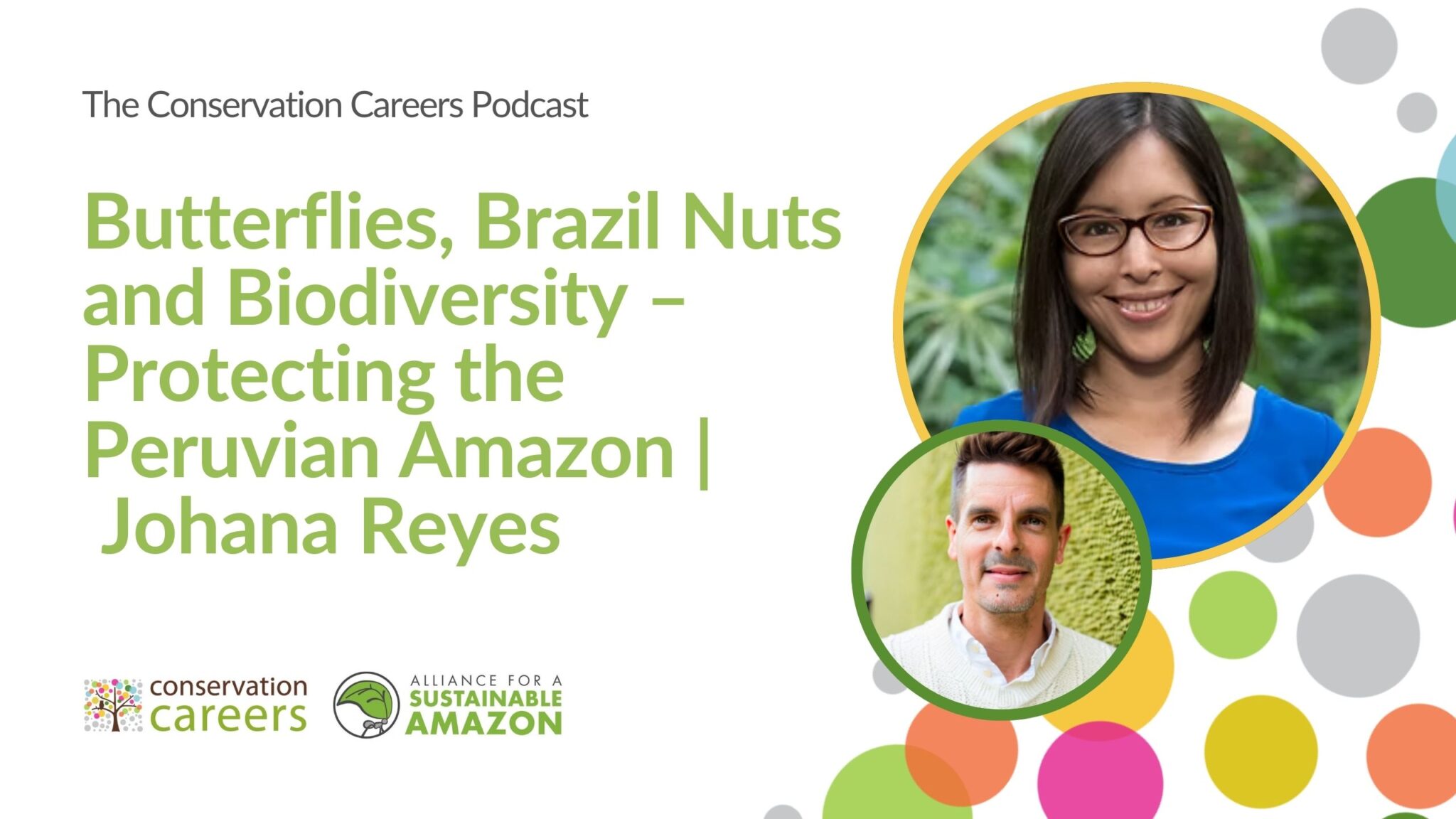
Podcast | Butterflies, Brazil Nuts and Biodiversity – Protecting the Peruvian Amazon with Johana Reyes

How the Alliance for a Sustainable Amazon is combining science, education and community action to keep the forest standing, with Johana Reyes.
If you’ve ever wondered what a sustainable Amazon looks like in practice – how local livelihoods, science and education can work together to protect one of the most biodiverse places on Earth – this episode is for you.
Today’s guest is Johana Reyes, Founding Member and President of the Board for the Alliance for a Sustainable Amazon. Johana joins us from the south‑eastern Peruvian Amazon – a region rich in Brazil nut forests, scarlet macaws and community‑led conservation.
We unpack the Alliance’s mission and model – from long‑term biological research and reforestation with local families to education programmes that connect children and students directly with the forest. Johana shares what life is really like leading a small, field‑based team in the Amazon, the insights her work is revealing, and practical ways that you can get involved through internships, volunteering and research placements.
Whether you’re a student, career switcher or professional looking to make a greater impact, you’ll come away with grounded career advice – from experimenting early and translating your skills, to building confidence through hands‑on experience.
It’s a field‑based, hopeful, and practical episode. Enjoy.
Listen
Watch
Subscribe
You can listen and subscribe to the Conservation Careers Podcast on iTunes, Spotify or Stitcher using the following links, or search for ‘conservation careers’ and you’ll find us!
Resources
- Join CC – www.conservation-careers.com/join
- ASA – www.sustainableamazon.org
Join our live podcast audience!
If you enjoyed the episode, please follow or subscribe so you never miss a new release – and if you can, leave a quick rating or review; it really helps others find the show.
A quick reminder – we record these conversations live with our members. If you’d like to be in the audience next time, stay on for the off‑mic Q&A, and put your questions to our guests, there are two ways to join:
- CC Pro – our members’ community with a busy schedule of events, access to the live Pro Chats audience, resources and templates, plus our job board with 4,000+ live roles at any time.
- CC Pass – access to all our premium training courses, including Conservation Standards Project Management & Design, Communications, Fundraising, Rewilding, Community-based Conservation, Marine Conservation plus our careers-trainings on applications, securing experiences, scholarships and more.
You can compare options and join at conservation-careers.com/join
Thanks again for being here – see you in the next episode.
Transcript
[00:00:07] Hi there, Nick here from Conservation Crews, and welcome to the podcast. Now, if you’ve ever wondered what a sustainable Amazon looks like in practice, you know how local livelihoods, science and education can work together to protect one of the most biodiverse places on earth. This episode is for you.
[00:00:24] Now, today’s guest is Joanna Reyes, founding member and president of the Board for the Alliance of Sustainable Amazon. Joanna joins us from the Southeastern Peruvian Amazon, a region rich in Brazil, nut forests, Scarlet McCall, and community led conservation. We unpack the alliance’s mission and. From long-term biological research and reforestation with local families and education programs that connect children and students directly with the forest.
[00:00:51] Joanna shares what her life is really like leading a small field-based team in the Amazon. The insights her work is revealing and the practical ways that you can get involved through internships, volunteering, and research placements.
[00:01:04] So whether you’re a student, a career switcher, or professional looking to make a greater impact, you’ll come away with grounded careers advice from experimenting early and translating your skills to building confidence through hands-on experience.
[00:01:17] It’s a field-based hopeful and practical episode. Enjoy. My name is Joanna Reyes. I’m the co-founder and director of the Alliance for Sustainable Amazon Improve.
[00:01:35] Dr Nick Askew: Great. Welcome. Welcome to the podcast. It’s so nice to meet you properly. We’ve exchanged so many emails, but it’s really nice to kind of put names to faces and so forth, so yeah.
[00:01:43] Welcome. Um, so yeah, so you are the founding member and you’re the president for this, the Alliance for a Sustainable Amazon a SA. Um, and I thought maybe just start our conversation really with like, just paint a little bit of a picture about the Peruvian Amazon, where you are based, like, you know, bring, bring us to your amazing.
[00:02:02] Biodiverse Rich region for those who haven’t been there and I’ve not been there. So yeah. Tell me what’s unique about your location.
[00:02:09] Johana Reyes: Sure. Well, you can get a sense with my background picture. Yeah. Uh, but the, well, Peru, it’s, it’s my country. I’m Peruvian. Um, and it’s a beautiful country, but most people.
[00:02:23] Think about Peru and think about Machu Picchu and think about llamas and alpacas and like the Andes. Um, two thirds of the country. It’s Amazon Rainforest, um, and we are in one of the most biodiverse places in the planet. We’re very lucky for that. Um, we are located the Alliance for Sustainable Amazon. My organization is located in the Southeastern Peruvian Amazon, and this is very close to the border between Peru, Bolivia, and Brazil.
[00:02:56] Um, this is a very special part of the Amazon, not only for Peru, but for the Amazon in general because we are in what is known as the Brazil net corridor. This is in the Peruvian side. Mm-hmm. Uh, about 1 million hectares of Brazil net forest. This is the only part in the country where Brazil nut trees grow and.
[00:03:21] The neighboring areas in Bolivia or Brazil are also the only parts in Bolivia and Brazil where Brazil nuts grow. Um, and this is very special, um, for all of you that have ever seen a Brazil nut in your like, uh, trail nut mix. Uh, Brazil nuts are, um, Brazil nuts are nuts that grow, um, in the forest. We don’t plant them.
[00:03:46] They grow naturally.
[00:03:48] Dr Nick Askew: Mm.
[00:03:49] Johana Reyes: And we harvest them once a year. Um, and that’s a very important source of income for local families. In our part of the Amazon, uh, Brazil trees are, um, probably the only plant plant. For which we can get sustainable. Um, a sustainable harvest, uh, and is the only non timber product that can be sustainably harvest in our side of the Amazon.
[00:04:16] Dr Nick Askew: Mm-hmm.
[00:04:17] Johana Reyes: So this is a very important part for us. Uh, a very important part of the, the Amazon, because this 1 million hectares of land is mostly managed by local families and local people. Mm-hmm. These people are allowed to harvest the nut, but. They don’t do anything else in the forest. Um, meaning that like the forest is mainly protected.
[00:04:41] Unfortunately the laws have been changing. Um, there’s like, of course like some pressure, um, to allow people to do more in their forest and some people have been allowed to do some elective logging. However, um. Forest for the most part in this Brazil corridor is still um, intact. And that means that like we have very high, uh, biodiversity levels, um, in these areas.
[00:05:08] Another interesting fact about my region, the Madrid region, is that more or less half the territory of this region is protected land. So it’s either a national park or like a protected area. Um, mostly, uh, managed by the government, but we do have some private, uh, conservation areas as well.
[00:05:30] Dr Nick Askew: Yeah,
[00:05:30] Johana Reyes: so if you have like 50% of the land protected, like as a national park or national forest, and you have.
[00:05:38] On top of that, a million hectares of like Brazil nut forest that are managed by local people. That looks very good for, um, all the wildlife, um, that lives in this forest. Um, the one thing, um, that it’s like, uh, a challenge for us here because. There are challenges everywhere. And the challenge that we have here certainly is, uh, mining.
[00:06:03] Um, we do have gold and there is a big problem with, uh, informal and illegal gold mining in our region. The, the mining happens very far away from where we are, uh, but it is like. The top one economic activity in the region and you can feel it, um, even in the capital city again. Luckily for us, we’re located very far away, so we don’t get to like gauge in any kind of like, um, like activity near a mining area.
[00:06:39] But this is something that is definitely debilitating, um, many communities and they are, um. Um, they’re degrading, uh, parts of forest even within some protected areas. So it is, it is a challenge. And the other challenge that we have is logging, uh, most of the logging that happens in Peru in general, it’s informal and or illegal, meaning that most of the, like wood that leaves the country, um, hasn’t been cut like legally.
[00:07:12] Dr Nick Askew: Mm.
[00:07:13] Johana Reyes: Um, and that is. That is an issue. Um, luckily for the Brazil corridor where we are located, Brazil, na trees are really good. Wood, have really good wood, but they are, um, also very productive trees and that is the main reason why they’re not being cut and. For the most part, they are the one, um, tall, stunning tree in our forest.
[00:07:42] And that’s great because Brazil trees provide shelter and, um, and they’re an important like ecosystem for lots of, um, animals and, and plants. Uh, a good example is the Scarlet Macaw. This is a very, uh, well known bird, um, Scarlet McCaw, A Nest in holes. Um, of tall trees. Um, so if you don’t have tall trees in a forest, then Scarlet Macau are not going to be able to nest.
[00:08:11] Um, and of course if they don’t nest, they don’t reproduce. So we know what happens after that. Um, because there are Brazil nets, Brazil trees standing, then McCall have a chance to nest in these trees. Um, so that is just one of the advantages of having, um. Brazil trees around and being, um, in a, um, Brazil tree forest.
[00:08:40] Mm-hmm.
[00:08:40] Dr Nick Askew: That’s such a great introduction. Thank you so much. You touched on so many different aspects there about some of the threats where you’re based, you know, the, the, the uniqueness of the area. And it’s really interesting with like, particularly Brazil nuts and Brazil, that trees to have that direct link to local livelihoods in the economy and the, and the preservation of the forest too as a result of that.
[00:08:59] Yeah. Uh, you mentioned like half of your area’s National Park, like how protected do you feel as a national park? You talked about mining impinging elsewhere. Some unsustainable or illegal fo failing. But does Dewey National Parks typically feel quite well protected in, in your area on pre Peru, like more generally or, or are they still under threat?
[00:09:19] Like what does the future look like for these parks?
[00:09:22] Johana Reyes: Mm-hmm. Uh, that’s an excellent question. I’m gonna start with like, um, how the country is doing. Yeah. I’ll say that for the most part, like the, um, the National Park system, it’s a good system. Meaning that for the most part the areas are protected. They are rangers around, they’re never enough rangers.
[00:09:40] But that’s another, another topic. But for the most part, these are areas that are like, uh, well protected. Yeah. Um, in. Areas where national parks or protected areas are overlapping.
[00:09:54] Dr Nick Askew: Mm-hmm.
[00:09:54] Johana Reyes: Uh, the existence of important natural resources. Then we have a big challenge, um, that doesn’t happen everywhere, uh, in our region.
[00:10:04] It does with mining. Uh, it doesn’t happen for all the national parks that we have in the region, but it happens for like a few And, um, the, the Peruvian government. Tries. Uh, and this varies depending on the administration, of course, uh, but they do try to control it, um, in, in different ways. Um, sometimes they could, they’re successful, they’re partially successful, but usually it’s just temporary.
[00:10:33] And, um, and you can see it, um, because like the mining towns went from like small towns 10 years ago, 15 years ago, to much larger towns these days. Uh, and of course everything that like comes around. Um, like illegal mining. Mm-hmm. Um, so it is, it, it can be a problem. Um, it can be a problem for like degradation of, of the forest.
[00:10:58] It, it is a problem like polluting water. Mm-hmm. Um, and of course the fish in it, um, in a region where a lot of people eat fish. Mm-hmm. Um, and mercury levels are certainly like high. Um, so there are a couple of national parks that are. Right in the mining area, and those are the ones that are being, like, hit the most.
[00:11:22] Dr Nick Askew: Mm.
[00:11:22] Johana Reyes: Uh, but there are other national parks that are like far away from those areas and they don’t really like, um, are impacted by it.
[00:11:30] Dr Nick Askew: Mm.
[00:11:30] Johana Reyes: They might be impacted by like logging to some degree. Mm. Uh, but mining is, it’s its own thing and definitely is the, the, the most like troublesome one because when you mine.
[00:11:47] You destroy everything. Mm-hmm. So basically what you see after a mining operation has gone through a patch of forests is nothing but sand. Um, and there have been a few, uh, a, a few initiatives in our region to like do reforestation on those areas.
[00:12:04] Dr Nick Askew: Yeah.
[00:12:05] Johana Reyes: And first of all, it’s very difficult and second of all, it will take a long time to recuperate.
[00:12:11] Yeah. Um, it is definitely its own. Its own system by now. And because gold is so profitable, like everybody, like makes money. Mm-hmm. Starting from the little, like, um, like the, the one worker that is just working on a daily basis to the people that are like, um, owning an operation.
[00:12:32] Dr Nick Askew: Mm-hmm.
[00:12:32] Johana Reyes: Uh, there are, um, mining concessions.
[00:12:36] So these are places that the government has like given. Like authorization to be mine under, of course, uh, certain regulations. Mm-hmm. Um, but even in those places, like, uh, people fail to, uh, fulfill all the regulations at when they’re what. Ends up happening is that because there’s so much pressure from like illegal mining, then the government is pushed to like withdraw some of the requirements that they’re asking or just like suspend the time in which they are, uh, they’re obligated to fulfill those requirements.
[00:13:16] And that is something that happens every couple of years. It’s like, oh, people have until this deadline to fulfill this. Requirements. And that deadline comes and the minors are out doing a protest. They go to Lima, to the capital of Peru. Just they stay in Congress and then like Congress says, okay, we’re gonna give you another two more years.
[00:13:37] And, and that has been happening for like 10 years, 12 years. Uh, so it is definitely a big thing. And again, because mining is the top one economic activity in the region, most authorities, like from the regional government to like the mayors of the different towns, uh, especially the mining towns, of course, yeah.
[00:13:56] They are miners themselves or they are, um, they, they’re in favor of mining and um, and they can be like. Vocally against the national government and their own, um, efforts to, uh, to, to reduce mining in the area. Um, so like, even like with, even with. Some, um, initiatives that the government take, like regulating how much gas is gonna go into the region.
[00:14:30] Dr Nick Askew: Mm-hmm.
[00:14:30] Johana Reyes: That hurts us all. That just happened a few weeks ago. There was, there wasn’t gas for like, an entire week. Um, and like people couldn’t. Go to where they needed to go because of that. Mm. So we do have, uh, and, and that affects us all also. Mm-hmm. Because like even if you are not in a mining area, if there’s no gas in the region, there’s no gas for anybody.
[00:14:52] Dr Nick Askew: Mm-hmm.
[00:14:53] Johana Reyes: So, um, so there are certainly challenges, but, um, I’m a positive person, so I wanna say that there are certainly also many opportunities. Mm-hmm. Um, and there is, um, a small but a. Very enthusiastic, organized civil society, um, that works, um, from different fronts. Yeah. Uh, you know, at the research level, at the like, um, political advocacy level, at the environmental education level.
[00:15:25] So we’re all trying from our own fronts to contribute to like making more people aware that. The, the forest is a resource definitely because that’s how most people see it here, but like there’s more to that.
[00:15:43] Dr Nick Askew: Yeah.
[00:15:43] Johana Reyes: And, um, and I, and I believe that the first step is always learning and like learning about your own forest and like being aware of like the extent, um, of.
[00:15:59] How important the forest is for everybody.
[00:16:03] Dr Nick Askew: Mm-hmm.
[00:16:04] Johana Reyes: Wildlife and people.
[00:16:05] Dr Nick Askew: Mm-hmm. Perfect. That, that sets the scene really beautifully actually, for the impact that you are seeking to make and are making through the alliance for, uh, sustainable Amazon, the organization that you founded, um, and that you are a president of.
[00:16:20] Tell us a little bit about you. No, you call yourself a SA, is that right? So it’s the Alliance for Sustainable Amazon. Yeah. Tell us about a SA, you know, why was it established in the first place? Like what was your intention? Like, why did it, why was it born?
[00:16:32] Johana Reyes: Mm-hmm. Uh, thank you. Um, the first thing I’m gonna say is that, um, a SA, the Alliance for Sustainable Amazon, we are in fact two organizations.
[00:16:42] Um, so we are a SA us, which is like we, we are, um, the US based, uh, 5 0 1 C3 organization. Mm-hmm. But we also have a SA Peru. Um, and I am the president of a, a Peru. Mm-hmm. We are sister organizations, uh, and we work together. It’s not that we’re separate. Mm-hmm. We are sister organizations. We work together and we make decisions together for everything that we do.
[00:17:06] Uh, in Peru, the, um, the Alliance for Sustainable Amazon was born. Um. In our heads, um, 10 years ago. This is today, this year is gonna be our 10 year anniversary. So we’re very excited about that. And, um, it was an idea that, uh, Jeff Gise, my husband and I, um, had, uh, while we were. Thinking about what our, like, what our interests and like hopes were for the future, for our personal future, and of course for our professional future.
[00:17:43] Uh, we both, um. Have been very invested in Peru as a country and, um, in sustainable development and conservation. Mm-hmm. Um, Jeff is an entomologist and like he did his, uh, PhD, uh, work here in this region. And before meeting him, I had been working in sustainable development for like over 15 years already.
[00:18:10] Um, and like I came to the region. I started seeing, like learning more about the region. ’cause I’m originally from Lima and um, I came to the region, I started like seeing what was the situation and we started thinking what can we do about it? What can we do about it with the, with the skills that we have, what can we do about it with the, um.
[00:18:39] With the possibilities that we have.
[00:18:41] Dr Nick Askew: Mm-hmm.
[00:18:42] Johana Reyes: And that’s how a SA started a SA started as a organization that wanted to contribute and still is contributing to the conservation of. Biodiversity in the Peruvian Amazon, and we’re doing that through research, education, and reforestation. Those are our three, um, focal areas.
[00:19:04] Hmm. On, on the research side, we are concentrating our efforts on long term basic biological research. Mm-hmm. Especially outside of protected areas. And why is that? First, because, um, there is very, very little research that is being done in this part of the Amazon in Peru, and the little one that is being made, it’s only in protected areas.
[00:19:32] However, we know that local people and people in general are going to be using more and more of their own forests. Um, that it’s outside of protected areas, um, and we don’t know much about those. Uh, so it’s like, okay, we are in the Brazil corridor. How much of, like, what is the impact that local families having when they’re harvesting the nuts in.
[00:20:01] The ecosystem. What, what is the impact they’re having in their forest? Um, how is that impacting, uh, biodiversity levels and so on and so forth? We don’t, we don’t know much and we don’t, if we don’t know much, then we can’t really advise on like how we can create conservation and strategy. So we need to start by learning and why basic biological research because, um, in.
[00:20:29] Let’s just say in North America.
[00:20:31] Dr Nick Askew: Mm-hmm.
[00:20:31] Johana Reyes: Um, there are 800, give or take 800 species of butterflies in that whole part of the world in Peru, in a small area within this region, in just one sampling That lasted less than a month. We found over 1500 species of butterflies.
[00:20:58] Dr Nick Askew: Wow.
[00:21:01] Johana Reyes: In just one sampling, one like it.
[00:21:05] It’s crazy. Biodiversity is like, it is very high. And we still know very little about it. So we need to start with basic research because we can’t advance to all the types of research is if we don’t know the basics yet.
[00:21:19] Dr Nick Askew: Mm-hmm.
[00:21:20] Johana Reyes: And while long term, because as like everybody that is in the nonprofit sector knows, um, long-term, it’s probably the hardest thing.
[00:21:32] Long-term projects are probably the hardest thing to fund and the hardest thing to engage in. Um, when you get funding, you usually get for short term and sometimes medium term projects, but never for long-term projects. And sometimes you do need long-term projects to like understand something like in a more like.
[00:21:56] In a more significant matter. Um, we know that it requires more resources. We know that it requires a lot of commitment. Um, but we decided that we wanted to go at it, and, and that’s why we focus on that. Um, I’m, I know you have more questions, so I’m gonna very quickly just tap on like education and reforestation.
[00:22:19] Um, in education, we are focusing our efforts on like. Uh, working with different groups and we have, uh, programs that like target each group specifically. So we work with, um, uh, local, uh, elementary school and high school kids. We also work with local undergraduate students, but also undergraduate students around the country and international students.
[00:22:45] And we also have, uh, specific educational programs for other groups like, uh, local families or groups that don’t tap in any of the previous groups. Uh, the basic idea, especially for the kids, um, teenagers and local and local families and local communities is to.
[00:23:08] Create significant learning experiences through which they can have firsthand connection with the forest.
[00:23:17] Dr Nick Askew: Mm-hmm.
[00:23:17] Johana Reyes: And see the forest. And understand the forest in ways in which they haven’t before. As I mentioned briefly, for most people here, the forest is seen as a resource to use something that is useful for me, for my family.
[00:23:33] Um, so like when you see the forest, they’re just thinking, okay, what can I hunt? What can I use, what can I sell? Um, and we want to like, just for a second, just stop that train of thought and just work with them and like, let’s see the forest as a whole. Let’s understand how the forest works and then let’s understand how well we’ve seen.
[00:23:58] It’s connected to me as a person, as a family. Um, so for instance, lots of the kids that we work with have families that harvest the nuts, but they didn’t know that we have the nuts because there is a bee that pollinates the flour that then is gonna become the nut.
[00:24:17] Dr Nick Askew: Mm-hmm.
[00:24:18] Johana Reyes: They didn’t know that we have new personna trees because there is a little animal called goodie that will bury the seeds.
[00:24:26] Mm-hmm. That’s the reason why we have trees. Um, so now they know that maybe I shouldn’t hunt too many a goodies because if we have them all, we’re not gonna have Brazil nuts in the future. Or they will learn, oh, if my Brazil, if my Brazil tree, it’s in the forest, then the bees that are pollinated pollinating it will like get to it easily.
[00:24:51] But if I clear all the area around Brazil, not. Then the bee’s not gonna get there, and then the tree’s not going to have fruit.
[00:25:00] Dr Nick Askew: Mm-hmm.
[00:25:00] Johana Reyes: So that’s, that’s what we’re trying to do with them. And um, and of course expose them to. Fincas, which is our research station, that it’s in the forest and expose them to a community that does research and why it is important to do research, how research can benefit us.
[00:25:22] Mm-hmm. Um, with the, like older people, like undergraduate students for instance, we provide a series of professional development opportunities that are very diverse from like one day experiences to like. 10 week or six month experiences in which they could like, um, improve their research skills. Uh, they that, uh, especially when we bring, um, undergraduate students from other parts of the country, um, to like provide them with an experience that, like a, a full cover, um, an all included experience that they probably like would’ve never had before.
[00:26:03] Um, so that’s important for us. And finally, uh, with reforestation, um, we are, we have two main goals. One was to recuperate, uh, the, the areas that were previously degraded at our own research station.
[00:26:18] Dr Nick Askew: Mm-hmm.
[00:26:19] Johana Reyes: Um, before we got it.
[00:26:20] Dr Nick Askew: Mm-hmm.
[00:26:20] Johana Reyes: Um, and we’re doing a lot of progress on that. Um. We’re like 85% are done.
[00:26:27] Um, and we are working with local families on reforestation efforts for Brazilian trees, and this include like training on how to germinate the seeds all the way to like planting them in their forests.
[00:26:41] Dr Nick Askew: Hmm.
[00:26:42] Johana Reyes: So that’s the summary. Sorry it took me so long.
[00:26:44] Dr Nick Askew: No, not at all. I, I, I’m transfixed. It’s amazing what you’re doing and what you have achieved actually across like 10 years.
[00:26:50] It sounds like things have really sort of built momentum. What, when you look back, like what have been some of the achievements, like what have you learned through your research? Has anything sort of stand out? You shared about, you know, just the one sample of the butterflies across a month and what you discovered there.
[00:27:02] Have you found anything else that’s kind of really Yeah. Been enlightening across the last 10 years? I’m gonna add other questions onto this, like what have you. How have people’s attitudes changed at all, um, with the education work you’ve been doing? And if you want to touch on the reforestation and how things have been evolving there too, I’d love to hear just Yeah, just give, give us a bit of an idea as to Yeah.
[00:27:22] What have been the impacts that you’ve, you’ve received over or you’ve created over the last Yeah. Decade or so?
[00:27:28] Johana Reyes: Happy to. Um, on the research side, we have three main projects. Our, uh, butterfly project.
[00:27:36] Dr Nick Askew: Mm-hmm.
[00:27:36] Johana Reyes: Um, our, um, eh. Biological monitoring project and our plant phenology project. We have three main projects and I’m gonna start with the Butterfield Project.
[00:27:49] That’s our biggest project and it has lots of like component, but the first thing I’m gonna say is that even though it’s called the Butterfield Project, it’s not about butterflies. Um. We use butterflies as an indicator to understand the forest. Right? We, we are studying butterflies, the diversity of butterflies and the relationship that butterflies have with their host plants.
[00:28:14] Dr Nick Askew: Yeah.
[00:28:14] Johana Reyes: Which for those that don’t know, one species of butterfly usually has one or two host plants. So if the plants disappear, then the butterfly disappears and, and that is a relationship that is important to like. To notice. Um, so we have a butterfly project and we are of course working with butterflies, but we are working with butterflies to understand how the forest works and how the forest is changing.
[00:28:46] Yeah. Um, and by understanding like. The biodiversity of butterflies, but also some of the butterflies dynamics. We have a couple of projects, one of on migration of butterflies, another one of like, um, reproduction in butterflies, and how depending on the temperature, butterflies will, let’s say pause the reproductive skills, uh, or abilities until like their con the conditions get better.
[00:29:20] Um, and by doing that, like we are also starting to understand more about like what are the effects on the changes on temp of temperature, uh, but also what are the effects of like. A degraded forest, like a previously degraded forest with a forest that was recuperating and how that brings like newer communities of butterflies and so on and so forth.
[00:29:45] Dr Nick Askew: Mm.
[00:29:46] Johana Reyes: We have, uh, a series of publications that you can, um, access through our website, sustainable amazon.org that I must say we’re relaunching this year. Very soon. Uh, but we have lots of, uh, peer review articles, scientific papers, um, describing new species of butterflies. Last year we launched a, uh, DNA molecular lab in C two.
[00:30:12] Um, so we have been doing DNA analysis and that’s great because that is allowing us to, um, um. To discover new species of butterflies faster. Um, so that’s great and also is a great resource for, for the region in general. Um, DNA analysis in this region and in the country is not as common and as it could be in the, the like northern hemisphere.
[00:30:39] Um, so we have a lot of that, um, in, uh. We work in partnership. So we have our own team, of course, and we produce our own, uh, articles, but we also work in partnership with, um, a couple of, um, researchers. Um, the one that’s probably closer to home for you, Nick, is, uh, the Queen Mary University of London. We work with a researcher there and we have been working with series of PhD students and master’s students on, um, follow following, following up.
[00:31:11] Some of the discoveries that we’ve made also. So there is a lot of, um, there’s a lot of cool stuff for the scientific community that are interested in, like butterflies, um, and insects in general that you like that, that, that we’re contributing to. Um, on the biological monitoring side, we have been. Not only surveying different groups of animals and plants, uh, we have a like weekly survey on birds.
[00:31:39] We, uh, are now like doing a, like, um, a permanent survey on mammals with, with camera traps, um, and with, with survey fish. Um, um. Herbs and different like groups of plants. And because of that, we are creating a, uh, robust data set on biodiversity outside of protected areas. And that’s, uh, very important because that allows us to see what is in our forest and what is not in our forest.
[00:32:13] And the biodiversity levels that we found are. Tarnishing, they’re like, great, like we have pumas, we had js, we have like, um, uh, short E dog. That is a very, very rare, um, um, mammal to see. Uh, we have pretty much everything that you could find in the middle of the national park and we have it there, um, in our res research station, which is three kilometers away from the closest.
[00:32:44] Local community. And that is great news because that means that like, regardless of the, the influence of the, the human activity that is happening, uh, in the forest, biodiversity is thriving. Um, so that’s good news, but also that like makes us think. So now that we know that. We are rich, like biodiversity levels are, are very high and rich in our area.
[00:33:16] Then how can we ensure that they stay like that? Um, so that’s, that’s important. And then, uh, in terms of plants, we have a, um, we have a couple things. We have a lot of data on Brazil trees, their flowering and fruiting processes. Um, and. And that’s, and that’s cool. Important. We’re working on a paper, um, about that, um, this year.
[00:33:41] Uh, and we have, uh, one Hector Forest Dynamic plot, which is, uh. A plot where we have like, um, survey a like plant that it’s, that has certain characteristics. And again, this is a long-term project. So like by looking at the development of the plant, uh, community, in that plot, we’ll understand more about how the forest is working.
[00:34:06] Dr Nick Askew: Hmm.
[00:34:06] Johana Reyes: That’s pretty cool in terms of, uh, education, well, where can I begin? We’ve worked in all these years directly with about like between four to 5,000, um, uh, kids, um, in different experiences. Um, we have work with. At least, uh, like 1500, um, undergraduate students, like local and nationwide, uh, undergraduate students, um, many of which have produced their own like, uh, research outcomes, um, and research papers.
[00:34:44] Um, that’s, we have worked with local teachers. We have created like, um, a manual to teach science locally, uh, with teachers in the community. We have also co-created a, um, a handbook on, um, best practices in like educational initiatives for field stations. And that we did in collaboration with two other field stations.
[00:35:12] One, uh, in Canada managed by the McGill University and one in Belgium with, uh, Hassel University. And that was part of an initiative with, um, the organization of biological field stations, OBFS. Um, oh. Uh, OBFS is a great resource, uh, for like your listeners, uh, most likely. Um, so it’s, it’s great to know it has information about all field stations around, around the world.
[00:35:39] Um, so it’s great. And we’re currently, uh, being part of an initiative called the Virtual Field, um, that will allow us to have different videos about our, like, different ecosystems that will be, um, free of access, uh, for like. All sorts of educational initiatives for anybody that wants to use them. Um, so we’re currently doing that and that’s, that’s pretty fun as well.
[00:36:03] And finally, in terms of reforestation, I’ll say that like we’ve, um, I actually had those numbers somewhere. I need to like go at them soon. But, uh, we’ve worked with, in the course of this past five years, we’ve worked with, uh, about 60. Um, local families to do reforestation in their areas. We have, um, we have contributed to the reforestation of about 20,000 hectares of land.
[00:36:37] Um, and we have distributed like over 2000, uh, Brazil net trees, which might not sound as a large number, um, when you are talking about planting, but, um. Like germinating Brazilian trees is a very labor intensive process, and usually it takes an entire year between this, you germinate the seed until the plant is ready.
[00:37:03] So, um, we’re very happy with our numbers so far.
[00:37:06] Dr Nick Askew: That’s, that’s amazing. Yeah. Thank you. So interesting to hear how things are developing and where you are, and exciting to think about where things might go into the future too. Uh, I wanna change gears slightly. There’s a few more things to talk about, and I’m a little bit conscious of our time as well, and we’ve got people who are listening want to ask questions once we, I finish our recording as well.
[00:37:24] So, um, I wanna talk about your, your work, your career personally, China as well, people listening. We, we want to try and. Really kinda shine a light on what it’s like to actually work in conservation, kind of what’s and all. So, you know, um, sort of fairly briefly, like what, what is exactly your job? I mean, I know you are, you are the founding member, you’re the president, but what does that actually mean to someone who doesn’t know what it’s like to be you on a, a day to day or week to week level?
[00:37:51] Like, what does it typically look like to do your job?
[00:37:55] Johana Reyes: Okay, well, how do I start? Um, uh, I think the best way to start is to say that I’m a community social psychologist. Um, and, um, for all my professional career, I work in the nonprofit sector. Mm-hmm. Um, I’ve always been interested in, um. Working at two different levels.
[00:38:15] On one side, I’ve always, always liked designing projects, um, carrying them out, evaluating them, just being in touch with the communities I serve. Mm-hmm. And on the other hand, I’ve always been interested in strategic planning, fundraising, like how to make sure that an organization is running. And I’ll say that, like for, for me, those two things are important.
[00:38:39] I always like to be connected to the two things. Um, and that’s what I do in my job. I, um, I work at those two levels. We are a small organization. Um, we have like a little bit more than 15, um, employees between like full-time and part-time. So we’re a small organization and when you are, when you work in a small organization, you wear many hats.
[00:39:04] Mm-hmm. Um, so although I do a lot of like designing like all the education activities, um, evaluating them and just facilitating them with my team, um, I also work a lot in like fundraising, connecting with potential donors. Um. I do all the communication with like faculty members that we work with or like local teachers, uh, or with people that want to like, uh, get involved with the organization in any way.
[00:39:41] Uh, we have a, like an international internship program and like I, I work a lot with my in interns as well. Um, so like I, I do a lot of communication, let’s say like, um. That that is, that is part of the job. But like I, at, at some point, I remember, especially at the beginning, uh, because we were like even smaller than, like, I’ve done birth monitoring at some point because like the person that was doing it was on vacation.
[00:40:10] Um, you know, if like something happened to the cook at camp, we will all just like rotate the, the, the, the cooking. Um. The cooking task, the cooking duties or whatever, um, that was at the very beginning we’re like tiny. Um, but I, I think the point is like, I, I just do what is needed.
[00:40:35] Dr Nick Askew: Yeah.
[00:40:35] Johana Reyes: And, um, and because of that, like I’ve gained so many different skills.
[00:40:41] Dr Nick Askew: Yeah.
[00:40:41] Johana Reyes: Um, I am convinced, like, and I have been convinced of this even before I founded, um, a SA, that you do need. Interdisciplinary teams pretty much everywhere where you are.
[00:40:56] Dr Nick Askew: Yeah,
[00:40:57] Johana Reyes: and like everybody needs to be able to comprehend. Everything that you’re doing. Um, and, and you don’t need to be a physicist if you’re working in like, um, a physics project, but you at least need to understand why you’re doing it.
[00:41:12] Like how is it working? Um, what are the results that you’re expecting? And like, of course, I’m just, we’re not working at the physics level, but I’m just giving a random example.
[00:41:22] Dr Nick Askew: Mm-hmm.
[00:41:23] Johana Reyes: But I do work with people with all sorts of backgrounds. Um, we have this, we have this collaboration with a project called The Jungle Biomechanics Lab, for instance.
[00:41:33] And most of the people that we collaborate with for that particular project are engineers, are chemists, are physicists. Like, and, and we work together and like we need to brainstorm about the things that we’re gonna do together.
[00:41:49] Dr Nick Askew: Mm-hmm.
[00:41:49] Johana Reyes: Um, and I think that that’s very special because like we, we, we all are, um, thankful and grateful about the skills that we have and how those are useful to like, you know, create a valuable.
[00:42:05] Project. Um, so I do a little, like the summary will be I do what is needed and I do a little bit of everything
[00:42:12] Dr Nick Askew: and it shows the diversity and the interdisciplinary nature that you mentioned that I think is typical across conservation actually. And the skill sets. You mentioned that you use, the ones we talk about quite a lot here, communications, fundraising.
[00:42:24] Project management along with everything else that you’re talking about in terms of running a successful organization from the ground, from the cook up, you know, or wherever anyone might sit. That’s, that’s really interesting. If, if someone’s listening and they are inspired by you and your work. Or perhaps you meet someone and they’re an aspirational conservationist, one of your interns may be like, what careers advice do you typically give people who want to work in conservation?
[00:42:49] What, what things, what things do you think might really help people to, to move along and tick and also to move towards, yeah. A career, a, a paid role.
[00:43:01] Johana Reyes: We work with a lot of, um. People that just graduated for our international internship program, for instance. And, and one of the, the things that I always tell them is like, if you are interested in a career in conservation or in academia, because many of them, uh mm-hmm could go either direction. Um, and you just graduated just.
[00:43:24] Try it all. If you’re curious about this thing, try it. If you’re curious about this other thing, try it because this is the time in which you try things and you see what you like and you see what you don’t like.
[00:43:35] Dr Nick Askew: Yeah.
[00:43:36] Johana Reyes: If you are interested in academia and like you come to us, for instance, and we’re doing it like, or we’re assisting you to do an independent research project.
[00:43:45] Be flexible. Mm-hmm. Because if you think that you have it all, figure it out and then something happens because something always happens when you’re in the field and you need to change. Like don’t feel that like that is your fault, or that is like something that like you could have prevented. Sometimes things are not preventable, so just.
[00:44:08] Learn from that experience. Yeah. Um, if you are doing an internship, for instance, in your independent project didn’t come up, like you couldn’t finish it or like it didn’t obtain the result that you were hoping for. Yeah. That is still fine because that is part of the learning process. The process of doing the project is the learning.
[00:44:29] Mm-hmm. More than the result.
[00:44:31] Dr Nick Askew: Mm-hmm.
[00:44:31] Johana Reyes: If you’re at that stage of your career, um. We also work with some people that are changing careers and um, and they can be a little like, you know, afraid of like start trying things again.
[00:44:46] Dr Nick Askew: Yep.
[00:44:46] Johana Reyes: Um, and, and for those people, like piece of advice that I give them is, it’s okay to be scared.
[00:44:53] You’ve worked in this for 10 years, 12 years, whatever. And, and now you’re looking at something new. So let’s start with something that you know, and um, and. Use that thing that you know what to do or how to do, and let’s translate it into something that you can do here, um, and start making yourself more comfortable.
[00:45:16] Um, and of course you might realize that like you thought, oh, I wanna switch career conservations, but. Like, maybe like, not this part of like doing conservation in the field, but maybe I’m better suited for doing like, communications about conservation and, and that’s great. And that’s great.
[00:45:38] Dr Nick Askew: Yeah.
[00:45:38] Johana Reyes: Um, because again, this is the time to figure things out.
[00:45:43] Dr Nick Askew: Yeah.
[00:45:43] Johana Reyes: And lastly, I’ll say in my mind, it’s always the time to, to figure things out. I mean, like, it’s almost never like. A time when you’re like, okay, this is how things are forever and ever. And, and that’s it. Like I think that like you’re always just questioning yourself, questioning what you’re doing, thinking what would be my next step.
[00:46:05] And that is part of growing and that like, and that for me is a good sign because that means that you’re moving forward.
[00:46:11] Dr Nick Askew: Yeah. Fantastic advice. I love all that. So what I heard was, um, yeah, embrace uncertainty. Yeah. Um, be agile. Um, immerse yourself, explore. Yeah. And, and build your confidence. See if you’re switching, how you can transition some of your existing skills into the sector too.
[00:46:30] Um, if people are listening to this, they’re inspired and they want to kind of. Get involved with a SA. Yeah. Uh, what do you offer at a SA in terms of experiences or ways that people can kind of come and help or, or to learn and develop themselves?
[00:46:44] Johana Reyes: Well, there are many ways to get involved with what we do.
[00:46:48] Um, you can get involved remotely, you can get involved, be with us at the field station, um, at the station. We have different opportunities. If you are. From somewhere else that is not approved. Probably you wanna look at our internship program and our volunteer program. Uh, our internship program. It’s a more like structured academic and research oriented, um, experience.
[00:47:13] Dr Nick Askew: Mm-hmm.
[00:47:14] Johana Reyes: And usually we have three sessions, a four week session, an eight week session, and a 12 week session. And the idea behind this program is a, that you like learn to do field research or connect yourself with conservation projects, that you have the opportunity to do your own independent project, uh, from zero all the way to the end.
[00:47:39] And, um. The possibility to also develop new skills. We have specific weekly workshops on like QGIS, camera trapping methodologies, off trail navigation, et cetera. And we also have reading discussions because it’s a nice way to start like making sense of all those thoughts that you might be having about like the Amazon and the conservation challenges that the Amazon’s facing.
[00:48:04] And, and we put all those into, um. Reading discussions. We, we have specific papers and we discuss them and, and I, I’ve always found it to be a very powerful moment because even though it’s only one hour or an hour and a half a week, it’s a moment in which people can really like just stop for a second and reflect about like what they are seeing and experiencing.
[00:48:26] So that is like one, one part, um, that is very like, um, that program will fulfill many, um, uh. Motivations that you might be having. Uh, if you are undergraduate students, it could fulfill your motivation of getting more experience. If you just like recently graduated and you’re thinking about applying for graduate school, it could fulfill your motivation of like getting, um, more like real experience on like field research, for instance, or like publishing something.
[00:48:59] Um, if you’re changing careers. This could be a great opportunity to like, get an initial taste of how that new career is gonna look like.
[00:49:07] Dr Nick Askew: Mm-hmm.
[00:49:07] Johana Reyes: So it, it’s a great opportunity and, and guided it, uh, from the very beginning until the end. We have like preparation workshops. We have q and a sessions to help interns prepare for the experience and where with you all the way.
[00:49:20] Mm-hmm. Um, the volunteer program, it’s, it’s more like, uh, fluid. In the sense that like, it, it’s shorter. Like it goes for like as many days as you want and, and you get to experience and contribute to the work that we do in research, education and reforestation. Um, but we also have other experiences. I was mentioning about the jungle biomechanics lab.
[00:49:43] That is a, uh, an experience for now only for us, uh, for people that are either US citizens, your residents, or studying in the us. Mm-hmm. Um, that can apply to anybody can apply if they are enrolled at school. Um, and you can like develop a, a research project, um, and you can come to the safe one. To the station for two weeks to develop that, uh, research project.
[00:50:09] So that’s a cool, it’s a cool program to have. Um, and we also have the Resident Naturalist program, uh, that is coming up very soon. Um, uh, sorry, the call is coming up very soon for that program, and this is a six month placement where you will like, um. Be with us and, um, work specifically on the education reforestation and some of the research, uh, projects as part of our like, uh, team.
[00:50:39] And, and that is what you can do like. With us directly, but I always, uh, get also like people that might be interested in contributing remotely in many ways. And like you are always like, welcome to just reach out to me. Uh, my email address is joanna dot res@sustainableamazon.org and you can find it at the website Also sustainable amazon.org.
[00:51:05] And I’m always happy. I always reply to every single email. Um, so even if I take a few days, I will always reply. Um. So reach out to me if you’re curious. I’m, I’m always like, happy to like, um, listen to what you have to say. Um, and like, I’m always here, like, uh, if you have like a project for school and you need information about the Amazon, we’re always happy to help.
[00:51:30] Um, we have like cool resources that you can use. You can find, uh, more information about like what, what you can see. In our part of the Amazon, on eBird. On iNaturalist, we have a project on like Wildlife Insights. Um, so we’re out there and, um, happy, happy to hear from you.
[00:51:51] Dr Nick Askew: Lots of ways to get involved. Yeah.
[00:51:52] And we’ll obviously put links below wherever you’re listening to or watching this podcast right now. Um, in the last few minutes before we kind of hand over to, uh, our audience who want to, I’m sure, ask some questions of you also. Um, I want to kind of wrap up with a few kind of quick questions with you just to kind of think and hear about how you, how you feel about conservation.
[00:52:10] The first one’s a really open one, um, which is if we could take you anywhere on the planet, Joanna, and you could see any species, where would you love to go and what would you love to see?
[00:52:22] Johana Reyes: That one is a tough one.
[00:52:23] Dr Nick Askew: Yeah.
[00:52:24] Johana Reyes: But I am going to go with under a leaf cutter, cutter ant nest.
[00:52:31] Dr Nick Askew: Ooh.
[00:52:32] Johana Reyes: Uh, leaf cutter ants are, well, I love ants in general, but leaf cutter ants in like, especially, um, they are actually in our logo because they have a very interesting story.
[00:52:45] Like when you see leaf cutter ants, they’re always carrying their little ant. And, um, their little leaf, sorry. And, um, and I asked when, when, where with kids were, when we had kids at the station, I asked like, what do you think the ants do with the leaf? And most of them will say, oh, they eat them. And, and I’m like, no, they don’t eat them.
[00:53:05] They take them into their home. They just like mush them up and mushrooms will grow out of them. And they eat, they eat the mushroom. So they’re farmers. Um. They’ve been doing that for so many years without really changing that much of the forest. Um, humans on the other hand, we haven’t been doing agriculture for like, as long as ants and the impact that humans have been having.
[00:53:32] It’s different than the one that ants have having. So one of the things that I would like to see if I could go anywhere is just like, be it. Tiny. Tiny is like a leaf Cana hand and go deep inside and just like see it all from the inside. I think that will be very cool.
[00:53:49] Dr Nick Askew: That would be incredible. I love that.
[00:53:51] I love that. Yeah. Um. Another question I wanted to ask you is, as a kind of conservation movement, we are all a force for good. We’re doing our best to change the world, to protect nature, to protect wildlife, and yet we are still seeing nature, wildlife, biodiversity, whatever you want to call it, on the decline globally.
[00:54:10] What do you think we need to do more of or be better at as a kind of conservation sector to have more impact?
[00:54:21] Johana Reyes: Well, I think that there are many answers to that question. Um, and it depends on like your role, what, what you’re doing, what your job is, um, kind of person you are. But I’ll just go with the one that I think could apply for anybody. Mm-hmm. And this is if you are a person that is already aware that we need to work harder on conservation of.
[00:54:48] The Amazon rainforest or any forest or any natural space, then talk about it, but don’t talk about it with the people that. Already know about the problem or think like you talk about it with the people that don’t know about the problem and that don’t think like you. Um, I, a couple of years ago, I remember listening to this lecture and, and the woman like made the point of like, you know, I always talk about conservation with every single person.
[00:55:16] Then I’m with like, with the taxi driver, with everybody, but I don’t talk about it like as I am giving a lecture. I’m just like. I think about like, what can connect to that person? And I use that to, to say like, oh, you like, I dunno, baseball, do you know what like baseball balls are made out of? And like, and, and then I make a story, um, that could connect them with why would be important to like, care about this or that.
[00:55:47] Dr Nick Askew: Mm.
[00:55:49] Johana Reyes: And like, and that means that like we are actively just. Getting the word out. Um, and I’ll say that that is important and that at the same time it is important to listen and to remember that people have different, like different views and. Be respectful of those, um, as well. Um, so I think that that is important.
[00:56:17] And, and I’ll say that that is important because we have an excellent relationship with all the local communities that we work with. And most of the, the people that we work with are like. Of course a Brazil like harvesters, but many of them also do some logging. Many of them have done mining at some point.
[00:56:36] Mm-hmm. Uh, they hunt like, and for same for the kids. Like for them it’s like, you know, like hunting is okay and it doesn’t need to be, not okay. I, I need to say that. Mm-hmm. Um. Or like, um, cutting trees is fine and, and you have kids that will come with all their little ideas, big idea, big ideas.
[00:56:57] Dr Nick Askew: Mm-hmm.
[00:56:57] Johana Reyes: And like, we, like, we connect with ’em and we give our message and we listen to what they have to say.
[00:57:05] Mm-hmm. Um, and, and we don’t judge. Um, and. That can be hard sometimes. Mm-hmm. Uh, but I think that is, that is, that is crucial because like little by little, like things could change and, and, and you are, you are always gonna find people to be more receptive of you if you start by listening.
[00:57:30] Dr Nick Askew: Yeah.
[00:57:30] Johana Reyes: Instead of just like going at it straight.
[00:57:34] Dr Nick Askew: Yeah. And on that hopeful note, my final question is actually one connecting to hope and optimism. I just want to kind of check in like how are you feeling about the future of either our planet of wildlife? Yeah. How do you think things are looking? Are you hopeful? Are you optimistic? Are you pessimistic?
[00:57:53] Are you unsure? Like where are you sitting in your feelings?
[00:57:56] Johana Reyes: Well, I know that there are certain things that we won’t be able to change. I know that we are going to be facing the extension of many things in our lifetime. Um, and I know that the future that my son is gonna see is going to be very different than the one that I’ve seen.
[00:58:14] Um, but even with all that, like I, I don’t think that that’s a reason enough to just give up. I think that like, if anything, that’s the reason enough. That’s, that’s a good reason. To keep fighting for what we can save.
[00:58:36] Dr Nick Askew: Mm-hmm. Galvanizes spirit. Yeah. Thank you so much for your time. It’s been lovely talking to you, Joanna.
[00:58:43] Yeah. If people wanna find out more, we’re gonna drop a link into where we’ve been talking. But thanks again for your time. Thanks for sharing your passion and your knowledge with us free. It’s been lovely to talk.
[00:58:54] Johana Reyes: Oh, thank you for inviting me, Nick. Yeah, it’s a pleasure. I’ve been, I’ve been a, I am, we are a proud member of the Conservation careers, um, community.
[00:59:04] And, um, I’m very excited to be joining after all this many years of like being part.
[00:59:10] Dr Nick Askew: Wonderful, wonderful. Thank you again.
[00:59:13]
[00:59:21] Okay, thanks for listening. If you enjoyed this episode, please follow or subscribe so you never miss a new release. And if you can leave a quick review or ratings, it really helps others to find this show. And a quick reminder, we record these conversations live in front of our members.
[00:59:36] So if you’d like to be in the audience next time, stay on for the off mic q and a and put your questions to our guests. There are two ways to join. The first is CC Pro our members community with a busy schedule of events, access to pro chats like this, resources and templates, plus our job board with over 4,000 live jobs at any one time.
[00:59:55] And the second is CC Pass access to. All our premium training courses, including conservation standards, project management, design, communications, fundraising, rewilding, community-based conservation, marine conservation, plus our careers, trainings on applications, securing experiences, scholarships, and more.
[01:00:13] You can compare options and join@conservationcareers.com slash join. Thanks again for being here and see you in the next episode.
[01:00:23]