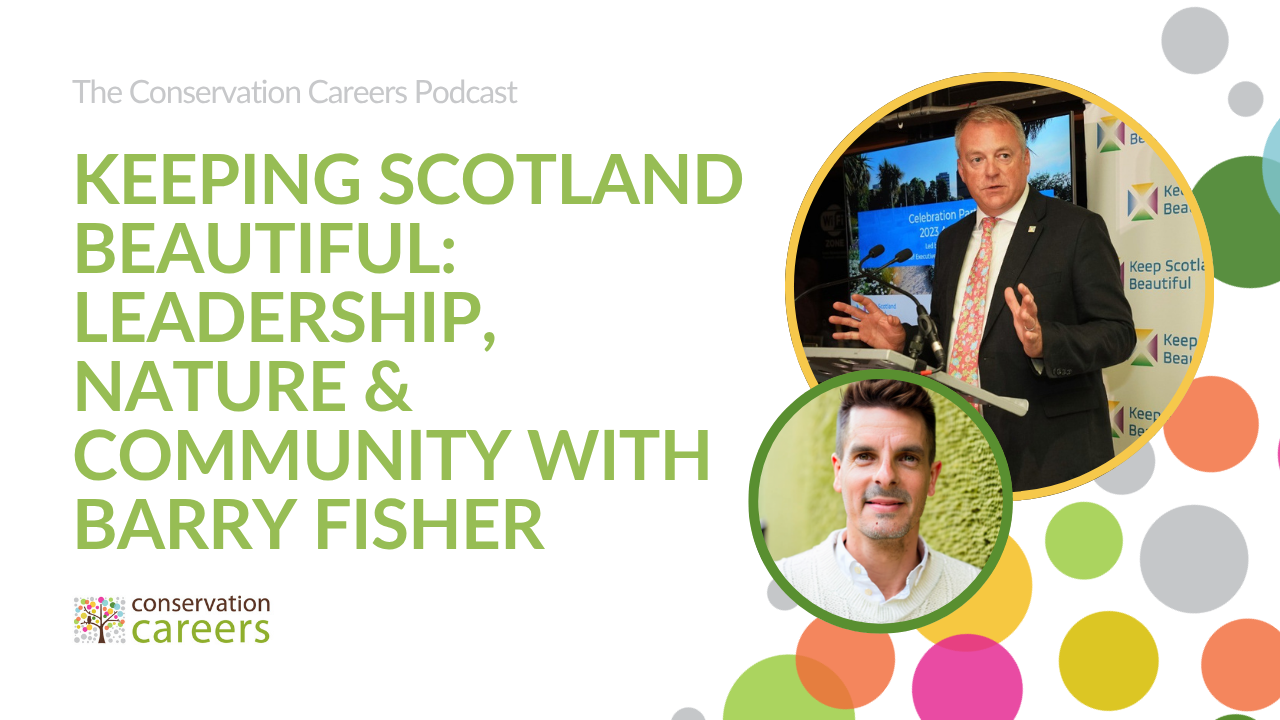
Podcast | Keeping Scotland Beautiful: Leadership, Nature & Community with Barry Fisher

Scotland is a land of breathtaking beauty — from its rugged coasts and misty glens to its rich biodiversity and wild spaces. But like all places we love, it needs care, commitment and community to keep it that way. In this episode, we’re joined by Barry Fisher, Chief Executive of Keep Scotland Beautiful, the environmental charity on a mission to inspire action for a clean, green, sustainable Scotland.
Together we explore what makes Scotland so special — especially for wildlife — and why it can’t be taken for granted. Barry shares the charity’s current strategy, how they work with partners across government, schools, businesses and communities, and how they’re tackling issues like biodiversity loss, climate change, and waste.
We also explore Barry’s personal journey — from youth development to leading a national charity — and what it’s really like to be a CEO in the conservation space. He reflects on the challenges and rewards of leadership, what success looks like for him, and the pivotal career moments that shaped his path.
Whether you’re based in Scotland or just love the idea of community-powered environmental action, this conversation offers insight, inspiration, and real-world examples of conservation in action.
It’s a reflective, practical, and optimistic episode.
Enjoy.
Listen
Watch
Subscribe
You can listen and subscribe to the Conservation Careers Podcast on iTunes, Spotify or Stitcher using the following links, or search for ‘conservation careers’ and you’ll find us!
Resources
Join our live podcast audience!
All our podcasts are now recorded in front of a live audience who sit in and listen to the chat, and then after the mics are turned off get a chance to talk to the guest, share their thoughts and ask questions.
If you’d like to be in the audience all you need to do is join our CC Academy.
In the CC Academy you’ll get access to the world’s biggest conservation job board – listing over 80,000 jobs, volunteer and internships across the globe each year.
You’ll also enjoy access to our amazing CC Pro private members community with regular events, networking and support.
Plus you’ll get full access to our growing library of career-boosting resources, guides and templates.
And best of all it only costs a few dollars, pounds or euros per month to join the Academy.
To find out more please visit the CC Academy, or simply click the join button at the top of our website.
See you on the inside!
Transcript
[00:00:19] Barry Fisher: I’m Barry Fisher. I’m the Chief Executive of the national, uh. Environmental Charity in Scotland called Keep Scotland. Beautiful. Wonderful. Yeah. Thanks for sharing your time with us today and we’re looking forward to kind of hearing about your work and, and the organization as well.
[00:00:34] Dr Nick Askew: Yeah. Um, where to start now we have an international audience here at, at Conservation Career, so maybe for people who haven’t visited Scotland, uh, you know, and don’t really know the country or its scenery or indeed the wildlife as well, can you just sort of paint us a picture about why is Scotland or what is beautiful about Scotland?
[00:00:51] Indeed. What a great question to answer, Nick. Thanks for that. That’s, we can knock that one out the part. Yeah, I, I mean, I think, you know, I’ve lived all my life in Scotland, uh, but I’ve had the great privilege of traveling. So, um, particularly by sea and you might might want to talk about that. You know, I’ve sailed halfway around the world.
[00:01:08] Barry Fisher: I’ll maybe get sailed the other half at some point. Um, and I. I, I realized just how much I probably took for granted as a young person that, you know, what an incredible place that, that, that I live. You know, we’ve got incredible seascapes, mountain environment, very remote habitats, uh, habitations, um, still, you know, some wildlife, uh, wilderness areas and Scotland was still hanging onto them.
[00:01:31] Um. We’ve also got very thriving, busy, uh, cities, European cities that are very well connected through, through transport. Um, so, uh, places like Edinburgh, obviously internationally known as a great destination for people who visit that, that incredible built heritage that goes with it. But I think one of the features of of Scottish cities in particular is that connection to nature.
[00:01:54] In, in Glasgow, for instance, a, a city I know very, very well, having lived there for four years, 45 minutes later, you could be at one end of the lock lomond sitting, having a coffee, looking at the mountain views. And I guess, I think, you know, inevitably, and I’m sure other people listening to this will say the same about their own country, we take it for granted.
[00:02:11] But it really is, uh, a, a great place to live and work. Yeah, absolutely. Stunning country. Yeah. And when I think about Scotland, I’m English down in England, but you know, I think about the remoteness of St. Kilda and Shetland and some of the huge diversity of wildlife and landscapes and cultures you’ve got.
[00:02:28] Dr Nick Askew: Yeah. And yeah, yeah. You mentioned, you mentioned St. Kilda. I’ve had the fortunate, um, happenstance to have gone three times. Nick, have you, um, and you know, it, it, it is an, I actually think it’s an incredible kind of metaphor in, in some ways for the country that, you know, for. Hundreds and hundreds of years, this community of people lived out in the middle of the Atlantic for, for those listening at some 45 miles west of the remote islands of the Western Isles.
[00:02:56] Barry Fisher: Right into the middle. Right into the Atlantic. Yeah. Um, and, you know, you know, people lived there for, for thousands of years and adapted to that incredibly hostile environment, but it was actually tourism. Actually brought that community to an end in terms of the way of living, partly because they were exposed to a sense of what living in the mainland could be and could be better.
[00:03:19] And people were constantly telling them that they were living in very difficult circumstances, whereas the reality was they thought they were living in perfectly reasonable circumstances. And the kind of really weird quota to that whole story about St. Kilda Nick, is when those, that community moved to the Scottish, what’s called mainland.
[00:03:37] The place they actually moved to was actually still fairly remote. They were treated as refugees, sometimes are badly treated today, and they felt homesick. And then there’s a, it’s a, it’s an incredible story actually, um, which I urge people to listen to in this podcast. Apart from the extraordinary natural habitat that St.
[00:03:55] Kilder is, you’ll know that it’s, um, famously a, uh, a well, a bird life sanctuary. Absolutely. And incredible statistics of, um, nesting birds there. Um, so incredibly important placement for na nature perspective. Uh, and of course the soy sheep, which, um, there’s some controversy around that at the moment in terms of.
[00:04:15] They are, um, very much left as a species to their own device. And of course that means sometimes they, they die in fairly awful circumstances. But actually it’s a really interesting concept that they’re just self-sustaining. So, fascinating place. Yeah. Um, incredibly remote part of our country. So it’s, it is a, a great example of this, the special environment we’ve got here.
[00:04:36] Dr Nick Askew: Isn’t it? Yeah. And shows the connection between people and wildlife actually. Perfectly. Yeah, indeed. They used to live and survive on the seabirds, didn’t they? And yeah. Yeah. Hundred percent. Um, tell us a little bit about, uh, keep Scotland beautiful. Then if you could please Barry, like, you know, what’s your mission as a charity, um, and what are maybe some of the big kind of environmental challenges or broader challenges that you are, you’re seeking to tackle?
[00:04:58] Barry Fisher: Yeah, well, we, we’ve had the great privilege of being around our, our history dates back to about the 1960s, very much part of a United Kingdom wide organization. And then when, um, devolution happened in our country, um, as you remember, Nick back in 90. Gosh, 1999, uh, or nine, seven, uh, we became our own independent charity.
[00:05:20] So there’s loads of charities in Scotland, right? Celebrating their 25th anniversary. Yeah. That we weren’t unusual. So, uh, technically we’re 25 years old this year. Yeah. Um, I guess we want, um, our, our mission statements for, you know, Scotland to be cleaner, uh, cleaner, uh, and be, you know, much more fuller of nature.
[00:05:41] Dr Nick Askew: Yeah. Um, so, so our objectives are not necessarily unusual to anyone on this call in terms of we want combat climate change. We are very much interested. Particularly in reducing litter and waste. Yep. Restoring nature and biodiversity, which is, I think Scotland has had, I think the statistic of 25% reduction in, its, in its nature, you know, quite significant.
[00:06:01] Barry Fisher: Mm-hmm. Um, but we still retain an interest and I think people will find it slightly unusual, but an interest in place. And how, how places are better. Places to be. Um, the, the, the, the, the short, um, way of describing that I think is where people are better connected to where they live. Um, where they feel a, a greater sense of connection, a greater sense of ownership, actually.
[00:06:24] They’re much more likely to want to take care of it and be invested in it from whether that’s a nature perspective over our litter and pollution perspective. Um, so, so we really. Play on. It’s a terrible phrase, but, you know, we, we really want people to feel that connection. We want them to love the, where they live.
[00:06:41] Dr Nick Askew: Yeah. And then by doing so, that kind of, whether it’s a community or, or indeed a business, um, the, the power that comes from that, and I guess I’m sure many of you this will, will understand that it’s probably worth. Maybe if you’re happy, just to sort of describe the kind of four teams that we’ve got.
[00:06:57] Barry Fisher: We’re, we’re not, we’re not a massive organization. We have around 45 staff. Yep. Um, but we have four distinct teams and I think that points to really the kind of key things that we’re about. Mm-hmm. So the first thing I would, um, describe as our education team, we’re very privileged to deliver mm-hmm. Um, the International Program Eco Schools, which you’ll be familiar again to many of your international listeners.
[00:07:19] Um. We are also fortunate, the Scottish government structurally fund us to deliver that program to as many schools in Scotland that we can now numbers fluctuate, but you know, we, we do think that we’re reaching about two thirds of all schools in Scotland and we’re incredibly proud of that work. Wow. Yeah.
[00:07:36] The, and you know, we really focus a lot on supporting teachers and educators and young people to, to, um, in effect not, not drive a curriculum at them, tell them what to do, but give them, build their capacity to, um, talk about the local issues that they have. So whatever the issues around litter and pollution or nature and biodiversity.
[00:07:59] An urban environment in Scotland is separate to what it would be in a fairly remote environment. We want those schools and those young people to feel particularly confident, uh, about, about looking after that themselves. Yeah. Delighted to say that. Uh, with recent investment, again from the Scottish government, we’ve been able to increase our, um, education program through the medium of Scottish Gallic, which is very much an indigenous language.
[00:08:23] Yeah. Again, that, that’s been a fascinating program, Nick, because, uh, actually the people who speak Gallic in Scotland, which sadly has diminished greatly over the years, but, but they’re going through a current conversation. We understand between themselves about what. Language they’ve got just now. Mm. What stoic words they may have used to describe the certain concept, particularly in climate or whether they need to adopt a sort of English, um, um, the English words that we, we, we, we talk about.
[00:08:53] So, but actually as we know, and again, many of listeners will understand, if you can talk about in your own language. That’s much, much more powerful. You, it doesn’t feel so ab, abstract or remote. So really, really proud of that over the last couple of years and, and that’s developing beautifully in the way it should.
[00:09:09] The next team we have, uh, we’ll talk to you about is our communities team. Yep. Um, and, and it may be a surprise to listeners, actually, one of the biggest things we do in that space is working through Heritage. So working with community based groups who are, who are again, enthused. Um. Inspired by the local heritage.
[00:09:29] Dr Nick Askew: Mm-hmm. Um, but actually thinking about how climate change particularly is affecting that. Um, so, so, you know, buildings built heritage can be, can be destroyed, but even the, particularly the natural heritage as we know is, is changing enormously at the moment. Uh, whether that’s to do with flooding or it’s to do with te temperature differentials and the different types of species that are flourishing.
[00:09:49] Barry Fisher: Yeah. Um, it’s, it’s been really, really. Powerful. Actually. That’s a very big program for us, a very tive and creative program, uh, where, where communities are enjoying discussing, um, what it means to them very much in a local space. Mm-hmm. Also within our communities team, incredibly proud of what we call our beautiful Scotland, uh, program.
[00:10:09] Beautiful Scotland is. Around 250 to 300 groups in Scotland, normally based around villages and towns, and indeed some of our bigger cities. And these are groups of volunteers who are taking active steps, um, to improve their local environment to to tackle litum waste. Get out there, you know, do litter picks and remove those items from, from our streets and from our, from our towns and villages.
[00:10:35] But go that step further and decide that they want it to be a, a nicer aesthetic place to live. Um, and so they, they’re, they’re planting flowers, they’re planting trees. Um. But they’re also contributing enormously, I think, to that inc. You know, that, that, or, or connecting people, particularly local people mm-hmm.
[00:10:55] Back to some of that nature depletion that, that we all know is a, uh, quite a, quite a big issue. Mm-hmm. So, so that’s, that’s, that’s our community based work. We also have a camp campaigns team. Now they’re largely, um, focused on, I guess what keeps Scotland beautiful, has been traditionally known for, which is tackling litter in this country.
[00:11:13] And I’m afraid Scotland statistics around litter are, are as terrible as probably lots of other countries in the world. But you know, we, we certainly take that issue incredibly seriously. Some of that is. Popular campaigning, work motivating people, communities, organizations, and businesses to do something about it.
[00:11:31] Literally go out and pick up some litter. But we’re also trying to tackle the issue, if you like, from the source. So we, we are engaged in the space around the circular economy. Yeah. Um, but also trying to connect people to what can be quite a jargon filled environment. Um, so what does a circular economy mean to a person in the street who’s struggling with a cost of living, uh, and all sorts of other issues in their life?
[00:11:53] How, how do we make that meaningful and active and easy? Uh, so it becomes just a habit. And of course around the world there are fantastic examples of organized, particularly communities that are recycling more the repurposing material. Um, and, and. And the guess a, a big part of what we try and do, keep Scotland beautiful, is make it fun, make it engaging, make it something that people want to do, rather than making it so complex, so abstract that actually it’s, it’s just, it’s too difficult to work out how you would get on board with that.
[00:12:24] So that, that’s a large part of what our campaigns team. Spearheaded by the, uh, spring Clean Scotland campaign last year. Nearly 40,000 people, uh, over a month got up, decided to do something about the littering environment. And of course, throughout the year, uh, thousands of people are doing it. So really proud of that work.
[00:12:42] Dr Nick Askew: Yeah. The final team we’ve got, and I’ll come up for breath after this, Nick. That’s good. Yeah. Um, is our environment and place team now within that team, um, there’s a huge amount of auditing work. So there’s a, there’s a huge amount of, uh, literally people measuring, you know, the quality of our local environment.
[00:12:59] Barry Fisher: Uh, but working with, uh, organizations so. Quite often businesses mm-hmm. Um, to accredit what they’re doing. We know that business is very much what I certainly feel is very much part of the solution that they have to be. Um, and we’ve got some great programs. For instance, the international program Green Key, which is a, a program for the hospitality sector, rewarding and acknowledging where that industry are really committed, um, to making improvements to their practices, not just about carbon reduction.
[00:13:28] And, and sometimes we, we always go to that space and whilst else that’s important. What I like about the program, we also look at how you are making a contribution within your own community. So can you make your supply chain smaller? Can you buy local? Can you work off each other, uh, and make that impact of tourism?
[00:13:46] Which, as we know, has seen some controversy, uh, certainly over the last year. How, how can it make better connections? And I’m delighted to say I think we’ve, we’ve really highlighted some excellent examples. We also deliver a huge program of training from that team. Mm-hmm. We deliver carbon, um, literacy or climate emergency training.
[00:14:04] Nature and biodiversity training. And we’ve recently just added, uh, circular economy training. Mm-hmm. What we’re not delivering, Nick is an MSC in environmental science. Uh, what we’re trying to do is create programs of learning so people can understand, um, first level, if you will, foundation level, whatever, whatever phrase works for you, but not a, not, um, making the mistake, I think of assuming people know what you’re talking about.
[00:14:30] So climate training, I think is talking to people who. Might not be talking about the climate who are working in a job and are, and are being told by their company that this is important to ’em, but they haven’t been put into context before. So thinking about what you can do as an individual, as much as what you can do through your role within that organization, similarly.
[00:14:50] We band around the phrase a green solution. A lot to, to business, but I think sometimes we haven’t explained, um, to the, potentially to the people working in these organizations. What, why is your company interested in this stuff? Why is it planting trees? Why is it thinking about different ways in which it can use its space?
[00:15:09] Its, its, it’s states, if you will better, um, rather than just having a big, you know, factory with big grass areas. Could you, can we think differently about how we can use that space much more effectively? And then finally in terms of our circular economy training, um, that, that is, we’ve literally just trialed it, so it’s hot off the press.
[00:15:27] I’m waiting for the evaluation in that. But again, building the capacity of that incredibly interesting network of organizations that are taking materials that people thought were, were, were not useful anymore, and then repurposing them. That, and, uh, I, I’m a great believer in that and I may have done a bit of that myself.
[00:15:45] The other thing that team does is, is, is also celebrate. We think it’s incredibly important to celebrate the small and the large steps that people take. So we are in that space. We’ve, we operate the Scottish Beach Award program, a green flag for parks, municipal parks, yeah. Program. Again, recognizing where people are making huge strides.
[00:16:06] Uh, in terms of the work that they’re doing. So hope that’s a, a reasonable fly through the organization, but it’s not been too much information there. No, I, I would say that was incredible actually. Yeah. Really nice, clear overview of the breadth. Great. And scale of work that you’re doing. I mean, I’m impressed that 45 people can have that much impact now.
[00:16:26] Dr Nick Askew: I know a lot is done through volunteers and partnerships and so forth. But it feels like there’s a, a few people achieving a lot within, within. And what stood out for me as I was listening to you as well, I was just sort of jotting down words that really kind of seemed to kind of be thread throughout all your work was one was like localness.
[00:16:43] Mm-hmm. It really, that feels really important. It’s about meeting people where they are. We talked about that just before the recording actually, but, and building pride in where you are, whether that’s an urban setting or whether it’s in the or, whatever that might be. Yeah. Yeah. And then that kind of connection to.
[00:16:57] To community. Yeah. And, and sort of working in partnership with others. They, correct me if I’m wrong, but they seem really important to what, what you’re doing. Yeah. And I, and I think they’re really important to me personally. We might, we might come onto that when we possibly talk about my journey, but, you know, I, I see.
[00:17:13] Barry Fisher: Um, it’s, it’s almost exemplified by, and, and this might be controversial to your listeners, it, does it matter that people are talking about climate? Yeah. Or does it matter that they’re doing the thing? Yeah. That make the steps that are better? Uh, you know, we can be conceived. Environmental improvements, and I guess I’m in the latter category.
[00:17:31] I, I think possibly, um, we forget just how busy people are, just how many other priorities they have in their lives. Um, and then we add on. Um, sometimes in environmental sector concepts that e could be quite abstract, but we’re not connecting them. Yeah. And I think that’s where litter can be quite visceral.
[00:17:51] Yeah. As, as an issue. Now some people call it litter, some people call it pollution. Um, and I think now we’re having to call it litter pollution ’cause that’s what the UN are using. But fundamentally we know that, um, if we’ve created, um, places where people live, all of which, uh, are. I dunno, heated by air source heat pumps.
[00:18:13] Yeah. And outside every one of these homes is a electric car, but the local park is full of cans and crisp packets. Mm-hmm. What have we learned? Um, so, so I think that that connection of starting with something like what’s going on in your local area mm-hmm. Leads in inevitably to conversations that could be talking about, um.
[00:18:33] Climate adaption around increased water levels and rivers. But I wouldn’t lead with that. I think, I think that’s sometimes where our sector and our organization can be accused of making mistakes in the past. And I think we’re very keen just to meet people where they are, talk about what matters to them through the lens that matters.
[00:18:50] We talked just, uh, just earlier about that heritage. Mm-hmm. Um, and I, and I think that, that, that’s. An example of, of what that looks like, um, what matters to them, how we connect them to their place better, and then we can talk about everything else that follows from that. Um, so yeah, I, I think that sense of localism, I can’t, I can’t connect as an individual to some of those concepts around, you know, melting ice caps.
[00:19:17] Yep. I could do something about. Something within a hundred yards of my house or a hundred meters within my house. I think, I think that’s really important to give sense of people’s, a sense of optimism. Yep. That they can take a piece of this enormous puzzle. Yeah. Um, it’s a big jigsaw, but um, let’s start with a couple of pieces and get ’em together.
[00:19:35] Dr Nick Askew: Yeah, yeah. I love that. Yeah. And sometimes some of the big issues that we’re facing, you talk there about climate change and melting, it’s almost too big. It’s it people just bury their head in the sand and it’s, you know, whereas actually you are enabling people to do something quite local. Mm. And then build momentum from that.
[00:19:50] Yeah. I mean, as a charity, you’re seeking to change behaviors. That’s the bottom line of, of what you’re trying to do. Mm. And something that I think the. The wildlife conservation sector more generally is struggling with Yeah. Mm-hmm. How, how do we preach to the unconverted? Yeah. How do we reach people who don’t care?
[00:20:05] And it’s, you know, they’ve got other things to concern themselves with quite rightly. Yeah. So, yeah. What, what are you learning more generally about actually, yeah, reaching and connecting with people. Um, about behavior change, about making Yeah. A positive impact on the environment. You, you talked eloquently there about, you know, small steps, things locally.
[00:20:23] Are there other things which bear in mind that might be, you know, beneficial to, uh, you know, other organizations? Yeah, I think, you know, I mean there’s, just to sort of finish up the kind of the, you know, the where people are. I, I got a really interesting, well, I thought it was interesting to me, so I’ll share it with you.
[00:20:39] Barry Fisher: So this is, this is a polling of the Green party members in England. Yep. And I think England and Wales, forgive me, you’ll probably know better than me, Nick. The environment is their third most important issue. It’s not the first or second. Wow. It’s the third. Yep. Now it’s a snapshot, it’s a poll, it’s a thing, but that sense of.
[00:20:59] Cost of living. Yep. The challenges that people have in their own personal lives and health. Yep. Continue to be those important. Um, now sometimes I can hear, you know, maybe some of my colleagues might say, yeah, yeah, but the, the environment’s incredibly important. It might be, but to reach them, to reach that issue, we might need to put it through the lens of cost living.
[00:21:19] Or, or, or, or health. Yeah. So we know that. Yeah. I think the, if you, you wanted to be clever, you’d call it green prescribing. We know that spending time outdoors in nature is good for you. You know, it’s, it’s inarguable. There’s plenty of, um, scientific journals about it and articles about it, and we know instinctively I go like, go for a walk.
[00:21:38] Dr Nick Askew: Yep. Um, but, but that’s, that connection is the bit that matters. I think in a more practical level, I’ll, I’ll probably talk about some of the work we do in, in education. So, um, the kinda, I guess the kinda classic approach with young people and litter was to get a whole bunch of young people, stick them in fluorescent jackets, give them a litter picker, and march ’em out the front door.
[00:21:58] Barry Fisher: And there’s nothing wrong with that. But what you can do is also. Go beyond that. It’s, it’s almost like a functional response to a problem. Yep. But actually what we need to do is turn that into a much more, is a, a deeper learning experience. Don’t waste the opportunity of, you know, you’ve got young people, you’ve got them organized, you’ve got them out.
[00:22:18] What else can you do with that, that experience? Mm. So we, we, when we do, um, particularly some of our marine litter activity, we work closely with a number of engineering companies. And what we get them to do because they will have STEM ambassadors. Those ambassadors are trying to promote science, technology, education, uh, uh, environment and mass.
[00:22:38] Uh, and what what we’re really trying to get them to do is, is give them a challenge. So for young people, uh, in the river, Clyde, which is the river that flows through Glasgow, we ask them to come up with machines that would collect what, uh, litter out. The river. Yeah. And you can just imagine, yeah, the spectrum of creativity from a primary one, you know, 5-year-old all the way up to, you know, someone in our final year in secondary school in Scotland who’s got Yeah, you know, technic Lego, uh, prototype, ready to go.
[00:23:09] All of that is valid, but the one thing that binds it all together, it was good fun. Yeah, so, so we’re turning into, you know, quite a bad, difficult issue in terms of the environment and do social issue, but actually turning it into something fun. So making them feel that they, they can tackle it equally. We had a fantastic art project as well, looking at the kind of issue of litter and, and what young people unleash in that area is fantastic.
[00:23:32] But also we, we talked to them about material in itself. Why was plastic used for this particular item? Yeah, what alternative were there? What else can be done? And that helps, I think, a better understanding for young people at a kind of basic level about why something like a deposit return scheme might be a really useful thing.
[00:23:50] But equally, if you’re gonna go into manufacturing as a career, you know? Yeah. And, and there’s gonna be thousands of jobs continuing to be in that space. You can influence that by choosing different materials, by thinking how you design out, because that will be your experience in the workplace when you go into that workplace.
[00:24:07] Actually, I think there’s lots of examples of where. Organizations really are trying to change the type of material that they’re using. Um, so let’s not make that part of the education experience. I love it. Yeah. So taking, so again, really tangible, but using that to kind of build out from with different Yeah, yeah.
[00:24:24] Dr Nick Askew: Um, experiences and educational opportunities. Um, let’s talk a bit about you, your job, your career, but I’m gonna change gears ever so slightly. Now, one thing that connects quite well to what we just talked about, I think. Is it according to LinkedIn, and correct me if I’m wrong, you started as chief executive Officer in around March, 2020, which was right at the start of COVID and thinking about people connecting to nature, wellbeing, walking, there is quite a transformation for a lot of people.
[00:24:51] Just going out and being part of nature and, and realizing it’s important for our own being and actually there’s a lot to see and kind of gain from that. Mm-hmm. Um. Where to start? Well, what I wanna start, let’s start with you and your job. Like what, yeah. What’s it like to do your job? What, what is, what is a chief executive officer?
[00:25:09] Um, yeah. What’s a typical day, week look like? What does success or failure look like in your task? Yeah. Yeah. I mean, I think. It’s great. It’s, it’s, you know, it really is a privilege. Mm. And, and with that privilege comes, you know, some great highs, some lows, and, and most of the time, you know, in the, in the middle, what you’re just observing is brilliant colleagues engaging with the, the, the, the community based organizations and, and other partners that we’ve got.
[00:25:37] Barry Fisher: And you’re just watching something really positive happen. So, so, absolutely. First and foremost. Mm. It really is a privilege. Yeah. There’s all the challenges come from, um, as an organization that’s independent from government, although we see some funding from government, um, what’s important to us is we have an independent voice.
[00:25:56] We’re still able to, um, point out where we think we could, we could do things slightly differently and, and make progress. But at the same time, um, we also have to put together a program of funding for all the programs that we run that allows us to be here. That allows us, and also to offer an excellent place for people to work.
[00:26:16] And I think you, you, you’ll be speaking to I’m sure quite a few charity organizations that are finding that quite tough at the moment. And I don’t, I don’t wanna pour into a woe is me conversation, but it’s, it’s tough. Yeah. Um, and I, and I think there’s no difference of quality in what the team. My team are delivering the room.
[00:26:34] They’re, they’re doing exceptional work. Um, but, but looking for that next opportunity, looking for that next funding is very much a bit, a big part of what we do. Yeah. So, so looking ahead, um, seeing which way the wind is blowing. Yeah. Uh, in terms of funding. Um, whilst also trying to maintain an, an, an high, an interest and a and momentum on the, on the issues that really, really matter to us too.
[00:26:58] Uh, that is certainly a challenge. You, me, you mentioned COVID, um, and then obviously lots of people had. A really tough experience during COVID and I acknowledged that and possibly some people within my organization. Um, I, I started, as you say, two weeks before the UK shutdown. Uh, I changed career. I changed city where I worked.
[00:27:19] I moved house. Uh, and there were certain times when I thought, I’m not entirely sure I’m gonna do the right thing. Um, but I think what was fascinating was for us as an organization, it was as it will be for lots of org, an impetus for, for doing things differently. Uh, and I, and you know, really was really impressed how the organization embraced that.
[00:27:40] And, and I think as I literally walked out the door and, and I said to, uh, my operational managers, I said, this is the time to give something a goal. You’ll definitely be remembered for giving it a goal. People will, you know, will totally forgive you if it doesn’t go quite. So they’ll just understand why you tried to do something differently.
[00:27:59] Yeah, and a great example of that, a practical example because you know, this isn’t just about, you know, we all moved to home and a practical example of that was we started a series of live lessons in our, um. In our education team. Yeah. And at the height of that bit of COVID, when young people were sitting at home and teachers were probably looking for a bit of support, we reach 12,000 people now, 12,000 in the context of Scotland.
[00:28:26] To get, to give you a listen of some idea of numbers EV every year in Scotland, so there are about 70,014 year olds in Scotland, 70,000, 16 year olds, that that kinda level, yeah, it’s quite a big number. Yeah. But, but when you actually watched it in practice, we delivered that over teams, MS teams and you know, we had contributors from different countries, but we had young people sitting on those carpets and classrooms in front of a smart board, and we were joining up.
[00:28:57] Um, some people might think Scotland’s a relatively small country, but you’ve pointed out Nick, you know, some of the, the distances between our communities are absolutely enormous because of geography as as much as distance. So, young people in the isles of Shetland, and I mean the Northern Isles of Shetland Yeah.
[00:29:13] Western Isles and the middle of Glasgow and the middle of Edinburgh brought together around a lesson about a skate fish. Yeah. I mean, and if someone had come to me before and said, I’ve got this great idea, I think I would, as a chief executive, we’d probably point out all the problems. Whereas what we did was we said, no idea.
[00:29:33] Let’s give this a go. And, and that endures to this day, Nick. And you know, we just finished Scottish Climate Week last week, and the engagement we had, um, with, with young people right across the country, uh, was, was absolutely fantastic. So, so again, it was really. For, for all. We look back, you know, with, uh, not much joy towards that time.
[00:29:54] I think an acceleration of, of change and, and, and a different way of doing things in a fresh set of eyes on how this can be delivered has certainly been a way in which we’ve, we’ve, uh, responded here at Cape Scotland. Beautiful. Yeah. And I’ve read through your strategy and innovation comes through and it’s really what you’re, you are talking to there.
[00:30:12] Dr Nick Askew: Um, what COVID aside. You walk in the door, new chief executive, like did you have a plan about how you wanted to lead the organization? Uh, some people talk about that a hundred day plan. I’m just gonna listen for the first, or whatever. Like, what, did you have an approach? Did you have a strategy yourself?
[00:30:33] Uh, talk plan through. I’m really interested. Yeah. Let, let’s go to that classic 100 day plan because I remember speaking to a trustee about 30 days in. I said, you’re gonna have to give me a wee bit of an extension on this hundred day plan because ’cause of what happened with COVID. Yeah. But I think what was, what was actually interesting was.
[00:30:54] Barry Fisher: Probably it, it just completely shifted how I was going to approach it. And actually what I did was, because we were all working from home at one point, I had individual conversations with colleagues. Yeah. Genuinely, and I don’t wanna make this sound so horrific. I genuinely was interested to make sure they were personally okay.
[00:31:10] Dr Nick Askew: Yeah. Because I had met some of them kind of odd situation, but equally. Um, it was an opportunity to ask him a question about, uh, what do you think keep Scotland beautiful is, and I think, uh, and, and none of this is negative, uh, Nick, but if, you know when, when I listened to that, I described it as a blizzard of stuff.
[00:31:30] Barry Fisher: I mean, may, maybe you thought I was describing a blizzard of stuff earlier in terms of the programs they work and whatnot. But, but for me, what was really important was we needed to make, keep Scotland beautiful, a bit easier to understand what, what, what, which bit of the environment sector are we about, and which audience are we trying to connect with?
[00:31:48] And I think internally. That was as much as about being comfortable about not being across every bit of the environment. You don’t have, we can’t possibly be across. And there’s, you know, Scotland benefits, I think from being a relatively small country. So we, we meet our colleagues in other environmental organizations on a fairly regular basis and just being comfortable about the space in the audiences that we are trying to grab.
[00:32:11] And I, and I think that was important to me. It was, was literally telling people that, so we, we’ve got a big enough challenge with the audiences we are after. You’re doing a great job. Um, but I think for me it was trying to make, um, uh, keep Scotland beautiful. A bit more digestible in terms of how you received us.
[00:32:28] So we, we, we thought a little bit about, um, how we create a strategy. And my greatest achievement is always creating a strategy that fits on one piece of paper. 180 4 piece of paper, and you can go and look at the website and, and and, and see that. Um, but part of that was, was trying to describe what we’re about.
[00:32:47] We’re not an organization with, as you say, uh, a relatively small number of, although, you know, it’s, it’s, we’re delighted to have Fort five, uh, colleagues. Um, but, but what we’re about is inspiring change. So, so that, that’s what we talk about. We are, we are here to inspire and also amplify inspiring activity.
[00:33:07] Yeah. So again, whether that’s through a, a, a, a hotel that’s taken steps around their sustainability journey through to, you know, a local authority that is, uh, increased its volunteer engagement in the local park. Yeah. For us, that is exactly what our organization’s about, is inspiring people A, to take some action.
[00:33:26] On the environment. Yeah. But be to amplify that and make sure other people see that. My wife, um, uh, was, she’s not now, but she was a, a guide dog instructor. I dunno if this is too tangential for you, Nick. No. Okay. Um, but when I asked her, um, about how, how, how does that work? You know, how, how do you, because I mean, it seems such a complex thing getting a dog to, to work with someone who’s visually impaired.
[00:33:49] Um, I mean, that, to me, that’s, that’s incredible activity. How do you train the dog? She says, it’s dead. It is dead, dead easy. You praise the behavior, not the result. You focus on the behavior, not the result. And I’ve kinda carried that with me through just the work that I’m doing now. But you know, whether I’m, you know, doing things in, in other parts of my life, the, the bit that matters is whether people are doing things slightly differently because actually then you’ve not, you’ve got them, but you’re, you’re, you’re actually watching the change take place if it’s simply about they’ve got the certificate.
[00:34:23] And then you move on. I, I, I don’t think we’re, we’re connecting the same way. So inspiration, positivity around the environment matters greatly to me, and I think we’ve, we’ve certainly looked at that and brought that forward through our work over the last number of years. Yeah. I love it. Yeah. When you are hiring staff as an organization, like what, what do you look for in people?
[00:34:44] Dr Nick Askew: Yeah. Mm-hmm. Or who stands out as Yeah, as right for the organization, A good fit. Are there certain skills or character traits or speak to that as you will like, you know, what is it that you know, makes people brilliant and you want them? Yeah, so it’s an interesting one. We, I guess, uh, to, to, to capture it in, in, in a short sentence, we’re probably, uh, recruiting more generalists than specialists.
[00:35:08] Barry Fisher: Now, having said that, we’ve just recruited a data officer, so, which is, which is a real specialism. But I think for us, um, uh, the ability to engage with the public is really critical. Yeah. Yeah. And, uh, so the next question is how, how do you demonstrate that? And I think, and throughout my whole career, um, I do look at things like, you know, have you worked in hospitality?
[00:35:34] Have you sometimes seen how tricky the public can be at times? Um, but also, you know, volunteering and different ways in which, which you, you, you’ve, uh, demonstrated your passion but also and had to, had to influence others. So, so an ability to, um. Present a concept positively and win people over. Um, and therefore, probably a bit of, uh, endurance, probably a bit of resilience, uh, really, really matters.
[00:36:03] Passion for the subject naturally is, is, is great. Um, but I think almost a passion for being able to. Want to see a whole community change. I mean, I see, I see that a lot through our communities team where sometimes they’re dealing initially with people, and we’ve slightly covered this, but with people who are not really talking about the environment.
[00:36:25] Mm-hmm. They are. They just don’t know yet. But, but, but, but actually the ability to, um. Create trust, create a, a, a space where people feel connected to as an organization develop that, um, confidence with us, we think allows greater things to happen. So that critical ability, um, to to develop communities of interest really, really matters when people come towards us.
[00:36:47] Yeah, and, and I have to say, we’ve been thrilled. Um, with the, the kind of quality, um, the enthusiasm and also how people have come to our organizations and, and left for, for a whole number of different reasons. Um, but I’ve taken, um, you know, maybe some of the experience I’ve taken here, um, and then talked positively about it and, and their next employee, and I love that.
[00:37:08] You know, you know, I think that’s one of the best things about, uh, the, the voluntary sector opportunities. And I think you possibly get a bit more opportunity to, um, take a bit more leadership in a role, take a project in a way that, that you want to take it that reflects your passions and interests. Um, and, uh, and hopefully you get real life experience, uh, in that subject area or in that approach, in that, for instance, behavior change.
[00:37:34] Dr Nick Askew: Yeah. Yeah. Wonderful. When you look back at your career. So far, Barry, um, what have been some of the roles that you’ve held, uh, or maybe even like, what have been some of the kind of pivotal moments you think that have really on reflection helped you to get to where you are today? I mean, it might not have felt like a very straight line, very few careers do, but yeah.
[00:37:55] What stands out to you have been really important? Paint us a bit of a picture, please. Yeah, well, hopefully this will be a, a short sort of recap. So I started, I have a huge, and still do have a huge passion for, um. Working in the outdoors Uhhuh. Um, and so I have a great privilege of being a, a leader in the outdoors, but I ran at 26 years, I ran a sail training organization called Ocean Youth Trust, which was about taking, you know, 12 young people on a boat and exploring the west coast of Scotland.
[00:38:23] Barry Fisher: Um, and I, I think what you learn is a real healthy, um, understanding of risk and reward. And I actually, it actually came up in an, in a, an interview question and may, maybe it was inappropriate, but I’ll share it with you, an audience anyway, one of the trustees for Keep Scotland beautiful said to me, what’s your appetite for risk?
[00:38:44] And may, maybe it was too long an interview, but I responded well, taking a. A number one jib sail down in the middle of a four six off the west coast of Heide is real risk. So, uh, maybe it was a bit flippant, but I, but I think there was, there was some element of truth in there around, um, you know, if, if you, you, if you’d be brave, of course, you’ve got to think about what you’re doing and of course you’ve got to create the right environment for success.
[00:39:06] But fundamentally, uh, if you don’t wanna get CS six, sit under a tree. Yeah, yeah. At some point you’ve gotta say, let’s go, let’s, let’s get this done. So let’s execute a plan or a thought or a program or whatever it is. And that, that requires leadership and my concept of leadership, um, I, I, I’m really surprised how often it’s challenged.
[00:39:28] I genuinely believe. Leadership is everywhere in an organization. It’s not sat people who happen to have a title. Everyone can display leadership in their particular role that they play. Um, so, and every good organization knows that good administration matters. Yeah, it just does. And people who administrate and, and do the communication function and pay wages and create the right environment for staff to do their job properly are incredibly important people.
[00:39:57] Um, so in the, in the context of this conversation, Nick, the fact, the, the fact that that happens to be within the conservation of the wider nature of climate sector, you still need to run your organization well. Yep. And that allows people then to be successful in a kind of forward operational role. So, so to me, leadership really, really matters at all levels, I would say.
[00:40:18] I also, when I, when I left the SAIL training organization, I, I worked for the Duke of Edmonds Award, which again, many listeners will know. Yeah. It’s also a very big international program, uh, around the world. It’s sometimes not always called the Duke of Edmonds Award, but it is international. I think you’re gonna be surprised what, what I’m about to say I learned when I became director for, for Scotland for that organization.
[00:40:39] Data really matters. And data allowed me to ask the right questions, which allowed me then to, to get more people taking part in the program. So I’m not a scientist. I did okay at Mass, but I wasn’t, I wasn’t a genius, but, and now I’ve, I’ve developed this kinda strange, strange love for it because I think the world is.
[00:41:01] Challenging, difficult, and goodness knows. We’ve got some examples where science becomes less important, and I don’t wanna stray into any more than that, but, but good data should allow people to ask much, much better questions. So where are you getting your data from? What is it telling you? Is it a good benchmark to allow you to see whether the intervention you’ve made has made a difference?
[00:41:23] Yeah, so I, I actually learned that through the Duke of Edmonds Award and how we were trying to tackle, um, a lack of participation in particular target groups and particular geographic areas, but the importance of. Taking a moment, understanding what the real picture is, and then applying the things that you’re good at.
[00:41:40] Yeah, to make the difference, but also being realistic and, and honest about whether they had, they had worked. Um, so did the intervention work and why did it work? Or, and even better question, I think for, for leaders is where do you not need to spend your time? Ah. So if something’s working well, if a community and organization do you really need to spend as much time as you think in that space?
[00:42:06] Now, sometimes those relationships, particularly if you’re in a third, a voluntary organization, could be really important to you. You like those relationships. You like spending time with people who are like-minded. Yep. But actually you have to question whether, I think sometimes they don’t need so much of your time.
[00:42:23] Actually, what we need to do is go and spend some time with people that. I’ve, I’ve yet to experience that level of our, uh, love, care and empathy and, and interest in what they’re trying to do as well. So, so I think, I think there are a couple of maxims that would take forward. Yep. And then I think, uh, in, in the role I’m playing in terms of what I’ve, what I’ve learned is that you, you need to try and find space for people to unleash their own creativity.
[00:42:46] Now it needs to be done within a a in a space of there’s a job to do and we need to do it. But I think people really want to. Not just have a voice. I think that, I think that’s a bit trite. It’s much more about, I think I’ve been very fortunate to see incredibly creative people. How, how do you unleash that and how, how do you allow people to, you know, get that space and time within their job to say it well, let’s go work it up and try it.
[00:43:11] And have a look and see if it works. So, you know, again, you know, it, it’s important. I, I hate the word, you know, fail, fail quickly and move forward, you know? But failing is such a loaded word. Yeah. I don’t think fail is really the right, you, you never fail. It’s never, it’s never useless space. Yeah. It’s learning space, isn’t it?
[00:43:30] Yeah. So I, I wouldn’t use the word fail. I would use learning. Yeah. Know. Let’s, let’s learn quickly and move on. But it’s always been worth doing in my experience. Yeah. It feels quite agile. Your approach. Yeah. Sort of data driven. Learn quickly. Yeah. Learn the lessons, move on, see what the data’s showing as quite analytical.
[00:43:49] Dr Nick Askew: Yeah. You mentioned a minute ago you, you’ve just hired a data manager, was it? Or a data officer. Yeah. Is that because you’re seeking to apply similar lessons within Keep Scotland beautiful now? Is that their role or have I totally mis misalignment. It, it, it is a replacement role, Nick. But it, but it is, it is, the nature of that role is changing.
[00:44:07] Barry Fisher: So, so we do a particular, uh, piece of work, which is in effect the independent report in Scotland and weather. Yep. And literary pollution is increasing or not newsflash, it’s increasing. Um, so, which is why we’re so passionate about it. But to do that, there’s a methodology. Yep. There’s a scientific approach and, and we’re doing something in that space.
[00:44:26] Got you. But, uh, at the moment we believe that there’s a slightly different way of looking at this as well. So we’re also, um, working with a local university here. Our office is based in Sterling. We have a fantastic university here in the city. Yeah, yeah. And we’re looking at an AI based project and, you know, having a technology to see if there’s more, there’s different ways in which we can gather data in which we can interpret data and understand.
[00:44:52] Um, what, what’s actually going on within our local environment, which is a big part of what we do. So, um, counting items. Matters. Yep. What is it? Because your intervention on particular, um, items is completely different. Yep. So let, let’s take food and drink on the goal. So typically going to a food outlet, uh, whether it’s a well-known brand or not, that that type of litter has a particular audience, general litter.
[00:45:19] Has a different audience, cigarette related litter has a completely different audience as well. Now that’s inconvenient. Uh, ’cause it’s expensive when you’re trying to reach those audiences. But it’s the truth. And I think it’s important that you don’t just go to a community and say, here’s your ones, um, stop shop for reducing litter in your area.
[00:45:37] ’cause it’s. It’s unlikely to work. Our approach is going do some pre-audit work, um, and let’s hope in the future that’ll be, uh, you know, with, with a much more of a digital, uh, support behind it. Yeah. And that helps us understand the intervention that we think will, will be better suited, uh, to make the, the impact that we think we can make.
[00:45:58] Um, so we’re trying to refine that and also trying to make it better for. Local government, uh, local municipalities who, whose budgets are really stretched, you know, how, how do we deploy resources better? Yeah. Um, so, so it’s, it’s an exciting area of work. Um, in, in some ways it’s like a rollercoaster train and we, you know, we, we dunno where it’s gonna go and, and, but it, it feels exciting to be in that space.
[00:46:21] Um, but probably without, you know, a, a fairly skeptical view of. Of, of what can happen, um, as well. Just for the sake of the record, we know that data’s a massive issue in ai. So the, the approach that we’re taking is the, the system will capture a report and then doesn’t need to hold onto the data. Um, so, so, so within that project, we’re also beginning to understand the kind of carbon footprint that would be associated with that type of work.
[00:46:48] So we’re carefully considering that, but it is new technology. Uh, it’s a new way of thinking, so we’re learning as we go. Yeah. Wonderful. Sounds exciting. Um, as we start, sort of wrap up the conversation, um, you’ve already shared lots of careers advice. I mean, the interview’s been like, you know, um, I was gonna say littered with it.
[00:47:07] Dr Nick Askew: That would be a terrible word to use. Apologize, I like it. No, that’s fine. Um, what. Advice would you like to give someone? Perhaps they’re a young person in Scotland, actually. Mm-hmm. And they’d like to go into a, a leadership role and perhaps they’d like that to be in sustainability or something related.
[00:47:24] Mm-hmm. Let’s say they’re 18, you know, that sort of age. Have you got any particular advice as someone like that? Things they should bear in mind as they. Step out into their careers and think about their future. Yeah, I mean, I, I think, listen, I, I know I’ve been lucky to, to follow lots of passions in my, my, my career and, and that that’s translated into to jobs that I’ve really love doing.
[00:47:44] Barry Fisher: And I, I, and I’ll, I’ll put it out there. But yeah. You know, I think, I think my love of probably landscape is, is where. Generated. Um, I’m not a scientist. I’m, I don’t have a scientific background. Um, but I have experienced a, a large number of the kind of natural environments, um, that, that we, we discussed earlier, we’re very privileged to have.
[00:48:09] And so I care about that. And I think that’s enough in some ways to be able to interpret that. So when you come to an interview situation that, that you ha you’re, you’re, you’re talking from a point of direct knowledge. Yeah. Um, uh, I’ll, I’ll never, I’ll never forget, I dunno if this is useful, Nick, but, but bear with me.
[00:48:28] I, I once did a mock interview for a, for a friend of mine mm-hmm. Who. She was actually going for a role as a teacher and, and, and as part of our letter, she said, uh, I really, I really think the values of this school are really important. So in the mock interview, I said, what are they? And she, she faulted and stumbled.
[00:48:49] So it’s a classic example of, hopefully it links back to what I just said. If you’re gonna say it, then you need to really understand it or you need to, you know, do your homework. So, uh, but, but that passion for, you know, if you have a passion for nature, well how are you gonna describe that and. I, I think it goes beyond, um, you know, just, you know, I’ve, I’ve, I’ve read a book recently.
[00:49:10] It’s, it’s, I’ve, you know, I’ve been immersed in it and, and I can see the challenges that go along with it. I think also there’s a lot of, I mean, it’s incredible amount of information now that that was probably, and that creates own challenges as well, but that ability to research organizations and find out what they’re really about.
[00:49:26] Uh, my organization would be delighted if you phoned up and said, could you tell me a little bit more about it? And then, and what, what is it you do? Um, so when genuinely organizations offer the ability to speak to ’em about their role, I would definitely take it. I would genuinely work out what the role’s about.
[00:49:42] Dr Nick Askew: Yep. Um, I, I think our experience, and I think we touched on it a bit, uh, uh, recently. Sometimes in our sector you can get fixed term roles. I understand the problem of fixed term rules. It’s a, it’s a period of time. Project funding. Yeah. You are looking for a permanent con. I understand that, but an answer to the question, should I work in, forgive me.
[00:50:04] Barry Fisher: Food, retail. Food retail as a stopgap or take on a six month contract? I, I think it’s a no brainer, I’m afraid. I think that ability to get that practical experience, uh, is, is incredible and in a related area. So we’ve had lots of people come in, in short term contracts in our campaigning team. Yep. Um, it is kept them massively attached to the environment sector, but they’ve not necessarily gone on to another campaigning job.
[00:50:28] They’ve, they’ve gone on to perhaps a more nature or climate related role. Yeah. Um, so, so I think these opportunities are worth looking at. Even if you’re, you’re, you’d be really keen, as we all would be, and I understand that, to get a permanent contract, don’t, don’t dismiss it. It’s like the best, uh, I mean, it, I was gonna use the word internship, I mean.
[00:50:45] We, we, I feel a bit funny about in terms because I think, I think, you know, I, in a balance, I probably, I wouldn’t do an, an internship ’cause it just feels a huge lack of, you know, equity for, for lots of people who can’t really afford to work for nothing and that, so for that reason, we probably wouldn’t.
[00:51:02] The converse of that is we do try as much as possible to offer particularly school work experience Yeah. Opportunities, which are, I guess are relatively short. I think in Scotland, I would love to see that better organized, I think. Um, and I think government and public bodies could help in that space. How you create opportunities for people who might want to end up in environmental jobs, whether in local government or a public sector, but they’ve had an incredible rich experience.
[00:51:30] Coming through. Organizations such as ours, I think are, uh, is is generally something worth thinking about. Wonderful. Yeah. Uh, I just wanna ask a few sort of more broad questions then as we sort of start to wrap up a bit more. Um, first one is a short question, how easy it’s to answer for you to say You’re very well traveled.
[00:51:47] Dr Nick Askew: Um, if we could take you anywhere in the world and you could see any species or Reese, any species, it’s totally up to you. Where would you like to go? What would you like to see? And I note when I say this, I’m gonna sound really conceited, but it’s genuinely true. We weren’t supposed to go to Galapagos. We were sailing between Panama and Tahiti, but we had to go to the Galapagos to pick up additional fuel for the boat for, for reasons the whole explain in a different podcast.
[00:52:13] Barry Fisher: We were there for 24 hours. I mean, what a ridiculous scenario. Yeah. The, the, the species abundance in that tiny, uh, archipelago, and I was there for 24 hours. So frankly, I would like to go back with the permit. I understand all that. Uh, and, and genuinely have this, the time to, to enjoy what that incredibly, uh, place, place was.
[00:52:37] So I remember the black Irans and the blue fitted boobies. I was there in undue haste. Yeah. Um, so I’d certainly like to go back there with a bit more time, but on the basis that I sailed out to New Zealand, I guess what I’m really trying to do is go New Zealand, Australia up and over and back and back home to the UK the other way.
[00:52:53] So, so who knows what, uh, Papua New Guinea would have in store and, and Indonesia and Malaysia would have in store. That, that those kind of places really appeal to me in terms of, um. Yeah, because I was brought up in an island, I, I, I understand that every, I, you know, pe people think there’s lots of Scottish Islands lobby because they’re nothing like each other.
[00:53:14] Famously Jira, um, which is almost, what is it, less than a mile from the island of is they couldn’t be more different. But, you know, one island is 200 people, the other one is three and a half thousand people on it. They’re just completely different, uh, places. So I, I love that ability. It’s like a, it’s like a sort of chocolate box or selection box of places to visit.
[00:53:34] And each one has its own species, its own, um, uh, history. Its own, its own story to tell. So I love that and that’s why I like sail. Yeah. Wonderful. I hope it happens for you. Yeah, it sounds fantastic. Thank you. Yeah. Um. When you think about the future of Scotland, Scotland’s environment, um, are you feeling hopeful?
[00:53:54] Dr Nick Askew: Like how are you feeling about the future Right now? Obviously we’re facing all sorts of threats and mm-hmm. You know, we see, we hear lots of concerning stories, but how are you feeling about the future? Um, I think I am feeling positive in that. I think, I think there’s a listening ear. I think. I think people.
[00:54:11] Barry Fisher: I think, and, and it’s not just us, obviously. I mean, I, I pay tribute to an incredible wide, uh, variety of organizations and indeed political leadership. I think sometimes it’s easy to say poli, you know, politicians don’t get it. But I think there’s a, there’s a reasonable consensus and that’s being developed in the country that understands that, um, this stuff matters.
[00:54:32] That, you know, our country is at the forefront of some of this stuff. Um, particularly rising sea levels part for the west of Niles. I mean, they could be. Really devastated by it. Um, and everything that kind of matters to Scotland. Um, so, so I think the political leadership exists. I think that are massive challenges in terms of, um, our contribution to net zero, I think is, is slightly hampered by certain communities feeling that that’s been, they’ve got no choice but to accept a, a change in, in energy, uh, or, or certainly visual impacts of the, you know, for instance, wind turbines.
[00:55:06] Um. They’re not necessarily in a significant benefit from that. And I think there is, I think we do need to, and I’m sure all countries will be similar, where you’re making huge investment as a country, genuinely as a country, um, but actually not seeing the benefit of that at a local level and indeed within your own family.
[00:55:27] Yeah. So there’ll be no surprise to you, Nick, that it’s colder in Scotland, uh, because we’re a wee bit closer, um, to the North Pole. And we are generating this massive amount of energy. But the bills are just as high and the transmission charges are disproportionate. Now, not everyone understands that, ’cause no one’s always interested in the intricacies of the energy market, but it does seem to me that, um, for, for particular communities that are doing huge amounts of, um.
[00:55:54] I’ve done a lot of acceptance actually, that the, the benefits haven’t swung, uh, perhaps back yet in the, in the way they should. So I, I think that causes me some concern. Yeah. Uh, because I think there is an opportunity for, for Scotland to do incredibly well in terms of electrifying Yeah. Um, battery storage and other forms of, uh, alternative forms of energy.
[00:56:17] Yeah. Um, perhaps more quickly than others. Um, but I think people need to feel that benefit a bit bit quicker upfront. Yeah. Yeah. Final question. If we could make you a global leader for the day. Barry Fisher, you’re a global czar. Um, and you could enact one new law or decree or whatever you want to call it.
[00:56:37] Dr Nick Askew: Mm-hmm. That, um, yeah, that would benefit the environment or climate change or pollution, whatever it is you want to tackle. It’s the ball’s in your court really. Like what, what would you like to see happen? Well, obviously I would, um, ensure that my, I would complete my circumnavigation is law under law Nick.
[00:56:53] I mean that, well, that’s done. That’s lockchain start. Yeah. I think perhaps more cerebrally. Um, you know, I think there is, uh. We, we are deeply passionate about littering and pollution in this and in this organization. Yeah, we have been huge, you know, uh, impact on wildlife. Um, if nothing else, and I think we need to think much more carefully and much more, I.
[00:57:17] Barry Fisher: Honestly about the type of material that we keep on churning into the environment. So whether that’s a global deposit return scheme as a, as a first off, or perhaps something a bit more, uh, uh, meaty in terms of reduction use in plastics. Yeah, that, that’s definitely, I think that that needs to be tackled.
[00:57:32] I mean, the damage that’s already been done as significant, um, but it feels like something we can do something about with the technology we have. Yeah. Great place to focus on. Barry. It’s been a huge pleasure. Thank you again for your time today. Um, if people wanna find out more about your work, or particularly about Keep Scotland beautiful, perhaps they wanna get involved.
[00:57:51] Dr Nick Askew: Where, where should they send them? Where should, where should we send them? Where should they go? Yeah, yeah. Listen, we absolutely delight. We’ve got a website, www.keepscotlandbeautiful.org. Mm-hmm. Um, and. Tons of information in that space around those four subjects that I talked about. Yep. Uh, but delighted to speak to anyone.
[00:58:08] Barry Fisher: Uh, my emails there as well. Uh, and, and happy to engage with anyone who wants to speak to me directly. Great. We’ll make sure links are shown in the show notes too. Once again, thank you Barry. Thanks. Really enjoyed it, Nick.
[00:58:21]
[00:58:28] Speaker: Okay. I hope you enjoyed that everyone. If you did, then please do hit the subscribe button to get notified of new episodes as they drop. And also, please give us a rating or a review because it really helps us to get in front of more people and we really enjoy reading them all. As you’ll have heard, our podcasts are now recorded in front of a live audience who sit in and listen to the chat, and then after the mics are turned off.
[00:58:49] They get a chance to talk to the host to share their thoughts and also to ask questions. It’s a really great format. If you’d like to be in the audience, all you need to do is join the Conservation Careers Academy. Now in the Conservation Careers Academy, you’ll get full access to the world’s biggest conservation job board listening over 15,000 jobs, volunteer and internships across the globe.
[00:59:10] Each year, you’ll also enjoy access to our amazing CC PRO Private members community with regular. Fence networking and support. Plus, you’ll get full access to our growing library of career boosting resources, guides, and templates. And best of all, it only costs a few dollars, euros, or pounds per month to join the academy.
[00:59:30] Now, to find out more, please visit conservation careers.com/academy, or simply click the join button at the top of our website. See you on the inside.
[00:59:40]