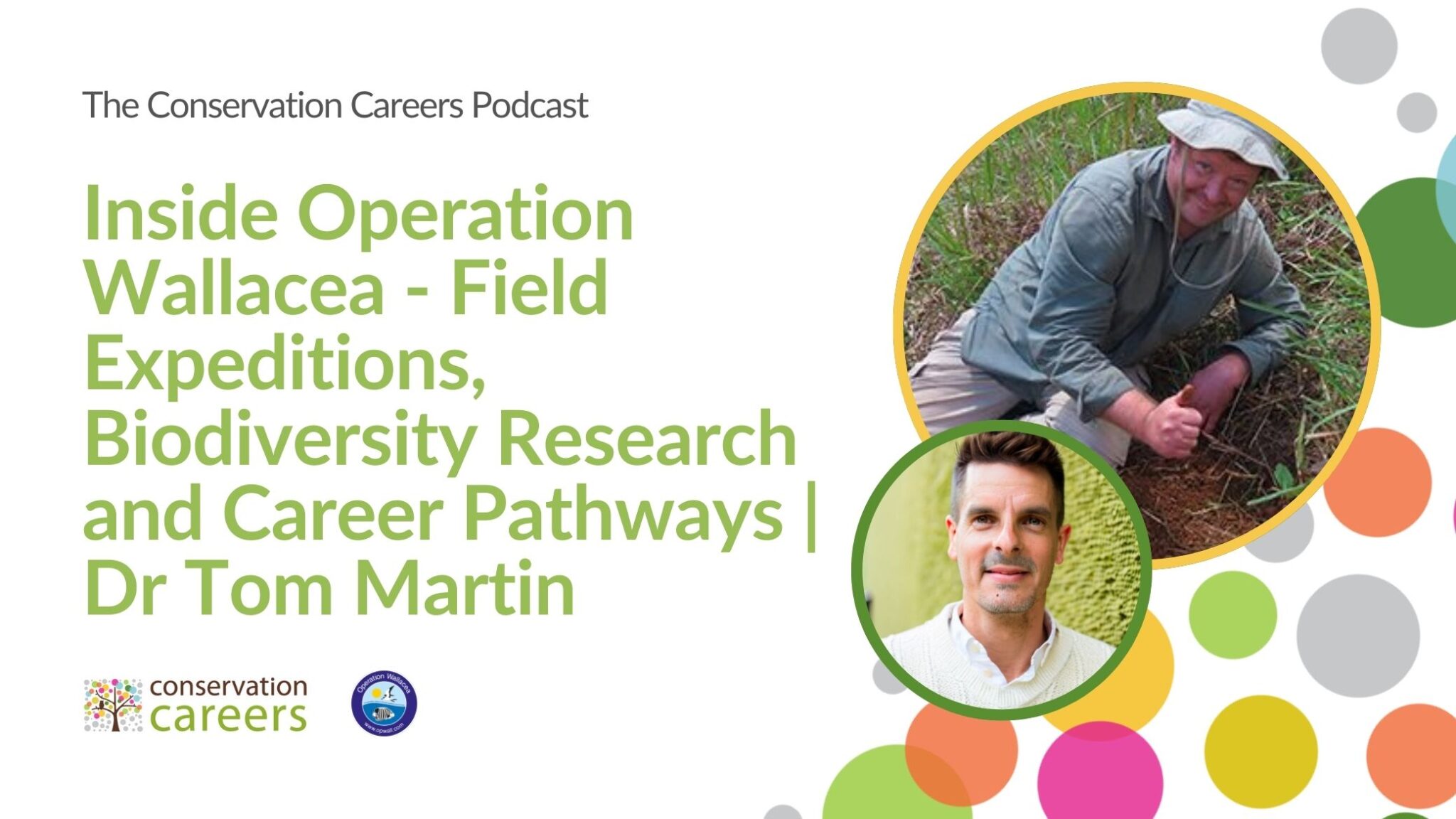
Podcast | Inside Operation Wallacea – Field Expeditions, Biodiversity Research and Career Pathways | Dr Tom Martin

From cloud forests to coral reefs – how Opwall blends science, education and conservation impact with Dr Tom Martin, Head of Research at Opwall.
Did you know that Operation Wallacea has taken more than 50,000 students into the field over the past 30 years.
But what actually happens on an expedition? How does the science work? And how can an experience like this shape an entire conservation career?
In this episode, I’m joined by Dr Tom Martin, Head of Research at Opwall, to unpack how their unique model combines rigorous academic research with hands-on field training across nine countries worldwide.
We talk about long-term biodiversity datasets, climate change in cloud forests, marine research programmes, and why practical field skills are becoming increasingly valuable in today’s conservation job market.
If you’ve ever considered gaining field experience overseas – or wondered how organisations like Opwall contribute to global conservation science – this episode will give you clarity and insight.
It’s an expeditions, ecology, and research podcast. Enjoy.
Listen
Watch
Subscribe
You can listen and subscribe to the Conservation Careers Podcast on iTunes, Spotify or Stitcher using the following links, or search for ‘conservation careers’ and you’ll find us!
Resources
- Join CC – www.conservation-careers.com/join
- Opwall website – https://www.opwall.com/
- Opwall Instagram site – https://www.instagram.com/operation_wallacea/?hl=en
- Opwall webinars – https://www.opwall.com/free-webinar/
- Opwall jobs – https://jobs.opwall.com/jobs/
Join our live podcast audience!
If you enjoyed the episode, please follow or subscribe so you never miss a new release – and if you can, leave a quick rating or review; it really helps others find the show.
A quick reminder – we record these conversations live with our members. If you’d like to be in the audience next time, stay on for the off‑mic Q&A, and put your questions to our guests, there are two ways to join:
- CC Pro – our members’ community with a busy schedule of events, access to the live Pro Chats audience, resources and templates, plus our job board with 4,000+ live roles at any time.
- CC Pass – access to all our premium training courses, including Conservation Standards Project Management & Design, Communications, Fundraising, Rewilding, Community-based Conservation, Marine Conservation plus our careers-trainings on applications, securing experiences, scholarships and more.
You can compare options and join at conservation-careers.com/join
Thanks again for being here – see you in the next episode.
Transcript
[00:00:00] Dr Tom Martin: I’m Dr. Tom Martin and I’m the head of research at Operation Wallacea.
[00:00:04] Dr Nick Askew: Tom, it’s also I should say Dr.
[00:00:06] Tom. Yeah, it’s so good having you on the podcast. Thanks for your time today. It’s good to kind of connect and I really want to know more about Operation Wallace here. We’re gonna hear about your career story, what it’s like to do your job as well. Um, but where to start. And I feel like the best place to start is like, just tell us about the organization that you work for.
[00:00:22] Yeah. So who is Operation Wellness or Op Wall as I think you’re often known as. Yeah. It gives a paints a bit of a pitch for those of us who don’t know much about you.
[00:00:30] Dr Tom Martin: Sure. Absolutely. So it’s, it’s a relatively unique organization. There’s no one. Maybe a few other smaller organizations, but not that many people who do precisely what we do worldwide.
[00:00:40] Um, essentially we’re a conservation, research and expeditions organization, so it’s, it’s been running for a long time now. So last year was our 30th anniversary. Um, and essentially for the last three decades, every single summer we’ve been taking students from schools and universities all around the world.
[00:00:55] And we take them to various sites, um, mostly but not all in the tropics. Uh, usually places which are not very well studied and could benefit from scientific attention. So we’re working in nine countries at the moment. I think historically we’ve worked in about 16 countries over the last 30 years. Uh, and essentially it’s a partnership between students and academics, so it’s actually quite rare for students to get, in fact, it’s increasingly rare compared to 30 years ago for students to actually get the opportunity to do really kind of hard nosed.
[00:01:27] Go have dirty hands, field work in interesting parts of the world. Those, those opportunities are diminishing as, as papers that have kind of proven that. So we offer students the opportunity to come to places like Indonesia, Honduras, Madagascar, um, learn how to complete surveys and collect data firsthand in those sites.
[00:01:43] Um, and it works very well because they’re taught in the field by experts, academics who are. Oh, have strong expertise in, in the particular fields of the countries or the tax that we’re working in. So essentially how it works, we’re based in a little, uh, village in the middle of Lincolnshire in the uk, but we work with academics, universities all around the world.
[00:02:02] Um. Essentially students join and they pay a fee, which covers basically all their costs that they have on site, but it also pays for scientific equipment, research permits, um, other bits and pieces that professional researchers need to come and do their research. So everyone benefits, really. The students benefit from having the opportunity to learn from world experts in recology or primatology or whatever it is they’re doing Surveys on.
[00:02:26] Very often they’ll collect data, uh, for their dissertation projects at university too. In fact, that’s how I first got into Opal 20 years ago through being a, a dissertation student that kind of set out my entire career. Uh, and the academics benefit because they get access to research sites, which are usually very hard to access even in the short term.
[00:02:43] But the real beauty of Opal is as long as we have students who want to come to our sites in the summer, we can just keep running year after year after year after year. Very hard to get. If you’re kind of from a more traditional academic background, ’cause that’s reliant on consistently getting grants funded, and as anyone who writes grants will know, that’s absolutely not certain.
[00:03:01] You might be lucky and get three years that you’ve gotta apply for it all again and hope you get another three years. Continue, continue with us. As long as there’s students who come to site, we can just keep going back to these places and develop these really long, long-term data sets. So we’ve got super long-term data from places like Honduran Cloud forests and you know, lowland forests in Mexico now.
[00:03:19] Pretty much no one else in the world has because of the way that op war works. So it’s very successful at educating students. I think we, we, I, I got the numbers last year. I think it’s 15,000 students we’ve taken away, give or take. Since 1995, um, sorry, 1996 was our first expedition. Uh, we’ve produced more than 700 papers.
[00:03:38] We’ve got our 700 peer reviewed academic paper last year, quite a few in science and nature. Uh, we’ve described over 18 new species to science. So yeah, as a concept, it’s, it’s working pretty well and has been working well for, for three decades now.
[00:03:50] Dr Nick Askew: That’s, it’s just incredible and what a great summary.
[00:03:53] Thank you. Yeah, you’ve really painted such a clear picture about the organization and, and how it works and it’s unique structure as well. Actually, I hadn’t quite appreciated the scale and how it works and how you’re providing like sustainable, long-term like volunteer, um, scientists collecting data that provides such important information about these particular sites.
[00:04:13] Dr Tom Martin: Yeah, it’s a bit of a hybrid, so
[00:04:16] Dr Nick Askew: yeah.
[00:04:16] Dr Tom Martin: It’s tempting to say operational as a citizen science organization. It is not really.
[00:04:21] Dr Nick Askew: Mm-hmm.
[00:04:21] Dr Tom Martin: Certain surveys that we do are capable of people, you know, within a week or two learning, they’re able to learn how to collect scientific data appropriately. So things like carbon stock projects and things like that, that is citizen science.
[00:04:32] ’cause the students will, will, will actually use the data that students source. Quite a lot of it is. Quite high level stuff, like you need years of experience to be able to source like bird ringing for example. Yeah. You, you can’t come to a site and be an expert bird ringer in a week. So for those, the students, so sometimes you’re collecting the data yourself, but other times you are facilitating an expert to be able to source those data by being on site by helping to collect, you know, helping with carrying equipment around logging data, being involved with the surveys.
[00:05:01] But it’s an academic with very specific expertise who’s actually. Driving that. And that’s why we’re able to publish lots and lots of papers. ’cause most of them are, are helped by students, but they’re ultimately driven by someone with a high level of scientific expertise.
[00:05:13] Dr Nick Askew: Yeah. Um, tell me about sort some of the sort of different types of experiences that people can get involved with.
[00:05:19] Are these all cloud forests? Is it coastal as well? You know, just, yeah, paint a bit of a picture. The sort of the, the different offerings that you have.
[00:05:27] Dr Tom Martin: Sure. So it is, it’s, there’s two ways of splitting it. There’s the, the sites that we have
[00:05:31] Dr Nick Askew: Yeah.
[00:05:32] Dr Tom Martin: And the way that students can join. Mm-hmm. So in terms of the site, they’re both split pretty much right down the middle actually.
[00:05:38] Um, so the sites are divided into marine and terrestrial. Mm-hmm. So I said there’s, there’s nine countries that we work in. Every single one of those nine countries has a terrestrial site. Um, often they’re tropical forests, but all the tropical forests are radically different. So there’s no such thing as a typical tropical forest.
[00:05:55] So, you know, our Indonesian tropical forest is, is low and wet forest a bit like what you might imagine in your head, a rainforest to look like. Honduras is, this is very special rare cloud forest. So you, you are working altitudes there of about 1,200 to 2,200 meters above sea level. Um, we also have dry forest in Mexico.
[00:06:12] We have a very rare dry forest ecosystem in Madagascar. So Madagascar, most people will go to, not many people work in Madagascar anyway, despite how famous it is, but of of scientific research programs that do occur there. Most people will go to the rainforest in the east. We’re the only people working in the dry forest up in the northwest.
[00:06:29] So all of our tropical forests are different. On top of that, we are also working at NEP here in the uk, which I’m sure some people will have heard of. It’s a very famous Rewilding site down in Sussex, so that’s not forest. Um, that’s kinda rewild farmland. Um, we work in a national park in Croatia, which is a bit of a mosaic of Mediterranean habitats.
[00:06:45] Um, and we work in a really beautiful site in Romania as well, which is not strictly forest. Again, that’s a patchwork of forest and farmland and other things. Hmm. So those are our terrestrial sites. Um, not all of our countries have a marine. Every country we work in has a terrestrial site. I think of the nine, six, have marine sites as well.
[00:07:02] Dr Nick Askew: Mm-hmm.
[00:07:02] Dr Tom Martin: So three are just terrestrial, um, Honduras, Mexico, Madagascar, Indonesia, these, and Croatia. These all have marine sites where we do drug dive training. Also, marine research as well. It’s about 50 50 in terms of research outputs. About half of them are, and about half of them are terrestrial. Um, all of those are, are coral reef, with the exception of Croatia, which is, is more of a Mediterranean dive site.
[00:07:24] Um, so tempting to say more homogenous are there of course, as, as big differences between Indo-Pacific reefs and Caribbean reefs and so forth. Um, in terms of how students can get involved, that split. Down the middle. So we take school groups, um, every single year from schools all around the world. We also take university students, so university students can join as one of two things.
[00:07:47] About 70% will join as something called a research assistant, an ra, which is broadly a little different from what school students do. So you’re coming out as an ra, you’re basically, you can come from between one week and, and sometimes even up to six or seven weeks. Um, so it’s, it is very variable in, in how long you come for as an ra.
[00:08:06] And the really, the goal there is to learn as much as you possibly can. So if you’re going to a site like Honduras, or we have like eight different biodiversity surveys in the cloud forest, you’re gonna go through as many of those as possible, as, as the time on site allows ’em learn as much as you possibly can.
[00:08:19] Um, you haven’t got anything really specific riding on it. Your, your goal there is just to meet people, learn from experts, learn survey techniques, learn about cloud forests and so forth. Um. If you come as a dissertation student, which is about 20 to 25% of universal students, it’s totally different. You’re coming for a very specific purpose.
[00:08:37] This is what I did when I first came out. Um, there you’re coming for six weeks and you have a very specific goal, which is to collect data for your dissertation. So if you’re coming to do a bird project. You are not gonna be chopping and changing between, you know, amphibian surveys and bat surveys and everything else.
[00:08:52] You’re just gonna be doing birds. You’re gonna be getting up at 4:00 AM every single day for six weeks. And you are gonna collect a really, really good data set. And that will then you’ll return to university and then write that up as your final year project.
[00:09:02] Dr Nick Askew: And just on that, um, do people choose the, the, the research topics themselves?
[00:09:07] Do you offer the topics that people choose from your selection? How does that work?
[00:09:11] Dr Tom Martin: It’s a hybrid. You’ve gotta be a bit careful because if you, if you had it like as a complete open board
[00:09:16] Dr Nick Askew: Yeah.
[00:09:16] Dr Tom Martin: People would suggest things, which absolutely would not work in any way, shape, or form. So it has to, it has to fit in.
[00:09:21] Dr Nick Askew: Yeah.
[00:09:22] Dr Tom Martin: Um, with the surveys that we’re also doing, and it has to involve a survey. That’s gonna produce a really robust data set. So all of our surveys are useful for scientific data, but some of them are quite, some of them like rely on exports, which can take a really long time to get out of the country.
[00:09:36] So that’s useless for dissertations. Some of them are super interesting, but they don’t produce big quantitative data sets. So what we do is we advertise on our website, it’s, it is a wide choice, but it’s not absolutely everything. You have to pick a theme. So the theme might be. Bird communities in a cloud forest or, or her petor distributions in, in a Mexican tic forest or whatever.
[00:09:58] Dr Nick Askew: Yeah.
[00:09:58] Dr Tom Martin: So you pick a broad theme from a list of about, oh, we’ve probably got about 25, I’d say we’ve got about 25 terrestrial ones, maybe 20 marine ones now.
[00:10:07] Dr Nick Askew: Yeah.
[00:10:07] Dr Tom Martin: Um, and then you still have to come up with your own question. It is quite a vetted process. You have to do quite a lot of work before you come to site mm-hmm.
[00:10:14] To make sure you’ve come up with an idea that’s actually gonna work when you arrive. Um, but essentially you, you pick your own topic from the theme that we give you, and then you write a proposal for us. And then around this time of year we check it and we make sure is this actually gonna work? And if it does.
[00:10:29] That’s great. You are set to go with a bit of feedback. Yeah, it is not gonna work. It’s something that’s just, these students have never actually been to site before, so it’s often hard to tell what’s gonna work and what’s not. Then we are able to point ’em in directions where you could tweak it. So it is actually practical.
[00:10:43] So you pick within a theme, you pick your topic, and then we make sure that the topic will actually work. And yeah, it is working really well. We’ve done this. Ever since we’ve existed, um, I think the latest stats I’ve got 90% of students who do a dissertation get a two, one or a first, and it’s about 65 to 70% get a first.
[00:11:01] So because you, you’re doing a really interesting project that’s gonna stand out from, you know, what your other, um, course mates are, are likely to be doing, not necessarily that you should. That’s the case.
[00:11:10] Dr Nick Askew: Yeah. So fascinating with the now. Was it the research associate, have I got that right? The RA
[00:11:15] Dr Tom Martin: research assistant?
[00:11:16] Yeah.
[00:11:16] Dr Nick Askew: Assistant. Thank you. Yeah. What, what, tell me what, like a typical experience looks like for a research assistant. If most people are, are of that level, um, how long are they there for again, and what does a typical day or week or experience look like? What are they doing day to day? Like if you’re on the ground landed day one, what are they?
[00:11:32] Expecting to, to experience. I know that’ll be depend on where they are. So you, you can pick an example if you wish. Yeah,
[00:11:38] Dr Tom Martin: sure. I mean, it depends a little bit on how long you come for.
[00:11:41] Dr Nick Askew: Yeah.
[00:11:42] Dr Tom Martin: Um, but let’s say like an average ra, let’s say if you, if you go into a forest site, let’s say an average RA will come for two weeks to a forest site.
[00:11:48] You can come for longer. You can come for less sometimes as well. What you get with RAs, it’s not that common. But you might get someone who. Only cares about snakes. They just wanna do snakes. They care about nothing else, which is fine. You can just go and do snake surveys if that’s what you want to do.
[00:12:00] Yeah. Um, normally what you’re doing, like 95% or more of students who come out or want to get through everything.
[00:12:06] Dr Nick Askew: Yeah.
[00:12:06] Dr Tom Martin: Um, so you typically in, so let’s, I don’t know, let’s go stick with Honduras, for example. Um, ’cause that’s a, that’s a, well they’re all interesting sites, but that’s one I know quite well. Um, you tend to be going out three times a day.
[00:12:18] So it’s, it’s busy. You’re gonna get a good workout. These are proper field work sites, uh, particularly terrestrial ones. There’s like a, a gradient of physicality to them, but they usually, you know, you’re, you’re quite far out in, in, in which you have to, you wanna go and study these really interesting ecosystems.
[00:12:32] You have to be sort of 1500 to 2000 meters up a mountain to kind of study the species that you wanna study in. Um, so I guess you, you fly out at the beginning. Um, we pick you up in country. So you meet at the airport, we take you to a. You know, a hotel your first night, then we drive you up the mountain the next day.
[00:12:49] You have a little bit of acclimatization for a couple of days. First we call it jungle training, where it’s, it’s 50% to acclimatize and get used to hiking and that kind of thing. It’s 50% to kind of learn about the forest and do some fun things in the forest before you settle into the survey. So you do that first.
[00:13:04] Then for the rest of your time, you’re kind of rotating between the surveys. So. There’s morning surveys. Afternoon surveys, and there’s night surveys. Um, so you can, most people do, but you don’t have to. You’re feeling exhausted. And if you’re there for two weeks, you might be getting a bit tired by the end.
[00:13:19] Um, but typically speaking, you’re getting up early to do a morning survey. If it’s birds, that’s really early. ’cause you’ve gotta be up here, your site at the crack of dawn. Um, if it’s something like mammal surveys, you, you’re having breakfast first and then you’re heading off.
[00:13:32] Dr Nick Askew: So, and if it’s, and if it’s butterflies, it’s just mid-afternoon, isn’t it?
[00:13:34] We all know that’s how they work. Yeah. Yeah.
[00:13:36] Dr Tom Martin: That’s one of the afternoon ones. Yeah, exactly. Exactly. So you tend to go out in the morning, you’re doing birds, you’re doing mammals. There’s various other things you can do in the morning. Um, three meals a day. So you and all, all the expeditions are basically rolled around meals as any good expedition should.
[00:13:50] Yeah. So you come back, you have lunch, uh, and then you go out on the afternoon, which can be, you know, going to measure carbon and habitat structure in a forest.
[00:13:58] Then you come back again and if you have dinner, and if you’re not exhausted at that point. You might want to cut this if you’ve been up at 4:00 AM to go on a bird survey. Uh, but then there’s night surveys, which are, you know, frog surveys on rivers at night, bat surveys, um, and so forth. So it is pretty busy.
[00:14:15] Like you, you get through a lot of things. Um, during your time there. We have some really specialist projects as well. There’s fungi surveys, for example, in the Hondu and Cloud Forest. I think we are the only people in the world doing a long-term fungal survey in a, in a central American cloud forest. So, so yeah, some really kind of.
[00:14:31] Common survey, some really specialist ones as well.
[00:14:35] Dr Nick Askew: And tell me a little bit about the, sort about the, the academic rigor of this that seems so important to like the experience that the students get, but also the kind of the. The, the, the importance, the authority of the data sets that you’re building, the studies that you’re doing as well.
[00:14:47] Like how do you select the experts who are the experts? Um, yeah. And what are you learning from some of the long-term studies? You mentioned, you know, 700 studies and so many different species. There any, like particular things that really stand out to you as, you know, we’ve really learned something important here, or this has been, you know, important to conservation efforts in this site?
[00:15:07] Yeah, just, just, yeah, just talk to that if you can. Yeah.
[00:15:09] Dr Tom Martin: Yeah, I’ll, there’s, I’ll sit with Honduras as a really good example. Yeah. Which, which I’ll discuss. Um, it’s a series of papers rather than one, but it’s, it, it kind of shows the value of these data sets. The first thing I’d say is, is to bear in mind that the, the nature of the surveys are gauged to.
[00:15:24] The suitability of the people that run them.
[00:15:27] Dr Nick Askew: Yeah.
[00:15:27] Dr Tom Martin: So we can get really good carbon stock data simply by having students measure trees. That’s easy.
[00:15:32] Dr Nick Askew: Yeah.
[00:15:32] Dr Tom Martin: But if you’re talking about point count, bird, point count data, it’s a highly skilled job. You’ve gotta have someone who knows what they’re doing doing.
[00:15:38] We can train you in it and you can learn the basics. If you’re a dissertation student, you’ll be pretty good by the end of six weeks.
[00:15:43] Dr Nick Askew: Yeah.
[00:15:43] Dr Tom Martin: It’s not something you can pick up in two days. So you learn the basics of it, but it’s the actual experts who are, um, sourcing that data. For something like mis nesting or bat, obviously you, you can get involved with the BAT surveys, but you’re not gonna be extracting bats from the net yourself.
[00:15:56] It’s someone who’s trained in, in bat handling.
[00:15:58] Dr Nick Askew: Yeah.
[00:15:58] Dr Tom Martin: Um, so we’re quite lucky in that we have quite a lot of returning staff who work with us. So these are the guys that benefit coming back year after year, after year. We sought the permits, we sought all the equipment out, we, so it’s actually really good value for a lot of these academics ’cause they get access to these long-term data sets.
[00:16:13] They help train and teach and educate our students. And they’re getting these amazing data sets, which they’re sourcing in exchange. So a very good example sticking with Honduras is the impact of climate change on birds. So climate change is talked about all the time. It’s actually incredibly difficult to get empirical data that proves some of the theory on climate change.
[00:16:35] So there’s a, there’s a big thing with cloud forests. It’s called the escalated to extinction effect.
[00:16:40] Dr Nick Askew: Hmm.
[00:16:40] Dr Tom Martin: And the idea is if you imagine a, a mountainous forest in the tropics, it’s a bit like a wedding cake. So you’ve got the lowest band at the bottom of the mountain is lowland forest. You go up a little Hyatt, there’s like a smaller band of hill forest.
[00:16:51] You go up a little bit more and there’s cloud forest. And then right at the top you’ve got something called Elfin Forest, which only really persists on the, on the really high peaks. And the theory, um, which is makes sense, but it’s very hard to prove, is that as global warming kicks in the, the lowland forest will go into the hill forest.
[00:17:07] The hill forest will go into the cloud forest. The cloud force to go right to the peak. What happens in the open forest, it just completely vanishes ’cause it hasn’t got anywhere else to go. So these bans of habitat, as they’re warming up, are creeping higher and higher up the mountain. That in itself is, has a lot of destabilizing effects.
[00:17:22] But for the stuff at the top, that’s a squeeze. That’s the escalator to extinction ’cause other things just don’t exist anymore. In theory. The, the reality is if you want to prove that something that that works, you need a 15, 20 year data set. You can’t get dev evidence on climate change in a year or two.
[00:17:36] Um, that’s circumstantial. It’s not two points on a graph, it’s not climate. Um, so yeah, it just so happens in Honduras, we have actually been going back to these, these same points of 20 years now. We first started collect point count data in 2006. Hmm. We took right the way through to 2026. The exception was COVID.
[00:17:53] Like we have a gap in all our data sets. ’cause we couldn’t go anywhere in COVID. Other than that, we have these, these, these huge data sets and it’s actually long enough. So there’s, there’s a guy we worked with called Dr. Sam Jones. He’s, he’s currently out at the University of South, sorry, the Georgia Technological Institute in, uh, in Atlanta.
[00:18:09] Um, he’s actually been able to show, yeah, if you have a long, long enough timeframe, you can start to see birds that were recording at lower altitudes in 2006 are now getting higher and higher and higher. 20 years later. So it is, it’s a rare example of being able to actually prove, yes, this escalator to extinction effect does seem to be born through with, with empirical data.
[00:18:30] So there’s, there’s lots of other examples of similar things, but that’s, that’s a particularly good example I think.
[00:18:35] Dr Nick Askew: Yeah, so clear, isn’t it? Yeah. And shows the value of these long-term data sets. As I say, like when you go for funding grants, 2, 3, 4, maybe five years, you’re really lucky you’re not gonna get 20 years funding for these sorts of data sets.
[00:18:44] And to be able to answer some of these really important questions. Yeah. Do you just, um, for your participants, you talked about school groups and university groups. Um, do you welcome other people as well that aren’t within a kind of, you know, an academic or a study setting? Or is it just people who have of those Yeah, those settings that can come along.
[00:19:03] Dr Tom Martin: Yeah, that’s a good question. Anyone can come. Um, all, all we really want is people to be enthusiastic and have a desire to learn about biodiversity and about field work and so forth. Um, it so happens that for most of our sites that it’s. Dominated by people who are at university or or school. Yep. Because that’s where the majority of our contacts are.
[00:19:23] That’s where we go and do talks throughout the year and so forth. But we increasingly, we do give talks to societies and things as well.
[00:19:28] Dr Nick Askew: Yep.
[00:19:28] Dr Tom Martin: Um, so we do get a few people every single year who are nothing to do at university. Retirees. People are looking for a career change. Absolutely. They can get involved.
[00:19:37] It, it tends to be just historically dominated by those two groups. So there is a really interesting exception though. Which is nep. So we have a really interesting site down in that Rewilding center in, in Sussex.
[00:19:48] Dr Nick Askew: Yeah.
[00:19:48] Dr Tom Martin: That is the most di ’cause people hear about that from all kinds of sources. It’s quite well known.
[00:19:53] I think our youngest people at the NEP site were 16 and the oldest was 75 last year. So big range of ages there. Lots and lots of people who aren’t university. It’s, that’s the most kind of, um, diverse in terms of the backgrounds that people come from in terms of their, you know, whether they’re in an institution, an education or not.
[00:20:12] Although we, we do welcome people from pretty much anywhere at all of our sites.
[00:20:17] Dr Nick Askew: Fantastic. I’ve got, you can’t see it’s fades. That’s wilding there about NEP just over my shoulder. Oh, nice. In the background. Such a, yeah. Such an amazing site. I’ve yet to visit it yet, but I can see why it’d be popular for people, particularly in the UK, to go and see what’s happening and the changes that have occurred so rapidly over the last, I think just gone 20 years for them.
[00:20:34] See, it’s, it’s such a great site, isn’t it? Yeah,
[00:20:36] Dr Tom Martin: yeah. It’s, it’s, it’s much more, I. I went there with an open mind thinking how good can a site in Sussex really be actually is really good. It’s super, super, it is massive and the biodiversity is super, super impressive. So I was, I was pretty blown away the first time I went there.
[00:20:49] It’s, it’s a, yeah. Really, really interesting site.
[00:20:51] Dr Nick Askew: Yeah. And in, and it is changing the way that people think about conservation and. And I think providing huge hope for people about how rapid change can come when we get conditions right? Yeah. Yeah. As someone, I used to, I used to work at BirdLife International and we, we were studying like migrated bird species and things like turtle doves that we’ve seen huge declines, you know, and has problems all along.
[00:21:12] Its Flyway, but I think what NEPs shown is that we can tackle these problems at home and these species can come back so quickly, you know, so whereas sort of. Not hope was lost, but it was a real challenging case of how do we tackle such huge problems actually we can tackle ’em at home and change things really quickly.
[00:21:27] And nets kind of questioned an awful lot about what we do as a movement and how we Yeah. Resource things and, and how quickly change can happen.
[00:21:35] Dr Tom Martin: Mm-hmm. Yeah. 20 years in the, in the grand scheme of things is a blink of an eye and what, how that site’s changed from open agricultural fields to what it is now of Nightingales everywhere.
[00:21:43] Purple Emperor butterflies, everything else. Yeah. It’s, it’s really phenomenal.
[00:21:47] Dr Nick Askew: Well, before we kind of talk about you and your job, Tom at Upwell, um, I was gonna ask about what, what do you see in terms of the career outcomes for some of the people that go through some of your expeditions then?
[00:21:58] I mean, obviously it sounds like you did it all back in the day and you are there now, you know, heading up conservation, but what, you know, what typically do people go on to do? How does it benefit people’s careers?
[00:22:08] Dr Tom Martin: So it, again, it depends a little bit on what site you go to. I mean, I’m thinking this particularly about NEP here, so I’ll start on nep, um, N’S a little different from other, other sites.
[00:22:18] All our other sites are set up in quite a similar way. Yeah. NEP was set up in a very specific target in mind. Mm. So, um. Nep, you don’t come for for six weeks, you just come for one or two weeks. Mm-hmm. And the entire thing is run as a course. So we do do primary research in nep. We’ve got some really interesting papers out last year from including a new fly record for the uk, which was really cool.
[00:22:39] Um. But essentially the, one of the main reasons we set up net is we realized that, and this builds into our wider concern with all of our sites, that there aren’t just really opportunities to do really kind of field centered skill development. There used to be, which is, I’m very unfortunate because.
[00:22:56] There’s lots of jobs that require field focused skills and universities aren’t really teaching them very well anymore. That’s a generalization, but I think it’s fair to, in fact, there’s papers that show, you know, there’s a really good one titled to, you know, are field studies being relegated to second place in education and things like this.
[00:23:10] So there’s, there’s genuine concern about that. Um, so that’s broad regardless of where you go. Net was set up particularly to give skills to people who are interested in any career, but particularly environmental consultancy. So consultancy work is the single biggest employer of any biology related degree, doesn’t matter.
[00:23:28] It’s environmental science, zoology, ecology, whatever. It’s the single biggest employer that’s just gonna get bigger and bigger. It’s a great way of getting a really kind of secure job that’s gonna, you know, that’s attainable and it’s gonna keep you employed for a long time
[00:23:42] Dr Nick Askew: and gives
[00:23:42] Dr Tom Martin: you
[00:23:42] Dr Nick Askew: trade as well as you enter it.
[00:23:43] Yeah.
[00:23:44] Dr Tom Martin: Exactly. The issue is you’re not actually given much information about how do you actually become an ecological consultant, and what do you actually do when you’re doing your degree. So that whole site is set up. You come for one week or two weeks, and again, we have got scientists there, they are doing primary research.
[00:23:59] Mm-hmm. But what the students do is you sign up for a one or two week where you just spend as much time as possible learning those really hard skills on how to be, uh, ecological consultants. How to, you do UK Hab surveys? Mm-hmm. How do you do UK breeding bird surveys? How the demonstrations of, of new surveys from someone who’s licensed and so forth.
[00:24:15] How do you can calculate carbon stocks in the forest?
[00:24:18] Dr Nick Askew: Mm.
[00:24:18] Dr Tom Martin: So that’s super vocational. ’cause it’s, it’s teaching you those really, really hard skills. And a lot of people will then go on to become consultants where there’s lots and lots of work. Mm-hmm. Courses online you can join as well. They teach you skills like GIS and R coding and things like that.
[00:24:32] It is quite common to come to one of our sites, do the surveys, um, in the day, and then in what time that you have. You can also work on the online courses and ask people questions while you’re there as well. So you’re getting these, these technical skills.
[00:24:43] The sites will massively benefit your career and, and kind of guide people’s career paths. It’s certainly very true for me. Um, the first thing is you’re separating yourself by having a really, really interesting dissertation if you do a dissertation. Mm-hmm. And you are separating yourself by showing that you have really hard field skills, which again, are in the client elsewhere.
[00:25:02] Um, the other really useful thing it gives you is contacts. Mm-hmm. So this is, I’m sure other people have said this, but personal contacts are like one of the most important things in the conservation career for sure. Mm-hmm. Um. And you’re going, one of these expeditions, you’re spending six weeks potentially in a forest of other experts or, or experts in that field who are teaching you, who are gonna remember you.
[00:25:21] Loads and loads are the light minded people who are joining expedition at the same stage of the career as you are. Mm-hmm. Um, so that is also really good for networking and, and finding future routes that way, um, if you do really well, you also get invited back as well. You can get invited back as a staff member, which is also what I did, which again, you kind of snowball your contacts, you snowball your experience by coming back as staff and running the surveys that you started off as a student on, um.
[00:25:43] It’s actually surprisingly common. If you look around, it’d be interesting to actually dig into this a bit more. But for academic career paths.
[00:25:49] Dr Nick Askew: Mm.
[00:25:50] Dr Tom Martin: There’s a lot of people out there whose first experience ever on publishing a paper or their PhD or their first ever overseas field work experience was, um, coming out with an opera expedition decades ago.
[00:26:03] So lots of the professors, it might be teaching some of your listens at university. If you’d look at Intuit, they actually have their roots of coming out with us a long time ago. It is, it is set up a lot of careers from an academic perspective for sure.
[00:26:13] Dr Nick Askew: Yeah, the sort of 30 year sort of ripple effect of all those people now out in their careers doing what they’re doing and the impact that you’ve had must be huge.
[00:26:21] Yeah.
[00:26:22] Dr Tom Martin: Mm-hmm.
[00:26:23] Dr Nick Askew: Um, tell us about your job then, Tom. Like what, yeah, what is it like, what is your job, um, and what is it like to do sort of day to day, week to week, just sort of bring your role to life then I imagine someone flying around the globe all the time doing lots of surveys. Having lots of fun, seeing some amazing things, but, um, yeah, put me right.
[00:26:42] Dr Tom Martin: I mean it’s actually, it’s, it’s incredibly variable depending on the year.
[00:26:45] Dr Nick Askew: Yeah.
[00:26:46] Dr Tom Martin: So it, it shifts massively annually. So I’m the head of research and my overarching goal is to oversee collaborations with the academics we’re working at. I have a strong educational role as well, so supervising dissertation topics mm-hmm.
[00:26:57] And supporting the company with various research related questions and managing data sets and things like that. Um. How it tends to work. We don’t go overseas that much. Actually, like this is the same for all of us. Our expeditions, I’m not sure if I mentioned this at the start, but they’re very, very seasonal.
[00:27:12] They only run in the university holidays and the school holidays. So we’re only actually in our field sites from early June to early August.
[00:27:19] Dr Nick Askew: Mm-hmm.
[00:27:20] Dr Tom Martin: So our field sites run then we’re, I’m in the field the entire summer, but I’m not in those sites for the rest of the year at all, except for very rare kind of exceptions.
[00:27:29] Um, so it is usually starting with the year. It’s a lot of January’s quite good for collaborations, chatting to people, making sure things are working the way they’re going. We work with universities all around the world, lots of collaborators. There’s lots of always something, you know, papers to push through new collaborations, to set up visits to universities,
[00:27:47] and now is a really kind of solid time for, for working on those collaborations and, and pushing research projects forward. As we get closer to the season, it gets busier and busier with, with regards to, um, making sure the expeditions are ready to run. So we all leave in June, so kind of March, April, may is very focused on making sure everything’s gonna run properly.
[00:28:08] Are the dissertation students ready? Are they got projects that will work after we’ve got all the staff contracted to come out to site? Do we have all the equipment we need? Are the permits all in place? All these bits and pieces like that, that tend, it becomes very, very field focused. Um, in those three months proceeding.
[00:28:24] June. Um, so spring is, which we’re just kind of transitioning into now, then the summer, eight weeks in the field. Um, that’s great. It’s really fun. Uh, I used to go in my old, my other roles at Oppo. I used to go for one site for the whole season. So I was based in Indonesia for years and years and years. I used to just go for eight weeks to Indonesia, then Honduras, uh, and I also Croatia.
[00:28:45] But now I tend to go to one or two or three sites. Well not one, two, or three, or four sites probably every summer. Mm-hmm. Um, and you kind of just check in. Everything’s running properly, go where the kind of, the, the most complex scientific programs are usually. Mm-hmm. Um, make sure everyone’s happy. Yeah.
[00:28:59] It’s great. Um, so that’s, that’s a very, yeah. Always a very enjoyable time of the year to go around and see the sites and make sure everything’s running smoothly. Then you come back and there’s a lot of close down report writing, things like that.
[00:29:10] Dr Nick Askew: Yeah,
[00:29:11] Dr Tom Martin: making sure dissertation students who have just been out are still supported.
[00:29:14] Um, and then in the autumn we do a lot of university work. So we go around universities in the UK talking to students, promoting the, the expeditions, making sure people are aware that we run. Um, and if you wanna sign up to us, you can sign up with us, you know, all the way through spring. But most people will do it quite far in advance.
[00:29:30] That kind of October through to December period is, is when most university students will sign up for an expedition or sign up for a dissertation. Um, so there’s a lot of kind of. Traveling around the country, chatting to people. Then, um. We have the bits and pieces as well. Like in October we have our annual conference, which is called October Fest, uh, which we do basically 10 talks and all the research that our, our collaborators are doing.
[00:29:51] So that’s a bit of organization. So I guess in summary, it’s highly varied, like different parts of the year tend to evolve really distinct things. There’s always collaborations to push, there’s always students to support and things like that. Yeah. But it definitely kind of rotates from winter being very collaborator focused.
[00:30:09] Spring being very expedition preparation focused. Summer being the expeditions and Autumn being quite university focused, I would say.
[00:30:16] Dr Nick Askew: Yeah, very cyclical, very seasonal. Yeah,
[00:30:19] Dr Tom Martin: it is. Yeah.
[00:30:20] Dr Nick Askew: What do you, what do you enjoy most about your job and like what are some of the biggest frustrations or challenges that you’d like to share publicly?
[00:30:27] Dr Tom Martin: Um, it’s a, I mean, it’s super, super interesting. You’re working with people all over the, well, it’s, it’s interesting from the student facing side of things, it’s also really interesting from the academic facing side of things.
[00:30:37] Dr Nick Askew: Yeah.
[00:30:37] Dr Tom Martin: So from the students facing side of things, I’m, I’ve, I’ve got a background in lecturing as well.
[00:30:41] I love working with students. Um, it’s very satisfying seeing student projects come together. What’s super, super satisfying, actually, we see this quite a lot, is you, you meet someone online as an email, you know, in February. 10 years ago saying, I wanna come out and do a dissertation with you. And that then needs to come out as a staff member, then they can’t to be a survey leader and so forth.
[00:30:59] And you quite often follow the progression of, of these students who come out, you know, as their first ever field topic. Yeah. And you, you end up seeing them being, you know, world experts in Honduran birds or whatever. That’s really satisfying. Yeah. Um, the, the research collaborators point of view is, is super interesting too.
[00:31:14] It’s, it’s hard work. But there’s a lot of place to spin any given time and you know, you kind of have to have some kind of knowledge of the most kind of diverse, kind of, not an expert in anything but, you know, some expertise or, or at least knowledge in a lot of different things. ’cause you are, you’re collaborating with people doing bats and carbon and all sorts of things.
[00:31:32] I don’t do so much of the marine stuff. That’s, I’ve got a, a colleague who, who heads up a lot of that. And another colleague who’s just started, who’s, who’s more near tropical facing. Um, but, um, I am involved with the marine research. I’m just not the, you know, necessarily the, the primary contact, but for a lot of the other work I am.
[00:31:46] So it’s, it keeps you on your toes. Um. And it’s, yeah, it’s, it’s very satisfying, kind of jumping between all these different projects and learning lots about lots and lots and lots of different things. So I, I started off with a background in Ornithology, I’d say.
[00:31:59] Dr Nick Askew: Yeah.
[00:31:59] Dr Tom Martin: Um, that’s long since passed and now I have to kind of know about lots of things I didn’t know about 10 years ago.
[00:32:05] So that’s, that’s been super interesting as well.
[00:32:07] Dr Nick Askew: Broadened out. Yeah. It’s funny, as we’re talking, I sort of, to me it feels like Operation World. It feels like you’re almost like a university, you know, it feels like you’re academic institution, you know, and your campus is these sort of nine field sites and students flow through it every summer, and everything else is about organizing those visits and the trips and then publishing the scientific literature off the back of that.
[00:32:28] Yeah. Does that sort of, does that feel like a, a true description of who you are?
[00:32:32] Dr Tom Martin: Yeah, I think so. I think that’s a good analogy. The, the, I guess the differences are, um, faculty. Are very dispersed. Yeah. So it is, it’s like an open university, I guess, kind construct. ’cause they’re not in all in one building.
[00:32:45] Um, they’re in Birmingham University and Vancouver and Georgia and everywhere else. Um, but yeah, it, it’s kind of a, a dispersed academic community is a really good way of looking at it. And all the academics who, who are basically these institutions work with each other for up all as well. So it’s kinda like a big, a big web.
[00:33:01] Um. Some of us will get together every October in person and, you know, have the conference and have chat face to face and we see in the field season. But otherwise it’s, yeah, a lot of Zoom calls and things like that, but it’s, yeah, it is still a very good analogy for sure.
[00:33:14] Dr Nick Askew: And what does the core team at opw look like?
[00:33:16] Those yourself? I mean, it sounds like, it sounds like quite a lot of staff are quite seasonal, but are there, how, how much, yeah, how much is the, how big is the core team? What does that look like? The, who work? You know, I,
[00:33:26] Dr Tom Martin: I would say the court, so the, we’re based in Lincoln Show.
[00:33:29] Dr Nick Askew: Yeah.
[00:33:29] Dr Tom Martin: Um, the research team is, is three people strong.
[00:33:32] Yeah. So, so there’s three of us basically doing all those tasks. I just went through, yeah. That split between us with, you know, equipment ordering and permits and academic collaborations and all of that. Um, so I, I’d think that the overall company size. I’m gonna say it’s about 25 to 30 people at the moment.
[00:33:50] Full-timers who work all year round. Um, that doesn’t include all our in country partners and things like that. They’re, they’re employees. Um, we have a very, lar, well I say very large, we’re only 30 people in total, a sizable group are, um, in sales. So they’re maintaining, you know, making sure people, the admin’s working.
[00:34:09] Also doing a lot of school visits and talks, although we do that as well. Actually, we’ve got to give talks at schools, but other people will do that as well.
[00:34:15] Dr Nick Askew: Yeah.
[00:34:15] Dr Tom Martin: Um, but I, you’ve got, you know, a couple of thousand people coming out every summer. That’s an awful lot of admin related to it. Mean sales. But it’s, it’s really, it’s supporting, supporting the process of getting people from expressing a first interest to actually getting them out to site.
[00:34:29] That’s, that’s, that whole process is a lot of work. So there’s a lot of people working on that. Um, a lot of those people in sales as well though, said, yes, that’s a big part of the company, but they actually wear two hats. So most people in the company will also be a country manager, not everyone, but most.
[00:34:44] Dr Nick Askew: Mm-hmm.
[00:34:45] Dr Tom Martin: Which means that pretty much everyone in Opal, there are some exceptions, but almost everyone in Opal who’s in the office for nine months of the year or 10 months of the year, will also be in the field for two months of the year too. Mm-hmm. Um, so it’ll often be the case in Autumn. You’re doing a lot of, of the more kind of office based work.
[00:35:00] Relating to people trying to book on and things like this and supporting that process. But increasing is same with me. March, April, may, they’re then starting to put their country manager hats on. So someone in the office would be the manager of Madagascar, someone else would be the manager of Indonesia and so forth.
[00:35:14] You start to get a lot of logistics, um, kind of work well.
[00:35:18] Dr Nick Askew: Mm-hmm.
[00:35:18] Dr Tom Martin: So a lot of our. Yeah, a lot of people wear two, two or more hats at as well. Um, then we have a travel department. We’ve got finance. Um, so yeah, we’re, we’re not a huge organization, but um, yeah, it’s a medium sized one where, which is usually a lot of work to get everything going, but we manage pretty well.
[00:35:39] Dr Nick Askew: Yeah, yeah, yeah. Fascinating. Um, what has been your career? History to date. When you look back at you’re head of research now, like, well, let’s start at the beginning, like where did your interest in, it sounds like birds in on morphology come from. Mm-hmm. What have been the kind of key career steps, progression moments that have helped you to get to where you are today?
[00:36:01] Dr Tom Martin: I’ve had a bit of an unusual career path. It’s, it’s been very interesting. Um, I’ve had a good time, certainly, I mean, I’ve only really ever done, I’ve done like, you know, when I was younger and stuff in between university. Kind of years and things like that. I’ve done other smaller jobs, of course, um, but since I was 18, I haven’t really done much different.
[00:36:18] Um, so I guess, yeah, I guess it started, I went off for seven months to Zambia. After I finished my A-Levels all these years ago, and that was great. It was really fun. It was like very eyeopening and that kind of set the tone for the rest of my whole career. I went and volunteered at a, a national park out there.
[00:36:33] Um, great fun looking back. Oppel was a very kind of high level organization with lots and lots of everything’s kind of risk assessed and very tightly run. Uh, that one, that one wasn’t. So, you know, I had a great time at the time and looking back at it, I was like, Ooh, yeah, that would’ve raised a lot of red flags if, if, if, you know, I got audited, um, by today’s standards.
[00:36:54] But it was, it was wonderful fun. It was, it was fantastic. I had the most wonderful time. Um, and that kind of cemented my desire. I really want to, you know, get into this as a career.
[00:37:02] Dr Nick Askew: Mm.
[00:37:02] Dr Tom Martin: So then I went to university. I was up at Lancaster and I actually made a very important decision, um. Which I guess maybe will bear through as some advice actually, but it was, it was a course that I took, so I knew that I was interested in conservation.
[00:37:16] I knew I was interested in zoology. I also kind of knew very clearly that zoology and conservation can be very broad things and you don’t necessarily have to be pigeonholed of how you study it. And I also knew that that comes from working in Zambia for all those months amongst other things. Um, and I also knew I wasn’t very good at certain things.
[00:37:35] I knew I was terrible at lab work, for example. I wasn’t very good at anatomy and things like that.
[00:37:39] Dr Nick Askew: Mm-hmm.
[00:37:39] Dr Tom Martin: So a zoology degree or environmental science degree, I probably wouldn’t have done very well at. Um, but I did like geography and I knew what geography entailed, and I also knew that geography can basically be tailored to whatever you want it to be.
[00:37:50] It as a bit of a synthetic subject where the principles of spatial analysis, but also that intersection between human society and the natural world. That’s geography. I decided to pick that over. You know what some people might think is a more common degree choice for a conservation biology. And that worked really well for me.
[00:38:05] ’cause I did, I did really well at geography, but I would’ve been awful as a, you know, environmental scientist or something. Or you’re in a lab with test tubes and that sort of thing. So that set me up really well. Um, I got into oppo, I think I mentioned already. I got into oppo in my undergrad, so I signed up to go and do a dissertation on birds.
[00:38:21] That’s where that kind of first connection with bird specialization came in.
[00:38:26] Dr Nick Askew: Yeah.
[00:38:26] Dr Tom Martin: Um, so I went out to Indonesia in 2005, did my project with oppo. I felt it was absolutely fantastic. It was the first kind of really sort of scientific project I’d ever worked on.
[00:38:36] Dr Nick Askew: Yeah.
[00:38:36] Dr Tom Martin: It was very easy back then. I’m not sure. You look, you see the hoops of people jump through for PhDs now. Email going, yeah, your dissertation was good. Do you wanna do a PhD? It’s like, yeah, all right, why not? And it was of that undergrad thesis. So the, the project I did in opera in 2005 then led into all of my PhD work as well.
[00:38:55] And I, I did that in collaboration with op. Um, so that, that took me through another three years at Lancaster. Um, then I did a few other different things. I, so I finished my PhD, didn’t have much to do and I was applying for jobs and I got invited for a job up in Wales. There was something to do with birds of pre.
[00:39:18] View and it clearly like wasn’t the job for me. Um, I wasn’t very well qualified for it, which was fine. Um, and they wrote to me that same day and said kind of, yeah, sorry you haven’t got the job. And I wrote back. I didn’t even, like, I was just being polite. I appears to show, always be polite to potential employers ’cause I remember you more, but I just wrote back a message saying like, um, oh, thank you very much for having me.
[00:39:39] It was really interesting to see your, your institution and, and email it. Learn more about your company. And they wrote back to me and just said like, oh yeah, I know there are some people in the Middle East at the moment looking for work. Maybe you should contact them. Um, uh, and I sent an email. I didn’t really know anything about these people.
[00:39:55] They were just a consultancy based out in the Middle East with a, with very little information online. And I wrote to them. CV in an email, didn’t get a reply. And I remember I was driving back, um, I went, we were out birding and I just got a phone call saying, I’ve heard you’re interested in another job in Uzbekistan.
[00:40:10] And I was like, no, but it sounds interesting. He said, yes, yes, yes. We really want you can, can you get on the plane in 48 hours? I was like, oh yeah. Alright. Wow. Um, and I got sent a ticket to go to Abu Dhabi. I landed there knowing very little about the job, and I got picked up in a white SUU blackout windows and driven out into the desert about four in the morning.
[00:40:28] Um, not really knowing what was going. I got there and it was like amazing. It’s actually this really legit organization who work a lot on busted conservation.
[00:40:35] Dr Nick Askew: Yeah.
[00:40:36] Dr Tom Martin: Um, which is massive. Like it’s a huge thing. It just isn’t very well known in the uk.
[00:40:40] Dr Nick Askew: Yeah.
[00:40:41] Dr Tom Martin: And I actually ended up working for years on this.
[00:40:44] Station and population monitoring project in Uzbekistan, Kazakhstan, and Morocco and, and elsewhere. Just, and the only reason I got that job was ’cause I was polite to someone who didn’t give me a job after. Um, so that was fun. That was, that was very field work related. Um, and I left that and then I came back to Op Upward, did some more work with Opal.
[00:41:06] Um, COVID was a bit of a difficult time. Because none of us could go overseas. So I went and did something else. I, I worked at, um, a zoo. I’ve always been interested in zoo science as well, so I ended some more academic things for a bit. I worked on some academic projects with collaborators in Canada. Um.
[00:41:22] Also down in Peyton Zoo in collaboration with Cambridge. And then I worked for a couple of years at Banga University as a lecturer, um, which is great as well. And then I got a call pretty much two years ago today. It was like, there’s a vacancy for the head of research, would you like to apply? I was like, yeah, yeah, yeah.
[00:41:38] That sounds like a great opportunity. So yeah, applied for that two years ago and, and here I am now. So in a, in a nutshell, that’s, that’s been most of my career. The
[00:41:46] Dr Nick Askew: rest is history. Yeah. Yeah. What, what do you think you’ve learned through your career path that others might learn from, or another way of rephrasing that?
[00:41:54] Like what careers advice would you give someone who’s looking to kind of follow in your footsteps? Like what have been the kind of, yeah, the key lessons that you think might help speed sorn up? Who maybe that U University right now they might have done or be doing even an op wall, you know, um, experience at the moment.
[00:42:09] Like what will help them to progress with a bit more confidence, a bit more certainty moving forward?
[00:42:14] Dr Tom Martin: There’s still a few things. I would say. Firstly, pay, play, uh, to your strengths. There’s gonna be certain jobs out there. No matter how much you might like them, they’re not gonna be for you, which is like that job in Wales for me, like I was completely unqualified for it.
[00:42:28] Don’t be put out if you don’t get them. You know, try, try and figure out what you’re good at and, and try and specialize in that. Yeah, that’s definitely good advice. That goes to my career choice, sort of the, my, my degree as well. Yes. I knew I’d be a terrible, terrible, you know, lab-based biologist, so over a course that, that, that definitely.
[00:42:44] Lent to my strengths a lot more. Um. Always be courteous and polite to people. I got six years employment out of just being polite to someone after a job interview once.
[00:42:55] Dr Nick Askew: Yeah.
[00:42:55] Dr Tom Martin: Didn’t get so you didn’t get, yeah, exactly. Exactly. Um, and actually that happens with oppo loads of times. There’s been loads of times of oppo where we’ve applied for a position.
[00:43:04] This happened really recently actually. And it’s not impressive. It’s happened quite a few times. Yeah. We’ll have a job interview, you’ll come, you don’t get that job, but you stay in our minds. Like actually, okay, they weren’t right for this job or there was a better candidate for this job. However, I liked you, you interviewed well.
[00:43:19] Um, and then another job comes up a month later and we write to ’em say, Hey look, would you be interested in this one? So again, always, always following up with employers when you don’t get jobs. Being polite, being memorable. That’s super, super important. Um, I would say as well. Don’t be afraid when a split decision comes up to take a chance sometimes.
[00:43:40] Um, quite a few times in my career I’ve made very kind of split decisions on things that actually turned out to be like really, really long-term beneficial. So, yeah, sometimes, you know, be bold with choices, I guess is, is also very good advice.
[00:43:54] Dr Nick Askew: Yeah.
[00:43:55] Dr Tom Martin: Um, I mentioned it already, but cultivating personal contacts, I’m sure a lot of other people have said this is huge.
[00:44:01] Dr Nick Askew: Yeah.
[00:44:01] Dr Tom Martin: So. Yeah. A lot of the, a lot of the, the opportunities I’ve had over the years are from, I’ve come from a network of people I’ve, I’ve built up over the last 20 years or so. A lot of ’em through some things like Opal actually.
[00:44:13] Dr Nick Askew: Yeah.
[00:44:14] Dr Tom Martin: You know, getting no big academic networks and other people who are similar interests to you and things like that.
[00:44:19] It cultivating that c an awful lot. Um, the other thing I would say is be aware that success in particularly in academia. But I think this applies to other things as well. Success can often be very cumulative. So what I mean by that is it might take you years and years to break into a career.
[00:44:39] Dr Nick Askew: Yeah.
[00:44:39] Dr Tom Martin: Or it might take you ages and ages to get your first paper and your first set of, of, um, collaborators and things like that.
[00:44:45] But the longer you stick with it, the faster those successes seem to come. So you might spend five years writing your first paper 10 years down the line. You’ve got so many collaborators that suddenly you’re writing, you know, 10, 15, um. So the longer you stay with things, the more contacts you get, the faster things progress and the, the kind of faster things often move.
[00:45:03] So don’t be discouraged if you’re at a stage in your career where things are quite slow. That’s often the case at the start. Mm. And kind of success and progress breeze more success and progress quite often.
[00:45:14] Dr Nick Askew: Yeah.
[00:45:14] Dr Tom Martin: So yeah, be aware that that’s, that’s very often the case.
[00:45:17] Dr Nick Askew: Yeah. Momentum builds. Yeah,
[00:45:20] Dr Tom Martin: definitely.
[00:45:20] Dr Nick Askew: Great advice. Really practical. Any, any more advice you look like? You might have one or two left.
[00:45:24] Dr Tom Martin: Uh. I think that’s probably most of the things I was gonna say. I guess any of the, a couple of jobs I’ve got over the years I got by pushy. So a couple of, don’t be afraid to be bold sometimes, like, yeah. I can think of one or two occasions I applied for a job or a collaborator or something like that and they didn’t get back to me.
[00:45:42] And I’m not a very kind of pushy person generally, but once or twice I, I really have gone for it.
[00:45:47] Dr Nick Askew: Yeah.
[00:45:47] Dr Tom Martin: Um, and, um. Yeah, it works. So like it temp, just say, I haven’t heard back from em. They might not wanna hear from me, but then I actually said to them, look, have you got this? I’m still interested. Yeah. And then you get a positive response as well.
[00:46:01] Um, I guess there a couple of other things as well. Well, I think if it’s, um, kind of comes with taking a chance. There’s certain things which. Sometimes don’t work, but sometimes they come off really well. So if you haven’t got a big web of contacts and things like that, it can sometimes work to blind contact people.
[00:46:19] So I’ve only ever done that once in my life and it worked really, really well. Um, that was a collaborator I still have to this day in Canada. So I, I hear people finishing university and writing, you know, putting your CV out there to lots and lots of academics and I think the hit rate is quite low, but sometimes it comes off.
[00:46:33] I ended that once this guy and I wrote to him. Um. I think I found out his campus had bears on it. In Canada. I really wanted to see bears, so I just thought, wow, I’m gonna write one thing. I’m gonna write to him, say, are you interested in collaborating? Here’s my cv. He actually got back to me and invited me over to Canada as well.
[00:46:47] So again, like four years later, I, well, four trips later, I still hadn’t seen a bear. But I did get some very good collaborations out of that. So again, you know, some of those tricks, a lot of people sometimes, well not tricks, but some of those approaches can be quite, um, sort of. Low yield returns for a lot of investment, but they can come off as well.
[00:47:06] Um, and it’s, it’s a good way to start again, if you haven’t got that big level of contacts already, which most, you know, frequent graduates and PhD students don’t necessarily have approaches like that directly. Approaching people unsolicited can sometimes work really well.
[00:47:20] Dr Nick Askew: Yeah. And often I think we see from our side too.
[00:47:22] I think the more personal you make that message, the more you know about the other person. Yeah. And how you can help support, fit in. Like, you know, I know you have bears on your campus, you’ve done your homework and I’d like to come and do it. You know, make really, rather than just blanket fire something out, it’s like really carefully bespoke and personalized gives you a better chance of success.
[00:47:38] Yeah.
[00:47:39] Dr Tom Martin: Hmm. Absolutely.
[00:47:41] Dr Nick Askew: Great. Okay. Well as we sort of start to wrap up, I’d like to ask some sort of more broad questions really about, you know, about your career and how you feel about the industry actually more generally as well. And the first one, I’d be really interested with you ’cause you’re so well traveled.
[00:47:54] Um, if we could take you anywhere on the planet and you could see any species, uh, where would you go and what would you like to see?
[00:48:02] Dr Tom Martin: That’s a difficult one. Yeah. I quite like weird, like I really like weird species. I like, like unusual things. So like we have a a, I’ve seen that actually, I’ve seen both of these examples, but in CRO we have this really weird, I think called an m.
[00:48:14] She’s like this blind cave salamander that lives to a hundred years. The white stems with a big, the white white thing.
[00:48:18] Dr Nick Askew: Yeah.
[00:48:18] Dr Tom Martin: But I love seeing stuff like that. And Indonesia, I’ve seen it as well. We have a bird called Ameo, which is like the laziest parent ever. So it lays, it eggs in, in naturally hot springs or hot sand or things like that.
[00:48:29] And then just runs away. Doesn’t incubate its own eggs. And so I do have quite a, like a, a predilection towards those kind of weird and wonderful things. But the honest answer, there’s a species, I, it’s not, it’s a big charismatic one. I’ve never seen it. I’d love to, I’d love to see tigers. Never seen a tiger.
[00:48:43] So that’s, that’s high on my list. Yeah. Um, but I like, like things like Aard vs. I love things like that. I’ve never seen an Aard v or a Pangolin or, you know, these, these kind of more weird and wonderful things I’d, I’d very much like to see. So lots of
[00:48:54] Dr Nick Askew: unfinished business out there. Yeah.
[00:48:57] Dr Tom Martin: So in India is a place I’ve never been to and that has a big cross section of biodiversity, including tigers and pangolins and stuff.
[00:49:03] So that would probably Sri Lanka, India, Nepal, somewhere like that.
[00:49:06] Dr Nick Askew: Yeah.
[00:49:06] Dr Tom Martin: Completely untouched kind of part of the world for me. So yeah, I’d love to go and and do some work there sometime, for sure.
[00:49:12] Dr Nick Askew: Fingers crossed. That sounds great. Yeah. Um, when we look at the kind of the state of wildlife across the planet.
[00:49:19] Sort of more generally now we’re doing some great work as a conservation movement, as a sector, we are kind of saving wildlife. NEPs a great example of that we’ve already discussed. Mm-hmm. But generally speaking, we are losing the battle. I think when you look at kind of some of the global stats, I think last night we ran a webinar and I was saying that the WWF State of Nature report, so the nature of decline by 73% since 1970 and something like a million species are, uh, at risk of extinction.
[00:49:46] Yeah. What do you think we need to do more of or be better at as a kind of conservation movement to really have more impact, to really turn things around at the scale we need to do?
[00:49:57] Dr Tom Martin: Hmm. I mean, it comes down really the, the really, really big thing. Really. It’s not, there’s no silver bullet. Um. Like you can do lots and lots.
[00:50:06] I would say like the single biggest threat, if you’re gonna put one thing as the biggest threat is habitat loss. That’s the most blanket issue. Yeah. Deforestation, other habitat degradation. Um, so ways and means of mitigating that is, is probably the single most important thing to do. Um, and there have been some, we’ll see how it pans out.
[00:50:25] I’m not massively involved in it myself. Um, it’s not my area of expertise, but we have a partner organization called Replan who are very interested in carbon credits, biodiversity, net gain credits, things like that, that, that, that way of leveraging massive amounts. ’cause one, the thing with conservation is, you know, it is very altruistic, but the end of the day.
[00:50:45] Compared to big business, there’s no money in it. But you have these huge, huge businesses with huge amounts of money that can really make a big difference. So there, again, I’m not an expert in it, but there is potential there of, of finding ways to, to leverage the value of biodiversity. It’s actually quite controversial subject.
[00:51:01] Um, and the argument there as well, should, should you be able to put a price on nature, should be able to put a value on the, on a rainforest. Um, and some people would say, no, it should have the same value. I think the way things are going, it’s pretty evident than just saying things have intrinsic value for their own sake isn’t working as much as we might like them to.
[00:51:17] Dr Nick Askew: Yeah.
[00:51:17] Dr Tom Martin: So finding really hard nosed ways of leveraging funding really for things like habitat loss and stuff like that. Funding is the root cause you need, or the root solution. You need lots and lots of money usually to protect things well, and once you’ve got that in place, then you can basically fund various different ways of, it can be from a national park, which sometimes works and sometimes doesn’t.
[00:51:37] Building those up, um. They require, at the end of the day, they all require funding in ways and means of doing. That is a really, really key thing. And perhaps, again, I don’t, well we’re still at a fairly early stage, but perhaps this is a, not a silver bullet, but a very valuable means of getting a lot more money flowing into the conservation sector than currently exists.
[00:51:59] Um, education’s obviously the really important one as well. So it’s not just about money and flows of money, it’s about changing perceptions, getting people to realize the value of biodiversity.
[00:52:09] Dr Nick Askew: Mm-hmm.
[00:52:10] Dr Tom Martin: Um, so education can take many, many ways and means, and many different ways of reaching people. It can be something like Operation Wall of Sea, where you’re taking hundreds of school students, however you, some are university students and showing them this is a rainforest, these are all the things that live there and these are all the things that are killing them.
[00:52:25] Um, you know, putting, making it very stark that. You know, things like deforestation are creeping across cloud forests. Things like Kit Amphibian Disease, which nobody’s even heard of. It’s like the biggest driver of extinction by a disease in geological history, and it’s happening now and no ones even knows what it is.
[00:52:39] You know, educating people on things like that, considering it’s actually humans who are actually spreading around the world. It’s also super important. Um, to a degree those things go hand in glove. It’s awareness, um, and it’s projects to promote that awareness, but that required money and basically supporting people’s careers with that money.
[00:52:58] And that requires new and novel ways of leveraging. The money that we need outta society, I guess. Yeah, I guess that’s, that’s probably a, a potted overview I’d say.
[00:53:09] Dr Nick Askew: Yeah,
[00:53:09] Dr Tom Martin: but it’s not, none of this is a silver bullet. You can do all of this stuff and then for certain ecosystems, like cloud forest, you’ve got climate change, which doesn’t matter how many people you educate on, on that island, on the on, on that mountain, on the value of the things that live there.
[00:53:20] It doesn’t matter how much protective legislation you put in place. It’s a global problem, and climate change is still gonna, you know, completely ravage that ecosystem no matter what you do locally. So there, there are some sweeping things that you can do, but the, the reality is it’s really complex and it requires really complex solutions.
[00:53:35] Dr Nick Askew: Yeah. And in the face of some of the kind of challenges that we’re facing, like how are you feeling about the future of wildlife, the planet biodiversity, what, whatever you want to call it. Um, yeah. Are you hopefully optimistic? Are you pessimistic? Like where’s your feeling at in terms of Yeah, our, our future outlook.
[00:53:53] Dr Tom Martin: I’m pretty, I mean, it’s hard to be a complete optimist. To be a conservationist, but I think on the scale of conservationist, I’m pretty optimistic. Um, and there’s certain things you can look at. So the Living Planet Index you mentioned,
[00:54:03] Dr Nick Askew: yeah.
[00:54:04] Dr Tom Martin: That is worrying, but actually a lot of people think that that’s the way that they’ve used those statistics is actually makes it seem worse than things actually are.
[00:54:11] That’s not to say things aren’t bad. This is actually the guy I mentioned who I collaborated in Canada. Some of his labs looked at this and the, the I, I. It’s definitely not the case that we’re not in a bad situation. We are in a bad situation. That’s definitely true. However, it may not in all parts of the world at all times be quite as bad as some of the really kind of damning reports say it is.
[00:54:30] Yeah. I think that’s nuanced, but I think that’s, that’s partially true for sure. Um, things like we are actually, I mean again, it’s not really a solution, but things like actual extinction. Extinction is actually very rare. Like, we haven’t predicted extinction rates, but could you name a mammal or bird that’s actually gone extinct in the last 20 years?
[00:54:49] I think you, you’d find it hard. Um, ’cause we’re quite good at, not in all cases, but we’re actually quite good at preserving very small amounts of populations. Doesn’t mean their functional role isn’t lost. Doesn’t mean 95 other population isn’t gone. Yeah. But keeping them hanging on is something we seem to be quite good at.
[00:55:05] As long as you have enough attention and enough people who are are, are calling attention to these species in trouble. So there’s reasons to be optimistic, I think. I think understanding of global ecosystems, particularly young, younger generations, is far better than people of my generation or people older than me.
[00:55:18] That’s also super, super encouraging. Um, I think that’s also true in other parts of the world as well as in the uk again, encouraging. So yeah, there’s a lot of, there’s a lot of things to be very, very concerned about, and the trajectories of certain countries and their attitudes to the environment is also very concerning at the moment.
[00:55:35] But I think there’s also lots to be optimistic about as well. Um, and at the end of the day, if you’re not optimistic, then you won’t solve anything as well. So you have to be optimistic, really. Um, yeah, and take the wins and, and do what you can.
[00:55:47] Dr Nick Askew: Great. Well, on that optimistic note, Dr. Tom, it’s been so nice talking to you.
[00:55:51] Thank you so much for your time. If people wanna find out more about you, your work, or even operation policy and more generally, perhaps they’re interested in going on Expedition or something like that, where should they go? Where should we send them the.
[00:56:01] Dr Tom Martin: So the best thing to do is look at our website. I think if you just start with ww dot.com, um, that’s a super useful resource.
[00:56:07] What we do, if you are, if you’re interested in, in potentially coming away with us, the best thing you can do, you can do this on the website, is sign up for a webinar. So we have webinars, uh, twice a week. Um, there’s a, an initial one on a Tuesday and a follow up one with myself on Thursdays. That’s a really great opportunity ’cause we go into a lot of detail about what the projects actually entail and how you can sign on and what you’ll do.
[00:56:27] And there’s also a chance to ask any questions that you have about the expeditions as well. So I think joining a webinar which will run for two more months, so twice a week, um, for the whole of March and the whole of April, I’d definitely encourage you to, to have a look at those. ’cause those are usually the, the most useful resource of, of learning more about us.
[00:56:43] Dr Nick Askew: Great. Okay. We’ll drop links in and people can find it on Opal Op. WALL. Yeah. Dot com. Yeah.
[00:56:49] Dr Tom Martin: Yeah.
[00:56:49] Dr Nick Askew: Brilliant. Dr. Tom, thank you so much. It’s been great to talk to you.
[00:56:52] Dr Tom Martin: No problem. Thank you very much for having me.