Podcast | Passion, Pangolins & Community Power | Beryl Makori, Pangolin Project

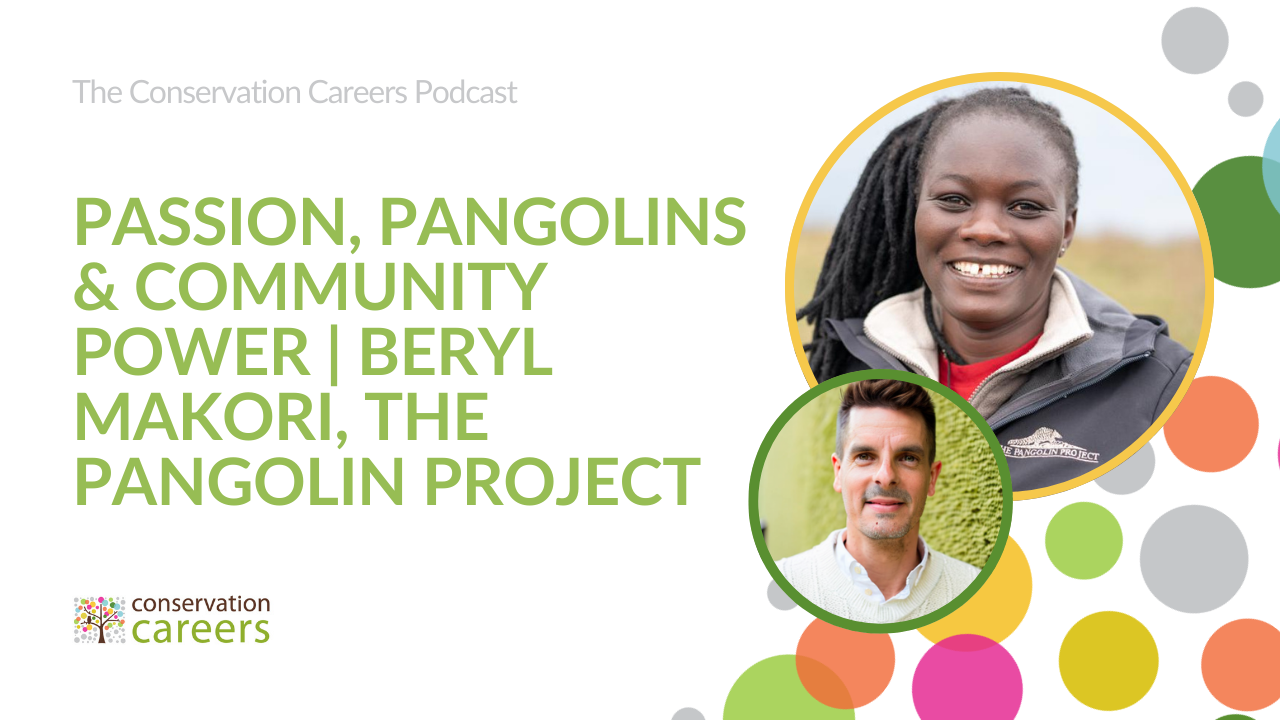
How community-based conservation is helping protect Kenya’s last known giant ground pangolins—with our guest Beryl Makori of The Pangolin Project.
What does it take to save a species so elusive it was thought extinct in a country for decades? And how do you build trust, change behaviors, and create conservation impact in just a few years—when time is running out?
Today’s guest is Beryl Makori, Conservation Manager at The Pangolin Project in Kenya. A biologist and former “Bat Lady of East Africa”, Beryl has devoted her career to protecting misunderstood and underrepresented species. Now, she’s leading urgent efforts to save the Giant Ground Pangolin—Africa’s largest pangolin and one of the most trafficked mammals on Earth.
In this episode, we explore the rediscovery of the species in Kenya, and how Beryl and her team rapidly shifted gears to protect its last known habitat. We dive into her work engaging local communities, leasing land for conservation, and training rangers—all while navigating the complex challenges of land rights, wildlife crime, and environmental degradation. Beryl also shares inspiring advice for aspiring conservationists and offers insight into working in East African conservation.
It’s a story of passion, perseverance, and profound ecological urgency.
Enjoy!
Listen
Watch
Subscribe
You can listen and subscribe to the Conservation Careers Podcast on iTunes, Spotify or Stitcher using the following links, or search for ‘conservation careers’ and you’ll find us!
Resources
🔗 Learn more about The Pangolin Project: https://www.thepangolinproject.org/
Join our live podcast audience!
All our podcasts are now recorded in front of a live audience who sit in and listen to the chat, and then after the mics are turned off get a chance to talk to the guest, share their thoughts and ask questions.
If you’d like to be in the audience all you need to do is join our CC Academy.
In the CC Academy you’ll get access to the world’s biggest conservation job board – listing over 15,000 jobs, volunteer and internships across the globe each year.
You’ll also enjoy access to our amazing CC Pro private members community with regular events, networking and support.
Plus you’ll get full access to our growing library of career-boosting resources, guides and templates.
And best of all it only costs a few dollars, pounds or euros per month to join the Academy.
To find out more please visit the CC Academy, or simply click the join button at the top of our website.
See you on the inside!
Transcript
My name is Beryl Makori. I am the conservation manager for the pangolin project. Beryl, it’s lovely to meet you. Yeah.
Thank you so much for jumping on the podcast and finding the time to chat. Yeah. I’m really excited to hear about the work that you’re doing for pangolins. And and also your career as well. You’ve had such an interesting career.
So, yeah, excited to have an hour together to kinda talk. Where to start? You’re a conservation manager at the Pangolin Project. Let’s start with pangolins. It feels like the obvious place to start.
They’re such a kind of charismatic family. I think most people have heard of pangolins. Right? But I don’t think many of us know a lot about them if I’m honest. I don’t.
I was surprised there’s eight species. I just read that before. I thought there was one that shows what I know. Tell us just a little bit about the the family of pangolins if you could please. Like, what what’s yeah.
What should we know about them? What’s interesting and special? Yep. So pangolins are very charismatic as you say. Not many people knew about pangolins, especially before COVID.
That’s when a lot of people came to know about pangolins. But pangolins are, you know, individuals that have been here from, you know, where when people knew other wildlife, it’s just that they have not been out there, and people have not because they are not like a tourist attraction mostly. They don’t they don’t bring so much money into tourism, so a lot lot of people didn’t really bother with them. But, pangolins, at the moment, we have eight species. There is one that probably will come up in Asia that they found, but on record, we have eight species.
Four of those species are found in China, and four of them are found in Africa. Wow. So then in Africa, 3 of those species are found in Kenya. So we have the white bellied tree pangolin, the, Temix ground pangolin, and the giant ground pangolin. All those three are found in in Kenya.
The only one not found in Kenya is the black bellied tree pangolin. So then in Kenya, we’ve worked with the term ex ground pangolin, and now all our focus in the is the giant ground pangolin. So just for the record, everything I mentioned about pangolins on this podcast mostly will be about the giant ground pangolin Yeah. Because that’s what we’ve been focusing on for the past three years. Perfect.
So also people don’t know that pangolins are the most trafficked mammals in the world. They surpass ivory and rhino and all those other things we think about. And it’s because putting them is easier than the others. You know, the others, like an elephant, you have to prepare yourself for, you know, an attack maybe. Yeah.
And, you know, it’s like not a one man job. But a pangolin, you just pick it, put it in a bag, and it cuts into a ball, and that’s it. And there’s no trace left behind. There’s nothing to show that a pangolin was here unless it was tagged, and the people who tagged it can follow and see. Otherwise, you don’t you can’t tell a pangolin has been pushed.
And that has made it easier for them to be pushed, especially out in the world. And another fact that because there hasn’t been noise about them, even the local communities living alongside them didn’t know they were important and they’re protected. So if someone came along and say, do you know this thing? Yeah. I know it.
It’s in my backyard. Can I get one? Yeah. Sure. So then they go find it because they they haven’t they know they’ve been told an elephant shouldn’t be poached.
They’ve been told a rhino alive, but no one has said a a pangolin shouldn’t be because it’s important. So that’s also one of the things that we are doing is the pangolin project to ensure communities understand the importance of pangolins. Yeah. I can go I know about pangolins too. Yeah.
Well, that’s what we’re here to talk about too, but let me ask some follow-up questions then. So, I’m actually just gonna let someone in as well who’s just joined. I know they’re a bit late. I’m gonna let them in. I’ll let this down.
There we go. You there’s two two things that kind of jumped out for me as we were talking just then. One is you mentioned that they are more well known now after COVID than before COVID, and I’m really interested, like, what changed in COVID to raise their awareness? And then the other question, I’ll ask at the same time anyway. Yeah.
Why are they trafficked? Why are people trying to catch them and, you know, and traffic them? Yeah. So two parts of that. So during COVID, there was speculation that COVID came from pangolins, and that’s that’s that’s what caused the noise.
It hasn’t been confirmed yet. There’s no scientific backing of it or any or medical or anything, but there was speculation that it came from COVID and bats. Both of my favorites. Yeah. Yeah.
But, it hasn’t been confirmed. So that’s what made people now start looking into what is this. Like, what is this thing they’re talking about? Yeah. And then their poaching had been going on even before that.
It’s just that it’s a silent poaching and people didn’t really realize it. But now after COVID when all the noise was made, now everyone now understood and so online and news and everything that they are being pushed. Now pangolins are being pushed mostly and the trafficking has shown that they mostly end up in Asian countries. And this is because they are highly used in Asian traditional medicine. Chinese traditional medicine, specifically, they are highly used in that.
And just recently, some good news that it has been banned to be used for those, traditional medicine in China. So that’s good news for pangolin. Yeah. But that is why they are being pushed a lot. And then also there is, meat.
Pangolin. Meat is very, very expensive and is a very expensive delicacy in Asian countries. So, basically, those two especially at Sanatana, the scales, that is the the reason why they’re being pushed. Yeah. Eva, I’m just gonna put you on mute.
There you go. Yeah. Pangolins, they have this kind of unique scale structure, don’t they? It’s almost like lots and lots of fingernails. I’ve only ever seen pictures of them.
I’ve never been close to them. They curl up into a beautiful ball surrounded by the scales for protection, but they’re not going anywhere. For us, it would be like a hedgehog. Just cut they’re curling up with the spikes. They’ve got the scales, got their armored protection, haven’t they?
Yeah. Yep. Tell us a little bit about the giant ground pangolin, the thing you want to talk most about. That’s what you’re working on. Like, it’s how big is a giant pangolin?
And also, what’s its conservation status? Like, where is it in terms of conservation, you know, threats, endangered levels, that sort of thing? So the underground pangolins are the largest of all the pangolin species in the world Yeah. As their name suggests. They are an African, species.
And in Kenya, we only have it confirmed in one location where we are working on, in a very small, area, that’s the only place they’ve been confirmed to be found. And we that is this from 2021. Before then, it was suspected that they were extinct in Kenya. Wow. Because the last record was in 1971 on the shows of, like, Victoria, and then there was no record at all in between.
So they are very huge, pangolin. If you compare them with people who’ve seen Chinese species or a tree pangolin, they are huge. They are about forty five kilograms, in weight, and, they are about two meters long. Wow. I wasn’t expecting that.
Yeah. That’s like a human child in weight. Yeah. My kids are about forty kilograms and and two meters. Wow.
K. Yes. Which is my They’re very strong also. They are very, very strong individuals. And if you look at their photo and compare with others, you can see this massive head compared to all the other pangolins, and they have sort of larger scales if you look at them.
And then they are if you compare them with the other ground pangolin in Kenya, the Temix, these ones, the giants walk in four, they could repeat all while the ten weeks is bipedal. They only walk in the two hind feet. So those are, two major distinguishing features of the ground pangolins, is that. And then the the ant pangolin is mostly, sort of a forest species. Forest, and glade species like open glade species, while the 10 mixed spangolin is completely, a savanna species.
So those are the major differences of the two, but many people really confuse them, especially in photos. People really confuse the two Temix and the giant drowned pangolin. So the giant pangolin the all pangolin are endangered. They’re all listed in IUCN as endangered species, and also from some records of scales trafficking, it has been said that giant pangolin was the most the scales of the giant pangolin were the most found in in trafficking. So it looks like also they’re also in more danger than the others.
We don’t know why, but maybe it’s because their scales are bigger. No idea. Yes. How how was such a big creature overlooked for so many years in Kenya? Like, what it sounds astonishing, but yeah.
So first of all, there was no organization really doing pangolin, research before we came, into the picture. And mostly other records like National Museums of Kenya or Kenya Wildlife Service, Mostly, they were not were not looking at specifics. They had records that, there was these pangolins, but mostly even in Kenya, even locals, if you ask them about a pangolin, they wouldn’t tell tell you these different types. To them, a pangolin is a pangolin. Yep.
So even when we were working in the reserve in the Mara Reserve, we will hear of people have seen a pangolin up here, but it was a Temix because everyone would just say it’s a pangolin. No one would highlight that she’s a giant pangolin until we saw some footages in in in 2021. Yeah. Amazing. Yeah.
So tell us a little bit about the pangolin project then and the work that you’re doing to help protect the species. Like, what are some of the, yeah, the conservation efforts, the projects that that you’re undertaking? So the pangolin project is a non profit organization that is based here in Kenya. Our director, doctor Claire, started the the project as a research to just look into pangolins, and then there was a need for more, and there was a lot of unknown and, a lot of gaps. So then it evolved into this, organization where, now we are here.
We started working the reserve and also in the Masai Mara National Reserve. And, we are also doing a lot of training to rangers, law enforcement, communities living around the the national park, because people didn’t know, as I said in the beginning, they didn’t know about families. They didn’t know it’s protected. Even law enforcement, some of them begin to know about this. They would let it pass through a barrier and and confiscate, because they didn’t know pangolin was protected.
So then with time, we in 2021, end of ’20 ’20 ‘1, then there were records of pangolins here Mhmm. In, in Nikwiri. The area is called Nikwiri. And it looked big. It was walking on fours and we’re like, this one is not.
This one doesn’t look like. So then we made follow ups, got more photos, and then we came here in 2022 and just started the groundwork speaking to local communities, rangers, and just finding out where they’ve seen these pangolins and marking mapping those places. And then one time funny story. Sorry. I’m diverting.
No. Please. We were here myself and doctor Claire. And then we were still doing our groundwork. And then we get a call from the rangers, and they were like, the thing you’ve been looking for, we have it.
Then we jumped up, got in the vehicle. It’s just the two of us. It’s like 11PM. And then we’re like, we have no idea where we need to go. Can you send someone to get us?
Then they send someone on a bike. So this motorbike is riding in front of us, and then the two of us on a vehicle following. Uh-huh. And there were three things in our minds. One is a scam, and we are in trouble.
Because we are riding in this forest, we have no idea where we are going. It’s just as women and we’re like Yeah. Or two, it’s something else like a hedgehog or a porcupine because people confuse those a lot. Yeah. Or three, it’s just academics.
And everything we’ve been doing for the past year is is not important. There’s a lot on the line here. Yeah. So I think when we got there, when we saw, I think that’s still my best photo. It’s not the best.
It was at night with just a phone camera, but it’s still my best photo of a giant pangolin because it was a confirmation that they are here. It was our first sighting of a giant pangolin. It was the most amazing night for me. Oh, wow. So then from that day, everything changed for the pangolin project.
Nice. Because now, there was already problems here with the habitat. There was a lot of habitat destruction, a lot of it. And there was a lot of fences, and there was a lot of people not knowing what this is. So then it means it meant that we had to halt everything else we were doing everywhere else and moved everyone here to focus on just the giant ground pangolins because to them, we didn’t have time.
We were already late to the party, and we couldn’t just be sluggish anymore. So that’s how we ended up here. That’s And now we are doing an array of things from protecting the forest, leasing, working with the conservancies to lease land for conservation. Then we are monitoring also, what other wildlife, not just pangolins, because there’s a lot of wildlife here that you don’t find anywhere else in the Mara. There are Congo given species here, so that’s also very important.
And then we’re also working with conservancies to develop their governance. And we we are working on a lot. There is a vet department that is helping with injuries, and then there’s a community department that is making sure people understand what pangolins are and the importance and where they can report if they see one. Yeah. So we are doing all that and of course pangolins are the main the main invitee in this event.
Yeah. Amazing. And that’s just really in the last, what, four years is what you’re describing. About three years. Yeah.
Three years. There’s a lot going on quite quickly. You’re focusing your efforts into one area and really doubling down to protect the species and others before it’s too late. Yeah. Because we are already we were already running out of time when we came, and we just had to do everything we can do.
Because losing the the penguin in here meant meant they’re nowhere else in Kenya. Yeah. So we had to do everything we had to do for for for the pangolins, and now it it meant also for the habitat, which now houses all these other important species that are there. Yeah. What was the first thing you as an organization focused on when you threw all your effort into the area back in, you know, 2021, ’20 ‘2?
Like, what was the first priority? We’ve got to do this first before everything else. Community engagement was the first thing. Yeah. The first thing was community engagement, and that meant we recruited local people from here.
Mhmm. Then we trained them, and now we are working with them very closely to make sure people understand, one, that this is a bumbling. This is how it looks like Mhmm. With photos and everything and videos. And then secondly, it’s a highly protected animal.
Mhmm. And thirdly, you can report this if you see one to us so that we can have records of it. Mhmm. And fourth, that, is is any other animal. So there is the the same way there’s benefits from elephants, there will be benefits from pangolins.
Yeah. So they should see it as one of animals that will bring because locals need to to see what is the benefit of this wildlife being next to me. Yep. Yeah. And then it was really not very difficult because already pangolins were known here.
They knew what pangolins were. They just didn’t know it was important. It’s not like we were teaching them a new completely new animal. No. They had lived with them all their lives here.
And so they already knew pangolins are not harmful because they don’t have, poison, so they can’t harm you. They can scratch you. They don’t eat maize or, you know, vegetation, so they don’t compete with, the livestock here. So they don’t eat meat. So they they they don’t compete like, they they’re not like predators to the cows and goats.
Mhmm. So then people didn’t see a harm of Mhmm. Having pangolins living alongside them. So that made it a bit easier for us to get into the community. But community engagement was the first first thing before we did anything else.
I think for almost eight months or nine months there, we just did community engagement. Nothing else. We didn’t tag. We didn’t do anything else. And how how were you sort of received, if you like?
Has it gone well? Are the communities embracing the project? Are there tensions or challenges? Has it has it been easy? Yeah.
What what how would you talk to that? It hasn’t been easy because as every project, you are a new face in a community who have always have the way of living. Yeah. And now you, in quotes, disrupting it because now there are things that have to change. Yeah.
So, of course, there has to be some friction here and there, but it wasn’t bad. As I said, what was a plus for us was that pangolins was not a species that had any conflict at all with them. There was no conflict. So it made it a little easier. Secondly, what the Pangolin project made sure it did was we did what we said we will do.
Mhmm. And keep that promise. Mhmm. That is very important for this community. Yeah.
You say you’re going to do this, you do it. Yep. And you keep to it. That helped a lot with the Pangolin project gaining, trust from the community. And so working with them hasn’t been as challenging as as, you know, we you’d think.
But then also just as everywhere else, conservation is contentious to people. So there are people who think farming is way better than conservation and pays more. So there’s those conflicts that, you know, are there. But I can say we we are good with most of, the people in on the ground and the community, and it’s because of of the trust we’ve built together and we’ve been here for some time. And there’s a lot that we’ve done within the short period, compared to other projects or organizations that they’ve worked with.
So they feel safe, to work with the Pangolin project. Yeah. And that safety and that trust, yeah, and that being on the ground and the relationships that you’re building and the longevity, yeah, of being there. So Then also maybe majorly because I think 90 80 to 90% of our staff are locals from here. So Yeah.
Yeah. Yeah. That really helps. They know the people. They know the systems, their cultures.
Brother, your father, your uncle, your son. So I’ll ring my uncle. He’ll do it. Yeah. Yeah.
Yes. Yeah. What have you discovered then within the last three or four years? You you you confirmed there was one twenty twenty one in the middle of the forest. It is one.
You’ve thrown your effort in there now. Have you found more? Yeah. What have you discovered? So, yeah, we’ve discovered more, but, unfortunately, their numbers are very low.
Mhmm. We are talking about maybe 30 marks. If we stretch it, 30 marks, that are still left in the in the area. Yeah. But, when we we came in, we realized there was a huge problem with, fences, electric fences because there’s so many fences.
Everyone wants to put an electric fence around their home. Yep. And we were finding in the beginning when we started, we were losing a pangolin every month. At least one or two every month on electric fences. And that also informed some of the decisions we made over the years and the changes that we’ve made as an organization of what now we want to get involved in and what is a priority.
Because then we thought if we are losing them that much, then our priority cannot be research on pangolins. It has to be safe space for pangolins. Mhmm. Mhmm. But we’ve we’ve we’ve seen more.
We’ve we we get records a lot from community members when they see one now. We’ve create built a rapport. Now they call us when they see one. We we have camera traps with the monitoring team, and they see them on the camera traps. At least every week, we see a pangolin on the camera traps, which is very good.
We also have live calls at night when they meet one. And so yeah. So it’s good. We’ve seen quite a number. The only challenge I can’t tell you how many exactly because it’s very difficult to differentiate between individuals.
Yep. But we have tagged, six pangolins Mhmm. Previously, and then we halted tagging a little bit because of tech issues. The tags were not really, really made for giant pangolin, so it was, difficult for them to keep them on. But we are getting back on that this year with the modified tags and see how that works.
So then with the tags, it could be easy to tell how many individuals we we’ve tagged, and then we can look at the the home range and see if we are seeing any other, camera traps on the area or something. But at the moment, I cannot conclusively tell you we have 12 or 30 or something pangolins in the area, but we’ve seen quite a good number. And, within the 5,000 hectares that we’ve focused on, I think we can, say about we’ve seen at least 12 different individuals just using different things to differentiate them. Like, this one is bigger. This one looks smaller.
Yeah. This one is, in a very far area from the other. It couldn’t be the same. Just those ones, but it’s not a very conclusive data, if I can say. Yeah.
Yeah. Yeah. But you’re building the awareness, you’re building the relationships on the ground, and removing threats. Yeah. I think it’s amazing, amazing what you’ve achieved in just a short space of time.
Yeah. And hopefully, just in the right nick of time as well as we’d say, you know, you’re just there in time to kinda turn things around. I’d love to talk a bit more about you, Beryl, actually, in your job, your work, your career as well. We’ve heard a bit about the Pangolin project, but, I mean, you’re the conservation manager at the Pangolin project. What does that mean?
Like, what’s your job? What do you do? How would you describe it to someone who’s never met you before? Like, what what’s a typical day, week, month, you know? Yeah.
Paint a picture as to what your job’s like. Okay. Thank you. So as the conservation manager for the Pangnoli Project, first, I’m in charge of, the rangers. We have community rangers who help with monitoring the area.
And then there is also a habitat, protection team that is in charge of leases or, like, generally protecting the area in terms of whether leases, whether an MOU or things like that. Yeah. And then also, I’m working very closely with the conservancies on the ground, just to make sure that this is, brought together. So, many people do not understand the concept of conservancies. So I’ll say conservancies is a group of land owners.
They come together and say we have agreed that our land can be used as a conservation area. Yeah. And then they form a trust. And so that trust is called a conservancy. So then we already found those on the ground when we came in, but they didn’t have support.
So now we are really working closely with them so that they can have governance. And then now at the moment, I’m very excited to say we’ve started leasing together with the conservancy. Right. And it’s amazing. We we started leasing in April, and now we have 83 leases on ground.
We’ve protected 2,200 hectares of the land Wow. Which is really, really good. It’s a huge, huge achievement for us Yeah. Because it’s it was something that we’ve been working on for a long time, and it looked very difficult. But now we are here.
That’s amazing. It’s amazing work. So list means you can now manage that land as you want to manage it. You have control. Yeah.
Yes. Yes. And now this list is with the conservancy. That means we have to work very closely with the conservancies and support them as much as possible so that this works. And at least means now the land is protected fully.
There is no more tree cutting on that land. There is no more charcoal burning. There is no more fences. And that means wildlife have a free space to move around, and their data is protected. So that’s really huge news.
So at the moment, I think all of my time has been taken with that. Just working on the leases because it takes a long time. Yeah. So just a little background on this area is that it’s not communal land. In most places, conservation works on communal land, so it’s very easy to talk to people.
Here, everyone owns their their land, and they have a title deed. It means everyone have a say on their land. So everyone decides on what they want to do on their land. And that means you have to approach everyone individually. As much as you have group meetings, you really have to find everyone on their own and discuss it with them.
And that means talking to about 400 landowners Woah. Individually. Mhmm. And some of them, you visit them even 10 times in the space of time, and then it’s just constantly having the conversation with them. So that I think has taken a lot of my time, since January 2024, December 2023 there.
So that has been the main thing that we’ve been focusing on because that one was the only key to conserving this area in the Pangolinsia. Without that, it’s very difficult because people have a right to their land. They can do whatever they want, and that was not working at all. So we had to work on the leases so that we can protect that. Then it also means managing a team of 22 rangers who are always on patrols to check if there is charcoal burning, there is snares, there is tree cutting, or anything illegal going on on the land.
So that is also a team that is there. And then we are also working with so because as I’ve said, it’s personal land. There are people who do not want this list because it’s a fifteen year lease, and they look at it as a very long term thing. And they’d rather work with, an MOU that is like a one year MOU that is renewable. But then this MOU only protects the forest because the forest is the main part of pangolin’s habitat.
So we don’t want to lose any. So then for those who really do not want to get into the lease, we still work with them on an MOU that just protects the forest Yeah. For every twelve months, and then we renew it every whenever it expires. So that is also going on. So you have very different levels of people that we are are working with and discussing with.
So then there’s also a team that is dedicated to that and visiting people and talking to them and finding out, are are they ready to move to the lease? What are the issues that they have? And then if someone wants, wants to cut, we have to say, you know, you cannot cut because we’ve agreed that we protect this like this. So there’s always community engagement. So most of my work is based with community and the conservancies a lot.
Yeah. Then you just have, what is it called? You know, people just want to talk to you and see and understand what’s going on because someone may have signed a lease, a 15 lease, but then they sleep at night and remember they didn’t understand something. Then they they have to find you. I’m like, I don’t remember what we said is going to happen Mhmm.
To my trees. So there’s also that that is always happening. So it’s an ongoing process over the years. It doesn’t mean one sign, that’s it. Because there’s also the management part of it.
Once you sign people, you have to really manage the land. Otherwise, you find other people from outside will come in to cut the forest, and it’s not necessarily the landowner cutting or coming to put up snares or all that. So there’s also constant management that is has to to go on with the with the leases also. Yeah. What what I love about yeah.
Sorry. Yeah. What I love about all this is it shows how a project starts and the foundation’s up and quickly, and all the different moving parts, the importance of relationships and community building, and being on the ground, and understanding how things work. And I can see the the excitement as well that’s coming through from you as well, and the passion kind of overflows. I love it.
Yeah. I wanna talk a bit more about your career as well beyond your current role. When you look back at your career, and I I know that you used to be known as the bat lady of East Africa, so you’ve got a a nocturnal species background. It’s it’s late. Yeah.
Yeah. What have been the kind of key stepping stones for you in your career? The the the when you look back, you think that these have been important moments for me. They might be jobs or people or education or something. What’s helped you to get to where you are now?
So I think I think from when I I got into my university, one main thing that I know I was interested in was being out, just being out there in on in the field. Yeah. I enjoyed that a lot. Yeah. And by just, finding opportunities to be out there in the field, whether it’s birdwatching or just activities that took me there, I bumped into one one, professor, and he was one of our professors.
But then I always wondered why he was always traveling. He was always away. He was always always away in the field. Yeah. And then he was doing research on bats.
Everyone who’s Google bats in Africa and Kenya, you’ll find him. He’s called doctor Paul Webala. Amazing guy. And I bothered him for so long to take me to his trips for so long. And his worry was, it’s a night activity.
All his team are male, and then there is a female student who begs me that wants to come on this trip. That was in Zuri at only. Mhmm. And then one time he was like, okay. I’m taking you to this one trip.
And then if you mess up, no more. If you don’t like it, then at least you know you won’t like it. And I went to that trip, and that was it. I enjoyed it. I think I enjoyed it more than everyone in that team.
I was the first one to get it up. I was so happy on that trip, and it’s because I had seen zebras, elephant, you know, all these things. I’d never held a bat in my hand. Yeah. And it’s something I was now reading about, and it is this with a lot of, misinformation.
People didn’t know a lot about it, and I was so invested to find a lot about this thing that we didn’t know. And being on the project, I realized there’s, like, a 10 species of bats. What do you mean? I only thought there’s, like, one bat. So then I just wanted to get more and more.
So that’s how I got into this. But then I think from beginning, my main interest have been those species that people really don’t know much about. I’ve never, like, really been, interested in things like zebra. No. Generally, one, like but, like, to find more.
Mhmm. Because if you you try, you’ll find a lot of people have done research on it. There’s a lot known out there and things like that. So I’ve always wanted those species that people really don’t know any Mhmm. A lot about.
So that’s that was a huge stepping stone into getting where I am. Because from there now, it meant you do a lot of research because first of all, you’re holding a part that you ask everyone. They’re like, I’ve never seen that. And then you realize it’s a species that no one has picked up in that area. So then you have to keep doing research, and that’s how I got into research and just, doing more out in the field.
And so I think that was a huge, huge stepping stone to to where we are now. Mhmm. Yeah. That’s that’s amazing. Yeah.
I love it. I I yeah. How so many questions. I’m trying to decide whether I want to kinda drill down more into your bat work or whether I want to kind of ask more about careers. I want to ask a bat question.
How you how do you catch the bats? You say you talk about holding them in your hand. Yeah? But yeah. How do you catch them?
So they are nets made for cutting bats. Like, I don’t know whether you’ve seen nets for, like, birds. Yeah. I used to do bird ringing. Yeah.
Mist nets. Yeah. They are nets for cutting bats. So it depends on what you’re doing or where where you you’re doing it. So there’s, like, very high nets for high flying bats, and then there’s just nets for, within spaces.
And then you have, like, hand nets for, like, caves and things like that. So it really depends on where and and what species you you’re trying to get. So there’s there’s a lot of equipment for bats. Thank you. I should have figured that out for myself.
That makes much more sense. Yeah. What I wonder we have people listening from all over the world, from lots of different backgrounds, countries, and cultures. Like, what is particularly, if anything at all, like, you think unique about, like, East African conservation? In terms of, like, working in the conservation sector of East Africa, Kenya, and surrounding countries.
Like, yeah, is there anything particularly what should we know about, yeah, about your particular area, your region? So I think East East Africa is very rich, of course, with biodiversity, and there’s a lot of conservation organizations that have come around. And I think I’ve met very, very enthusiastic, you know, people in conservation in East Africa who really want to make a change and, and show value of what we have. I think the only little problem we are having is everyone who gets very good get gets poached to somewhere else Mhmm. In the world.
Yeah. Yeah. And then we are not here to To go. Yeah. But, I think also is the fact that I think we are not showing off what we’re doing and really, we’re not talking about it as much.
We are not letting people know what we’re doing on the ground. I’ve met very, very incredible projects doing amazing things, but then I’ve never heard about them anywhere. Yeah. Africa. So I think I think the only thing they’re doing amazing things.
They just have not gotten proper platforms to showcase exactly the projects going on in the in the in East Africa, but they’re amazing. This this is very good projects of, different wildlife and biodiversity around. So it’s just, I think, the platform to showcase what they’re doing and people knowing about them. But then also most of the projects are for things that people know of. You know, elephants.
I think there’s, like, six organizations just in Kenya on elephants or something. Yeah. Zebra, giraffe, you know, lion. I think there’s, like, four lions. So there’s there’s also that a lot of, same species project projects that are in the country, and that makes it you know, people don’t see it as a stand alone thing.
They see, oh, that’s a lion project like the other one. Yeah. Are there lots of opportunities for employment if people are coming out of universities in Nairobi and elsewhere looking for work as conservationists? Are there are there what are their job opportunities like? I can say fair.
I wouldn’t say there’s a lot of them. I can say fair. Yep. And, I think if you do a little research on, I’ll speak for Kenya, you’d find that most, conservation organization are run by by out no. People who are not Kenyans, if I can say.
Yes. Yeah. And so then you find that most, like, they would want someone very experienced on something. It would be sourced from somewhere else. And maybe it’s also because in in Kenya or East Africa, Conservation has not been seen as a career per se.
It, it has not been, that prominent. I had trouble getting here with from school because people didn’t understand. Like, my in when I was defending my thesis, my master’s thesis, the professors were like, no, you got to have find something else to do. You’re not going out at night as a lady, you casting bats. No.
Find something else to do. We are not and I really had to push for it to get through. Yeah. So people see, other careers as better and is because conservation is not very is not sold very much. Yeah.
So you wouldn’t find many people understanding what a career in conservation would look like. The general public. You didn’t. It would be they look at it as a government. If you say anything about wildlife, they look at the government and institutional Kenya Wildlife Service.
Yeah. That’s what they know about wildlife. So they think you’ll either work in a park or in the Kenya Wildlife Office. They don’t see it as my mother still doesn’t know what I do. He thinks I work for Kenya Wildlife Service.
I’m not sure mine does. But that’s interesting, isn’t it? People see it as a kind of civil sector, a government job rather than the charity sector or the academic institutions that they’re also delivering on the ground. Yeah. Yeah.
But I think that is changing a lot, especially because now online has become a very huge platform, and everyone is now online, and now they can see all these things. So I think that has changed very much over the years. Yeah. I think from my time in university to now, I think there’s been huge changes that has happened. Yeah.
Yeah. I was gonna ask about that. Yeah. What’s, what advice would you give someone maybe that’s at university right now in East Africa? They might be defending their master’s thesis soon, and they’re they’re hoping to work as a conservationist.
Like, what, yeah, what advice would you give someone who might be listening in that context? First of all, I think conservation is is passion. Like, you cannot be able to wake up every day at 1AM because there’s a pangolin outside if you don’t like it. Mhmm. You’ll get tired, find something else to do.
So it’s passion first. It’s you really, really enjoy doing it. I think everyone in conservation can agree with me that is not if you look at it as just a job, let me get up and get to this job. You will not be able to do it. Yeah.
So passion first. If you don’t feel it, just find something else. Mhmm. But if you really, really feel it, then you’re on the right track. There’d be many ups and downs, and you may you may not feel like you’re in the right place with the stars in certain species, and then things like that.
But then with time, you find you find that one that makes you feel fulfilled, and that’s it. That’s Yeah. That’s brilliant advice actually. Yeah. Absolutely right.
Yeah. I feel that too. Find the thing if you find the thing you love doing, it’s not a job anymore, is it? It’s like it’s almost like a calling, I guess people say, but Yeah. And then become really good at it.
Yeah. Yeah. Anything else people should bear in mind? Any particular, like, skill sets or character traits or behaviors that help people stand out? What are the sorts of people you look to hire?
Like, what’s what’s good about them? So mostly, especially if I say with the career path that I am on Yeah. It needs someone who is hands on. Yeah. It needs someone who already has some experience with being out in the field.
Yeah. We meet wildlife. Yeah. You know, sometimes you are out at night or sometimes you you you stuck in some weird place with no net, Internet connection or anything. So you need someone who is comfortable being outside.
Mhmm. So if you you’re afraid of of bugs, if you’re afraid of the dark Mhmm. You know, things like that. So you just need someone to if they know that’s what they want, you have to be able to have experience of just being out Mhmm. In the field and just getting your hands dirty and, you know, just being able to do to to be in the wild, if I can say.
Yep. And then, people overlook a lot about, you know, internships and attachments. I think that would give someone the experience too. Because if I if I have someone who’s had two years experience working in another an organization in the field Mhmm. And someone who’s never they’re direct from school Mhmm.
I’ll be really, you know, going towards the a bit of because now I know I don’t have to babysit this person. I don’t have to tell them, how to behave in the field that you shouldn’t be shouting, you know, simple things like that. So it’s just the experience is really, really key thing with this kind of of jobs because I mean, you are out in the wild. You need to know how to be out in the wild before you actually do the job. Yeah.
Some of the things you learn as you go on with a job, but at least come in with some experience from an attachment or an internship or something like that. Yeah. Fabulous advice. Thank you. Yeah.
As we start to kind of wrap things up then, and we’ve got a few people who are listening, which we’re gonna hand over to for questions for as well, like, once we finish recording. But before I hand to them, I want some to ask you some more sort of general questions as well about what’s important to you and your thoughts as well on kind of working the sector. The first one’s an easy question, but it can be a tricky answer. If we could take you anywhere in the world and you could see any species, where would you go and what would you hope to see? That’s why I’m just shaking.
I think I think at the moment, I’ve seen most of the things I’ve been interested to. I’ve tried to travel and see species that I’ve been interested to. But I think I would want to go to Madagascar Mhmm. Mhmm. And just just the habitat, just the forest.
Yeah. Yeah. Beautiful. And you might see some lemurs there if you’re lucky or something like that. Lemurs would be nice.
Yeah. But, I mean, the forest itself is is rewarding enough for me. Yeah. Yeah. Wonderful.
Well, I hope that happens for you one day. Yeah. Lovely. Yeah. Also, in terms of, like, looking at conservation globally, you know, we’re a global workforce.
We’re really trying to conserve nature, biodiversity, wildlife, whatever we want to call it. And despite our best efforts, we are seeing wildlife decline. You know, year on year, we’re seeing the trend, and we’re here to try and turn that around. What do we, as a conservation movement, need to do more of or be better at? How can we really, really turn it around more quickly?
I think it’s, conservation organizations that are working around the same place to really work together. What I’ve realized a lot is conservation organization always work in silos. Everyone is doing their own thing. They’re very busy. They’re focused on that.
The giraffe people just follow the giraffe. They don’t want to know about the zebra next. Then a zebra person comes. They follows the zebra. Elephant person comes to focus the elephant.
And then around you, all the antelopes are disappearing. Yeah. Or the pangolin inside disappear. But you’re just following the elephant and, you know, you’re worried about the elephant only. So I think it’s working together because if you’re working with these other organization, if you are your team is out following an elephant, they could report to me a dead pangolin that they found.
Yeah. If my team is out at night and doing pangolin work, we could find a poacher and report to to the people doing elephant or an injured elephant, someone. So I think it’s just trying to work together in the zones or areas that we work in just would make it very, not very, but a bit easier to curb some of the issues that we are facing as conservation organization or with wildlife on and habitats. I think that’s one key thing that and I think we need to start thinking about a lot. And as the pangolin project, we are trying to do that.
We are trying to hold at least a partner’s meeting every year and just bring people to the table and tell them where we are at, and then they update us on what they are doing and just see how we can closely work together. Yeah. Yeah. So you’re walking the walk as well. Love it.
Yeah. Yeah. Final question. Are you optimistic for the future in terms of wildlife biodiversity? Yeah.
I mean, how are you feeling about the future inside? I think I’m I’m optimistic. Yes. Especially on the area in the area we are working on. Things looked very bad for a long time.
All the habitat had gone. More 90% of the forest was lost, and then we had so many, wildlife injury cases and and deaths and things like that. And it was looking really dull for a long time. But now with the leases coming and people seeing the benefit of being in conservation and supporting it, I think we are headed in the in the right direction. And, it may take us time to completely turn things around, but we are on the right track, and we have the right support from communities, and, the the organizations that we are working around with.
So I think we are really looking into a very pretty inquiry that I invite you all to come and see in a few years. Yeah. We are going to do, so our goal is to protect 10,000 hectares of land, and then we are going to reforest, 4,000 hectares and then have that as a core area left for conservation only. Of course, the reason it is going to be mixed model because people already live on those parcels, but it’s going to be open for for wildlife to use. Amazing.
Amazing. I’m already booking a ticket. Yeah. And before two or three years’ time, if people wanna support the Pangolin project, get involved, or do something that benefits you, what what can they do, and where should they go? As I said, we are, an NGO.
Yeah. So most of our of our funding is from well wishers and, donors. Yeah. So if someone wants to support the pangolin project, they can check our website or our Instagram page, and then you’ll see how to support the pangolin project. We also really, really, ask people to talk about the pangolin project.
You don’t it it doesn’t have there has to be money. Just talking about the pangolin project in your spaces and your organization gives us them now people know what we are doing out there, and then it encourages also people to to help with the conservation of the of the area. So also tell people about the pangolin project and the amazing work that we are doing here in giant Pangolins Mhmm. So that people know about how important they are. Yeah.
Brilliant. Well, we’re doing a little bit of that today, but we encourage everyone to do even more. Yeah. We’ll drop links to your website in the show notes. And and, Beryl, it’s been so fun talking to you.
Thank you for sharing Thank you. Your work. Keep up the amazing work. I feel inspired as to what’s going on. But, yeah, thanks once again, and I hope people do support you even more.
Yeah. Thank you. Thank you so much for having me. It was really amazing. Lovely.