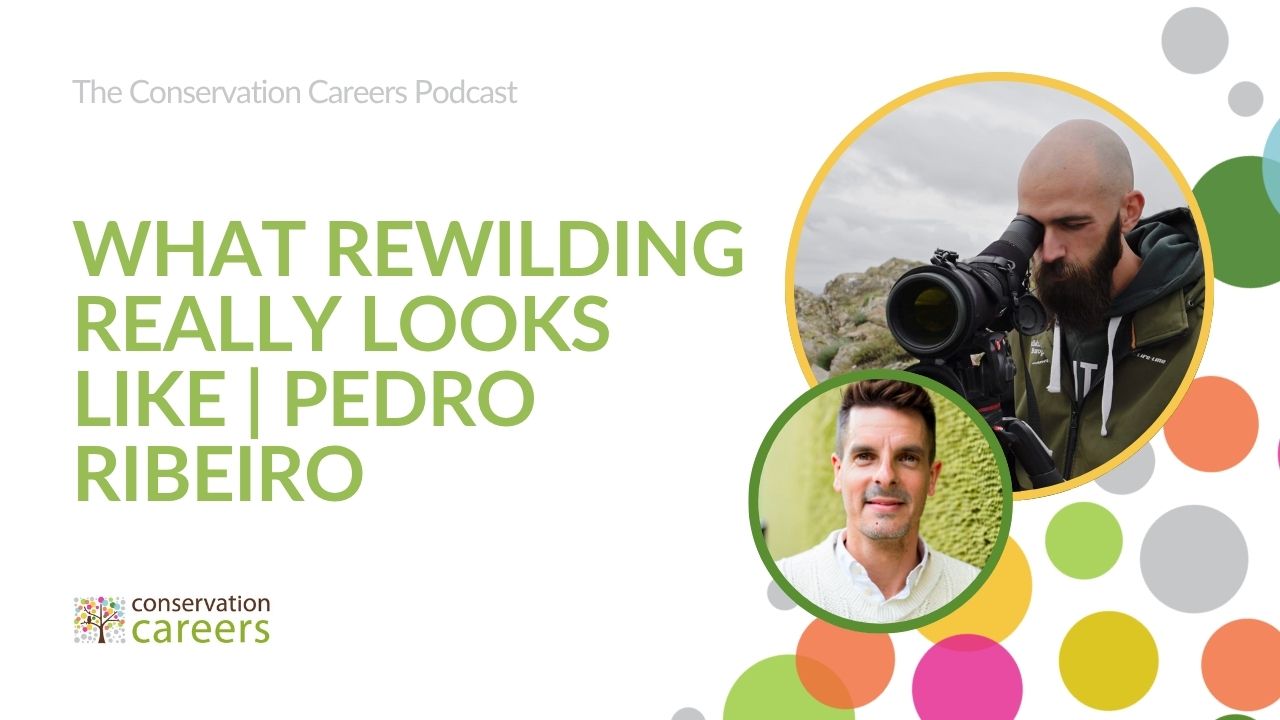
Podcast | What Rewilding Really Looks Like | Pedro Ribeiro, Rewilding Expert in Residence

How rewilding is helping nature and people thrive in Portugal and beyond, with our Rewilding Expert in Residence, Pedro Ribeiro.
If you’ve ever wondered what rewilding really means – or what it takes to make it happen on the ground – this episode is for you.
We’re joined by Pedro Ribeiro, our Rewilding Expert in Residence here at Conservation Careers, for a practical and inspiring look at rewilding in action.
Pedro shares what rewilding looks like across the Portuguese landscape – from restoring large grazers like horses, to supporting vultures and other scavengers, tackling invasive species, and rebuilding healthier ecosystems.
We also discuss Pedro’s career journey into rewilding, his work with communities and landowners, the kinds of jobs emerging in the field – and how you can get involved through our new Certificate in Rewilding training programme.
It’s a grounded, hopeful, and insight-packed conversation – and a “boots-on-the-ground” look at rewilding.
Enjoy.
Listen
Watch
Subscribe
You can listen and subscribe to the Conservation Careers Podcast on iTunes, Spotify or Stitcher using the following links, or search for ‘conservation careers’ and you’ll find us!
Resources
Join our live podcast audience!
All our podcasts are now recorded in front of a live audience who sit in and listen to the chat, and then after the mics are turned off get a chance to talk to the guest, share their thoughts and ask questions.
If you’d like to be in the audience all you need to do is join our CC Academy.
In the CC Academy you’ll get access to the world’s biggest conservation job board – listing over 80,000 jobs, volunteer and internships across the globe each year.
You’ll also enjoy access to our amazing CC Pro private members community with regular events, networking and support.
Plus you’ll get full access to our growing library of career-boosting resources, guides and templates.
And best of all it only costs a few dollars, pounds or euros per month to join the Academy.
To find out more please visit the CC Academy, or simply click the join button at the top of our website.
See you on the inside!
Transcript
Pedro: uh, my name is Pedro. I’m a conservation officer, INW Wilding, Portugal. Uh, I’m a field biologist and, um, basically I spend half my time in the field, half my time in the office, sometimes more time in the office than in the field. Uh, but yeah. Oh, it’s great. It’s great to connect with you properly.
Nick: We’ve been getting to know each other the last, well few months really. ’cause you are new. You are our latest expert in residence Rewilding. We’re kind of working on a course, which we’re looking to launch quite soon. We’ll maybe talk about that at the very end. Um, but yeah, we’re here to kind of talk about your work in Rewilding, Portugal.
And it’s nice to know you spend quite a lot of time in the field. So many conservationists. You know, we. We start wanting to be in the field and the office draws us more and more back with all the admin and [00:01:00] stuff. So it’s nice to kind of speak to someone who’s out in the field doing this, you know, very regularly.
Yeah. So, so welcome. Um, let’s talk, let’s talk about Rewilding. Let’s start there. It seems like the obvious place for us to kinda start our chat today. Um, we’ve all heard the word. Um, but just bring it to life for us. Paint pitch, like what is rewilding? How do you see it? Um, perhaps like what are some of the misconceptions?
Like what is it not as well, just to kind of help to clarify what this thing is. Okay. Well, rewilding um, is different for a lot of people in a lot of organizations. It really depends on who you speak to. Uh, me, I’m gonna give you my honest opinion of what we are doing here in Portugal and what I see other, uh, rewilding.
Pedro: Organizations doing, especially around Europe. Yeah. So basically what we do here in Portugal and some other organizations do is secure land, uh, try to, mm. Usually these lands, uh, have cattle farming or stuff like that. And what we want to do [00:02:00] is make it a lot more natural. So usually there’s a lot of grazing pressure or a lot of agriculture pressure, these lands that we can have access to.
Um, some are just abandoned because they’re very cheap. Uh, they’re rocky areas, they’re not good for agriculture. And you have both. And what you want to do is help the processes that are missing. They’re in nature. Usually if you have grazing in some areas, they’re over grazed, so you want to bring that back.
If you have other areas that are basically abandoned and have no grazing, then you’re gonna have a lot of shrubland. So that’s a process that is missing. Um, sometimes we have forests that are quite young and you don’t have any deadwood. You, you don’t have, um, mature trees that have holes for birds to nest in.
Um, and you, what you want to do is have these forests with a lot more processes in them. So you want to have more deadwood, maybe you bring deadwood in, which is something that, that we tried to do with a few companies, but we couldn’t really do it. Um, what we’re looking at now [00:03:00] is, um. In English is, is a quite a difficult word to pronounce it, but vectorization of trees.
Uh, so basically you take a young tree and you make some wounds. You break some branches. Uh, you do this quite surgically, uh, so you don’t really want to kill the tree immediately, but you want to create some micro habitats within that tree, uh, which would just happen in, I don’t know, 20, 30 or 40 years. So what we’re trying to do is help the, these pieces of land have more processes that they didn’t have before.
Um, mimic nature basically. And then once you do this, once you do a few, uh, first interventions, you just leave nature to be, uh, nature will take the lead. Um, and nature will do whatever nature wants to do. And then what we do is just observe, see if that’s going. With our goals or not, see if we’re having any negative impacts.
For example, uh, one very easy from grazing. Uh, we have horses in [00:04:00] basically all of our properties. And all of these properties have, uh, small puddles, uh, where a lot of amphibians are. Um, they live there and when you have horses, they want to drink water, of course, and sometimes the easiest access of water is a small pond.
And if you have five or 10 horses drinking in the same pond every time, that pond’s gonna get destroyed, and you’re not gonna have any amphibians, and the water quality’s going to be horrible. So sometimes you introduce grazing, you think it’s a great idea, you have great results in some places, and then you’re destroying habitats in other places.
So what we actually did is put fences around some of these ponds and make it easier for the horses to drink water in other areas that they wouldn’t have any negative impacts. So you are letting nature do its thing, but you also have to observe and monitor to see, uh, the impacts that you’re having. Yeah.
Nick: Okay. That’s great. You’ve really kind of brought it to life, to life actually, as, as to what goes on particularly in Portugal for you guys. Um, so you sort of, [00:05:00] in my view, you’re, you’re restoring natural processes. You kind of, you’re, you’re looking to secure tenure of a piece of land. You’re looking to see, okay, what’s missing?
How can we kind of put some interventions in place, perhaps at the beginning to restore what’s missing, whether that’s grazing or deadwood or whatever it might be. Open ponds, you know, and then sort of at some level, stepping back and observing nature. Okay. Yeah. Yeah. And, and just, and allowing it to then naturally restore itself.
Pedro: Yeah, exactly. And when you do this, sometimes you actually learn new things. For example, in some of the areas that we work with, we start with a few interventions, and then through monitoring, we actually see what else we could do. Maybe we have some initial interventions. We have two or three years where you don’t do anything, and then we see, oh, okay, maybe if I do this or if I do that, I can restore another process that I didn’t even know was missing before because maybe the land was so degraded.
Uh, that you didn’t know that that could be possible. Um, if you have [00:06:00] land with, that’s all very rocky and there’s no water, it’s quite dry, but through some of the revolving actions that you do, maybe you start seeing ponds getting created here and there because of the rain, where usually they didn’t because you had a lot of cows.
And as soon as it got, uh, a little bit wet, they would drink all the water. They would eat all the grass. And they would destroy response. This is just a, a small example for us to see that there is initial intervention, but then that, that you can have some other, uh, interventions in the future through monitoring because you need to really know the land that you’re working with.
You need to know how it used to be. So we try to talk, um, to a lot of elderly, elderly people in the community because they usually know where the water sources are, uh, where the animals used to like to be. Um, sometimes they even know where animals escape from these properties because these are properties that are hundreds of years old sometimes.
So they already know, okay, if you have cows, they’re going to escape from [00:07:00] this particular point. If you have horses, they’re not going to go over there. And this is all knowledge that there is no way for you to know, uh, once you start. And it’s very important for you to speak to, to the community, to the locals because they will give you information and then you’re also presenting yourself.
Uh, you, you don’t want to be, uh, a stranger in their backyard basically doing something that they have no idea what’s happening and why you’re doing it. Uh, so, so this is also very, very important for you to do. Yeah. Yeah. I love that. And sort of like the, the, the cultural knowledge that people have Yeah.
Nick: Really help those restoration of, yeah. Of those processes. Mm-hmm. What does like, uh, blank canvas, like if you’re looking to kind of go and secure the ideal piece of land, do you want a piece of land that actually is really degraded? It’s really poor quality from a biodiversity perspective? It’s overgrazed or it’s, yeah, it’s very intensive agriculture, something like that.
Or do you want something which is [00:08:00] really good habitat, and you can kind of lift it a little bit more. Like, what does perfect look like? If you could kind of wave your magic wand and say, yeah, that’s, that’s exactly what I want. And how big would it be? Yeah. Well, uh, it really depends. This is like the, the standard question and answer for biology.
Pedro: Right. It depends, right? Which is why I ask it. Yeah, exactly. So, um, if you have. Infinite amounts of money and there’s no other plot problems. What you want is to secure a piece of land that is already quite good because this way it’s not gonna get destroyed, right? Mm-hmm. So you have a good piece of land with good habitat, and then you can secure it forever.
Especially in the uk for example. Uh, it would be good to have the, the easements on that land. Mm-hmm. So, okay. You know, for a hundred years or forever. This going to be protected. That would be the easiest way to start, because then you could focus on a few other things that are more degraded, uh, because those take a long, a long time, uh, and a lot of interventions and a lot of money.
Um, so. It [00:09:00] really depends on what your goal is. Here in Portugal, uh, what we’re doing is going into really bad places. The the real degraded places, uh, the ones that don’t have great habitat, but that’s partly because they are the ones that are cheap to buy. Yeah. Basically. Yeah. Because if we could, we would buy some lands here, uh, that are protected.
They, they are protected by the government, but not really. Yeah. Uh, if we, if we could, if we had the money, we would secure pieces of land that have great habitat, uh, or could have great habitat, but are now, uh, degraded because there’s plantations for, for timber, or the people just have forgotten that they exist.
Uh, the traditional conservation, especially from the governments here. Yeah. Uh, is to, okay, we secure this land. This is protected. There’s only a few things that you can do, and that’s it. You don’t do any interventions. You don’t try to make the habitat better, and that usually leads to a degradation of the habitat because you could have [00:10:00] amazing forests, but since you don’t have any grazing, all you have is shrubland, and then that’s redland burns.
And if it burns, you’re gonna have a lot Moreland. The next years, uh, and this, the, the forest succession is just interrupted after year, after year, after year. Mm-hmm. So if we could, we would be buying pieces of land that are much larger than we are. Mm-hmm. Uh, here we have the largest, uh, area that we have is about a thousand hectares.
Nick 4: Mm-hmm. The smallest is about 60 or no, now is 80 hectares because we managed to buy a little bit more pieces. Um, but what you want is really, really big pieces. Uh, what you want are islands. So you have a piece here, a piece there, so you can have these stepping stones, uh, and work in the connectivity between these areas.
Pedro: So, yeah, it really depends on where you are, what you can get. Uh, there are areas in, in Europe that they don’t even, uh, buy land. They secure hunting rights. Yeah. Which is something that conservation doesn’t [00:11:00] really think about. Uh, we, I want the hunting rights for this place. Well, we want that because we don’t want to hunt, but this way we can manage.
Thousands and thousands of hectares. I’m talking about tens of thousands of hectares that you can have access to, to do interventions, to do monitoring, to do rewilding. Mm-hmm. Um, through hunting rights. So, yeah, it, it really depends on where you are because here we, uh, have a lot of pieces of land that are degraded, which means they are cheap.
We can buy it, we can secure them, but if we could, we would be buying elsewhere. That has, uh, a lot of forest, uh, a lot of forestry and that brings a lot of money. So it’s basically impossible for us to buy. Uh, we buy pieces of land for like. 1500 euros per hectare. If we wanted to buy the same piece of land in a forestry place, uh, that has great habitat for whatever we will be, we, we would be talking about a hundred thousand or, or something like that.
Wow. Huge difference. Especially in the, in the south of Portugal where you have a lot of olive trees and almond trees. The [00:12:00] prices are astronomical. Uh, but the potential for habitat would be fantastic. So, yeah, it really depends on what you have and where you are. It’s really interesting to hear your perspective here, like spoken through as to the pros and cons and the limitations and challenges actually of making this happen on the ground.
Nick: What is it about Rewilding that really excites and inspires you personally? Like why do you work in it and why do you think there’s so much interest on this as an area of conservation right now? What does it, what does it, yeah, what is it? Uh, allowed to happen. Yeah. I think it’s a, a different way to think about conservation because traditional conservation and, and the type of conservation that I always saw.
Pedro: Was basically going into a pristine place, securing it, looking at it, and you’re done. Right? Yeah. This is the traditional sense of conservation. But then in reality, uh, we don’t all live in, uh, amazing forests or, or the greatest habitats. And if I look outside the, of the window here, uh, it’s a nice habitat, but there’s a lot of degradation.
There’s a lot of [00:13:00] forestry works. There’s a lot of agriculture, a lot of places that are overgrazed. And if I use the traditional route of conservation, which is if I can make, uh, like a, a magic wand and say, okay, now I secure this piece of land and you can’t do agriculture and you can’t do forestry, and that’s it.
Where is that gonna lead? Nowhere I’m gonna have, uh, the same trees here. I’m gonna have a lot of shrubland. There’s not gonna be a lot of habitat for, for predators, for example, because I’m still gonna have people here that will shoot them. Uh, so rewilding is a different way of thinking about things. And there’s a lot more interventions in the beginning because you’re thinking about what that piece of land needs, what is missing from nature?
What do I need to bring back? Uh, and once you do those things, you can actually see nature, uh, be nature. Because like I said, if, if we secure land and we. Put a stamp on it. You can’t do anything else here. You just let nature do its thing. But if you don’t have the process in there Yeah, [00:14:00] it’s not gonna do anything.
Yeah. And rewilding things about what you need to do for the nature to be able to, to continue upwards. Uh, you, you look at the piece of land that has a lot of shrubs and not a lot of mosaic habitats, and you say, okay, if I put some cows here, the cows are going to graze, the cows are going to break some trees.
They’re going to trample and break a, a bunch of, um, shrubland. And then from then on they’re going to live happy. Uh, the habitat’s going to continue to create itself, and instead what we do here is we bring machines, we start cutting SRE blend. Uh, maybe we do some prescribed fires in some places. The habitat looks great for two years and then we have to come back.
Yeah. And then back. And then back and then back. And this is not nature, right? Yeah. So this is what, uh, what I like about Rewilding. We are thinking about, um, conservation in a completely different way. And we want nature to have all the means necessary to be nature again, especially in these places where, where it can’t be, [00:15:00] yeah.
Nick: And it feels like differences between classic conservation, if you like, and Rewilding is, rewilding feels like it’s restoring these natural processes and interventions at the beginning with a view to stepping back. Mm-hmm. And also with a view to not know what’s gonna happen. It feels quite sort of liberating to not have a clear goal in mind 10 years from now, I want this species to be at this level, or this habitat to be this size.
Or you know, conservation is quite goal driven typically. Because of donors and projects and plans. Whereas actually wilding is about let’s just help it to thrive and see, and we know good stuff’s gonna happen if we get the processes right and who knows where it’s gonna go. I can’t predict there’s gonna be this many turtle doves at NEP or whatever it might be.
You know, we hear about, and the change in the speed is also, I find really hopeful. You know, when you think about when things are done right and processes do restore. Things come back quickly. Like I, it’s one of [00:16:00] the most hopeful areas of conservation for me because you sort of see these problems that we’ve been seeing actually can do.
Nature can do its thing. We just need to give it a little helping kinda at the beginning and look what happens. Yeah. Yeah. Uh, this is something that I’m very excited about when we start talking about rewilding in the sea, for example. Yeah. Uh, I’m not a marine biologist by any means, but I can appreciate Of course, what the, the importance of oceans.
Pedro: Yeah. And I remember seeing clearly during the, the pandemic where the, the fishing boats couldn’t really go out and fish, uh, as much as they did, and the speed of recovery. Uh, and the fish is, is insane really. And yeah. Uh, you, you have a lot more fish like instantly because it’s like amphibians or, or insects.
They put a lot of eggs out, right? Yeah. Yeah. ’cause they already know that a lot of the animals are gonna get eaten and destroyed. Yeah. Uh, and if you do an amphibian pond and you. One or two, uh, frogs there, but they have no predation. Yeah. Then they’re gonna have a thousand [00:17:00] frogs in a couple of months.
Right. And it’s the same in the, in the oceans. And it can be the same here as well, because just the moment that you stop hunting in some of these areas, yeah. You can see animals coming right up really, really quickly. Uh, one of our areas, we do a lot of partridge red partridge uh, monitoring. Yeah. And it’s one of the species that people like to hunt more over here.
When we started, we really didn’t have a lot of red partridges. And then just a few years after, um, we stopped hunting there because we secured the land. You can see a lot more. It’s, it’s very quick in some species. Some species not so much. Uh, but you can see the difference even in regeneration from the forest.
Uh, if you stop having overgrazing. Uh, and you can control fires, especially here because, uh, the fire regime in Portugal and Iberian Peninsula in the south of Europe, uh, is not natural at all. Yeah. Uh, and if you can stop that, you can see the regeneration coming so, so quickly. It’s, it’s really amazing.
Nick: Yeah. Yeah, it really [00:18:00] is. Yeah. We’ve been already talking a lot about Rewilding, Portugal. That’s really a lot of the context and the stories you’ve been telling us already. But just tell us a little bit more, like who or what is Rewilding Portugal, the organization that you work for? How is it set up? Um, yeah, what’s the vision behind it?
Just paint a picture really, if you can, of the organization, please. Yeah. Uh, so Rewilding Portugal has a goal of Rewilding, the COA Valley, which is a river, uh, in Portugal. It’s about a hundred kilometers in length. Uh, if you, if we draw a straight line because it squiggles a lot, right? Yeah. Uh, so it’s quite a big, um, part of the country and what we’re trying to do is create stepping stones, uh, from the south to the north of this river because we can actually, um, connect to nature parks in Portugal, which are quite important, which is the Malta Reserve and the, the Dodo Valley.
Pedro: Mm-hmm. And these are amazing places with great habitat. But again, in some places quite degraded. Uh, what you want to do is, uh, create stepping [00:19:00] stones so animals can actually migrate naturally and expand. Uh, we are already seeing this with some, some deer, some red deer. I know in the uk, red Deer is not really a problem, but for us, uh, we have almost none.
Uh, especially in this part. Um, and parallel to that, we want to create, um, more value for people that live here because we want them to value nature. We want them to value predators and animals because they actually see that, uh, if we have good nature, uh, that people want to come and visit. Then you’ll have visitors coming to your town.
You will have people drinking your coffee. You have people sleeping, uh, in, in your town, uh, bring life back, basically. Mm-hmm. Mm-hmm. Not just economically, but also in the quality of life. Mm-hmm. You can see that a lot. Uh, some of the areas that we work with, they were basically, uh, very, very old, small villages.
Mm-hmm. Uh, with not a lot of people. And just the fact [00:20:00] that we are there and we drive our cars through, we bring people through. Um, one time, for example, we, we did a release of horses in, in one of these small towns, and we brought some influencers. So some, some actresses were there. Mm-hmm. And people just went crazy, like mm-hmm.
We have actors and famous people coming to our town because of nature and that really makes people, um. Appreciate nature and, and like what we are doing and, and, and want more of that. Uh, so this is a, a big part of rewarding Portugal. Yeah. Um, we help a lot of farmers and a lot of local products. Uh, we sell them through our website, so we try really to, to bring life back to these people, uh, and, and they can appreciate what we’re doing and the importance of nature.
And then also we try to help farmers, uh, protect themselves against predators like wolves. Yeah. And we do this because we know that if we have farmers, uh, [00:21:00] getting. Uh, wolf attacks every month, they’re gonna kill the wolves. Yeah. ’cause the government is not doing anything. Uh, the government does pay for damages.
So if you lose a sheep, uh, the government comes in and pays. Mm-hmm. But for that to happen, you need to take some DNA samples. That usually takes a few days just for the, the government to come in and, and take the samples. Uh, then they need to go to the lab, which takes a few months more. And then the results come back.
It might be a dog and you get nothing, uh, or it might be a wolf and you get like 30% of what the value of the animal was two years later. Yeah, basically it’s no good. So most of the farmers don’t even call the government anymore. They call us. Yeah, they call us. We go there, we take the samples, we processes that, process them and send them to the lab.
And we try to help, uh, in these situations, but it’s still going to be the government paying. Uh, it takes a long time. It’s not the, the right amount. So we know this is a problem and you can’t really blame the farmers, right. You have. You don’t know how to protect [00:22:00] yourself because the wolves have been almost extinct for, uh, quite a few years in some of these areas.
Yeah. Uh, maybe there’s a wolf that is new because you have wolf packs, but then you have, uh, lone wolves that travel a lot and they go places where there are no wolves. So the people are not protected with livestock guarding dogs. They don’t have fences, they don’t have anything. The, the sheep are just out in the open.
Then the sheep dies. Maybe you lose two or three, your neighbor loses another two and you get together and you kill them basically. Yeah. Yeah. So what you want to do in Rewilding is we go to these farmers, we explain what they have to do. We give them livestock, dog guarding, dogs. We have a veterinarian that, um.
Our only job basically is to help these people, um, train the puppy from two months old to a proper livestock guarding dog. Mm-hmm. We give them fences, we give them electrical fences so they can keep the animals, uh, protected from the wolves. And this really has a great impact because we’ve had a few people, uh, [00:23:00] that used to have, uh, wolf attacks with all of these measurements.
They stop having wolf attacks, and then sometimes they stop using the measurements, the, the measures that we gave them. Uh, I talked to one farmer a few months ago. Uh, he had, uh, a wolf attack. But he said, I didn’t even call you because I was ashamed, because I didn’t put the, the sheep in this fence that you gave me.
Uh, I thought the wolf was gone, so I left them out in the open. The wolf came, ate a few of them. What am I gonna do? It’s my fault. And he understands this and he’s not gonna go out and kill the wolf because he knows he has a solution and it’s his problem because he didn’t use it. Yeah. Uh, so this is another part of, uh, of what we do.
So revolving is not just about going in the land, putting some grazers on, look at it. Monitor and that’s amazing. And it’s done. Uh, it’s a lot of people, but you have to work with. Yeah. ’cause if you want to make this work, people have to be, uh, behind your back doing it. Yeah. And that really comes across in the stories that you’re telling us as well.
Nick: Yeah. And I love the phrase you’ve used many times [00:24:00] there. It’s about bring life back. And that’s not just about wildlife, that’s about bringing Yeah. Life back to the local economy and the local culture and the local people. Yeah. Um, again, just sticking with what Rewilding Port like as an organization, just how many people are working within it, roughly.
You might not know the exact number. Yeah. And what sort of roles do they play? Just paint a picture of the Yeah. The work. Basically we have about 20 people. Yeah. 20 something people. And you have our CEO, our, our director. And then you have several departments. So you have the conservation department where I’m in.
Pedro: Yeah. Uh, where that veterinarian is. We have, um, um, what’s it called? I, a management, a manager for, for the wild, for the animals that we have. The horses. Yes. So like a farmer, basically like a livestock manager or something like that? Exactly, exactly. Uh, then we have another guy, which is the patrol. So he’s alone in a car.
He has a, um, a dog that we are training right now [00:25:00] to detect Umca for Wolf and Lynx and Wildcat as well. And this guy’s job basically is to try to find, um. Sket for these animals, especially wolf. Yeah. And also to protect our landscapes. So what he does, uh, especially in the summer, is look for fires and try to put them out as fast as possible.
Get in contact with the authorities and, and all of this stuff. Yeah. Uh, we have. Uh, security cameras in all of our areas so we can monitor who’s coming in and who’s coming out. Um, these, these areas are open for people to come in and visit, but sometimes you have poachers or you have hunters, so we can see who these people are.
Um, we can actually find, um, so illegal, illegal loops for, for hunting animals. Yeah. We, we find them, we destroy them, we talk to the police. So we’re trying to, to manage the, the crime part, uh, in rewarding as well. And then we have me and my, my colleague that [00:26:00] are the conservation officers that are out in the field doing the monitoring and implementing some of these actions.
Yeah. Then we have a whole department on communications and finance. Mm-hmm. So these people are doing the communication of what rewarding is doing. And at the same time, uh, helping these farmers help, helping these people with, uh, which are selling their products. So we have a wild co network, which was what we call it, um, where you have a lot of different types of businesses and they sell their products through us.
So we can, um, basically show the products to a lot more people. We sell a lot to, to, uh, Europe and, and other countries. So you basically are taking this very, uh, small business in a very small part of the country, and they’re selling their products to, uh, I don’t know, England and Germany and all of these things.
So it brings life back to them as well. Um, and then we have an Airbnb, well we have two now actually. Uh, yeah. So we have people running [00:27:00] those. Then we have all the back office, uh, the administration work and all of that. Uh, so yeah, it’s quite a big business right now. Yeah. Uh, rewilding, it’s a lot of different departments and we’re growing a lot because we have, yeah.
Six years. Rewilding, Portugal has been going for six years. Yeah. Uh, yeah. We’re now 20 something people, and yeah, that feels, that feels quick growth actually. Yeah. Six. Yeah. Yes. Quite quick. Where’s the growth come from? What’s fueled that growth? Basically life projects and a lot of, um, private grants, which is an e funding program.
Right. So yeah. And the other one, sorry. Yeah. The others are private grants, basically from, from private organizations and private individuals directly. So we have private individuals that buy land and we go there and manage the land for them. Yeah. And they, they have to pay us for that management and then we can hire more people, uh, to do that work.
Um, some of the salary for, from my colleague, for example, started like this. So half of his salary [00:28:00] was coming from one specific private donor, um, that he wanted to, to manage the land. Uh, then you have private grants from, from other NGOs, um, from Cambridge, for example, the ELSP programs. Uh huh. Um, yeah, basically all private or life projects.
Nick 4: Yeah. So you have this money. Yeah. And then you have small grants from like, uh, the studio open, the tennis, uh, the tennis tournament. We had, uh, uh, one grant from them. Uh, we, we have small grants for, from Portugal as well. Government doesn’t give us any money. Mm-hmm. The Portuguese government has given no, no money, basically.
Pedro: Uh, they’re all private. Basically. Yeah. Yeah. Interesting. And that success will probably fuel success as donors. Yeah. You’re doing, yeah. Become more confident in what you’re doing and want to invest also. Yeah. Yeah. What, but life projects are, are a big, a big thing. Yeah. Yeah. And so there’s a really significant projects life project.
Nick: Yeah. We’re talking multimillion [00:29:00] euro projects, aren’t we? Yeah. Yeah. And it’s a, it’s a bit worrying that now the, the European Union is, is thinking about, uh, stopping those life projects. But we’ll see how it, how it goes. Yeah. Okay. Well, fingers crossed. Yeah. Um, tell us a bit about your job. You know, we talked just before the podcast, like we are here, just to be honest.
And what’s and all, like, what’s your job like, sort of day to day, you know, give us an idea as to what it’s like to be you. Um, what do you like about it? What are some of the challenges? Like what, what would you like to share about what it is like to do the work that you do? So when I started, I was hired to do a very specific job with vultures, with scavengers.
Pedro: Uh, so I was out in the field looking at the GPS, uh, movements to try to know where they were feeding what they were feeding on. So we know a bit more about their ecology here. Um, then I started doing monitoring on their nests, so their breathing monitoring. Uh, I found a completely new, um, breeding colony here in Portugal.
[00:30:00] There was only three, and then now it’s four, and now it’s five because another one was, was found in the south of, of Portugal. So this was basically a critically endangered species when I started working with it. And now it’s only in endangered. We have a lot more is vulture, if I got that right. Yeah, yeah, exactly.
Great. The scenarios vulture. Um, now there’s a, another live project working with Syner Vultures here. Um. We are, we’re working with them. We’re not a partner, but we’re working with them because of all of this monitoring. Um, I, I was hired to do all of this and also try to, um, have more food available for the scavengers in a more natural way.
Yeah. So in Portugal, what you have are vulture restaurants, basically. So there are large, uh, fenced areas where you put a lot of food and there’s a few dozens, uh, scattered around Portugal. But this is not very natural way of feeding. Um, it really only benefits one species with the, which is the Griffin Vulture, which is doing fine.
[00:31:00] Uh, so my job was to try to find farmers that could or want to have these private, uh, feeding stations in their own landscape, in their own farms, uh, which is something that the European Union allowed. The the countries to do, and then Portugal has a legislation for it. So I do a lot of work with them, but then from the government, we don’t get the licenses.
Nick 4: Yeah, yeah. So you wait five years and you have no license. So this is something that I’m trying to do in Rewilding, but then the government doesn’t allow it to happen. So this is extremely frustrating. So you wanted the good and the bad? The good is that we have things that we can do for vultures. Yeah, the bet is that we can’t do anything for the comp vulture sometimes.
Pedro: Yeah. Um, and this, this really is, uh, a story of rew because we want to do things and then the government doesn’t allow us to do it. Uh, we had another thing that was quite interesting in a life project previous to this one, which is for Wol. Where we wanted to, um, [00:32:00] put a lot of road deer, uh, do reintroductions of road deer in some places that we knew had wolves.
So if they have a lot more wild prey, they will not eat, uh, livestock. But then the government said no because they, they didn’t need any more wild, wild animals because I don’t know, the world hero is already there. But the, the density is so low that it doesn’t really matter for, for the wolves, but they said, okay, you already have road here.
You don’t need to do any reintroductions, so you can’t do anything about it again. Uh, it’s quite frustrating, but then it quickly changed my job role. Uh, I still work with vultures, but then I do a lot more things. So I started doing monitoring in our landscape. So bird monitoring, mammal monitoring, camera trapping, whatever you can imagine I’m doing now in all of our areas.
Um, then we hire, uh, other private companies to do, for example, insect monitoring because it’s very, very specific thing. There’s thousands of species, uh, so they do that in our [00:33:00] areas. I do a lot of monitoring. I help with the, the grazing animals, so. I wrote the grazing protocol for, for revolving Portugal alongside some of my colleagues.
Mm-hmm. Um, I tried to, to help in that department with the genetics to, to see, okay, we have these males. These males are better to cross with these females because you have to think about the genetics as well as you can just put a bunch of animals there, and then fathers and sons and daughters, it doesn’t really work very well.
Mm-hmm. Uh, especially when you’re working with breeds like we are. So the soya horse. Uh, when we started is about two or 300 animals in the world. So you want to keep that genetic up. Mm-hmm. Uh, you don’t want to do anything bad. Mm-hmm. So this is another part. And then a lot of writing reports, uh, a lot of reports for the life projects and the other grants.
A lot of monitoring work and data, uh, that you have to collect and analyze. So this is also a big part. Yeah. Uh, and yeah, just. [00:34:00] Doing a lot of monitoring inside of our areas and outside of our areas. For vultures, for eagles, for specific species, um, for, for deer as well, for wildcat. So lots of monitoring.
Nick 4: Yeah. Yeah. Gosh, lots going on. I’ve got loads of questions I wanna ask you. I wanna make sure I pick the right ones. Um. Hmm. One thing we’ve not discussed and we spoke to, we’ve spoken to, uh, rewilding Britain here on the podcast, um, Rebecca Wrigley. We’ve also spoken to Rewilding Europe as well, fr um, friends Shepherds who, uh, the director of that.
Nick: Yeah. What’s the connection between Rewilding Portugal and say Rewilding Europe? Um, are you learning from each other? You supporting, did they help you with the EU Life grant? Like, do they fuel your growth? How does the network work? Yeah, so Rewilding Europe is like, um. How can I say? There, there are an organization that right now their role is to help the other rewilding in across Europe.
Pedro: Yeah. So they help us with money because every year they have grants that they, they give [00:35:00] us directly. So we just say, okay, next year we want to do this, this, and that. Yeah. And they will pick, okay, we will finance this. We will finance that. Yeah. Um, so they give us a lot of money. They give us a lot, a lot of help, uh, in these projects.
They actually are the ones that bring us these private individuals that want to buy land. So, wow. The, the private individuals go directly to ALD in Europe and they say, okay, I would like to buy a land like this or like that. I would like to do this. And then they pick which areas are more suitable for that particular donor.
Yeah. And then we, we are all in connection, uh, for all. Uh, next, I don’t know, in two weeks time, I’m going to have a rewilding officers meeting, which is all of the biologists basically across Rewilding, uh, Europe. Um, places we are all get together and we have a whole week where you learn from each other and we learn new things.
So we always keep in contact. Uh, we’re always trying to do kind of the same things or, oops, sorry. That’s okay. Um, [00:36:00] we, we try to do, uh, things similarly to each other so that we have a clear view. Uh, we, and we don’t do, I don’t know, one, one person does a rew revolving this way, another person does a revolving, completely different.
We want to keep, uh, a stable idea because also scientifically we have to prove some of these things that we say, some of these, the, of these theories that we have, right? Uh, we, so we have to gather, uh, data the same way. We have to monitor, same way, kind of. It really depends on what you’re doing and where you are.
Uh, but yeah, rewarding Europe is, is essential for our work. Yeah. It really, they really help a lot. Um, yeah, we, it is an, the integral part of rewarding Portugal, of rewarding Spain, of rewarding Africa Highlands in Scotland up there. Yeah. Uh, so yeah, we’re all, we’re all together. It’s amazing, isn’t it? I, I, I love hearing about that and the connection and the network and.
Nick: You know how you don’t have to reinvent the wheel and you’ve got someone there supporting you who’s just like a little bit further along, it can help you throw others and [00:37:00] the, and the movement learns from each other. Yeah. Sharing funding and donors, I mean, that’s so open and inspiring to hear as well.
Yeah, it’s, it’s, it’s great example. There are other networks in conservation too, that work in a similar way, but. It really kinda brings it to life, rewilding Europe and the partnerships that you have there. Yeah. Let’s talk careers if we can for a little bit. Um, yeah. If there are people listening and they’re really interested in working in Rewilding, there are so many people interested in this as a kinda career path.
Like what advice would you have for someone who’s looking to work in Rewilding? Yeah. Let’s just start there. Yeah. Uh, this is the same advice that I give to any aspiring biologist, uh, which is when we start, when we, when we get out of university, well, before you get out of university, you already should be trying to get involved in anything that you can.
Pedro: So if you like birds do go out and do ringing, uh, mist, netting. Uh, if you like insects, go out, try to find some insects, even if it’s just by yourself. Uh, try to be. Really [00:38:00] interested in things and do a lot of things, uh, but as soon as you get out of university. I say yes to everything that you can.
Honestly. Uh, I see a lot of people that really struggle to have, uh, a job in biology because there are so few jobs, especially here in Portugal, and I’m talking about conservation, not doing, uh, environmental impact assessments and things like that because you do have a lot more jobs there. Um. But just say yes to every opportunity that you can.
Uh, when I started, I was doing ringing, uh, mist netting in three different places. Yeah, I was taking pictures of birds by myself. I was, uh, going out in the field just observing birds, just learning as much as I could. Um, I liked amphibian, so every night that would rain. I would go out in the field and just look for amphibians with my friends, just because.
You know, because we like it. And what this allows you to do is when you get to, to a job interview, you can say, oh yeah, I have all of this experience. I know every species that you can ask [00:39:00] me. Uh, and you’re a step further already from, from everyone else. Um, and if you can, if, and if you want to, to work directly in rewarding or any other thing, you should actually try to, to volunteer in places that, uh, do what you want.
Do Rewilding do, um, birding, whatever. Um, just, yeah, say yes to everything and try to really hone your skills by yourself. Don’t wait around for other people to take you out in the field, or don’t wait to to read a book on Rewilding so you know what rewilding is. Or take this course like many of you’re probably doing right now.
Uh, just learn as much as you can by yourself. Don’t wait around and if you have a job opportunity in something that you don’t like. Take it anyway. Uh, the job that I had previous, directly, previous to Rewilding, I was working in a construction site, being the biologist for that construction site for a year and a half.
Uh, I was dealing with, uh, a lot of, uh, racism, uh, sexism, a lot of [00:40:00] very bad stuff, uh, that you, that you can actually, uh, think about construction. Yeah, I was dealing with it. It was very bad. Uh, but the people did not care about animals at all. I was completely alone there trying to protect species that was being, that were being destroyed.
Uh, it was very difficult. It was a year and a half of this. And then I got this job because I had a lot of field experience because I knew every bird that existed, uh, in Portugal. Yeah. Uh, so just say yes to everything that you can. Honestly, this is my honest, uh. Opinion. Great advice. Really practical advice as well.
Nick: Yeah. About just not learning something about going and doing it and showing others that you can do it and yeah, creating opportunities. And taking opportunities. Yeah. Where do you see like the Rewilding movement going from a careers perspective, like looking forward, it sounds like it’s growing, right?
Maybe I’m wrong, but what sort of jobs roles do you think there’s gonna be more in the future? Where might the growth be? [00:41:00] Like if you could predict where, where is this going? I think it’s going to be a lot bigger than it is, uh, rewarding. Portugal is six years old and it went from three people to 20. Uh, and this is just in Portugal now.
Pedro: I see a lot of organizations in Portugal using the word rewilding. So there are a few projects that are coming up and they, are they calling themselves Rewilding something? Uh, yeah. We called ourselves Rewilding Portugal because we were the only ones doing it when we started. But now you have these small organizations doing rewilding in, in particular places.
Yeah. Uh, so it is definitely growing. There’s going to be space for people like me out in the field doing monitoring, doing the regular biologist stuff. Yeah. Um, but there’s going to be a lot more places, uh, for data analysis, which is something that some people don’t like. Some people love it. Uh, and it’s, it’s a field that in biology, I feel like there’s not a lot of people, uh, really going into it because, uh.
The, the stuff that we need, [00:42:00] uh, for data analysis, we usually use software engineers or mathematicians or, um, statistics people and not particularly biologists. And it, it makes a big difference. Yeah. Because if you don’t have that knowledge behind, uh, your data analysis, it’s not gonna be great. Yeah. I feel like, yeah.
Um, so there’s a lot of space for that in the future. For sure. Uh, especially because we are getting more and more technologically advanced. Uh, a few years ago you would go out in the field to, to record bets, and you had, you would have a handheld thing and you would look and you see, okay, this frequency is probably this species, so you would write it down.
Now I go out in the field, I deploy 10 automatic recorders. I go back home for two weeks. Then I come back, I put it all in a AI thing and it says, okay, all of these species, and then I have to take that and actually see if it’s those species or not. But some, someone had to create this. Yeah. Someone had to do all of the work, uh, behind it.
Yeah. Definitely is gonna [00:43:00] be a lot of things here. And then, um, just funding, funding is very important. Yeah. Uh, if you don’t have funding, you’re not gonna have anything in revolving. So if you like that part or if you can get a job in funding, like I said, just say yes. Yeah. Step, step, uh, into this world any way that you can, I think.
Yeah. Uh, but it’s definitely growing and it’s, there’s going to be a lot of opportunities. In the future? Yeah. Gosh. Yeah. I mean, just, I mean, you’re touching up there, but ai, you can hear about the volume of data that we can collect now with like the bat detectors. Yeah. And obviously with birds, you’ve got Merlin app and plants.
Nick: You’ve got I I and so forth. So we’ve got loads of data, quality data and being able to kinda turn that into something and fundraising such a valuable skill in any job, no matter what you go into. Yeah. It’s, it’s valuable in your job right now as a conservation officer. Yep. Yeah, so anything you can get around fundraising is gonna help.
You can create projects yourself and start your own things off if you’re successful with that. Yeah. Yeah, it’s really good. And if you like data analysis, please go into it. You’re [00:44:00] right. ’cause we have so much data that, uh, I just don’t have the time. I just don’t have the time to do anything with it. And sometimes what we try to do is get a master’s student or a PhD or something to, to grab this data and do something with it.
Pedro: Because just for bats, I have a terabyte of data. Wow. Just for bats and then in, in camera trapping. I don’t know. I have millions of pictures, literally. And we do some, we do some things with it. We do things. But again, with the help of other organizations, of universities, of whatever, we can do it ourselves.
Yeah. Uh, and that’s why I, I say it’s very important to have biologists that actually know. What the species are and what they do. Yeah, yeah. Uh, in a way that we can actually monitor that data and analyze that data properly, because otherwise yeah, it’s just somewhere here in a hard drive. That’s, I mean, that’s a great example.
Nick: We often say you can kind of create opportunities and the best way of creating your own opportunities to reach out to someone who’s busy and needs support and say, how can I help? I’ve got data analysis skills, Pedro, how can I help and support you? Well, [00:45:00] I’ve got a million images on my. Yeah, like back to laptop right now, can you help?
And those, those are out there. But it takes initiative. People who are busy often don’t have the time to think, how am I gonna find someone? And yeah, what might the role be? Can I shortlist? Blah, blah, blah, blah, blah. If someone just drops out the sky, ’cause they’ve identified you as an individual they’d love to work with.
And, and showcase how their skills can help support, then the connections can be made. Yeah, that’s the most important part. Uh, showcasing what you can do, because I can tell you the amount of emails that we get, uh, every month of people wanting to work here, but if you, if you don’t tell me what you can do for me, it’s very difficult for me to sit down and think, okay, maybe how can I put this person here?
Pedro: What job can I give it for? Can I give that person for two or three months because. What we do is it varies a lot. Uh, so I might have one or two months that I’m out in the field, uh, recording data all the time, and then I have two or three months where I’m not doing anything. I might need help for [00:46:00] those two months, but it’s always in short notice because we’re always, uh, we have a lot of work to do, a lot of workload.
Um, so sometimes we get emails like, oh, I want to, I want to go there and help you out. Okay. How, if you send me, like you said, if you send an email saying, oh, I love, uh, vultures and I would love to work with the data that you have from GPSs. Great. I have a project for that right here. I do. Uh, but if you just come and say, send an email, oh, I want to go out in the field with you and, uh, see what you do, see what, how you work, I would love to do that.
But, uh, it’s very difficult. We don’t really have the capacity for that. Yeah. So be specific, showcase your skills and tell the organization that you are trying to apply to. What you can do for them. Yeah. Great advice. Brilliant. Thank you. Yeah. So as we start to wrap up, we’ve got a few people who want to, I’m sure, ask questions once we’ve kind of finished our recording.
Nick: They’ve been listening in. I want to talk specifically a little bit about the certificate in Rewilding that we’re co-creating at the [00:47:00] moment. So yeah, we’re probably about, I don’t know, three quarters through the course. We’re looking to launch it next month. Fingers crossed. Um, that’s October 25, wherever you’re listening from.
Um, tell us about the course a little bit. Like in a nutshell, what is this training that we’re creating and, and how can it help people? So this course is going to be an introduction to Rewilding. So we’re going to talk about the more basic things. We’re going to touch on a few ecological indicators, like the monitoring that we, that we can do.
Pedro: Uh, we’re going to talk about the types of rewilding that you, that we can do, uh, in which types of landscapes. It’s going to be an introduction, but we are also going to talk about some, some interesting things. So we’re going to learn. Uh, all of the different techniques in rewilding, the grazing, the, the processes that, the processes that we need, you’re going to, to learn about, which are the processes that are usually missing in nature and, and how to bring them back.
Um, we’re going to talk about how to do monitoring, how to start your [00:48:00] own rewilding project, what to look for. Uh, how to, how to deal with people, why it’s important to deal with people. Yeah. Uh, yeah, it’s going to be an introduction, but I, I think it’s going to give you a very broad and very, very good view of what Rewilding is.
And if you want to learn more, uh, there’s going to be a lot of additional resources that you can read through. Um, we’re going to talk about these careers as well. We’re gonna have, uh, a few, a few podcasts that you can hear. Um, and yeah, if, if, uh, I’m sure that if it’s going to be a success, there’s going to be a Rewilding two, uh, course that we can go a lot more in depth because there’s a lot of things that I could talk about for, for an hour or two.
Uh, we just touched on it, so, so you’ll know what rew rewarding is in a nutshell. Yeah, it’s great and I’m so excited and so pleased to be working with you on it too. You’re a great course leader. Um, yeah, so it’s foundations of rewilding, isn’t it? It’s sort of step by step, everything you need to know to kinda get you up to.
Nick: [00:49:00] A standard of knowledge of really understanding what Rewilding is and how, how it happens, uh, but also like step by step about how you can do it as well. As you say, we’re touching on careers, we talk about different career paths that are available to you, some of the kind of core tools and we’ve built it upon all the best practice and knowledge that’s out there in the industry as well.
So yeah, the guides from Rewilding Europe and others, so we know it’s got kind of a really good kind of knowledge base behind it. Yeah. It’s really fun. Uh, Pedro, it’s been a huge pleasure talking to you today. Yeah, thanks for your time. Thanks also for helping and building this great course that’s coming out very soon.
Um, if people wanna find out a bit more about, uh, about Rewilding Portugal specifically, perhaps they want to help support, get involved. Um, yeah. Where should they go? What opportunities do they have? Yeah, so rewarding Portugal. If you just Google it, you’re gonna have the Facebook, the Instagram, the YouTube, you’re gonna have all of the socials.
Pedro: Um, you have, we have, um, a website as well where you can see everything that we always did, the all of the life [00:50:00] projects, all of the project that we have, all of our areas. Uh, if you go on Google Maps, you can see our areas as well. Yeah. Um. So, yeah, especially the website, it’s very easy to, to see all of the things that we did.
Uh, you can see the whole team as well. Uh, so yeah, it’s very easy to find. There’s a lot of news items as well on, on revolving Portugal. Uh, so yeah. Very easy to find. And two final thoughts, one from me. You talk about news. Am I right in saying that Marta is in your communications team? Have I got that right?
Nick: Yeah. For Marta, Kali, uh, just, we always talk about how conservation’s a small world and you know, I’ve known Marta for 15 years, something like that. She was my intern when I was communications manager at BirdLife International. Now she’s obviously. Helping and working with you guys. Yeah, it’s lovely to make these connections.
I’d love to see that forming. One thing I didn’t ask, but now it’s a good sign to ask, what are some of the products that you sell as Rewilding Portugal? You mentioned that you have this marketplace. What can people buy? Yeah, a lot of things from wine [00:51:00] to honey to soap that is natural soap. Uh, so many things.
Pedro: Uh, there’s almonds. There’s a, a company that does almonds in very different ways, like sweet almonds and roasted almonds. Yeah, there’s a lot of things. I don’t even know how many things there are, honestly. Yeah, and they can stay in your Airbnbs too. I love it. Yep. So many ways to support conservation and have fun.
Nick: Yeah. Yeah. Yeah. Great. Once again, Pedro, it’s been a real pleasure. Thanks for coming on the podcast. Thank you. Thank you. It’s a pleasure.