Podcast | Crocodile Conservation with Dr Marisa Tellez

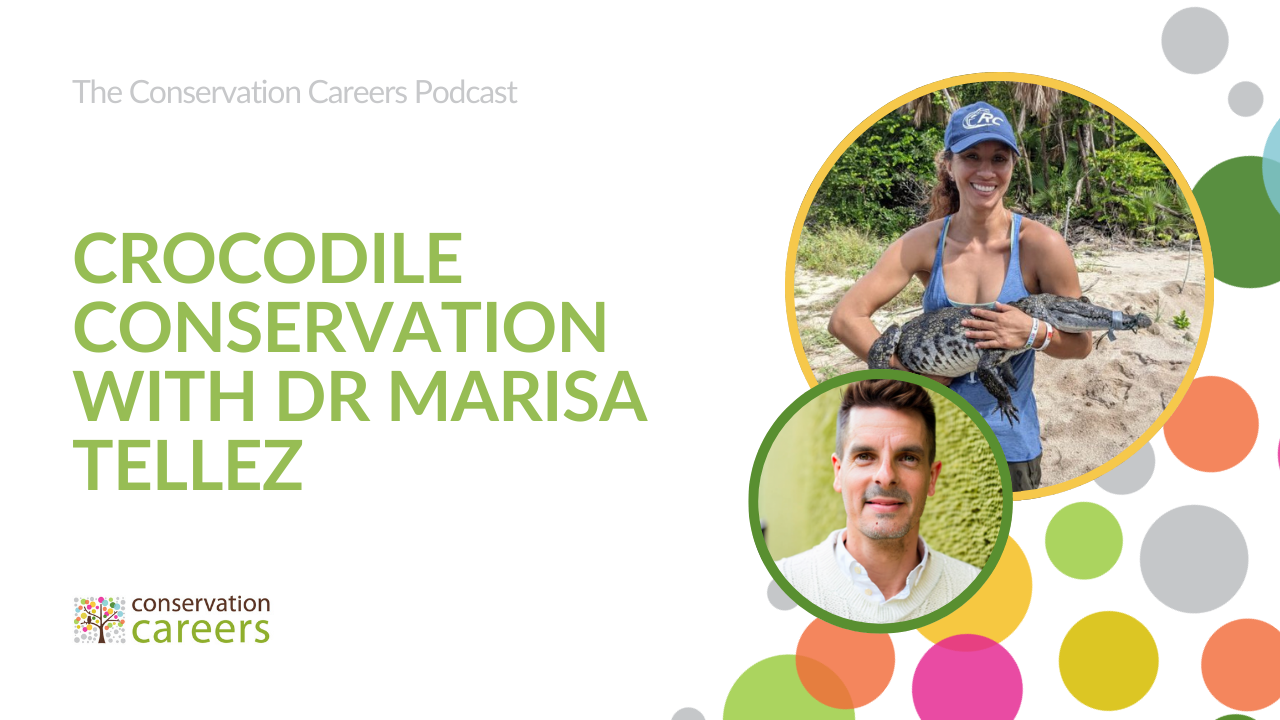
Dr Marisa Tellez knew from a young age that she was destined to work with the world’s apex predators—particularly crocodiles. While her peers played with dolls, she immersed herself in books, documentaries, and wildlife centres, determined to one day turn her fascination into action.
In this episode, we sit down with Dr Tellez, Executive Director of the Crocodile Research Coalition, to explore her remarkable journey from the suburbs of Los Angeles to the lagoons of Belize. Along the way, we uncover how her early love for reptiles led her into parasitology, science communication, and community-led conservation.
Marisa shares how local attitudes toward crocodiles in Belize have transformed through education and engagement, and we dive into what it’s really like to live and work among these often-misunderstood creatures. We also talk about threats facing crocodilians and what it takes to build a career in conservation as a woman, a leader, and a lifelong learner.
This is a podcast about passion, persistence, and predators—and why building empathy for crocodiles might just help save them. Enjoy.
Listen
Watch
Subscribe
You can listen and subscribe to the Conservation Careers Podcast on iTunes, Spotify or Stitcher using the following links, or search for ‘conservation careers’ and you’ll find us!
Resources
https://crocodileresearchcoalition.org/
Join our live podcast audience!
All our podcasts are now recorded in front of a live audience who sit in and listen to the chat, and then after the mics are turned off get a chance to talk to the guest, share their thoughts and ask questions.
If you’d like to be in the audience all you need to do is join our CC Academy.
In the CC Academy you’ll get access to the world’s biggest conservation job board – listing over 80,000 jobs, volunteer and internships across the globe each year.
You’ll also enjoy access to our amazing CC Pro private members community with regular events, networking and support.
Plus you’ll get full access to our growing library of career-boosting resources, guides and templates.
And best of all it only costs a few dollars, pounds or euros per month to join the Academy.
To find out more please visit the CC Academy, or simply click the join button at the top of our website.
See you on the inside!
Transcript
Dr Marisa Tellez: Hello everyone. My name is Dr. Marisa Tellez, and I am the executive director as well as the founder of the Crocodile Research Coalition here in Belize.
Dr Nick Askew: Wonderful. And thank you for finding time during what is a very busy period for you to kind of jump onto the podcast and you’ve just been helping nja turtles and crocodiles and birds and yeah, it’s, it’s great to have you on.
So thanks for that. Um, I was just doing a little bit of research before we jumped on, and I love this. I’m gonna read something out briefly. So it says, at an age when most girls were playing with dolls, you were developing a knowledge in the world’s top predators, and you knew you wanted to be an advocate and a leader in the conservation of the world’s predators.
Particularly crocodiles. Um, so I guess my first question’s quite an obvious easy one, like, you know, where did your fascination in crocodiles begin? Like, what was it about them that captured your imagination so early on?
Dr Marisa Tellez: So I always love to start the story with, I blame my father and I was about five years old and it was my birthday or [00:01:00] Christmas, and he gave me a stack of books.
Mm-hmm. And one of these books. It was about great white sharks. I fell in love with sharks. I read that book inside and out. I would say maybe about six, seven years old. I could tell you about every shark species, their range, their diet. At seven years old, I knew about the IUCN inci, like I, because I had to understand what does this mean?
You know, endangered, critically endangered, threatened, vulnerable, and so I would do my homework and I. Complete. I started to understand how a lot of shark species were threatened to extinction, and it was maybe when I was about eight or 10, um, I don’t know if you may remember this, but there was a magazine, a catalog for wildlife, and they would send you cards about once a month and it would be different [00:02:00] animals and it would be like four or five cards and they.
They also provided you a green box.
Dr Nick Askew: Yeah.
Dr Marisa Tellez: So you, you were able to start, like, start stacking like tons of cards. It was almost like trading cards. And um, so that was something that my parents got when I was really, really young. ’cause of my love and passion for wildlife. And it was about eight or 10 years old.
My mom came in, I was crying. I was crying in my room and she asked like, what’s going on? And I said, mom, like, you know, looking at all these in a sense, trading cards. I started to see a pattern where a lot of predators, they were critically endangered, endangered, threatened, and a lot of the threats had to do with habitat loss, but a lot of illegal or senseless killing people were just killing these animals out of fear.
And I was like, I don’t understand how someone can hate something so much that they have to kill it when they don’t understand it.
Dr Nick Askew: Hmm. So
Dr Marisa Tellez: that’s. [00:03:00] Pretty much the pivotal moment where I decided I wanted to be an advocate for Apex Predators. And at that point my focus was going to be great White sharks.
Mm-hmm. Um, I had seen Jaws at that time and I understood how people were very much scared of great white sharks. And I was like, Nope, I’m gonna be an advocate. I’m gonna let everyone know that Jaws was just a movie. You know, great white sharks are not out in the ocean trying to hunt us. Yeah. And so that’s what I thought.
I thought I was gonna be studying great white sharks. And then I was 15 years old and everyone in my high school knew I wanted to be a marine biologist or I wanted to go out into the jungles. I was, I wanted to be out in nature. I was born in the city, um, or I was born in the concrete jungle of Los Angeles, but I was not meant for that type of jungle.
I was meant to be out in nature. In the forest, in the ocean. And I was about 15 years old. And I had some girls come to my locker and they’re like, Marissa, there [00:04:00] is this crazy Australian dude and he’s bumping on crocodiles and he’s trying to save them. He’s trying to get everyone to love them. And they’re like, have you seen this show this?
Have you seen this guy? And I was like, I have no idea. Um, at that point, my family, we didn’t have cable and you could only see. Steve Irwin on cable at that point. And so finally I went over to a friend’s house, saw a show of Steve Irwin and his love, his passion just transcended into me. I just, I switched on a dime.
I was like, yep, that’s, I’m going to become an advocate for crocodiles. Wow. And I can absolutely say whether people admit it or not. Um, I people or scientists or conservationists of my age. All of us that study crocodiles, it’s all because of Steve Irwin. Yeah. I mean, he really, um, made a generation of crocodile advocates.
Dr Nick Askew: Yeah. That’s just amazing. What a, what a [00:05:00] beginning and to be so connected to these speeches when you’re in as your own with like a concrete jungle of la Yeah, and it’s funny, as a father, I’ve got two eight year olds and a 10-year-old, so you’re talking about their age right now. Yeah. And the impact that had, you know, on you at that age, I find really fascinating.
Yeah, yeah. I wanna go and watch the Steve Irwin with them now,
Dr Marisa Tellez: and my daughter, my daughter is now watching a lot of his old shows as well as some of the shows of his kids right now. And she’s, I mean, she’s just fascinated with wildlife. I’m not, you know, I’m not pushing her to be a crocodile liver or anything like that, but she absolutely loves watching his shows.
Dr Nick Askew: Yeah, it’s tough, isn’t it? Like do you lead them or you let them find it and you know.
Dr Marisa Tellez: Yeah. So,
Dr Nick Askew: um, what happened next? Then you started watching these crocodile shows with Steve Irwin. This became your focus and your love. Like what ha what next?
Dr Marisa Tellez: So after, um, so come high school, you know, I knew I wanted to go to college and I [00:06:00] went and received my undergrad at University of California Santa Barbara.
Yeah.
And I received my bachelor’s in zoology. Mm-hmm. Also in cultural anthropology, so I doubled majored and why I was so fascinated with cultural anthropology was at that point, no one, the, the term eth new zoology was not a thing at that point.
Mm-hmm.
He seeing reading in regards of human wildlife conflict, I realized that there was a lot of lack of knowledge, how to coexist with predators.
But at the same time, I took a step back and I started to look at indigenous cultures or rural communities at that point, because these people seem to be coexisting with. Lions and jaguars and crocodiles, especially if they’re keeping, if [00:07:00] they’re continuing. A lot of traditional knowledge, if they are passing along traditional knowledge, there really doesn’t seem to be a lot of conflict.
So what, what can we learn? What can we gain from these indigenous and rural cultures and how can we implement that into other societies? And that was something I was looking into. And my dad’s side of the family are in a or Mescalero Apache. And I know from some historical records from the last couple decades that when some of the people were given back the power to manage their own land, animals started to come back, the forest started to come back.
Um, there was also less conflict with wildlife. So there is something there amongst indigenous and rural knowledge. Mm-hmm. And so by. Going for my cultural anthropology as well as my zoology degree, I was hoping [00:08:00] that I can interweave the knowledge from both of those fields so that I could move forward in assisting with crocodile coexistence.
Mm-hmm.
Now, as most people, when they graduate college, it’s like, okay, I, I have an idea of what I wanna do. But I really don’t know what I wanna do, you know?
Yeah.
It’s like, okay, I got my zoology degree, I got my cultural, an anthropology degree. I want to work with crocodiles. I don’t know how, like how do I do this?
Yeah.
And at that point too, it was 2005, there was a recession, so there’s like, there’s no jobs.
Yeah.
And I was a hostess as a restaurant until I was able to. Get myself into working at a wildlife sanctuary in Los Angeles at that point, and it was, you know, I, I was able to start working with crocodiles and captivity as well as other animals.
I started to learn [00:09:00] about educational outreach at that point too.
Yeah.
And I started, that’s when I kind of also started to ponder about, is. Certain methods of educational outreach actually successful. Hmm. Because at that point, what I was learning was very, you’ve got to save animals. Animals are important.
Mm-hmm. Um, and animals are just important for the environment. And it was very preachy and I just felt, but this is what I was taught to do, but it just always seemed, it went in one ear and out the other.
Mm-hmm.
And at this point, I was really trying to. Understand, how do I get people to listen?
Mm.
Because here I am, I have an opportunity to start educating people about predators and to coexist with them.
They don’t have to fall in love with them, but they can at least tolerate them. Mm-hmm. But nobody’s listening, you know? And so this is already going in my head. And I moved from the wildlife sanctuary to the [00:10:00] Los Angeles Zoo. And so I started working at the zoo and was starting to work with crocodiles there and was really following my passion, and again, just with the education.
And it just was, you know, crocodiles are important, they’re keystone predators, and I just still feel like I wasn’t making an impact. And it was at that point, Matt. I remember my boss called me into his office and he said, Marissa, what are you doing here? And I said, uh, like, what did I do? What did I do? And he, he said.
You’re not meant to be a zookeeper. And I said, but I wanna work with crocodiles. And, you know, we’re talking about building a conservation program and at this point, the Los Angeles Zoo, they were redoing their reptile layer. And, you know, I was gonna be part of that expansion. So I was like, you know, I, I can see myself, you know, following my [00:11:00] passion through.
The LA Zoo. Yeah. And he said, you’re not meant to be a zookeeper. He said, you’re a scientist.
Mm.
I was, excuse me, A scientist because at this point. I did not believe I had the intelligence to be a scientist. I didn’t think I had it in me to be a scientist. I, you know, and at that point a scientist is, you know, just a highly, highly intelligent person and you know, in a lab and doing this and doing that, it just was like, I’m not a scientist.
I’m not that. Smart and he saw something in me that I didn’t even see in myself, and he could see it because of my passion for crocodiles, because of me constantly creating projects at the LA Zoo and trying to answer questions. And I was also assisting the LA Zoo at that time. With diagnosing some of the animals with parasitic disease because I do have a background in parasitology.
Yeah. So he [00:12:00] just said, he’s like, you are meant for more. And he’s like, you can only do so much here. Yeah. He’s like, you need to go to grad school.
Yeah.
And so I’ve, I’ve thought about it and I had a really rush to be able to get into grad school within. Eight months. I had to do, you know, all the recommendation letters, all the different tasks, finding a professor.
But I had my, my parents as well as some other friends of mine that were in grad school. You know, they’re telling me how tough it is. Mm-hmm. Marissa, you’re not gonna sleep some nights, or some nights you’re gonna give up and you know, and so it’s
Dr Nick Askew: not all you wanna hear, is it?
Dr Marisa Tellez: Yeah. You know, it’s just like all this stuff.
And so for me, I knew, okay, if I’m going, and plus I’m pretty stubborn, if I’m going to dedicate several years of my life mm-hmm. That I know it’s gonna be hard. It’s gonna be mentally and physically straining. I’m gonna do something that I want to [00:13:00] do.
Dr Nick Askew: Yeah.
Dr Marisa Tellez: Because I do know you can apply for grad school, you can apply for labs, but you’re necessarily doing a project that the professor kind of already has lineup.
Yep.
So you’re not doing something that you’re passionate about. And I was like, I wanna do something I am passionate about.
Mm-hmm.
And my passion was looking at. Parasites within crocodiles and alligators. Mm-hmm. I think parasites are some of the coolest organisms on earth. Um, they can turn an animal into zombies.
They can change the coloration, the physique of its host. I mean, it is. Parasites are fascinating creatures. Yeah. And why I was so interested in this topic was because crocodiles have one of the strongest immune systems in the world, like top, top, top immune system.
Mm-hmm.
And no one had really looked at the evolutionary interaction between crocodiles and their [00:14:00] parasites.
And I just had wondered, well. Is it possible that parasites have assisted in the evolution of a strong immune system over the last 250 million years that crocodiles have been on earth? And so this is something that I really wanted to understand and at that point, too. People had just recorded parasites and crocodiles since the 18 hundreds, but no one’s actually has asked questions.
How do they interact with the animals? You know, what is the benefit of parasites to crocodiles? And so this is what I was passionate about and I was lucky enough to find a professor at UCLA, university of California in Los Angeles that was like, that’s what you wanna do, if you can get the money for it.
Go for it. So I was like, okay, this is great. And I was able to get funding for six years. So I was able to get my Master’s and my PhD all paid for. So I walked. That was from the
Dr Nick Askew: government, is that right? [00:15:00] I got. Yeah. Yes. Just briefly talk us through how you got the funding. ’cause that was the final hurdle here, wasn’t it?
Dr Marisa Tellez: Yes. And so my, um, once I entered grad school, my professor knew of two different fellowships within UCLA. Yeah. So he said Apply for these. Yeah. If you apply for these, this one’s for one year. This one’s for two years. Yeah. That’s at least three years of master’s and PhD covered.
Yep.
And so I was like, okay, great.
I applied for them. I got them. Yeah. Then UCLA really pushes their students, their graduate students to apply for the National Science Foundation. This is very, very difficult to get. Yeah. And. I was, at this point, I was three years out of school.
Yeah.
And, you know, I hadn’t really written scientific papers.
I hadn’t really written proposals or grants. And my first round for NSFI did [00:16:00] not get it. And I actually, I had a reviewer, I’ll never forget this, I had a reviewer, um, it, they made a comment about how it seems like. My particular proposal, it seemed as if I was just coming out of high school like it was, it’s really, really bad.
I was like, oh, okay. I really need to learn how to write. Grants how to write a good, decent proposal. And unfortunately my professor at this point, he was out in the field, so he couldn’t really help me. Yeah. And again, it was, you got into grad school and they’re like, okay, next week you’re gonna start writing a proposal for the N SF grant.
And so it was like, wait, wait, wait. What? I had no idea how to do this because the. The fellowships I received from UCLA, they weren’t as intense when it came to the writing. But NSF, it’s, it’s a lot. It’s intense.
Mm-hmm.
So I did not [00:17:00] receive it the first year, but you can apply and try again for a second year.
Mm-hmm.
And at this point, um, because I, I love a good challenge and I always like to. Be at the top. You know, I always have the rocky theme song in the back of my head.
Dr Nick Askew: Yeah, yeah, yeah. A little montage. Yeah. Training.
Dr Marisa Tellez: Yeah. With the training. Yeah. And my professor, he did an amazing job in really helping me fine tune my grant.
Yeah. Or, or my, my, my writing, my grant writing. And that second year of the NSFI received this, the NSF and I had glowing reviews. Yeah. Amazing. Yeah. So it was, it was a good lesson. Even though you failed miserably.
Yeah, yeah, yeah.
First time. Yeah. Don’t, don’t hesitate to try again because I, like I said, I got it.
Yeah. And my whole master’s, my whole PhD, the six [00:18:00] years I was within my master’s and my PhD, it was all paid for.
Dr Nick Askew: That’s amazing, isn’t it? And what’s really interesting is there’s loads coming out of this. I’m, I’m really enjoying like your story so far. Like one is clear passion that started at an early age that’s run through and it’s been your rocket fuel and your compass or whatever you want to call it.
That’s what you wanna work on. That’s what you wanna focus on, tackle on. And it came through people like Steve Owen and your father and others. Then this kind of, it feels like. Hindsight’s brilliant. It feels almost strategic. Then thinking about the importance of like cultural knowledge and people and communities and their involvement, and people often talk about, you start loving animals and then you realize it’s all about people, and you start that journey early on.
Yeah, and then you start asking the big questions, well, how do I engage people? How do I talk to ’em? How do I educate them? Rather than just telling them facts, like how can I, you know, actually make a difference here? And now you’re getting trained up in, in something that’s been really important to you.
And you almost had a pivotal moment there with someone at the zoo guiding you into science and what, and there’s, [00:19:00] there’s a contradiction here as well, like where you talk about you are really strong, you’re really resilient. If you want to do something, the Rocky music plays and you make it happen. Yeah.
But at the same time, you think, I’m not a scientist, I’m not clever enough for
Dr Marisa Tellez: that. Yeah.
Dr Nick Askew: It’s like there’s like, you’ve got great confidence and also insecurity. Yeah. Yeah. Yeah.
Dr Marisa Tellez: Yeah, there was a bit of that insecurity of, of course, I mean, I wa I was in my mid twenties at that point, so I was like, I was, I was young, you know?
I was just like, I don’t, and then the other thing was too, is that no one, while I was at undergrad school, I had some good professors, but there was no one that ever was a, you know, have you ever thought that? Maybe going to grad school. You know, no one had really thrown that at me, so it just kind of, I guess subconsciously, well, I’m not smart enough for that.
I’m not, yeah. I’m not made for that, you know? And, um, but I, I, I kept, you know, I just kept going. And let me tell you, here’s [00:20:00] another underdog story, and I like to tell this to students as well because again, just because you may have a rocky, rocky start does not mean that you will not succeed. So again, I, when I went into grad school, I had been out of the game for a few years.
I, it was rough for me and I, I was struggling a lot compared to the rest of my cohort, where majority of them had come straight out of undergrad. They did all these scientific projects with labs. I, I did not do that in my undergrad. I’m sorry. I had fun during my undergrad. I kind of worked, I kind of did a graduate seminar, but I wasn’t an undergrad that was working in the lab because I just, that just wasn’t.
What I wanted to do at that point, you know, because the stuff that was, you could volunteer at a lab I wasn’t interested in. Mm-hmm. And so, um, I had a very rough start and I remember the chair of our departments, um, at one point, I forgot [00:21:00] there was some type of gathering. We’re talking and she goes, you know, you’re not made for.
Science, you’re not made for grad school. I see you’re struggling. Why don’t you just go, you know, work for some NGO and just, you know, just do the basic conservation. Just be an educator. She said, this is, this is not for you. And I was taken aback and I just was like, no. No, I, I know I have worked my butt off to get to this point, and I’m not going to have someone, um, that doesn’t truly know everything that’s happening right now, like with grad school to try to steer me off my path.
Mm. Long story short, um, when I, uh, received my PhD, I in a sense was a quote unquote, um. Vale Victorian of all of UCLA. It was myself and another. Um, another PhD student. Given everything [00:22:00] that we had accomplished within our PhD and all the awards that we had received within, as well as external at UCLA at that point, I became a member of the IUCN as well as.
The, uh, sub-regional chair for Central America.
Yeah.
And the Caribbean for the Crocodile Specialist group.
Yeah.
So we were highlighted at our PhD ceremony, and after my PhD ceremony, the chair came up to me and she. Apologize to me. Wow. And she mentioned you are one of the most successful students we’ve ever had in our department.
Mm-hmm.
Dr Nick Askew: Amazing. Amazing. Drop the mic bump, walk away. Yeah. Perfect. Um, well, I wanna. Fast forward a little bit then. Yeah, so it’s, it’s amazing hearing about your story and how interesting is, it feels like strategic looking back, but at the time it wasn’t. You didn’t know anything. It wasn’t, but actually there is a, there’s a thread there throughout today, you are now [00:23:00] executive director of the Crocodile Research Coalition.
You’re based in Belize. Um, tell us a bit like what, what is the Crocodile Research Coalition? Yeah. For those who haven’t heard of it, and I honestly, I dunno too much about it. So bring it to life for us. What is it you do? Why was it set up? Yeah. And yeah, paint us a bit of a picture as to what it’s all about.
Dr Marisa Tellez: Yeah, so the Crocodile Research Coalition, we are a wildlife and scientific nonprofit. Mm-hmm. In Belize, and we also promote conservation research and education throughout Central America and the Caribbean as we do have a satellite program in Dominican Republic now as well.
Yeah.
And our main goal is. The research with crocodiles and utilizing that knowledge to create new policy, new laws, new enforcement within crocodiles, within Belize.
Mm. But it’s also about education and community involvement because one thing I learned while, um, while working in Belize, I [00:24:00] moved to Belize about 10 years ago, and this goes back to the educational outreach,
was.
I started realizing how I was taught how to conduct. Educational outreach does not work because it’s preachy, and when you preach to someone, it’s subconsciously they get defensive and so they shut down or they’re already trying to.
Have some type of counter argument.
Dr Nick Askew: Yeah.
Dr Marisa Tellez: So, and the other thing is too, you can tell people, oh, crocodiles are really important for the environment that goes in one ear out the other. Crocodiles can bring a lot of tourism money, you know, by doing tours and this and that. That still goes in one ear out the other.
But if you connect culture, and that was something I learned here because Belizean. Nature is so intertwined with their culture. Mm-hmm. If something happens to nature, they fight for their forest, they fight for their animals. Um, if they lose a piece of forest, you can see how it, how [00:25:00] much it impacts ’em. Mm.
And I started to realize that that was something that was. Kind of being lost with educational outreach is the importance of culture, but also the importance of people. Mm-hmm. And so this is where with the CRC, we really try to get across that, you know, conservation is not just about wildlife, it’s about people.
If we want the long-term success of any conservation or management program, the communities have to be involved. Yeah. They have to be. They have to be given the facts, the, the true education about wildlife because a lot of the, a lot of knowledge has been lost over generations because of history, because of settlement.
Um, and so that is something we’re really trying to bring a. Cross is see the CRC as the catalyst. It’s really the community that’s going to create the long-term success stories of conservation in our area.
Dr Nick Askew: Yeah, amazing. I absolutely love it. Yeah. We’re currently developing a course, actually. Um, I’m not here to promote it.
It’ll launch a couple months time, community based [00:26:00] conservation, but a lot of that is talking about community led conservation. Yeah. Rather something sort of imposed, if you like, from the outside. It’s something that’s kind of generated and sustained and supported from the inside, and it feels like that’s what we were talking about.
Dr Marisa Tellez: Yes. Yes, absolutely. And we have noticed as we started to create, you know, every conservation program has volunteers. Yes. Volunteers come out with us, local volunteers, international volunteers come out, um, and help us out. But we have tried to create. Programs where the community is very much involved with the local conservation program.
So one of them, and it’s very easy, it’s our community science program. Mm-hmm. So we can’t, the CRC can’t be out. Everywhere, um, 24 7 to see what the different animals are that are moving on our peninsula or are moving within the lagoon that we’re, that we live next to. And so our community science [00:27:00] database, and we put this out on social media once a month to remind the community, and we have many, many people that participate.
But all it is is that if you see a dolphin, if you see a turtle, if you see a crocodile, you know, let us know. And we ask for the time, the date, the location, the behavior. And this goes in a database. Mm-hmm. And it is because of our community scientists throughout this area, we now, we started realizing the patterns of.
Bo constrict boa constrictor dispersal. Mm. So now we know that Bo Constrictors, they start moving around more between March and April. And this is coinciding with the breeding season as well. Mm-hmm. And you know, but there’s gonna be a lot of movement. During that time. And so we let people know, Hey, don’t be scared if you find a bow constrictor in your bathroom or that, you know, they’re just, they’re trying to find their mates right now.
And this was [00:28:00] all because of the community scientists letting us know, Hey, we’re seeing bow constrictors a lot and, and, um. So that’s been really helpful in educating people. So decreasing the fear.
Dr Nick Askew: Yeah. Um,
Dr Marisa Tellez: boa constrictors and then also our, this has also helped us to understand. And we still don’t, we kind of have an idea of why crocodiles are so active during this time, but it was several years ago, we started getting a lot of crocodile sightings between September and November.
This is not breeding season time at all, and so it was like, well, what’s going on? But it was because of the community scientists. We started seeing this pattern year after year after year. And so I’m about to post something on the CRC. Social media this week to let everyone know, Hey, it’s that time of the year our crocodiles are really active.
Please don’t go swimming in the lagoon at night. Make sure your pets and small children are away from the [00:29:00] water’s edge. This is a way to educate, and I would I, I love to say that here in Placencia, we have had zero negative interactions between crocodiles and people for the last 10 years. And it’s because of the education, but it’s also because people participating in our community science program, we’re seeing patterns and so now we can utilize those patterns of observation to educate the public to decrease any type of conflict.
So that’s been really great. And then we also have our Wildlife Youth Program, next Gen Crock. This is a program for nine to, I think our oldest right now is 14-year-old, is a 14-year-old.
So
between nine and 14 years old, we have several students that come out with us. They conduct nocturnal eye shine surveys.
They have helped us with capture surveys. They know how to use GPS, other types of equipment. Um, they fly our drones for our drone surveys. These are, we are getting a very strong foundation for the next generation of environmental leaders in this particular [00:30:00] area. So, um, that’s been a way to really, um, give a boost in involving community members.
And what’s great is that these kids end up being the voices for our wildlife in our area as well. Yeah.
Dr Nick Askew: Yeah. Amazing. Amazing. Gosh, there’s so much going on. Um, how has. Well, a like public perception of these species changed since you’ve been running the project, and also like how have the threats changed as well.
Are you seeing any difference in terms of Yeah. Threats or conservation status locally? You know, are there fewer or more animals the same? Just, just speak to that if you could please. Yeah,
Dr Marisa Tellez: yeah. We have seen. A more positive perception of crocodiles since we started. Yeah. I, when I established the CRC about 10 years ago.
Yeah. I remember being in, um, uh, around the lagoon and some woman came up to me and she said, Marissa, there’s a crocodile in the lagoon. I said, okay. What’s, what is it doing? It’s [00:31:00] swimming. Okay. Was it swimming towards you? No, it was swimming away. It’s like, okay, so what’s the problem? She’s like, but it’s a crocodile.
And I was like, well, that’s the crocodile swim in the lagoon. And it wasn’t swimming towards you, so the crocodile is scared of you. And so, you know, I was talking, but she just because she saw a crocodile, she wanted it removed because they have had such a bad perception because of Hollywood poor journalism history.
And so, um, there is. Everyone just saw a crocodile and immediately thought that they were gonna be eaten by a crocodile.
Dr Nick Askew: Mm-hmm.
Dr Marisa Tellez: Now move forward. Um, people are sending me pictures of their neighborhood Crocs. You know, we have Jeff, we have Gumdrop. We have Chupa, GATA. So I don’t know if you, uh, know of the mystical chupa Cabra that’s in Central America.
It’s a. Dog-like creature that goes after people’s goats. Um, but we have a crocodile [00:32:00] in this one neighborhood that goes after the feral cats. And Gotha is cat in Spanish. And so the security guards of this one area that they’ve named it Chupa. Gotha, right.
Dr Nick Askew: But
Dr Marisa Tellez: yeah. Um, we have people that are, that. I, I wouldn’t say like in love, but they’re fascinated.
They respect, they tolerate the crocodiles, and then we have, we call. Like the, the boss of the lagoon, he is our Nessie. Mm. His name is Charlie. Mm-hmm. He’s about a 1314 American crocodile. He is huge. According to the local fishermen, he’s about 70 years old. And I mean, he is a sight to see. Yeah. And I know years ago when people would see him, they’re just freaking out.
They’re scared. And now, I mean, it is. It is like a celebrity.
Yeah. When
people, they post about Charlie all over Facebook, Charlie’s out everyone. I mean it is, [00:33:00] people are so proud to have this animal ’cause they realize how unique it is to have an animal that large and that old and he just keeps away from people.
Yeah. He doesn’t want anything to do with people. Our crocodile species are very timid and shy. Um, they’re not considered your man eats. Really easy to coexist with ’em.
Yeah. Um,
so that’s been really something that we’ve seen. Just the perception change where people don’t care about seeing Crocs anymore.
Yeah. It’s like seeing the bird, like they’re like,
it’s a
guy, you know? They just let us know. And we’ve conducted outreach throughout the country as well, and we’re seeing even through our social media, Facebook is really big here in Belize and so we’re always posting on Facebook various. Educational facts and just coexistent tips and we are seeing people tolerating crocodiles even, uh, in other areas of lease.
Dr Nick Askew: Amazing. Lovely. [00:34:00] You are executive director, so you, you set this up 10 years ago. Um, obviously busy, thriving, doing great work. Like what’s it like to be executive director, like what’s your job? What, what, what do you do like day to day, week to week? Like, just give us an exact idea as to what it’s like to be you in your work.
Dr Marisa Tellez: Yeah, so I mean yesterday, ’cause you know, I give my team Saturday and Sunday off and. Being executive director also means that sometimes you are working 24 7. So yesterday, um, I was the one responding to all the wildlife calls and luckily it was easy enough if there’s an injured manatee, my team, if they’re in the area, they would absolutely help out.
Yeah.
Um, but it is, you know, it is the nonstop working. It is the nonstop networking. Yeah. Um. Figuring out research schedules, educational schedule, planning, various events. ’cause that was something else that I started to realize is that I want [00:35:00] our community to know who we are and know that we are for people as much as we are for wildlife because, uh, one thing from previous organizations establishing here, or international organizations coming here.
A lot of, a lot of the local people felt you don’t care about us, you only care about the wildlife and how that benefits your program. Mm-hmm. And so I want the community to know that. C or C? Yes, we’re about wildlife, but we’re about community as well. So it’s also trying to create fun events for the community.
Um, participating in other community events such as we, uh, we host a water station during one of the big marathons. Mm-hmm. And, you know, we start planning a theme for the water station and stuff. And so it’s very much always trying to get us involved, but it is, it’s a lot of work. Then we also have a facility where we have several crocodile ambassadors.
So it’s also tending [00:36:00] to the growth of the facility, tending to be husbandry of the animals, constantly being in the know with various colleagues internationally. ’cause I always try to make sure that we are at the highest standard when it comes to research, when it comes to husbandry, when it comes to education.
What are some of the new things that are happening? What is working? Because I just want us to keep improving, but also evolving with society. Yeah. You know, ’cause a lot of ways of how you approach research, especially in a different country or education. We can’t do it the way that it may have worked in the sixties and eighties.
That was another time. Mm-hmm.
Dr Nick Askew: That was
Dr Marisa Tellez: another lifetime. That was a different culture. That was a different society. We have to evolve with society and that’s something that I really try to strive to do.
Dr Nick Askew: Yeah. Yeah. Amazing if, um. If people are listening and they are inspired, listening to your story and hearing about your passion, the work you are doing, they’d love to do something similar themselves.
Maybe they have a different passion. Maybe it’s, you know, it’s barn owls, [00:37:00] or it’s turtles, or it’s something else, whatever it might be. Um, yeah. What advice would you give them? Like perhaps they’re a graduate or maybe they’re a, a career switch, you’re looking to switch in and follow their passion, like, yeah.
What, what advice would you give someone like that who’s looking to kind of, you know, follow in in footsteps like yours?
Dr Marisa Tellez: I always like to tell students, um, exactly what you had mentioned is follow your passion.
Mm-hmm.
Because if you are following your passion, you are going to succeed no matter what.
Challenges come are coming in, being thrown at you. Yeah. So definitely follow your passion and I would start looking for places where you can volunteer. Mm-hmm. Um, looking for places where you can intern or take wildlife courses to really start. Learning various methods because as I tell students that come for our wildlife, uh, research courses, that everything that you’re learning here about crocodiles and we expand more than just crocodiles, but anything that you’re learning [00:38:00] here, you can translate it to birds.
Mm-hmm. You could even translate it to dolphins. Mm-hmm. I have a student right now, a lot of the knowledge that she’s. Getting out of our course, she’s like, oh, I could utilize for my orca study. So even if you can’t, if you’re passionate about bar nows, but you know, you can’t really find anything in your area right now, just try to find something, um, that you, or a place that you can volunteer or intern with, just so that you can start gaining knowledge, but also the networking.
Networking is so key. Do not be shy. Scared to go to a meeting. To go to a conference. Um, I, in regards of what has helped me in my career, um, in the crocodile world was, and right as I was starting grad school in 2008, um, again, I knew about the IUCN and I was like, okay, my advisor is not a crocodile person, but I feel like I need some assistance.
With my [00:39:00] PhD for crocodile, so, you know, and I was like, I’m gonna, I’m gonna message the IUCN Crocodile Specialist group. I was like, I’m just gonna do it. No one’s probably gonna email me back. You know, they’re up there in their ivory tower kind of thing. I was like, no one’s going to message this low graduate student.
I got an email the very next day. Hi, my name is Dr. Ruth Elsie. I am the chair of North America. I see that you were about to go to grad school and you have questions. How can I help you?
Dr Nick Askew: Amazing.
Dr Marisa Tellez: She opened the door for me.
Dr Nick Askew: Yeah,
Dr Marisa Tellez: and I mean, I was hesitant and I was like, should, should I even bother to send this email?
So I always like to tell students. Email people. Mm-hmm. If you read a scientific paper and it, that person’s doing something of your interest, email them. Start making those network connections. It’s really, really gonna help with your career.
Dr Nick Askew: Yeah. I think that’s great advice. Yeah. And something that reflects back to [00:40:00] me from that is that.
Conservation generally, we’re a really kind of friendly bunch, you know? Yes. We want to help each other. We want to sort of throw the ladder down and support people who are trying to come along, you know? And yeah. And it doesn’t hurt to ask. Yeah. It’s quite flattering to be asked as well. Yes, conservation is gonna be busy and that can go against yes, us, but you know, it’s, it’s absolutely people are here to help ’em support, and we all share passion.
We all want to make a change. So it’s a kind of uniting force, really between us. Yeah, yeah,
Dr Marisa Tellez: yeah. Absolutely.
Dr Nick Askew: Yeah. Well, um, as we’re sort of starting to wrap up, then we’ve got some people in the audience we’re gonna ask their questions after we’ve finished our, our chat today, and we’re looking forward to hearing their thoughts as well.
I want to kind of ask some more sort of general questions of you, Marissa, as well. So, uh, let’s start with, uh, if we could take you anywhere on the planet and you could see any species, like where would you love to go? What would you love to see?
Dr Marisa Tellez: So this is probably gonna sound funny ’cause this is definitely not a predator, but I [00:41:00] think they are the most adorable thing.
I wanna go see red pandas in the wild.
Dr Nick Askew: Ah,
yes. I, I get that.
Dr Marisa Tellez: Oh, I love red pandas.
Dr Nick Askew: Yeah, a hundred percent. Can I see? I’ve, I’ve seen one. Um, but not truly. So I saw them in a zoo in northern India and then, and they were absolutely beautiful, beautiful species. And then I went for a three or four day hike with some friends through red Panda country.
I was hoping to see them the entire time and a guy didn’t speak English and we just trudged through and there were leeches and it was hard work. And when we got to the very end of the hike, there was a poster on the wall showing a red panda, and it sort of gestured to the guide, you know, do you see them here?
Type thing. He’d seen four that day and hadn’t pointed them out to me, so, so it’s still in me as well to go and see them. Yeah. Yeah. Gorgeous. Yes. I’d love that to happen for you. Yeah. Um, we hear a lot of doom and gloom within conservation and wildlife as well. [00:42:00] Uh, people like you do, you are doing amazing work and we are winning all sorts of Yeah.
Battles around the globe, but actually when you see the stats globally about how wildlife is fairing, it can be quite hard to stay optimistic. How, how do you feel about the future of wildlife on this planet? Are you hopeful, are you not? Like what, what’s your sense about where, where we are going in terms of our biodiversity and, and how conservation is making the impact it needs to,
Dr Marisa Tellez: yeah.
In Belize, I can say that. Belize gives me hope because of how people view wildlife. Mm-hmm. And we’ve had our struggles. And the thing is with Belize Jaguars, our crocodiles, our manatee, um, our sea turtles as well, I believe it was three, four decades ago, they were almost extinct.
Mm. [00:43:00]
And. The conservation and management programs have really helped bring these populations back and also the laws that protect them.
And you have some amazing advocates for the various animals, and they’re doing a really great job with the education and again, trying to bring people. Into the conservation efforts as well. So the community doesn’t feel standoffish or the community doesn’t feel like they’re part, um, they’re not part of the conservation success.
Yeah.
And when I see what’s happening here in Belize, it does provide me some hope.
Yeah.
And then also seeing some of the work of my colleagues in Jamaica and Dominican Republic and other places, it does. Give me hope because you do see the younger generation wanting to make a difference, and they have the education and they have the tools to [00:44:00] make that difference.
It’s not gonna be a drastic change overnight, but I, I think sometimes people, we, especially this world with technology, the smartphones, we want things now. We want it to happen now. We want. You know, all the red pandas, all the pangolins to um, be safe once, once again, you know where their numbers are stable.
Yeah.
It’s not going to happen overnight. And I think one thing that we need to do is start to focus on the small wins, because if we start focusing on the small wins. We start not focusing on all the negative that comes within conservation, and we do start to see that we are making progress, that we are making a difference, and I think that’s something that we just need to kind of keep our focus on to be moving forward in a positive manner.
Dr Nick Askew: Yeah. Yeah. Absolutely. Yeah. Yeah. [00:45:00] Recognizing success. Yeah.
Dr Marisa Tellez: Mm-hmm.
Dr Nick Askew: Um. Final question, and I wanna hear a little bit more about how people get involved in the Crocodile Research Coalition as well, and what you offer people. Um, what if I could make you a global czar for the day, a global leader, and you could enact any new law or decree that would help wildlife on this planet?
Like you could wave your magic wand and bump this thing would happen. Like what, what would be the one thing that you’d really like to see happen?
Dr Marisa Tellez: I. Think I would make a law where everyone would have to volunteer their time with some type of conservation program or wildlife rehab center for at least six months.
Mm-hmm.
Dr Nick Askew: Um,
Dr Marisa Tellez: because once you start working with wildlife, especially wildlife that you were once terrified of or just don’t like, or whatever you start. I, I believe [00:46:00] that can start changing the hearts and the empathy of people where they themselves wanna start making a difference. Yeah. Uh, and I think that overall would help people and wildlife,
Dr Nick Askew: 8 billion people all doing six months, what a difference that would make.
Yeah. I love it. Absolutely love it. Yeah. So practical as well. Um. If people are interested to find out more about the Crocodile Research Coalition, your work, or Indeed, if they want to get involved in any way, like what should people do? What do you offer them? Yeah, just give us a little bit of, yeah. A bit of information around that if you could.
Yeah.
Dr Marisa Tellez: The CRC, we offer wildlife research, education and conservation courses, also known as our rec course. And we offer these courses a few times a year. Mm-hmm. And this is, it can be a two week or a four week program. And this is where we go over [00:47:00] presentations. This is very much a one-on-one mentorship
in
how to conduct scientific research.
With crocodiles, but also with other animals. And we have now also included mangrove restoration within this program. And we have someone now that is going to bring in a sea turtle aspect to the program as well. So again, it’s more than just crocodiles with the CRC because we understand that you just cannot protect crocodiles.
That’s just our flagship species, but it, we really try to involve different types of wildlife. And then of course. Conducting education and talking about conservation and management. So that’s one way that you can get involved with the CRC. We also have virtual internship opportunities ’cause we understand it might be hard for people to travel sometimes.
And we offer that twice a year. We’re actually doing our virtual course right now, and then our next one is gonna be in March. We have also a rec course in Dominican Republic that. [00:48:00] Launches from mid-March to about mid-June every year. It’s just a small program at the moments.
Mm-hmm.
And then finally, if you’re just traveling or you know, you, you wanna learn about research, but it’s like, ah, you know, I don’t need to really dive deep into it.
We do just have a volunteer program, which you can come any time of the year and help us out with anything that we got going on.
Dr Nick Askew: Amazing. Lovely. Well, if people wanna find out more, we’ll also drop a link in the show notes whether people are listening or watching. Yeah. Dr. Marissa, tell us, it’s been so lovely talking to you, hearing your passion, um, your advice, sharing your story as well.
So thank you so much for your time. Um, it’s been a real joy.
Dr Marisa Tellez: Great. Thank you so much.