Podcast | Designing Your Conservation Career: MSc Conservation Project Management

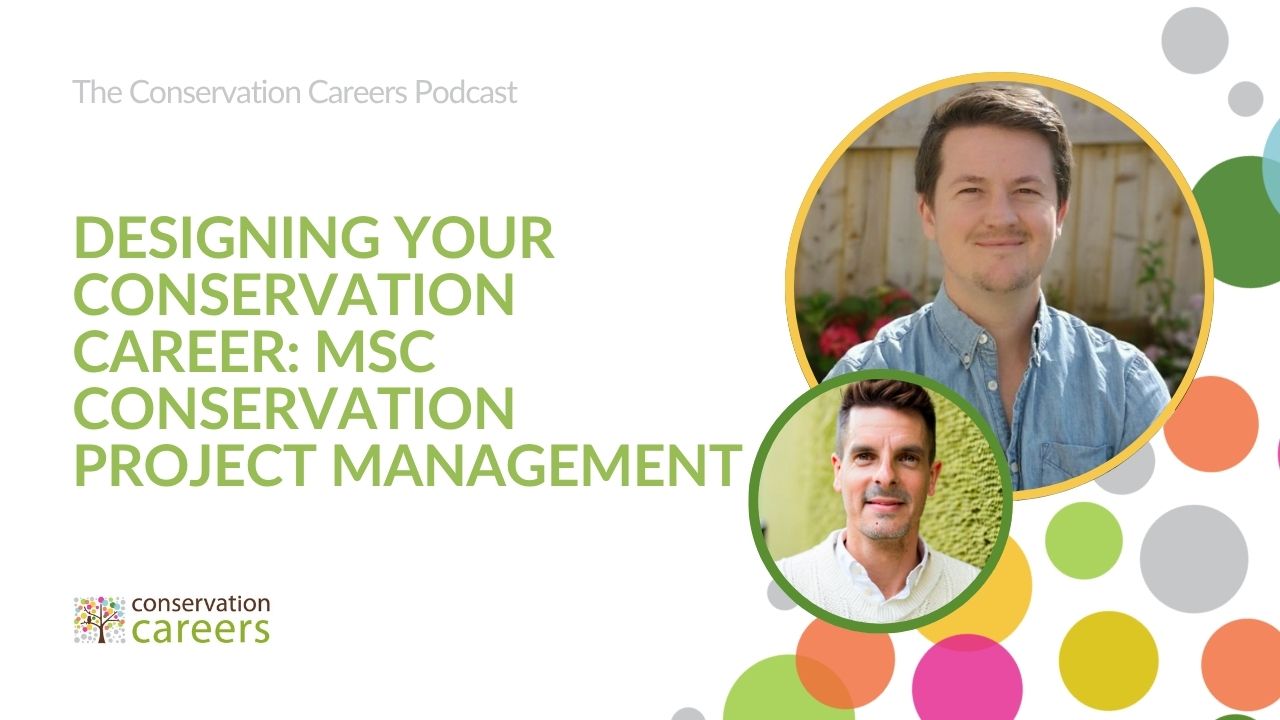
How do you design a training programme that actually prepares conservationists for the real world? In this episode, we’re joined by Dr Stephen Green, Senior Lecturer at Newquay University Centre and co-creator of our new MSc in Conservation Project Management.
Together, we reflect on the story behind this pioneering Master’s, review its first year, and discuss how it equips students with the real-world skills that conservation employers value most – from project design and fundraising to communications and career planning.
We also hear Stephen’s own story – from the module that sparked the idea to his reflections on change, motivation, and career clarity.
It’s an honest, hopeful and practical conversation for anyone navigating their path into conservation.
Enjoy.
Listen
Watch
Subscribe
You can listen and subscribe to the Conservation Careers Podcast on iTunes, Spotify or Stitcher using the following links, or search for ‘conservation careers’ and you’ll find us!
Resources
https://www.cornwall.ac.uk/courses/msc-conservation-project-management/
Join our live podcast audience!
All our podcasts are now recorded in front of a live audience who sit in and listen to the chat, and then after the mics are turned off get a chance to talk to the guest, share their thoughts and ask questions.
If you’d like to be in the audience all you need to do is join our CC Academy.
In the CC Academy you’ll get access to the world’s biggest conservation job board – listing over 15,000 jobs, volunteer and internships across the globe each year.
You’ll also enjoy access to our amazing CC Pro private members community with regular events, networking and support.
Plus you’ll get full access to our growing library of career-boosting resources, guides and templates.
And best of all it only costs a few dollars, pounds or euros per month to join the Academy.
To find out more please visit the CC Academy, or simply click the join button at the top of our website.
See you on the inside!
Transcript
I’m Steven Green, and I’m the current program manager and cocreator of the MSC conservation project management, which we run here at Newquay University Center, which is part of the Cornwall College group and, also the University of Plymouth.
00:00:56 [Speaker 1]
Great.
00:00:56 [Speaker 1]
Well, good to have you back on the podcast because we’ve spoken before about your career and your work and the master’s program that we’ve co developed that we’re here to talk about today.
00:01:05 [Speaker 1]
And it’s nice to reconnect because it’s always sort of a year in as the master’s program, aren’t we?
00:01:11 [Speaker 1]
So Yes.
00:01:12 [Speaker 1]
Really, the thrust of today is to catch up on what’s happened, to kinda share the news, to hear your own personal story as well about how things have gone.
00:01:21 [Speaker 1]
But maybe the best place to start is let’s just let’s just have a little reminder as to what this program is, and perhaps where it came from.
00:01:29 [Speaker 1]
Because I remember three, four years ago, an email came out of the blue from yourself saying you were developing this idea for a masters, and could we have a chat?
00:01:38 [Speaker 1]
So yeah.
00:01:39 [Speaker 1]
Wind the clock for us.
00:01:41 [Speaker 1]
Let’s start from there.
00:01:42 [Speaker 1]
That’s a good point.
00:01:43 [Speaker 1]
Yeah.
00:01:43 [Speaker 2]
Yeah.
00:01:44 [Speaker 2]
So the the idea came from initially, we were running a third year module as part of our BSc, well two BSc’s, BSc applied zoology and conservation and also BSc applied marine zoology and there’s a there’s a final year module in that called conservation project management where we we try to do a lot and we kind of started to realize that this was this one place where students were getting these brilliant skills about they were doing crowdfunding campaigns, they were running projects, they were doing all of the stuff that they weren’t really doing as much in the other modules and it worked brilliantly in in some respects, they were doing fantastic stuff but it was a lot, you know, it was a lot to try to cram into a module and we started having these conversations about well there are all these skills and employers keep saying to us, we love this module because people are coming out of it with the skills that we want.
00:02:39 [Speaker 2]
Students are coming back to us saying, oh, you know, I found that module really hard, but when I went and had that interview, that was the one module I found myself talking about, the project that I was running, the money that I’d raised, and all this stuff.
00:02:50 [Speaker 2]
And that was really lovely to to hear.
00:02:53 [Speaker 2]
But we recognized that in order to do it justice, we needed more time.
00:02:58 [Speaker 2]
We needed more space.
00:02:59 [Speaker 2]
So that’s where the the conversation about, well, let let’s think about how we can develop this further, and we started talking about running, an MSC
00:03:08 [Speaker 1]
Mhmm.
00:03:09 [Speaker 2]
Version of it.
00:03:09 [Speaker 2]
And so it then sort of landed on my plate as to to develop this further.
00:03:14 [Speaker 2]
And it was at that point that I was already familiar with conservation careers and the work that you were doing, and and I was I was thinking about what I was delivering and what I wanted to develop further and do more of and the resources that you had, it became obvious that a conversation needed to happen between you know I thought well let’s just let’s just talk.
00:03:38 [Speaker 2]
Let’s let’s see.
00:03:39 [Speaker 2]
We’ve got these fantastic resources that already exist as part of conservation careers.
00:03:46 [Speaker 2]
Let’s talk about that, and let’s see whether there’s any way that that could be integrated into what we deliver here.
00:03:52 [Speaker 2]
So I sent you an email, yeah, out of the blue just and and maybe that’s quite a nice lesson, isn’t it?
00:03:57 [Speaker 2]
That sometimes these these opportunities, it is just about sending an email sometimes, isn’t it?
00:04:02 [Speaker 1]
Yeah.
00:04:03 [Speaker 1]
Making contact.
00:04:04 [Speaker 1]
Yeah.
00:04:04 [Speaker 2]
And you just yeah.
00:04:05 [Speaker 2]
You just why not?
00:04:07 [Speaker 2]
And, yeah, then we we started talking, and and you seemed sort of quite excited about the idea in the same way that I was quite excited, and and things went from there.
00:04:17 [Speaker 1]
Yeah.
00:04:17 [Speaker 1]
And and and what I was excited about was it’s we’re on the same page.
00:04:22 [Speaker 1]
Like, what we’re looking to do is create trainings and support people to be as good as they can be in conservation and provide particularly their kind of core skills that is being led by employer demand in in that, you know, employers are looking for these things.
00:04:36 [Speaker 1]
We’re not looking to necessarily teach, you know, theory, just theory, or or deliver knowledge.
00:04:43 [Speaker 1]
This is about, you know, really kind of stepping back and saying, right, what are employers really looking for across this really diverse, sprawling sector that we call conservation?
00:04:53 [Speaker 1]
And how can we create a program that really, yeah, creates people that are ready for employment, you know, if I can sort of put it that way.
00:05:01 [Speaker 1]
So three or four years ago, we’d just been running some of our kind of foundation courses for a year or two, having done a review of the sector.
00:05:08 [Speaker 1]
So I’ve talked about this many times, you know, but I mean, look about what employers really look for across all the job types, like the recurring patterns, the foundational themes.
00:05:17 [Speaker 1]
It’s things like project management like you’re already talking about.
00:05:20 [Speaker 1]
It’s things like fundraising.
00:05:21 [Speaker 1]
It’s things like communications.
00:05:23 [Speaker 1]
These are the kind of just transferable skills that employers are screaming out for that not many programs are delivering really, I think right now in an academic setting.
00:05:33 [Speaker 2]
Yeah.
00:05:33 [Speaker 2]
I think that it’s things are having to shift, but but you’re right.
00:05:37 [Speaker 2]
It’s a lot of graduates are finding themselves in that position where they’ve they’ve gained a lot of knowledge, throughout their their degree, but they haven’t necessarily got those specific skills that when it comes to the job at, you know, application demonstrate that you have experience of doing these things.
00:05:56 [Speaker 2]
It’s all the stuff that you can do.
00:05:58 [Speaker 2]
Show me that you can do these things, rather than demonstrate that you have knowledge of something.
00:06:04 [Speaker 2]
Yeah.
00:06:05 [Speaker 2]
Some of it is you know, obviously, you’ve got to have knowledge as well.
00:06:07 [Speaker 2]
These things have got to be pairs together, and that’s why we decided that, okay.
00:06:11 [Speaker 2]
So by the time somebody has done their undergraduate degree, they should have developed a lot of knowledge, and then they’re looking to develop these skills.
00:06:19 [Speaker 2]
So the MSC that we wrote, we thought, right, this has got to be skills based.
00:06:24 [Speaker 2]
Yeah.
00:06:24 [Speaker 2]
And it’s got to bring people in from all kinds of different backgrounds that have different knowledge because conservation is extremely broad, and we don’t want people just coming into it with one way of thinking, one bit of knowledge.
00:06:39 [Speaker 2]
We we want all sorts of diverse people that can come in and, you you know, then develop the skills that are needed within the the industry.
00:06:50 [Speaker 2]
And so that that was the approach that we took.
00:06:53 [Speaker 2]
And I think that by combining and collaborating with conservation careers during the development of the the program.
00:07:02 [Speaker 2]
We ended up with a we we have ended up with a really nice program that that has talking about these sort of like core pillars of conservation, yeah, project management, funding, communications.
00:07:12 [Speaker 2]
There’s lots of other skills that are really important as well, but I think that they kinda sit quite firmly at the heart of what what we’ve tried to put together, which Yeah.
00:07:21 [Speaker 2]
Has been really important.
00:07:24 [Speaker 1]
Yeah.
00:07:25 [Speaker 1]
And before we kinda dive into actually what the master’s program actually looks like, just to kinda touch on what we talk about there as well in terms of how we see the the job market as well, which links quite closely to this.
00:07:38 [Speaker 1]
So we see the job market is almost like two things.
00:07:40 [Speaker 1]
One is like cause based roles.
00:07:43 [Speaker 1]
If you think about what job you want to do, the causes might be ecology, it might be marine, it might be climate change, it might be plastic pollution, it might be barn owl conservation, it might be whatever.
00:07:54 [Speaker 1]
And those are quite sort of knowledge based, things you need to learn, and it’s what many programs teach you.
00:08:00 [Speaker 1]
You know, you come away with an ecology degree or a biology degree.
00:08:04 [Speaker 1]
Those are kind of courses.
00:08:05 [Speaker 1]
They’re not necessarily skills that you’re deploying, you know.
00:08:08 [Speaker 1]
When we think about the jobs, it’s it’s a cause and it’s a role, which is then often a skill set.
00:08:13 [Speaker 1]
So you might be a Barnell fundraiser, you might be a marine project manager, you know, you might be a Barnell communicator and so forth.
00:08:22 [Speaker 1]
And we’ve been sort of leaning much more towards the kind of the roles and the skills, yeah, which can be then blended with the kind of the the knowledge and the cause based stuff that allows people to then create those niches.
00:08:34 [Speaker 1]
And I guess the bigger picture from our side is what we’re looking to do is create clarity in the sector as to where people might go, and we’ll talk a bit more about career planning in a bit as well and how we’ve folded that in.
00:08:46 [Speaker 1]
And really where we want to get to is where we have actual career pathways laid out for people.
00:08:52 [Speaker 1]
You know, this is sort of one piece of that.
00:08:54 [Speaker 1]
So, you know, if you wanted to be a lawyer or a teacher or a doctor or, you know, whatever, normally it’s quite clear what you need to do.
00:09:02 [Speaker 1]
You do this, you get this qualification, you get this experience, you apply for these jobs which lead to those jobs and so forth.
00:09:09 [Speaker 1]
We haven’t got anything as organized like that in conservation yet.
00:09:13 [Speaker 1]
But, you know, the vision would be to get something like that, and this is a key part of that.
00:09:17 [Speaker 1]
Yeah.
00:09:18 [Speaker 2]
Yeah.
00:09:18 [Speaker 2]
That that’s exactly it.
00:09:19 [Speaker 2]
We were talking in the office the other day about, you know, the role of apprenticeships coming into higher education and, and it’s really tricky for for conservation because you can imagine that if you’re doing something, you know if you’re training to be, yeah if you’re trained to be a doctor okay there are lots of different pathways you could then specialise, but if you were training to be, have a trade, if you’re trained to be an electrician, you’ve kind of you’re training for a certain set of standards working in a certain way, and you’ve got to demonstrate that you can do that.
00:09:49 [Speaker 2]
Mhmm.
00:09:49 [Speaker 2]
But, yeah, conservation sort of it’s it’s so many different traits that you can’t you can’t kinda just train, for a generic conservation role because it’s it’s more than that, which means that when we’re designing these programs and the the resources we’re doing, they have to account for that flexibility and diversity in what what conservation is, which is, you know, kind of, I guess, getting into into the program.
00:10:20 [Speaker 2]
One of the first things that we do part of it is, make sure that people are really reflecting on the the experience that they currently have
00:10:29 [Speaker 1]
Mhmm.
00:10:29 [Speaker 2]
And the role that they want to to go on and potentially do, but exploring that in more detail as well and kind of making sure that the role that they think they want to do is actually the right one.
00:10:42 [Speaker 2]
So really looking at the the jobs that are out there, the skills that they might need, and then going from there, which links really nicely with the, you know, the conservation careers kickstarter program that’s integrated into to what we deliver.
00:10:56 [Speaker 1]
Yeah.
00:10:56 [Speaker 1]
Well, let’s talk about the program then.
00:10:58 [Speaker 1]
So what what does it look like?
00:10:59 [Speaker 1]
What’s included?
00:11:00 [Speaker 1]
How long does it last?
00:11:01 [Speaker 1]
Just, yeah, give us a bit of a picture.
00:11:03 [Speaker 2]
Yeah.
00:11:04 [Speaker 2]
So it’s it’s a a one year full time or two year part time masters.
00:11:09 [Speaker 2]
Mhmm.
00:11:09 [Speaker 2]
There are also options to do kind of the postgraduate diploma or postgraduate certificate which are kind of slightly, shorter, small lower number of credits, but if we just kind of talk about the MSc in general to begin with.
00:11:24 [Speaker 2]
So yeah either one one year full time, it’s based down here at Newquay University Centre, in in Cornwall or obviously two years part time.
00:11:33 [Speaker 2]
In terms of timetabling, we try to keep it as a minimum so students are in for, only actually in college for two days a week on the full time programs so they’ve got the rest of the time.
00:11:46 [Speaker 2]
We make it clear that you you can’t you can’t do a full time masters in just two days a week.
00:11:51 [Speaker 2]
There’s other time that you’re gonna have spent, but we want to make sure that the other time is available for not only doing the, the work that that needs to be done as part of the course, but also getting out working, volunteering.
00:12:03 [Speaker 2]
And so combining the the taught element with the experience and really kind of pushing that and making sure that that experience is built into our expectations so that by the time you get out the other side, you’ve networked, you’ve built experience working and volunteering within the sector.
00:12:21 [Speaker 2]
And for part time students it works lovely because they they’re only in college one day a week which gives them a lot more space to really do that.
00:12:29 [Speaker 2]
So it’s also great for people that are already working in conservation that wants to then get the MSc as as the because, okay, at the moment under the current version, it does mean having to come into Newquay University Center one day a week.
00:12:43 [Speaker 2]
So, yeah, geographically that might be problematic for some people.
00:12:46 [Speaker 2]
But, for those who can, it allows them to to work, or potentially continue in the conservation job that they are already doing and and upskill and develop that as part of their continued professional development.
00:13:00 [Speaker 2]
And that seems to be working really nicely.
00:13:03 [Speaker 1]
Yeah.
00:13:03 [Speaker 1]
It’s nice to sort of two formats, isn’t there?
00:13:05 [Speaker 1]
Sort of full time, part time and sort of fit it around your life.
00:13:08 [Speaker 1]
Cornwall’s quite a long way down, but it’s also a beautiful place to visit It is.
00:13:12 [Speaker 1]
To spend a bit of time into.
00:13:13 [Speaker 1]
So yeah.
00:13:14 [Speaker 2]
Yeah.
00:13:14 [Speaker 2]
It’s it’s it does mean that geographically we’re sort of slightly isolated, but the the payoff for coming all the way down here and and being able to to study where we are is, is hopefully worth it.
00:13:28 [Speaker 2]
I mean, it’s an absolutely beautiful place in the world to to spend a year or two of your your life.
00:13:34 [Speaker 2]
And, and many people come down here and then stay for for a bit longer because, they they love it so much as as I have done.
00:13:42 [Speaker 1]
Absolutely.
00:13:43 [Speaker 1]
Yeah.
00:13:44 [Speaker 1]
I can see it’s got a suntan too, so obviously.
00:13:46 [Speaker 2]
It’s nice.
00:13:47 [Speaker 2]
Yeah.
00:13:47 [Speaker 2]
Yeah.
00:13:48 [Speaker 2]
Yeah.
00:13:48 [Speaker 2]
It was come last week.
00:13:49 [Speaker 2]
Yeah.
00:13:51 [Speaker 1]
In terms of the content of the masters, from our side, we deliver four programs that’s sort of included, yeah, in in, in the whole package.
00:13:59 [Speaker 1]
So you get the the conservation career kickstarter, which is a kind of a whole career planning program really reflecting upon, who are you as the kind of core foundation of career planning, really understanding yourself.
00:14:12 [Speaker 1]
Yeah.
00:14:12 [Speaker 1]
What are your core skills?
00:14:14 [Speaker 1]
What do you enjoy doing?
00:14:15 [Speaker 1]
When do you get into kind of peak moments of flow?
00:14:18 [Speaker 1]
What can you learn from that?
00:14:19 [Speaker 1]
What are your superiors?
00:14:20 [Speaker 1]
And so much more.
00:14:21 [Speaker 1]
Really understanding you.
00:14:22 [Speaker 1]
We’re all different.
00:14:23 [Speaker 1]
We all thrive in different contexts and environments, and it’s just sort of understanding that from the the basis of then trying to figure out, okay, where you’re gonna land in a happy career.
00:14:33 [Speaker 1]
The second part of the Kickstarter then is really about, okay, so where do you want to go?
00:14:36 [Speaker 1]
What are all the different career options?
00:14:38 [Speaker 1]
We talked about that a little bit already today, but, you know, what are the causes you care about?
00:14:42 [Speaker 1]
What are the skill sets, the roles you’re interested in, what are the different employer types that might suit you and your personality, and then putting together in terms of career plan.
00:14:51 [Speaker 1]
How are you gonna get there?
00:14:52 [Speaker 1]
What gaps might you need to fill alongside the masters and other training you might be doing and so forth?
00:14:57 [Speaker 1]
So At the end of it, you get real clarity as to who you are and where you’re going and how you’re gonna get there along with the skills to actually deliver success, you know, interview, application, training, all that sort of stuff.
00:15:08 [Speaker 1]
So in a nutshell, that’s that’s the kickstarter that’s included as the kind of career planning and and development module.
00:15:15 [Speaker 1]
And then we have the kind of three core foundation modules, again, we’ve touched on.
00:15:19 [Speaker 1]
So one being project management, so important, and we talk about this a bit a bit more in a second.
00:15:24 [Speaker 1]
But for that, it’s about the conservation standards framework.
00:15:28 [Speaker 1]
It’s about how do you design, develop, and and deliver, and manage, and learn from a successful conservation project, sort of start to finish as this cycle.
00:15:39 [Speaker 1]
Linked to that, we have communications, kind of core focus.
00:15:44 [Speaker 1]
You know, how do we reach audiences, develop, messages that really connect with people and and make difference in the world?
00:15:52 [Speaker 1]
And how do we kind of, yeah, build our audiences and build support for the movement?
00:15:57 [Speaker 1]
And then we have fundraising as well, like, how do you actually secure funds?
00:16:01 [Speaker 1]
And what I think is quite neat about the the the four aspects, but particularly those kind of three skills aspects is, well, one, they’re driven very much by demand of what employers are looking for, and two, they fit together so neatly as a kind of a cycle as to how a conservationist typically goes about doing their work in so many different contexts.
00:16:19 [Speaker 1]
So, you know, projects are the pixel size of activity, the Lego brick really of what happens in the sector.
00:16:26 [Speaker 1]
And the first thing many conservationists do is is design or develop a project from scratch.
00:16:32 [Speaker 1]
Like, what are the problems?
00:16:33 [Speaker 1]
How are we gonna solve it?
00:16:35 [Speaker 1]
You know, what’s our timeline?
00:16:37 [Speaker 1]
What the activities?
00:16:38 [Speaker 1]
What do we expect the outcomes to be?
00:16:39 [Speaker 1]
Like, just develop a solid project that’s been well thought through.
00:16:43 [Speaker 1]
That’s what the conservation standards is there to do.
00:16:46 [Speaker 1]
Having done that, well, how do we then get that idea off the ground where you you fundraise for it typically?
00:16:51 [Speaker 1]
You know, often it’s about writing proposals to donors, for funding or other ways of raising funds as well, but typically that would be the route.
00:17:00 [Speaker 1]
Once you have the money, well, then it’s back to the standards really about actually then delivering, managing a really solid project, being agile and adaptive learning, making sure it’s it’s that we’re learning and improving all the time, sharing lessons, and then that really does link to sharing lessons.
00:17:16 [Speaker 1]
It’s the communication.
00:17:16 [Speaker 1]
It’s about telling people about what you did, whether that’s donors or whether that’s other audiences and so forth.
00:17:21 [Speaker 1]
So the whole thing kind of fits together a really nice cycle of how people work and what employers are looking for.
00:17:28 [Speaker 2]
That that’s exactly it.
00:17:29 [Speaker 2]
And I think that that design the the management, project management design module, The idea of using the conservation standards and and integrating that with the the Meredy software Mhmm.
00:17:44 [Speaker 2]
Which allows us to implement the standards, which you you end up with these, what look like quite complicated plans, but it affects it.
00:17:51 [Speaker 2]
It’s it’s that making sure that you’ve got this really clear conservation target and you you you’re then assessing these problems and and kind of all of the contributing factors that that impacts those.
00:18:03 [Speaker 2]
And and just really clearly finding you’re not going to be able to solve the whole thing, as as as an individual, maybe as a larger organization or a group of organizations, you can kinda start hitting more of those those problems.
00:18:17 [Speaker 2]
But really just kind of looking at where those problems are.
00:18:21 [Speaker 2]
And, yeah, you know, often it is about, right, we need to do this thing, but we’re not gonna be able to do that thing until we get the money.
00:18:27 [Speaker 2]
So it’s having that really crystal clear project plan that is going you can demonstrate that theory of change that it’s going to have an impact, a positive impact on your conservation target, and taking that as part of your so rather than just saying, oh, we need some money to to conserve, you know, whatever it might be to to conserve lynx or tigers or or what or coral reef.
00:18:54 [Speaker 2]
Having the the thought, you know, that that theory of change of how that how much money you need and what you’re gonna do with it all the way through so that you have really strong funding proposals
00:19:07 [Speaker 1]
Mhmm.
00:19:08 [Speaker 2]
Or, well, and or a really clear narrative, clear clear story, communicating to your audience, and your supporters about what it is you’re doing, why you’re doing it, and, and writing it or communicating in a way in an appropriate way for for that audience.
00:19:26 [Speaker 2]
So we as part of the the funding module that we do here, so we we obviously integrate the, the module that the conservation careers delivers online.
00:19:37 [Speaker 2]
But I guess the the the nice link between conservation careers courses and what we then do and deliver is that, we get the students to actually implement the the learning that they’ve had.
00:19:50 [Speaker 2]
So you’ll learn about crowdfunding.
00:19:52 [Speaker 2]
You’ll run a crowdfunding campaign with the other students, and you will generate money.
00:19:57 [Speaker 2]
And we’ve been really successful with that with our undergraduate, version of it, the the module.
00:20:01 [Speaker 2]
You know, every year we’re we’re raising, you know, a few thousand pounds here and there for local conservation organizations.
00:20:09 [Speaker 2]
We’re getting much funding from count local council.
00:20:12 [Speaker 2]
All these things that are are really important.
00:20:15 [Speaker 2]
But in order to do that, you’ve obviously got to be effective in your your communications.
00:20:20 [Speaker 2]
And it’s a learning process.
00:20:22 [Speaker 2]
Right?
00:20:22 [Speaker 2]
Mhmm.
00:20:22 [Speaker 2]
Yeah.
00:20:22 [Speaker 2]
That’s it.
00:20:23 [Speaker 2]
You’re not gonna get it perfect the first time around, but the only way that you build that experience is by doing it, which is why, you know, we kinda throw students into it.
00:20:33 [Speaker 2]
And that’s why when you come out of the program and you get asked that question, you say, what experience do you have at fundraising?
00:20:39 [Speaker 2]
You can say, well, I have run a crowdfunding campaign, and I have hopefully raised money.
00:20:44 [Speaker 2]
There’s nothing within the program that requires you to raise anyway.
00:20:48 [Speaker 2]
You’re not being assessed on your ability to raise a certain amount of money.
00:20:53 [Speaker 2]
It’s it’s the reflection.
00:20:54 [Speaker 2]
So if you run a crowdfunding campaign and you don’t hit your target, and, you know, you could some people might see that as a kind of, oh, we we failed to do that, but but it’s not actually.
00:21:07 [Speaker 2]
A crowdfunding campaign is much more than that.
00:21:08 [Speaker 2]
You’ve communicated to a large audience.
00:21:11 [Speaker 2]
You’ve got a lot of information about the kind of people who are supporting you.
00:21:15 [Speaker 2]
You’re generating data that is going to in a conservation management context, you’re going to use all that information in your adaptive management side and say, right.
00:21:23 [Speaker 2]
Okay.
00:21:23 [Speaker 2]
So we didn’t hit our target this time.
00:21:25 [Speaker 2]
How are we gonna adapt this next time?
00:21:26 [Speaker 2]
How are we gonna communicate differently?
00:21:28 [Speaker 2]
What are we what do we need to do so that we can continue?
00:21:30 [Speaker 2]
But you’re not starting from scratch at that point.
00:21:32 [Speaker 2]
You’ve already gone one cycle.
00:21:34 [Speaker 1]
Mhmm.
00:21:35 [Speaker 1]
Mhmm.
00:21:35 [Speaker 2]
You’re adapting.
00:21:37 [Speaker 2]
You’re fine tuning.
00:21:38 [Speaker 2]
You’re going again.
00:21:41 [Speaker 2]
We but so far, we’ve actually every every time we’ve done it, we have hit our target, and I think that’s because students sort of, you know, really, really kinda wanna push that, push to get over that that line, which is fantastic.
00:21:55 [Speaker 2]
But, you know, to reassure people, you’re not you’re not being assessed on your ability to raise money for a specific organization.
00:22:02 [Speaker 2]
It’s understanding
00:22:05 [Speaker 1]
whether
00:22:07 [Speaker 2]
why you did or didn’t hit a target.
00:22:10 [Speaker 2]
That’s that’s kind of the assessment point.
00:22:12 [Speaker 1]
Yeah.
00:22:13 [Speaker 1]
So And and that opportunity to actually do what you’ve learned and therefore showcase to employers, it’s so valuable.
00:22:19 [Speaker 1]
It’s easy to say to someone, I know something, but it’s very different to say I’ve done something or I can do something.
00:22:26 [Speaker 1]
And that’s what employers are really looking for.
00:22:29 [Speaker 1]
They’re looking for, like, promise.
00:22:30 [Speaker 1]
They’re looking for, you know, actual delivery if you like, and that is really nice that’s been built in.
00:22:35 [Speaker 1]
It’s part of the innovation of the master’s program.
00:22:37 [Speaker 2]
And and as you were saying about these these kind of core modules dovetailing together really nicely
00:22:43 [Speaker 1]
Yeah.
00:22:44 [Speaker 1]
You
00:22:44 [Speaker 2]
know, that’s why we teach.
00:22:45 [Speaker 2]
So we teach on the full time program, you’re you’re going through and you’re doing your funding module, you’re doing your communications module at the same time.
00:22:53 [Speaker 2]
They’re they’re complementing one another.
00:22:54 [Speaker 2]
Mhmm.
00:22:55 [Speaker 2]
So you’re using those skills across both in the part time route.
00:22:59 [Speaker 2]
The way it’s structured at the moment is that you do your communications module in the first year, you do your funding module in the second year.
00:23:05 [Speaker 2]
We’ve done it in that way because we want you to have those communication skills in place before you then go in to do your, your funding because it’s it’s all linked together.
00:23:15 [Speaker 2]
And you’re able to then use those skills that you are have either already completed, in, in your first year or that you are learning at the same time as you’re going through it.
00:23:25 [Speaker 2]
So it’s it’s all been designed about using the skills, developing skills, using them, and being kind of assessed on the practicalities of doing it.
00:23:34 [Speaker 2]
And, yeah, there’s there’s bits of theory involved, there’s bits of writing that, you know, needs to kind of write reports and things.
00:23:41 [Speaker 2]
But in the age of generative AI, which is the other big problem, big, you know, challenge for universities and higher education.
00:23:52 [Speaker 2]
Being able to have assessments that really get to the core of whether you can do things, you know, and and produce things.
00:24:00 [Speaker 2]
And potentially with the aid of, you know, generative AI rather than trying to kind of push it to the side, pretend it doesn’t exist, recognizing it’s going to be used within, within all industries moving forward.
00:24:13 [Speaker 2]
So it’s Mhmm.
00:24:15 [Speaker 2]
How can we use that, as a tool for, making conservationists even more effective?
00:24:21 [Speaker 2]
And and, yeah.
00:24:23 [Speaker 2]
So we’re all going to be able to do more or expected to do more.
00:24:28 [Speaker 2]
Yeah.
00:24:29 [Speaker 2]
So how do we build that into?
00:24:30 [Speaker 2]
So that’s really, really interest interesting challenge that everyone’s wrestling with at the moment.
00:24:35 [Speaker 2]
But I think this program, because of the way that we have designed the modules and assessments, it it sort of it benefits from it in in in many ways, so rather than us having to be kind of too concerned about it.
00:24:49 [Speaker 1]
Yeah.
00:24:49 [Speaker 1]
Yeah.
00:24:50 [Speaker 1]
Huge opportunities with it too.
00:24:51 [Speaker 1]
I love that you kind of, yeah, using it as a tool and seeing it as an opportunity as well.
00:24:57 [Speaker 1]
So we’re a year in.
00:24:59 [Speaker 1]
You know, the program’s been running for a year.
00:25:01 [Speaker 1]
The first cohort have been part time, so they’re halfway through their two year studies.
00:25:07 [Speaker 1]
What are your reflections on that year?
00:25:09 [Speaker 1]
Like, how has it gone?
00:25:11 [Speaker 1]
What stands out from you?
00:25:13 [Speaker 1]
Any any stories you want to tell?
00:25:15 [Speaker 1]
I mean, yeah, share with what you want or what you don’t want really.
00:25:17 [Speaker 2]
Yeah.
00:25:18 [Speaker 2]
I mean, I’ve been I’ve been really, really pleased with how things have gone this year.
00:25:24 [Speaker 2]
You know, starting a new MSC, it it’s it can be kind of daunting.
00:25:28 [Speaker 2]
You don’t you know, you have a plan, but you don’t quite know exactly how everything’s gonna go.
00:25:33 [Speaker 2]
We’ve been really fortunate that the first cohort that we’ve had through, have they’ve gelled brilliantly, and they’ve all got different backgrounds and experiences that have complemented one another, and they’ve been able to learn from each other as well as we’ve gone through it.
00:25:48 [Speaker 1]
Without being specific, like, what are their backgrounds?
00:25:51 [Speaker 1]
Like
00:25:51 [Speaker 2]
So, yes, we’ve got so we’ve got a couple of students that have come directly through.
00:25:56 [Speaker 2]
They’ve they’ve just finished their BSC.
00:25:59 [Speaker 2]
Yep.
00:26:00 [Speaker 2]
One in, so ecological resource manage Mhmm.
00:26:06 [Speaker 2]
Resource management, one in sort of more traditional, zoology background.
00:26:12 [Speaker 2]
Mhmm.
00:26:13 [Speaker 2]
And then we had, one of our students had graduated quite a few years ago and had been off doing concentration work in Central America running programmes, conservation programmes out that way, and then had decided that they wanted to sort of after covid come back and be here and get more involved in UK conservation, so looking for kind of the next step in their career.
00:26:41 [Speaker 2]
We have a student, a mature student who has already had quite a long career but sort of outside of conservation and now wants to get into conservation later in her career.
00:26:56 [Speaker 2]
And she has been working for do doing some consultancy, on the side, but wanting to kind of develop, more formal training in conservation in general.
00:27:09 [Speaker 2]
So, and then yeah.
00:27:11 [Speaker 2]
And then we’ve got another student who also, completed her degree in applied marine zoology a few years back and is coming back into wanting to well, finding it, Veronica, maybe kind of difficult to get the jobs in the job market that, she would ideally like to get.
00:27:29 [Speaker 2]
So seeing this as a mechanism for for trying to do that.
00:27:31 [Speaker 2]
So we’ve got this we’ve got people in in different part yeah.
00:27:36 [Speaker 2]
Phase of their careers from kind of straight in from undergraduate degree to coming back in from completely the other side of things.
00:27:43 [Speaker 2]
And regardless of which direction people have come in, we’re getting the same feedback that it’s it’s been a really valuable process so far up to this point of just being able to have that time, especially with the the, you know, the Kickstarter, which fits into our professional development module to just really reflect on where they’re at within their career path, where they want to get to, and the steps that they need to take in order to get there.
00:28:11 [Speaker 2]
And and and the fact that they’ve all got different experiences, and wanna go in different directions sort of is brilliant.
00:28:20 [Speaker 2]
It doesn’t matter.
00:28:21 [Speaker 2]
You know, we we talk about within the quick the the Kickstarter program, there’s there’s kind of a handbook and there are different, different sessions that that we go through.
00:28:32 [Speaker 2]
And one of them is identifying your superpower within conservation role.
00:28:37 [Speaker 1]
The first session, I think, the first unit, the first module, that.
00:28:40 [Speaker 1]
Yeah.
00:28:40 [Speaker 2]
What are your kind of superpowers?
00:28:44 [Speaker 2]
I know I know, like, when the students went through that and and myself and, doctor Cathy Baker who who teaches, teaches that module, we decided we’d go through the process ourselves and, you know, being very British, we found it quite difficult to, sort of, like, think about what our own superpowers are.
00:29:02 [Speaker 2]
But but we
00:29:03 [Speaker 1]
And just the context here, the superpowers is about asking your friends and family who knows you well, isn’t it?
00:29:07 [Speaker 1]
Like Yeah.
00:29:08 [Speaker 1]
Yeah.
00:29:08 [Speaker 1]
What superpowers do you see in me?
00:29:10 [Speaker 1]
Get that feedback from others.
00:29:11 [Speaker 1]
Yeah.
00:29:12 [Speaker 2]
Yeah.
00:29:12 [Speaker 1]
Just put yourself out there.
00:29:13 [Speaker 1]
Yeah.
00:29:13 [Speaker 2]
That’s it.
00:29:14 [Speaker 2]
So asking other people how they see you, what what they think your strengths are, which is yeah.
00:29:21 [Speaker 2]
It it leaves you sort of maybe feeling a little bit exposed and vulnerable, but it but I think that’s that’s the key, isn’t it?
00:29:26 [Speaker 2]
It’s just allowing yourself to reflect fully and kinda see how other people see you, not just how you see yourself.
00:29:33 [Speaker 2]
But, but, you know, I think that one of the superpowers of this course is that ability to take people in from any direction.
00:29:42 [Speaker 2]
It’s not just zoology and conservation graduates.
00:29:46 [Speaker 2]
It’s people that are coming in having had a career somewhere else and recognizing that conservation is a really really broad field that needs people from all different backgrounds.
00:29:54 [Speaker 2]
So if you are, you know, you’re there, you’ve you’ve been working hard developing lots of really really relevant skills that could be used by conservation organizations, but you don’t have a degree in zoology conservation, then that doesn’t matter.
00:30:09 [Speaker 2]
It’s all about recognizing that you have something to to contribute to conservation organisations, and this is the time to reflect on.
00:30:18 [Speaker 2]
Right?
00:30:18 [Speaker 2]
What are my superpowers?
00:30:21 [Speaker 2]
How can I really help an organisation in a fulfilling way?
00:30:26 [Speaker 2]
But not only what’s going to help a conservation organization, but what’s gonna help you and be feel satisfied in in in your your work and your life in general.
00:30:36 [Speaker 2]
And so I think that all of us going through that process, the students and also, in the first iteration of this program, I wanted to go through that myself.
00:30:46 [Speaker 2]
So I sat in on those classes, and I went through the whole process with the students.
00:30:52 [Speaker 2]
And, you know, we might get onto that a bit more later on, but I found it from my own professional practice really, really informative.
00:30:59 [Speaker 2]
Just having that time to stop and be forced to really think and answer quite I say hard questions.
00:31:09 [Speaker 2]
They’re not hard questions, but it does require you to stop and be reflective.
00:31:14 [Speaker 2]
Reflective practice is what this whole program is about.
00:31:17 [Speaker 2]
It sits at the heart of the conservation standards.
00:31:20 [Speaker 2]
It’s that first step, assess what you know, if there is a problem, what that problem is, and then going through to, making a plan, implementing it, and doing it, you know, going and then reflecting again and kind of sharing, what you’ve learned.
00:31:36 [Speaker 2]
And and, you know, this this podcast, I guess, is part of that.
00:31:39 [Speaker 2]
We’ve gone through one iteration of the, the first year of the part time route.
00:31:43 [Speaker 2]
We’re now reflecting on how it’s gone.
00:31:48 [Speaker 2]
And, yeah, I think from the start of the program to where we are now halfway through for the first, you know, first year of the part time route, The students have come in.
00:31:59 [Speaker 2]
They have really thought about those skills that they’ve needed.
00:32:03 [Speaker 2]
They’ve then used so there’s the, the grants, so the the professional development grant that was in some of the money that we give back to students to then do the things that they want to be able to do.
00:32:14 [Speaker 2]
They’ve spent some of that money in, accessing courses and doing the things that they now know are kind of right for them.
00:32:21 [Speaker 2]
And some of the students came in with an idea thinking, oh, maybe I wanna go into consultancy.
00:32:25 [Speaker 2]
And as part of that process, I thought, actually, that’s not quite what I want to do, and it doesn’t align exactly with my values and what’s gonna make me happy.
00:32:34 [Speaker 2]
And so I’ve kind of pivoted mid course and are going off in a slightly different direction now, which is great.
00:32:41 [Speaker 2]
You know, having that time to think about what it is you wanna do and then make sure that your path is heading in that right direction.
00:32:48 [Speaker 2]
And, yeah, superpower of the course, you don’t if you come in with one idea and then during that those first couple of months you decide that isn’t the right direction, the course is flexible and everyone’s gonna be going off in different directions.
00:33:04 [Speaker 2]
You’re not signing up to do one specific thing.
00:33:06 [Speaker 2]
Mhmm.
00:33:07 [Speaker 2]
You’re signing up to allow yourself to have either a year or two years developing an appropriate career path for you.
00:33:15 [Speaker 2]
Mhmm.
00:33:16 [Speaker 2]
The the skills are transferable, along the way.
00:33:19 [Speaker 2]
So Yeah.
00:33:20 [Speaker 2]
So, yeah, that that’s working really well.
00:33:23 [Speaker 2]
And I think the way that these modules dovetail together is working brilliantly, working with the, local conservation organizations as well.
00:33:34 [Speaker 2]
And and we had a brilliant field trip, you know, reflecting on the first year built into the program, there is a module that is a field trip.
00:33:43 [Speaker 2]
So we spent, well, there are two two versions of it.
00:33:46 [Speaker 2]
There’s a UK version which we base on all around the the Southwest.
00:33:50 [Speaker 2]
So here in in Cornwall, then just over the the border into Devon.
00:33:54 [Speaker 2]
And so included within the cost of the MSC is is a week of going around camping, visiting conservation, or conservation projects, and and evaluating them.
00:34:05 [Speaker 2]
So it’s it’s not that traditional go on a a field course and learn lots of survey techniques.
00:34:14 [Speaker 2]
There’s a little bit of survey techniques involved within it, but it’s more about let’s go and actually see some conservation projects in action.
00:34:21 [Speaker 2]
Let’s go and talk to people that doing conservation, and let’s listen to all of the challenges that they face.
00:34:30 [Speaker 2]
And that allows us to then apply the conservation standards to these projects and say, right.
00:34:34 [Speaker 2]
Well, we’ve learned about about this, and, you know, we can see the challenges.
00:34:39 [Speaker 2]
And and and then as part of that assessment, they have to then think about, well, where could they potentially intervene either through applying, you know, a a funding or communications campaign or or other opportunities to, but but the main thing is it was just it was a lot of fun.
00:34:56 [Speaker 2]
We spent a week camping and having, yeah, having a really, really nice time, getting to spend time with, Cold Wildlife Trust.
00:35:05 [Speaker 2]
We went over to, Derek Gower’s Rewilding Coombs Head project.
00:35:09 [Speaker 2]
We saw, you know, rewilding in action from different different approaches to to rewilding and and, you know, really, really kind of different ways of doing conservation.
00:35:20 [Speaker 2]
We saw small conservation projects, big, ambitious landscape scale conservation projects, and we’re able to kind of identify all the sort of the the themes that linked these things together and how conservation is actually done.
00:35:35 [Speaker 2]
All of a sudden, oh, yeah, all the while talking to these people.
00:35:37 [Speaker 2]
So, like, you know, what are you looking for in the people that you’re employing on these projects?
00:35:42 [Speaker 2]
Or or what what skills do do you have?
00:35:46 [Speaker 2]
And so, yeah, constant kind of learning experience.
00:35:50 [Speaker 2]
Obviously, there is an alternative form of that module, which is the international field trip, which we haven’t run as part of the the first year.
00:36:00 [Speaker 2]
We did most of the students wanted The UK version.
00:36:03 [Speaker 2]
But hopefully, we’ll get that up and running, as long as there’s enough interest in it.
00:36:08 [Speaker 2]
Yeah.
00:36:09 [Speaker 2]
But that the idea is do the same thing, but do it outside of The UK trying to evaluate how conservation works in parts of the world where some of those challenges are very similar, some of them are more extreme.
00:36:25 [Speaker 2]
Yeah.
00:36:27 [Speaker 2]
And and and linking that all the while to people do you?
00:36:30 [Speaker 2]
So even our projects here.
00:36:32 [Speaker 2]
Excuse me.
00:36:33 [Speaker 2]
I should have turned my phone on to silence.
00:36:34 [Speaker 2]
That’s alright.
00:36:35 [Speaker 2]
And that off.
00:36:37 [Speaker 2]
Let me
00:36:37 [Speaker 1]
do that.
00:36:38 [Speaker 1]
So it’s in the audio edit.
00:36:39 [Speaker 1]
There you go.
00:36:40 [Speaker 1]
I can get that.
00:36:46 [Speaker 2]
So yeah.
00:36:48 [Speaker 2]
We so being able to to take people to experience conservation in the real world, you know, rather than just in the classroom, I think is a it’s it’s important.
00:37:00 [Speaker 2]
And it’s also just a really lovely way to spend some time.
00:37:04 [Speaker 2]
So so that was that was a a real highlight, I think, of the the year so far.
00:37:09 [Speaker 1]
Sounds great.
00:37:09 [Speaker 1]
Sounds great.
00:37:13 [Speaker 1]
Two things I’d like to talk about then towards the end.
00:37:16 [Speaker 1]
One is well, a, if people are interested, like, you know, how can they find out more?
00:37:21 [Speaker 1]
Enrollment is open now.
00:37:23 [Speaker 2]
Am I
00:37:23 [Speaker 1]
right, Insane?
00:37:24 [Speaker 1]
We’re not recording.
00:37:24 [Speaker 1]
It’s the July 18.
00:37:28 [Speaker 1]
Yeah.
00:37:29 [Speaker 1]
What’s the process?
00:37:30 [Speaker 1]
What are the deadlines?
00:37:30 [Speaker 1]
Have you got those to mind?
00:37:32 [Speaker 2]
So, yeah, we’re we’re still accepting applicants, for September 2025 start if people are are sort of thinking about doing it either on the the part time or the full time route.
00:37:42 [Speaker 1]
Mhmm.
00:37:42 [Speaker 2]
The best the the easiest thing to do is if you go to our website, so well, or if you were to just kind of go into a search engine, Google MSc conservation project management, UK University Center.
00:37:55 [Speaker 2]
That will take you to, to to the appropriate page.
00:37:58 [Speaker 2]
Mhmm.
00:37:59 [Speaker 2]
On that page for the for the course, you will find, a number of videos.
00:38:04 [Speaker 2]
So there is the original podcast that that we did way before, you know, we even kind of started the program.
00:38:10 [Speaker 2]
There’s also a webinar that we did recently that talks you through all the modules and everything.
00:38:14 [Speaker 2]
So that’s kind of where you can get most of the detail.
00:38:17 [Speaker 2]
You can apply directly, so hit the apply now button through that page, but but you can also find the details for details for for us sort of stuff here.
00:38:24 [Speaker 2]
So, you know, initially, contact us, send us an email, so all the information will be on that that page on how you can get get in contact.
00:38:34 [Speaker 2]
Over the summer with, you know, staff on annual leave, I think that it will take you through to, a general kind of filtering through which will then get pushed out to to the duty staff.
00:38:44 [Speaker 2]
So hopefully somebody, regardless of kind of fees on annual leave, should should get back to you.
00:38:48 [Speaker 2]
So if you are interested in a September start, we’d we’d encourage you to get in contact soon.
00:38:53 [Speaker 2]
There’s there’s still time.
00:38:55 [Speaker 2]
But it’s obviously for you in order to kind of make preparations and plans for for being down here ready for September start date, they would, you know, need to consider that.
00:39:05 [Speaker 2]
But if you’re thinking about next year, September 26, then then speak to us now, and, yeah, and see if the the program is gonna be right for you.
00:39:15 [Speaker 2]
We would always say to everyone, you know, look around.
00:39:19 [Speaker 2]
There’s lots of different programs out there, lots of different ways that you can do a masters, lots of different training that you can get.
00:39:25 [Speaker 2]
And as I say in the webinar, you can access these courses, the the conservation careers courses, obviously, through yourselves.
00:39:31 [Speaker 2]
You you don’t have to do our masters in order to to have access to them.
00:39:36 [Speaker 2]
But what we provide is a way of, I guess, interacting with that content in an extended format, which then allows you to to get your official, qualification.
00:39:53 [Speaker 2]
So it’s a it’s a University of Plymouth MSC that we deliver here at New York University Center.
00:39:59 [Speaker 2]
And so if you’re looking for that version of of the program, then, yeah, get in contact, see see if it’s the right thing for you.
00:40:07 [Speaker 1]
Right.
00:40:07 [Speaker 1]
And we’ll obviously provide links in the show notes and wherever you’re listening to this or reading it or watching it even.
00:40:12 [Speaker 1]
Yeah.
00:40:13 [Speaker 1]
And then the other thing I wanted to ask as well is, like, about you, Steven.
00:40:16 [Speaker 1]
Like, obviously, you talked about going through the Kickstarter yourself as part of your own professional development and really understanding what you’re delivering to as part of the master’s program.
00:40:25 [Speaker 1]
Like, what have been your insights from reflecting your career, who you are, where you wanna go?
00:40:31 [Speaker 1]
Is there anything you kinda wanna share around that?
00:40:34 [Speaker 2]
Yeah.
00:40:34 [Speaker 2]
Absolutely.
00:40:35 [Speaker 2]
I I found it really powerful, and and and I’ve so when you when you’re working in a in a role, often you sort of you go day to day sort of just doing the job, and it’s really busy and, absolutely love the job that I do.
00:40:57 [Speaker 2]
But there’s not always that time to just think about, right, so what what sort of like what’s the long term kind of plan you’re sort of just you’re going through and doing, week to week, month to month.
00:41:09 [Speaker 2]
And that module allowed me to really kind of go back and and sort of think about how I got to where I am and what is important to me and where where I’d like to go.
00:41:20 [Speaker 2]
And it it forces you to reflect not only on your career and professionally, but personally what’s important to you in life in general, family, friends, location, and all these things.
00:41:29 [Speaker 2]
Mhmm.
00:41:30 [Speaker 2]
And and what came out of it when I went through the analysis was that, the things that were going to make me the happiest and the things that I wanted to do, I probably needed to make some adjustments within both my my kind of personal, family, and professional life in order to get to that next peak.
00:41:56 [Speaker 2]
You sort of think about this mountainous landscape, and I kinda like I’m on a mountain.
00:42:01 [Speaker 2]
I’m on the top of the mountain, and I’m really happy there.
00:42:03 [Speaker 2]
But you kind of look out and suddenly you sort of see in the distance Yeah.
00:42:08 [Speaker 2]
That there’s another mountain that’s over there.
00:42:10 [Speaker 2]
And actually, potentially, that’s where I could be more effective and be doing something better.
00:42:19 [Speaker 2]
Well, not better, but, you know, it might be kind of time to go there.
00:42:22 [Speaker 2]
Getting there is sort of like you’ll go all the way back down through the valley, probably have some hardship, and then climb back up to the other side of the mountain and kind of be there.
00:42:33 [Speaker 2]
And that’s that’s really tricky.
00:42:35 [Speaker 2]
But then that’s where the, you know, the the conservation, project management and design bit started kicking in because I was combining these two things and thinking, right, so I’ve kind of identified that there are some other things that I would like to be doing more of.
00:42:50 [Speaker 2]
And, and that involved potentially kind of being more having more time to actually do conservation.
00:42:55 [Speaker 2]
So I I teach a lot.
00:42:57 [Speaker 2]
Right?
00:42:57 [Speaker 2]
And I love teaching.
00:42:58 [Speaker 1]
Yeah.
00:42:58 [Speaker 2]
It’s brilliant.
00:43:00 [Speaker 2]
But I don’t then have a lot of time to do the the actual getting involved in conservation.
00:43:08 [Speaker 2]
I I do a fair bit, but I’d like to do more.
00:43:11 [Speaker 2]
But how can I how can I kind of make that space?
00:43:13 [Speaker 2]
So I started then using the conservation centers, project management tools and thinking, right.
00:43:16 [Speaker 2]
So I I need to kind of make some sort of theory of change for myself and and how do I get there?
00:43:21 [Speaker 2]
And the career profession you know, professional development plan that I was doing in the Kickstarter, what are the things that I need to do?
00:43:27 [Speaker 2]
Where are the gaps in my knowledge?
00:43:30 [Speaker 2]
Because as you Mhmm.
00:43:32 [Speaker 2]
When you’re in a job, there is the the danger that other areas of the industry sort of continue to to evolve and and you’ve got to upskill all the time.
00:43:41 [Speaker 2]
So I started looking at what the things that that I needed to maybe kind of develop as I as I kind of went forward.
00:43:48 [Speaker 2]
And so I started thinking about that that training, and then also kind of the the personal side of it.
00:43:55 [Speaker 2]
So as a result of all of that, I’ve been sort of really fortunate in that, I’ve been able to hand over some more of the kind of administrative duties for the program, to a colleague that’s allowing me to free up space that could then sort of I can realign family stuff.
00:44:18 [Speaker 2]
I can have more time for looking at new developments, getting involved more actively within conservation projects, and also exploring new ways of developing kind of this program and other programs further.
00:44:34 [Speaker 2]
So so it it’s yeah.
00:44:37 [Speaker 2]
It it’s been a a really, really good thing for me.
00:44:41 [Speaker 2]
That means that my career is is sort of just it it’s allowing me that journey to continue, right, rather than just sort of staying where I was, where I was perfectly happy and everything was good.
00:44:55 [Speaker 2]
But it’s forced me to think, right.
00:44:57 [Speaker 2]
Okay.
00:44:57 [Speaker 2]
So how do we keep going with this?
00:45:00 [Speaker 1]
Yeah.
00:45:01 [Speaker 2]
And so that’s what I’ve learned, from it.
00:45:04 [Speaker 2]
And being then active in asking for things and taking action so that things do change Yeah.
00:45:12 [Speaker 2]
Rather than not.
00:45:14 [Speaker 2]
In which case, they they don’t.
00:45:16 [Speaker 2]
So, and, you know, I guess that goes sort of full circle.
00:45:19 [Speaker 2]
So where all of this came from, sending that email to you and just having that conversation.
00:45:24 [Speaker 2]
Sometimes it’s just it’s deciding to take some action that then opens up other opportunities.
00:45:32 [Speaker 2]
And so, I guess, with people listening to this podcast that thinking, well, is is an MSC the right thing for me?
00:45:40 [Speaker 2]
Maybe, maybe not.
00:45:42 [Speaker 2]
It’s about maybe just taking that action to investigate to see whether it is and, you know, it might be and it might be that catalyst then unlocks all sorts of other things or deciding to go and do one of, you know, the the course stand alone courses with with conservation careers or whatever it might be.
00:46:01 [Speaker 2]
Mhmm.
00:46:01 [Speaker 2]
But just deciding to give yourself some time to think and then acting on it.
00:46:08 [Speaker 2]
And that’s what I’ve learned is that, you know, sometimes life can get so busy and doing that thing, it just never happens because she’s busy doing all the other stuff.
00:46:17 [Speaker 2]
So take some time for yourself.
00:46:19 [Speaker 2]
Yeah.
00:46:20 [Speaker 2]
Reflect on your own plans, and and, yeah, get a plan and and then just start chipping away at little things that then just, you know, there’s little steps that can then go on to make actually quite big changes.
00:46:35 [Speaker 2]
You know, this this whole program came out of conversations and email and like like all all things.
00:46:42 [Speaker 2]
They they start off small, and they you get that groundswell and they develop and and exciting things happen.
00:46:49 [Speaker 1]
Yeah.
00:46:49 [Speaker 1]
Absolutely.
00:46:50 [Speaker 1]
They do.
00:46:50 [Speaker 1]
Yeah.
00:46:50 [Speaker 1]
And I’m so pleased for you as well.
00:46:52 [Speaker 1]
I think it’s so so exciting, and I think those two lessons that you shared are so important.
00:46:56 [Speaker 1]
One is about just sort of taking time for yourself, and you’ve done that, you know, by doing the Kickstarter, you know, within your kind of core time.
00:47:04 [Speaker 1]
And the perspective you shift you get with you on, like, a master’s program or even if you’re on a trip or on holiday or just taking yourself out of the normal and spending some time thinking about things and having the structure of something like the Kickstarter or whatever, really, just to to think about who you are and where you want to go, that’s number one.
00:47:22 [Speaker 1]
I think that really helps.
00:47:23 [Speaker 1]
I always have my best ideas when I’m walking.
00:47:26 [Speaker 1]
Yeah.
00:47:26 [Speaker 1]
Walking down the river or something like that, you know, just shift your perspective.
00:47:28 [Speaker 1]
And then number two, just getting some clarity as to where you’re going, that direction piece.
00:47:33 [Speaker 1]
And they can be baby steps, can’t they?
00:47:34 [Speaker 1]
They don’t have to be big.
00:47:36 [Speaker 2]
Yeah.
00:47:37 [Speaker 1]
Like career planning and reflection, it should be not a constant thing, but a regular thing.
00:47:42 [Speaker 1]
I think like a recurring beat within your life.
00:47:44 [Speaker 1]
I like to do it sort of annually, something like that.
00:47:47 [Speaker 1]
You know, it’s nothing’s ever fixed.
00:47:49 [Speaker 1]
You you’re on top of your mountain.
00:47:50 [Speaker 1]
You can see another mountain that you wanna move towards, and there’s another one behind that.
00:47:53 [Speaker 1]
There’s another one behind that.
00:47:54 [Speaker 1]
You know?
00:47:54 [Speaker 1]
It’s it’s just a journey of progression.
00:47:56 [Speaker 1]
Like, do I, mate?
00:47:57 [Speaker 1]
And where am I going?
00:47:58 [Speaker 1]
You know?
00:47:59 [Speaker 2]
And it’s it’s important not to kind of fall into trap or just constantly be looking at the horizon, never being the way you are.
00:48:08 [Speaker 2]
But recognizing that it’s also sort of okay to periodically just give yourself that time to to look around and see whether it, you know, there is, you know, somewhere else that you’d like to to move on to.
00:48:23 [Speaker 2]
And so so for career switches that are looking to to come into conservation, that’s sort of like, you know, you might be really quite happy in your job, very comfortable in your job
00:48:33 [Speaker 1]
Yeah.
00:48:34 [Speaker 2]
Knowing that, oh, a career change, that’s that’s really disruptive and gonna be a lot of kind of work and things.
00:48:40 [Speaker 2]
But it it’s worth exploring and just taking taking some time to to look around and just see whether whether that is the right thing for you to do.
00:48:50 [Speaker 2]
And it, you know, if it is I do think that this program offers, especially careers which is an opportunity to build those skills and take the skills that they have to go on and, to get something that that’s gonna help them, you know, help you to to find that job in conservation.
00:49:10 [Speaker 2]
It it’s all got to be linked with volunteering and work and, you know, you know, we will say that a a qualification on its own is not going to kind of land you that job.
00:49:26 [Speaker 2]
But because this qualification is very focused on developing skills, hopefully, it’s going to be paired with you working at the same time and volunteering and eventually doing your your big research project at the end, your conservation project, All of that combined puts you in a really good place to, to then start making progress within the sector, I think.
00:49:48 [Speaker 1]
Yeah.
00:49:48 [Speaker 1]
And a year from now, we should be seeing people graduating from the program, seeing where they’re going.
00:49:53 [Speaker 1]
Yes.
00:49:53 [Speaker 1]
Exciting times ahead.
00:49:55 [Speaker 1]
Yeah?
00:49:55 [Speaker 2]
Yeah.
00:49:55 [Speaker 2]
Absolutely.
00:49:56 [Speaker 1]
Well, Steven, it’s been really good reconnecting, hearing how things are going.
00:50:00 [Speaker 1]
It’s been really fun working with you for sort of three or four years now developing this.
00:50:04 [Speaker 1]
And, yeah, be fun to see what happens over the next twelve months or more in the program and also for yourself personally.
00:50:10 [Speaker 1]
So, yes, so thanks for sharing everything today.
00:50:12 [Speaker 1]
We’ll share links with people who might be interested in the program.
00:50:15 [Speaker 1]
You know, you can go off and have a little look.
00:50:17 [Speaker 1]
I’m looking forward to meeting the new cohort too and see how things are going.
00:50:21 [Speaker 1]
And, yeah, is there anything sort of final thoughts you want to share before we wrap up?
00:50:26 [Speaker 2]
No.
00:50:26 [Speaker 2]
I I think that, you know, it’s it’s really nice to just have got to the end of the the first year with everyone being so happy.
00:50:33 [Speaker 2]
You know, it’s it’s the it’s the the I guess when you run programs, you you expect there to be sort of a few, teething problems and, you know, things, but but look, it it’s just run unbelievably smoothly with everyone coming out happy and, and it’s really lovely to see this relationship between, UK University Center, and conservation careers, excuse me, yeah, growing and and seeing where it goes from here.
00:51:02 [Speaker 2]
So exciting.
00:51:03 [Speaker 1]
Yeah.
00:51:03 [Speaker 1]
Long way it continue.
00:51:04 [Speaker 1]
Stephen Green, thanks again.
00:51:06 [Speaker 2]
Thank you very much.
00:51:08 [Speaker 1]
Grant.
00:51:09 [Speaker 1]
I’ll I’ll stop the recording there.
00:51:10 [Speaker 1]
Yeah.