Podcast | Leading with Purpose: Inside Nick Bubb’s Mission at Tusk

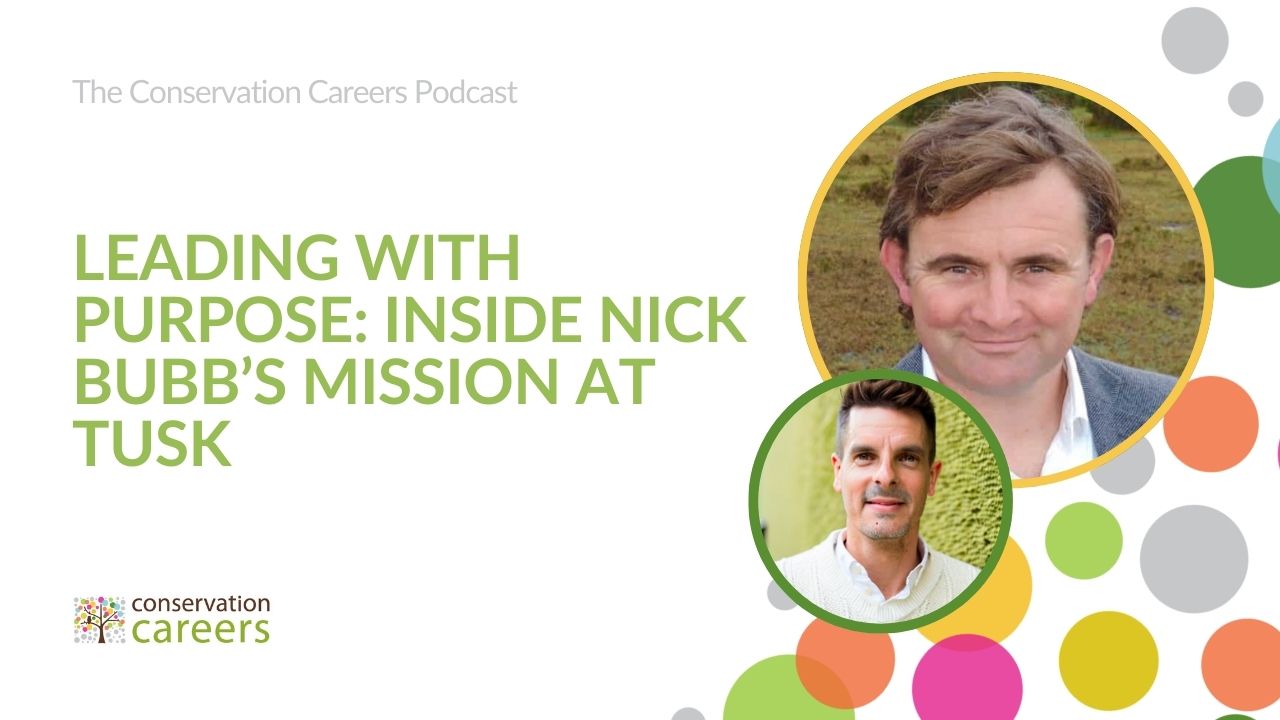
How Nick Bubb Combines Fundraising, Empowerment, and a Life of Adventure to Guide One of Africa’s Leading Conservation Charities, Tusk.
What’s it like to lead one of Africa’s most influential conservation charities? How do you support grassroots leaders across a continent while balancing fundraising, strategy, and your own wellbeing? And how can a mid-career pivot lead to purpose and impact in conservation?
Today’s guest is Nick Bubb, Chief Executive of Tusk Trust. With a background in engineering, ocean racing and finance, Nick brings a unique perspective to conservation leadership.
In this episode, we explore Nick’s approach to leading Tusk: supporting small, high-impact conservation projects, championing ranger welfare, and shaping a collaborative future for African wildlife protection. We also dive into his career journey, lessons from his time at Fauna & Flora International, the importance of career switchers in the sector, and how to handle the pressure of leading with purpose.
It’s a generous, inspiring, and mission-driven podcast.
Enjoy!
Listen
Watch
Subscribe
You can listen and subscribe to the Conservation Careers Podcast on iTunes, Spotify or Stitcher using the following links, or search for ‘conservation careers’ and you’ll find us!
Resources
Join our live podcast audience!
All our podcasts are now recorded in front of a live audience who sit in and listen to the chat, and then after the mics are turned off get a chance to talk to the guest, share their thoughts and ask questions.
If you’d like to be in the audience all you need to do is join our CC Academy.
In the CC Academy you’ll get access to the world’s biggest conservation job board – listing over 15,000 jobs, volunteer and internships across the globe each year.
You’ll also enjoy access to our amazing CC Pro private members community with regular events, networking and support.
Plus you’ll get full access to our growing library of career-boosting resources, guides and templates.
And best of all it only costs a few dollars, pounds or euros per month to join the Academy.
To find out more please visit the CC Academy, or simply click the join button at the top of our website.
See you on the inside!
Transcript
I’m Nick Bubb,and I’m chief executive of Task Trust. Great. Well, right, really nice to reconnect, Nick. It’s been I was just saying in the preamble, like, you know, five years since we last connected. We’d spoke to you in your last role as business development manager at FFI.
Change has happened in the world, but also for you in your career. So we’re here to talk about Tusk, your career, what it’s like to be a CEO, and so forth. But let’s start with Tusk. So you’re CEO of Tusk. What is Tusk for the uninitiated people who haven’t heard about it before?
Could you just describe its mission or or why it matters as an organization? Yeah. Okay. So, I mean, Tusk was founded, I think, thirty five years ago by by Charlie Mayhew really in response to the the, you know, the elephant and the rhino kind of poaching crisis at the time. And, you know, initially, it was very much, focused on on funding, I suppose, needy worthy worthy projects.
That’s still a very, you know, very much a central part of what we do, but, you know, the organization has grown since then. I think we probably, as an organization, deployed, just over $150,000,000 worth of support to, I believe, two fifty projects across the continent. So, you know, there’s quite a few sort of, I guess, small foundations doing fantastic work in the conservation space, but Tusk has really kind of continued to grow and evolve. And so, you know, for now or now, I would say we’re probably best known for supporting grassroots conservation initiatives across the continent, really trying to seek out those, projects that may be almost too small for bigger NGOs to get involved in, often looking for sort of charismatic leaders that just need a little bit of a leg up, a little bit of of support in in various different ways. And then more more more recently, really getting involved in supporting rangers through a variety of of kind of key initiatives.
Yeah. Great. That paints a really kind of nice overview picture. Why Africa for a start? I know that’s in its background and in in its heritage, but why specifically Africa?
Why do you have that focus? Yeah. I mean, as you say, that that’s the history of the organization. And I think there are a lot of big NGOs that that, I wouldn’t say make the mistake, but they they quite often evolve in trying to do everything because most most NGOs, they want to respond to need and and there’s obviously a huge amount of need and and the sort of emotion and the strategy and, it it will get a little bit confused. And I think one of the great strengths of task is in some ways is this the sort of the more simple approach.
And, you know, a lot of organizations will say they’re locally led. And whereas, I mean, Tusk really is. We this year, I think I believe we’re supporting 79 different projects across 25 African countries. And we don’t have, you know, a big team. We don’t have a big team of scientists here kind of telling those projects what they should do.
It’s very much about, asking those projects what they need, how can we best support them. And in many cases, those are you know, we make small and restricted grants, usually, where they’ve sort of highlighted what they’re gonna use the funds for with the smaller projects and their reporting requirements are minimal. All these things that with really small teams can actually hold them back a little bit. So, yeah, we have that that kinda niche, I suppose. And, yeah, it’s you know, a big part of our work is that portfolio kind of collaborating and and sharing knowledge and working together.
So we have a separate collaboration fund, which is very much focused on allowing leadership representatives from across the continent in those in that portfolio of projects to come together and share their experiences, challenges, opportunities, etcetera. So, you know, if we move beyond Africa, I think we we’d probably stretch ourselves too thin. So you’ve got your focus. You’ve got your niche. You’re looking for small organizations.
You’re looking for individuals with potential already showing potential, I guess, and then you’re investing in them and looking to kind of grow their impacts. Yeah. Yeah. Exact exactly that. And and also, I mean, my my passion, which a little bit comes from, I suppose, my career journey, but my passion is bringing new people into the world of conservation.
Nice. And, you know, I I prefer to spend my days talking to people, about kinda how they can get involved and why they should get involved rather than talking to people that are already, you know, very experienced and knowledgeable and trying to redirect their support to maybe my priorities. You know, I don’t see that as really adding much to the Yeah. To the the beast. And Africa tends to be where people new to conservation land.
You know, that that kind of concentration of of of megafauna and history is a really compelling case. And, you know, for a lot of people, going on a a safari in Africa is often their first kind of engagement point. Yeah. Yeah. And a beautiful place.
25% of all global biodiversity is in Africa. I was reading before this. What what are some of the challenges facing African wildlife right now? Before we kind of go into, you know, how you go about addressing that and your solutions to that, just, yeah, give us an overview of some of the kind of threats facing wildlife in Africa. Yeah.
I mean, pretty straightforward in some ways is is, you know, human wildlife conflict. Yeah. As as, you know, populations are are growing and and human development reaches out into what used to be, you know, open expanses. We’re seeing a lot of pressure on, on critically endangered endangered species that inhabit these these ecosystems, these, yeah, these areas where previously there was no, kind of human population. And so, managing that conflict and working with local communities to help them to not just to understand, but to realize the value and the potential in coexisting happily with wildlife, and where possible, you know, using that for for not just economic, but, you know, moreover, kind of more general environmental benefits is a huge part of what we do.
Some of our biggest challenges and obviously, also some of our greatest opportunities. You know, I think, thankfully, we’ve seen a slight reduction in the the sort of organized crime poaching side of things, and that will always be there. And, you know, it’s that’s that’s only really because of the huge efforts from, I think we’ve got something like 60,000 ranges across Africa. I think the research will say we need something like three or four times that number. But but the the point being is there are huge coordinated and consistent efforts to to try to hold that at at bay.
Yeah. I mean, I I think, yeah, that human development side is is definitely the the biggest threat for us. Yeah. And what are some of your initiatives that to us then to to tackle that, to turn that around, to to, yeah, to to work towards your mission? Like, what what’s going on?
Can you give us an idea of, like, projects or programs or initiatives, yeah, that you’re you’re involved with? Yeah. I mean, there are some some projects which are you know, it starts right at the beginning, really. I think there’s you know, we have a big education program called PACE, Pan Africa Conservation Education. Mhmm.
And, and I I saw some data from last year that those those educational materials, are now across 1,250,000 people across Africa using them, which is incredible, really. And a lot of that is just very much focused on the on the basic messages of, you know, how to how to coexist with wildlife, the some of the do’s and don’ts, how to, you know, we have some projects working on kinda setting up whether it’s kind of early warning monitoring systems for local farmers when there are predators in the area, how to, how to, you know, ward off herd of elephants. How just there’s some really kind of quite what I would call basic fundamental initiatives that that really provide practical solutions to some of these kind of conflict issues. Yeah. Then, god.
I mean, obviously, we only got 79 projects. There’s a lot Where do you start? Yeah. I mean, we’ve, a big thing that we’ve also moved into a little bit in the last, year or two is is growing our our sort of portfolio of marine projects too. So, again, very much community based coastal projects, and we’ve got seven now in in that portfolio.
And, yeah. And then we’ve, got what else should I jump to? We have some sort of bigger issues such as, something called the Wildlife Ranger Challenge, which that came out of COVID, really. It was a response, recognizing that really with the with the lack of tourism, there was a lack of funding to support, sort of the the front line of of of biodiversity guardians as I think they like to be referred to nowadays. So, so, so, yeah, they formed the Wildlife Ranger Challenge with the support of, Mark Sheinberg, who was a big backer who put up, just over a million dollars and it was a kind of a fund match challenge.
And the idea was that, rangers would would enter into a kind of a, you know, a a continent wide competition, which was really just their normal training schedules anyway. Yeah. And that training would be a sort of lighthearted competition, but also trying to really demonstrate that this is a really kind of worthwhile and professional profession that should be aspirational for for, for anyone really who who wanted to to get involved. Almost that kind of, you know, you see the sort of American Navy Seal type training program. You know, it’s that that kind of idea.
And it became this huge, not only fundraising mechanism, but also just, you know, exceptional camaraderie between, between ranges across the continent when often they’re working in, you know, very isolated and remote conditions. Yeah. Now since it was founded, it’s now raised, well over, I think, dollars 25,000,000 now, I think, is the number. And we’re continuing to grow that. And there have been some amazing initiatives that have come out of it.
Last year, in partnership with the Game Rangers Association of Africa, and the Royal Foundation, we launched the, bit of a mouthful, the ranger welfare and standards initiative, which really is, it’s an insurance medical insurance program, emergency evacuation, etcetera, etcetera. And the idea is that that all rangers should have proper insurance, and and their families should be insured, or supported through that mechanism. But as an organization, we give grants to organizations who who don’t have that insurance in place, but it’s on a a sort of a sliding scale. So over time, you know, organizations, should build that into their budgets as a standard. And at the same time, any organization that we give a grant to is obliged to sign up to the International Ranger Federation’s code of conduct.
So, and and this is also you know, obviously, in the press, there have been some, as there are in any industry, some negative stories about some conduct of some rangers. So we’re really trying to kind of promote those standards. And another underlying piece is is kind of mentorship and support and a kind of a ranger leadership council that can really help, continue to, yeah, to support the profession as a whole. So it’s really exciting focus for us. So much going on.
So much going on. So many questions as well that’s been out from that. There’s a couple of bits in that, that I’m conscious of your kind of background in finance as well. You mentioned a couple of things there. Warren is obviously supporting, like, the insurance and the welfare needs of Rangers.
And you also mentioned earlier on about how the funding can be fairly unrestricted. Or I I read that as sort of flexible for how it’s spent by the organizations and individuals involved. I just wonder if you can, like, speak a little bit to the kind of the, yeah, the finance side of it, if you like. So did you, as Tusk, set up the insurance or manage the insurance, or are you just providing access to something? Is there something behind that that’s kind of interesting to dig into?
And and how do you see the, yeah, how you invest and the flexibility for the importance behind that? So I know that can be really liberating for an an organization to be able to use finances, yeah, quite Yeah. Quite freely. Yeah. Yeah.
I mean, the insurance thing is is a is, a great question. So the insurance product was all already there Right. Yeah. With a combination called Satib. So that product is set up.
Yep. What we’ve done is work with a group of of of rangers to ensure that it’s actually meeting the needs because, you know, clearly, you know, the the sort of the payouts relate or the premiums relate to the payouts and the service. They’re trying to find a kind of a happy medium there. Yep. You know, and I should add there are some areas of Africa, typically the high risk areas where we can’t provide cover at the moment.
Mhmm. And and interestingly, it’s not just about the the risk level. It’s about proximity to to medical care too. Mhmm. So that sort of, you know, evacuation side is a massive factor.
So it’s not everywhere at the moment. It’s something we’re continuing to work on. Mhmm. So yes. The product is there, and we’ve really taken it, made made it kinda made sure it’s fit for purpose and then made it available to our to to our partners and actually other groups beyond our, you know, our kind of regular group of beneficiaries.
One of the the objectives is that, you know, this is part of raising the standards is that anyone who we support, we feel we have an obligation to make sure that, the ranges are properly cared for within that, within that, yeah, within that support program. Yeah. Yeah. And that comes across really clearly. And then just briefly, I got loads of questions I want to ask you, but, like, around the kind of flexibility of the investment organizations and individuals.
Like, what’s your philosophy or approach to that? Yeah. So we have, when I’m really talking about, the Tusk Fund, which is sort of unrestricted funds that we that we give out, and they sit largely within three groups. So we have what we call Catalyst, Evolution, and Keystone Partners. Yep.
So Catalyst, as you can imagine, those are small organizations that we give, grants up to £25,000. Mhmm. And that’s probably the largest group of our partners. So relatively small amounts of funding. Often, those are tiny organizations or or individuals that haven’t even sort of formed an organization.
Yep. And we tend to get to know those partners through a variety of methods, often through our existing networks. Then as those partners kind of, I suppose, you know, meet their objectives and and generally, yeah, you know, make positive progress, then we consider them to become, an evolution partner, which is the next step up, which is twenty five to seventy five thousand pounds. And then we have a group, I think, is about seven who are our keystone partners, and they receive larger grants, varying amounts. And we’re probably, you know, almost certainly a much smaller percentage of their overall funding.
Mhmm. But, we still believe that that’s sort of high impact. But at the same time, we really need those those keystone partners for the sort of knowledge exchange and sharing that happens with, you know, with those catalyst partners too. And in order to leverage and access that, every other year, we organize the Tusk Conservation Symposium, which brings together leadership representatives from all of these organizations, for a week. Last year, we were in Rwanda, and it was facilitated by Marie Sili, who we, you know, often have a lot of lot of close over that with.
And then separate to that, we have a collaboration fund, which then allows if, you know, if people came together, they identified common common, challenges, opportunities, experiences, etcetera, then this fund allows them to go away and sort of spend more time together, visit each other’s projects, and work up sort of larger funding proposals, which we may support in in some way. Got you. And some clear structure in some in in many ways. And quite a development structure and also support structure built into that. Yeah.
I love that. So it would it would be quite unusual for us to, you know, I I don’t think we basically would take somebody on that kind of later stage. You have to sort of grow through the portfolio. Yeah. You do you have some projects that we support through restricted funds.
Yeah. And that’s a sort of slightly different slightly outside of the strategy there. You know, if you have some bigger landscape projects such as, you know, we work closely with, Malolangwe in Zimbabwe. That that project there, we we try to connect with some of our other partners where maybe there are species specialists or there’s just knowledge exchange and transfer to Yeah. To be done.
Great. Okay. Well, before we start talking about you, your role, career changes, path, things like that, tell us a bit about the the Tusk Conservation Awards because I’m aware that it’s open right now for applications, isn’t it? We’re recording on the the April 1. It’s open till the April 25, so there’s an opportunity right now.
Tell us a bit about that. Yeah. So I mean, this I think this was, formed about twelve years ago. I would have to check that. But, and and, you know, I think Prince William was was really sort of closely involved.
He’s our is our patron in in shaping shaping the awards, really trying to, I suppose, you know, amplify the message and really to, you know, to give leaders in the sector a platform to really kind of step on from. And it’s very important the awards are not just about recognizing sort of individuals. There’s also three year grants that that come with these programs and are attached to, the the projects or programs that the individuals represent. So there’s there’s three awards. There’s the the Prince William Award for for conservation Africa, and that’s, £100,000 grants spread over three years.
And that’s more of a kind of a lifetime achievement award. Mhmm. Then there’s the the Tusk award for conservation in Africa. I should mention that the Britain award is sponsored by ninety one, investment management company. And then, Defender sponsored the the task award for conservation Africa, which is a sort of, kind of mid career conservation emerging leader award, and that’s a 75,000 grant over three years.
And then there’s also a a ranger award, which recognizes just an outstanding individual, working in the field, and there’s a £30,000 grant for that. And that again, all of those grants would go to the programs they represent. So is it you know, I think a lot of people see the prestige and the and I suppose that if you like the PR that comes with the awards, but for me, really, it’s about the underlying funding. Yeah. Brilliant.
Fantastic initiative. I mean, there’s a lot of good award schemes out there, but that that level of funding is is pretty special. It really is. Yeah. Okay.
And we’ll drop a link, obviously, I think, to us.org all on the website. Yeah. April 25. Funny things, Nick, is that, you know, we get we get some amazing applications, but, you know, I really would encourage encourage people to to to nominate somebody they know who who who might fit. You know, we’re always looking for for people new to the organization, new to our network.
And we’re just so aware there are some amazing untold stories out there, and we’d love to unearth more of those. Opportunity for growth. Brilliant. Brilliant. Okay.
Let’s change gears then slightly then. I’d love to talk more than about you, Nick, and your your job, your career, the journey that you’ve been on the last five years and plus. Let’s start with your current job. Yeah. So you’re the CEO of Tusk.
Not many people get to be CEOs of organizations like Tusk. Like, what’s your job like? How would you describe someone who has no idea what a typical week is like or what responsibilities are like? Paint a bit of an honest picture as to what it’s like to be here. I mean, so my background, I guess, for probably twenty five years now is largely in fundraising in one one respect or another.
So that’s kind of in my DNA. That’s something I focus heavily on still day to day. But the the reality is is is a lot of making sure everybody has the tools that they need to to deliver their jobs and and meet their objectives. Making sure as an organization that we’re, you you know, structurally as as you know, I spend a lot of time talking about organizational efficiency. You know, are we investing in the right areas?
Mhmm. Focusing on the sort of day to day problem solving, you know, working across 25 countries. There’s a there’s a lot of a lot of politics. I mean, there’s a there’s a huge amount that you need to try and keep up to speed with, but at the same time, you need to keep a focus on the bigger picture and the longer term, you know, strategic development of the organization. I joined Tusk.
We were, one year into this three year business plan. At the end of this year, we we have to have a new business plan in place. So, already, I’m kind of working with the team on that. There’s a lot less sort of overt leadership. It’s more about kind of empowering the the leaders within the organization.
You know, Tusk is a is a growing organization. I spent quite a bit of time last year slightly restructuring, you know, how our management team and our senior senior leadership chip team sit, focusing, I guess, topically, for you looking at career development opportunities for the team. You know, that the employment world is is is different to how it used to be, frankly. And, you know, to attract good people to come and work the task is something that you have to take seriously. And so, you know, it’s not just sort of come and come and work for an organization doing good work and take home your salary.
You know? You’ve gotta show that there’s career development on a personal level. There’s opportunities to move within the organization. There’s opportunities to build your knowledge. So, yeah, there’s a huge amount to kind of think about.
Day to day, I probably spend I typically spend three days a week in the office. Yeah. Just, team meetings, lots of face to face stuff. All of my, kind of my inbox tends to just fill up every day, and then in the evening, I have to try and deal with it. That’s the reality of it.
I have an amazing assistant who, you know, she keeps on on top of the stuff that’s urgent. Try to have FaceTime with with most of the team every week. And then, yeah, fundraising in London on a Wednesday. That’s kinda my my day to to go to the city. Bit of travel to The US, which is a big fundraising focus for us.
You know, obviously, it’s a very interesting time at the moment over there and indeed globally, but there’s still huge opportunities to fundraise. Last year, I traveled quite a lot whenever there was sort of an opportunity to do so in sort of cost efficient way to visit projects. So, so, yeah, there’s there’s a lot going on. Sarah Watson, who is based out in in, in Kenya, she lives at Lewa. She is our chief conservation officer.
So she leads all of the kind of conservation strategy. She has a or we have a head of conservation partnerships that sort of oversees the day to day of all these partnerships, but I very much try to check-in on all of that. I’d say that my my focus is the business of conservation. And, you know, nowadays, this backdrop of sort of development funding under under huge pressure. You know, in many ways, just like COVID, we’re looking at, okay, what are the sort of other sustainable finance mechanisms that that we can put in place?
You know, I really see philanthropy largely as being, seed funding for for bigger initiatives or in some cases, there are examples where there’s no other way to generate funding and that’s you know, you’re meeting a sort of a systemic failure. But, you know, a big piece of work for us up ahead is is some of our catalyst projects. You know, these there is no way that that these organizations have started thinking about kinda how to build sustainable revenue streams. They’re not at that stage. So for us, it’s it’s trying to push those conversations forward at the right time, you know, bring in people with relevant expertise either from within our portfolio or externally to help develop those.
So, yeah, there’s a there’s a lot to think about. Yeah. Much less of an old school approach where the CEO sort of stands up at the front and, tells everyone what they’re doing is much more about empowerment of the whole team. And and I think in a founder led organization, when you have this transition, you know, you’re you’re moving to more shared leadership. And I guess I suppose, you know, I’m very open.
I don’t have all the the skills and knowledge that many of the team do have. Yeah. You know, I I’m not, an academic in this respect. I’m an engineer. You know, I first got involved really in conservation, I I guess, in the in the late two thousands, but not as a a sort of a career until, you know, the end of twenty thirteen.
So it’s been in some ways, you know, it feels like a fairly fairly sort of, well, I’d say rapid progress, but I don’t know. It’s for me, there’s there’s a lot to come at me quickly, and I feel, I feel a huge pressure to utilise those opportunities and enormously grateful for the people that have, helped me along the way. You know, I’ve always, been very open to advice. You know, I don’t necessarily have to take it all, but I love to receive it. And, you know, and maybe as I reflect back a bit on my time with FFI under, you know, Mark Rose’s leadership, you know, the CEO of thirty years, I mean, you don’t have to look very far to find I mean, the CEO of the Rufford Foundation, a couple of the Wildlife Trusts, huge new initiative in in Saudi Arabia.
These are all former colleagues who are now the FFR. Yeah. Exactly. So there’s, you know, there’s a huge legacy from from that organization and and the leadership there that really has given us all the skills to to go on and, yeah, do what we can. Go off and keep flourishing.
Yeah. Yeah. What was your decision like to leave FFI and move to Tusk then? What’s that journey been like? And you might wanna talk about your actual journey on a a boat across New Zealand with your family since it’s part of that post COVID I was reading about.
Yeah. Yeah. So, I mean, as I as I said briefly, you know, without going into too much, I’m an engineer. I did a lot of offshore racing and sailing as a as a youngster and a lot of sponsorship as that sort of whole industry professionalized. Got involved with some marine conservation organizations and then big trip down to Antarctica and then met FFI effectively in 2012.
And I guess sort of informally became some sort of ambassador for them and then Mark Rose offered me this job as the or what turned into being the in the business development director for them, sitting with him managing the sort of ultra high net worth partnerships. And Yeah. You know, I’d had the privilege of going to a lot of FFI projects, getting to know an awful lot of the team. And so it became, you know, just a huge part of my life, like, hugely attached to it. And the most sort of efficient way for me to to largely fundraise was taking people to projects.
Obviously, in COVID, that became difficult. As we came out of COVID, a lot of people didn’t, you know, were were wary, rightly, of of of starting to travel again in the same way. And, you know, I I’ve got a young family. I haven’t spent a huge amount of time with them, if I’m honest. I spent so much time traveling, whether it’s in The UK or overseas.
You know, I committed absolutely 100% to the job because I think that’s kind of the only way I could really do that. You know, you don’t you don’t get to have career progression by accident. You know, there’s an awful lot of hard work that comes in that. So, yeah, at the end of COVID, like a lot of people, a bit of a reassessment of priorities. And, you know, I said to said to the well, to Mark Rose, really, you know, I think I’m gonna take a take a year or so and and, I’d like to go off cruising with my family recognizing that you probably need to replace me.
And and they said, well, look. Why don’t you, you know, sort of continue to work for us as a consultant? And, effectively, I did x number of days a year, and we, and we sailed from The UK, to New Zealand. So down across the Atlantic and through the Caribbean and through the South Pacific to Fiji and then and then down to New Zealand. And a big part of that was also for me to visit more FFI projects and to re you know, sounds a bit of a cliche, but to reconnect with nature, to spend time seeing not only the kind of, you know, the negative impacts of of climate change, but also to see some of the positive stories, you know, because there are a huge amount of uplifting positive stories and some wonderful experiences to have in nature that tend to get lost as we have this sort of half glass half full approach of life.
So What did you learn what did you learn during that during Nick? Like, what, you know, what what sort stands out for you? Yes. Great question. I had to summarize it.
I would say that that charismatic, strong, motivated individuals will actually have some wonderful successes and bring a lot of people along. You know? A lot of Individuals can make the difference. Yeah. Yeah.
Because and that’s something I think I’d almost started to question in a way. You know, a lot of small projects, can, you know, can can really be catalysts for huge positive change. Mhmm. And so, yeah, I think I think, especially in some of those remote islands, very few people Yeah. Just understanding how people are changing traditional practices, how they’re working with, you know, increasing visitor numbers and managing that and and then kinda getting us as the positive benefits out of it was amazing.
And just a meeting, whether it’s scientists doing research in the middle of nowhere or or just so many touch points, spending time with my sons on kind of coral restoration projects. Just, yeah, really meeting all these people who are doing so much. And in many cases, just because it’s the obvious thing to do, not necessarily even first sort of, you know, financial remuneration. So so it really motivated me. And then, you know, frankly, there was a point where I had to come back to to the day job.
So so we came home, and, and Mark Rose announced shortly afterwards that he was he was leaving FFI. Can’t quite remember the whole sort of timing of events. But at that point, I think I became aware that it was time for for a change, really. And and in fact, I’d known Tasper for a long time and, you know, a few initial conversations led to a few interviews. And, yeah, I started in, January.
So Wonderful. Yeah. What a story. And how what to ask? I I wanna know, like, what what was your approach to the job then?
So you day one, you’re in the job. Is it just a case of picking up the business plan and delivering it? Or did you have a first hundred days approach? Or, you know, it’s like you’ve got, like, almost like a blank canvases then, you see. What what were your priorities?
What was your strategy? So, I mean, it’s quite intimidating, really. Yeah. You take on a new role. And I was very fortunate in that I wasn’t coming in into the job to to sort of fix problems.
I was coming in to evolve and develop the organization. And Charlie Mayhew, the founder and and previous CEO, is now sits in a role as founder and president, so still works for the organization. Very much kinda hands off on sort of day to day operations Mhmm. But very much hands on on the fundraising and some of the big initiatives and relationships that he leads. Yeah.
So, so, yeah, that’s you know? And so I suppose with with both Charlie and Mark Rose, I have two sort of fantastic mentors from the conservation world, which is hugely important. I have a little group of of, of friends, really, who are in sort of senior leadership roles across a variety of NGOs. So I kind of worked with that group, and I spoke a lot to them before, before starting. And, but, yeah, day one well, before you start, there’s an awful lot of reading around Yeah.
These bad conservation strategies. I think, like like a lot of people, you look back and think, oh, maybe there were certain things I would have done differently. In reality, the approach is really getting to know the team because it’s all about the people. Yep. Getting to know what are their strengths and weaknesses.
Recognizing there there are, of course, things that needed to change, things that hadn’t changed maybe because, I guess, Charlie knew I was gonna be coming. So, you know, certain things you leave. And, you know, I think I’m very wouldn’t say I’m very commercial, but, you know, I have I also have a finance background. And so coming to the organization, I was very keen to make sure that, you know, we were putting in place the right systems to allow us to succeed and to scale. Mhmm.
That we have sort of long term development plans that are both ambitious without being too risky. So getting to know the trustees, which isn’t always easy. You know, the team are are in the office most of the time, but the trustees who I obviously the board of trustees I report to Yep. Now they’re all, pretty pretty busy people. And it’s actually quite hard to find a way to build a relationship with them.
You know, you go to a board meeting and it tends to be quite functional, functional, compliance, governance, a few key updates. So, yeah, that that’s taken a bit of time. I think when you start a role like this, you always wanna come with a load of ideas. Mhmm. And in reality, you’re not gonna be able to do all of them.
Mhmm. The people are quite resistant to change. You know, I love to tell the team that change brings opportunity, but, it doesn’t for everyone. And, now we’re in an interesting time, and I’ve also had to to manage, an office move. So, you know, we’re in a very small office in Dorset, and the team has outgrown it long ago.
I think there were conversations of moving before, before COVID, but that that didn’t happen, obviously. And so now as we’ve got more people back and we’re growing the team, we’ve really got to move. And these are these are difficult processes to manage. So having to to get involved in that in my first year has also been quite challenging, but I think we found a new place to be to be confirmed. But, so, yeah, there’s a lot of you know, how do you do that shared leadership, stakeholder engagement?
How do you bring everyone along whilst at the same time demonstrate clear leadership and and be decisive? You know, these are these are things that you can’t really read in a book. You and it depends a lot on the personalities with your team too. Fabulous. What sort of skills as you’re growing and hiring an organization like Tusk, what are the skills you’re looking for?
What the attributes are for of a staff member? What should people be considering when looking to develop their careers into organizations like yourselves? Yeah. I mean, we’ve over the last, well, last year or so, you know, we’ve had to recruit a few people. And Yeah.
One thing that really stands out is just how difficult it is for somebody to get across their enthusiasm and their commitment and their because everyone says largely the same things. Right. Yeah. And, you know, you have some people that are hugely qualified. But in reality, what what you’re looking for is individuals that will fit within your team Mhmm.
And that understand, you know, what what your objectives are and, are prepared to really work for them. And, you know, you in some ways, you want a couple of people that are a little bit disruptive that will come and shake up with new ideas, but you have to be confident they’re also gonna work with the team. Mhmm. When you make decisions and you take strategic sort of choices, then everyone’s gonna pull together and follow those. So I think more and more that that ability to to evidence and demonstrate, like, real teamwork is is something I look for straight away.
Somebody that’s worked maybe sort of on their own for a long time. You know, I’m a little bit, not wary of, but, you know, it’s definitely something that’s really important. You know, nowadays, we have so many people who are so well qualified. Most people can find a way to get some kind of field experience one way or another. That can be, obviously, can be challenging.
Mhmm. But, yeah, I think it’s that teamwork element is something that is really important to to forward. And do you still we talked about this previously. I wanna look back on this in the previous episode that people are gonna listen to and hear more about your career history and and the potted history you gave in more detail. We talked about the role and opportunity for career switchers in conservation as well, people coming from outside the sector in in whatever role or form that might be.
Do you still see opportunities for career switchers? Do you still see a need for them? Have things changed? Like, what what are your thoughts around that? Yeah.
I mean, firstly, yes. Of course. You know, we’re not a science based organization. So by definition, you know, we we need people that have experience in finance. We have digital experts, communications experts, obviously, fundraisers.
You know, there’s, there’s huge opportunity. The reality is sometimes, you know, salary expectations don’t don’t meet. Mhmm. I think we’re getting closer to that. You know, we certainly go through benchmarking exercises here to make sure remuneration is is right within the team and also the sector generally.
Mhmm. Yeah. I mean, we as we we’re in the middle in the process of hiring a new communications officer, for instance, huge, huge variety of people’s experiences, in in those applications. So that’s something where you don’t need, necessarily need sector knowledge. Mhmm.
Certainly, in the finance team, you know, you you don’t need that experience. Digital wise, no. Not at all. I mean, I wouldn’t say we’re going through a full digital transition, but we’re certainly reviewing a lot of our processes under that organizational efficiency banner. From a fundraising perspective, again, you know, my I I said my first fundraising experience is really around sponsorship, which, you know, arguably is more transactional, which is probably gives me that sort of focus a little bit more than maybe a classic charity fundraiser.
Yep. So yeah. No. I think there’s huge opportunity for that. I mean, what we are seeing is, you know, there there are so many different new small organizations, and I think in part, a lot of those are kind of small consultancies.
There are people coming out of coming out of certain roles or maybe coming out of university, maybe being frustrated and not being able to get a job. So they’re sort of forming an organization. Mhmm. And in some ways, that’s great. But at the same time, we, as a sector, we need to have coordinated efforts.
We don’t wanna be kind of you know, I don’t want duplication of effort. We don’t wanna be fighting over the same resources. So Yep. Now I would like to think at Tusk, we’re very open to what we’ve worked hard, as I said earlier, in trying to establish what exactly is it that we do that others don’t do. Mhmm.
Yeah. You know, where can we pass on support elsewhere? And, you know, the range of wealth for our standards initiative is a fantastic example where, you know, we’ve literally been kind of actively going out to other organizations working in Africa and saying, look. Can we can we help insure your ranges? Mhmm.
We can we can put you on a bursary program for that. So these kind of collaborations are really key. Amazing. Amazing. We’ve got a few minutes left.
I wanna ask you a couple of quick sort of open questions. And then after recording, I’m gonna hand over to a couple of people there in our audience who I’m sure want to ask some questions of themselves. One question, quick one. If we could take you to one place on the planet and you’re a well traveled man, and you can see one species, where would you go and what would you hope to look at? Well, gosh.
It’s like picking up your favorite child. It’s it’s awful. I know. Yeah. Yeah.
I, god. I mean, as you said, I’ve been very fortunate to travel a huge amount. But, god. I don’t know. I honestly, I don’t even know where to start.
I I always you if you are on this one. I always used to say, at at FFI, I always wanted to go to I can’t even say it now. Tajikistan and and and try and see a snow leopard. That was a thing, but but I never did. I think, maybe you know what?
I went to Zambia last year to, South Luangra, and I just absolutely loved it. I I love the people. I love the the pace of life and the wildlife there. I mean, just, yeah, just just incredible. In terms of I mean, god, favorite animals.
God, I couldn’t even really begin. You know? This is not particularly endangered, but I I actually love a warthog. Oh, nice. I love that.
I love their crazy irrational behavior. I love their unpredictability. I love their sort of disruptive nature, and I also love their sort of endearing stupidity. Love that. But, yeah.
No. I mean, that’s the great thing about this this job is, you know, you get to meet you don’t just get to go to so many places if you if you find yourself fortunate enough to be in the in the right roles. Yeah. Amazing. You mentioned a couple of times during this.
Actually, it’s you feel the pressure. Yeah. You feel pressure to deliver. You spent a lot of time working hard. Career progress doesn’t happen on its own.
You know? How do you handle that pressure? Do you do you handle it well? Is it some do you have mechanisms to look after yourself? Yeah.
I mean, that, the that, kind of life balance, I suppose, is is pretty difficult to find the more senior you are in any organization. So, you know, I do you know, first thing I do when I wake up is check my emails. And, you know, my my assistant is, she’s, well, she’s husband’s a farmer. They live on a farm. So she’s up at five in the morning.
She’s already filled my inbox of what needs to happen that day, which is fantastic. But but, no. It’s managing the the pressure and stress. I think the way to do that is by having a sort of a peer group that you talk a lot to, and I still think I already mentioned that. I have other other good friends in in different organizations with similar roles.
So we kind of cancel each other a little bit. Yeah. Look. It’s not easy. I I the the pressure I feel is because I’ve spent a long time building up networks of people that are hugely supportive, really engaged, and and I do feel that I need to, you know, direct it’s about efficient deployment of resources ultimately.
You know, I have some very yeah. Some some wonderful networks that, you know, I’ve built over a long time, and I want to leverage those properly and responsibly. I feel a pressure when I direct someone to a project for it to work out. You know, I’ve had projects that haven’t worked out. Of course.
Yeah. We all do. So, yeah, it’s, you know, I’m sat here now. I can feel my palms a bit sweaty. You know, I’ve got there’s so many things in my inbox that I need to do.
It’s just always like that. And, you know, being an engineer, I’m quite precise. And, actually, I can’t I can’t be this precise. I just can’t get everything done, and I need to have time with my family. But, yeah, you know, I’m also just really grateful for the opportunity.
You know, we had one of my colleagues, She she left Tusk, last year, went off, took up another job. I I don’t quite know exactly why she left. I was probably looking for a job that maybe, was closer to home. Anyway, she, she ended up, reapplying for a different role with Tusk and coming back, and and she’s an outstanding candidate and outstanding colleague. And before we offered her the job, I sat her down and said, look.
You know, I just need to understand, you know, why why did you leave, and why do you wanna come back? And she said that, you know, she hadn’t realized just how much of a privilege it is to have a role that’s full of purpose. And, you know, that that is just a huge, yeah, huge driver for me every day. And I don’t really think I could ever go back to a role where that that purpose isn’t at the center of everything you do. Yeah.
Wonderful. And on that note, thank you so much, Nick. Thanks for reconnecting. Thanks for sharing your very precious time with us. We really appreciate that.
Yeah. If people wanna find out more about, Tusk, your work, perhaps they want to find out more and nominate someone for the Tusk Awards, where should they go? Yeah. They can just go to tuskawards.com/nominations. So yeah.
Or just, tusk.org is our main website. And, and really, also, you know, congratulations to you, Nick, and the team. You know, I think the number of, of communications I get across so many different platforms, people asking for for work experience or career opportunities or advice and, you know, and we’ve spent a bit of time. We’ve got a bit of a short list of, I think, probably 10 partners that offer sort of professional volunteering opportunities, which is a good, you know, good place to direct people to. But having your website and your team certainly makes you know, I’m an amateur at that sort of career site, so that must be amazing.
And I I would have thought over the years you’ve you’ve placed a huge number of people into the sector with a big impact. You’re very kind. Thank you. Yeah. We share that mission.
We want to put good people in great roles and set them free. So yeah. Wonderful. Once again, thank you, Nick.