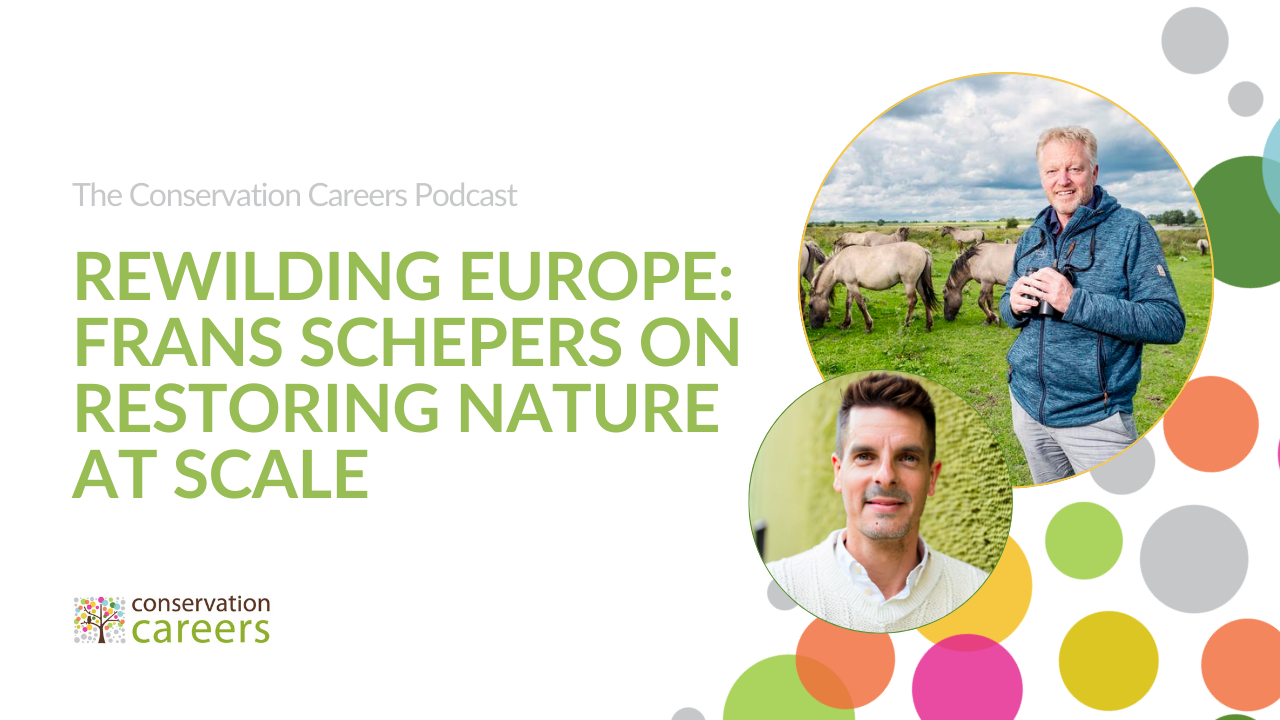
Podcast | Rewilding Europe: Frans Schepers on restoring nature at scale

How do you transform landscapes, restore biodiversity and reconnect people with nature – all at scale? And what does it take to build a pioneering conservation initiative from scratch?
Today’s guest is Frans Schepers, co-founder and Executive Director of Rewilding Europe. Frans has dedicated over a decade to leading rewilding efforts across Europe, turning ambitious ideas into tangible results.
Under his leadership, Rewilding Europe has become a frontrunner in nature recovery, combining innovation, entrepreneurship and practical conservation to breathe life back into our landscapes.
In this episode, we explore the origins of Rewilding Europe, how it works and the steps involved in rewilding a landscape. Frans also shares career advice for aspiring conservationists, discusses the future of rewilding and explains why he remains hopeful about nature’s incredible power to bounce back.
It’s an inspiring, forward-thinking, and opportunity-driven podcast.
Enjoy!
Listen
Watch
Subscribe
You can listen and subscribe to the Conservation Careers Podcast on iTunes, Spotify or Stitcher using the following links, or search for ‘conservation careers’ and you’ll find us!
Discuss
If you enjoy listening please leave us a rating and review on wherever you get your podcasts, it really helps us to get in front of more people! If you can share with your friends that would also be great. If you’ve got any questions or suggestions for the podcast please tweet them to @ConservCareers. We’d love to hear from you!
Resources
Learn more about Rewilding Europe and making Europe a wilder place.
Read our guide to Careers in restoration and rewilding.
Join our live podcast audience!
All our podcasts are now recorded in front of a live audience who sit in and listen to the chat, and then after the mics are turned off get a chance to talk to the guest, share their thoughts and ask questions.
If you’d like to be in the audience all you need to do is join our CC Academy.
In the CC Academy you’ll get access to the world’s biggest conservation job board – listing over 15,000 jobs, volunteer and internships across the globe each year.
You’ll also enjoy access to our amazing CC Pro private members community with regular events, networking and support.
Plus you’ll get full access to our growing library of career-boosting resources, guides and templates.
And best of all it only costs a few dollars, pounds or euros per month to join the Academy.
To find out more please visit the CC Academy, or simply click the join button at the top of our website.
See you on the inside!
Transcript
I’m Frans Schepers. I’m, one of the founders, and I’m the executive director of Rewilding Europe since the start in 2011. Brilliant. Well, welcome to the podcast. Thank you for sharing your time with us today. We really appreciate that.
Let’s start with rewilding. It was the reason we kind of reached out to you in the first place is it’s been such a kind of popular topic within conservationists in recent years. There was a book published rewilding. I’ll put it on the shelf here, Isabella Tree Wilding. So many people have read that and become interested in the movement.
And you cofounded Rewilding Europe to really kind of deliver that at scale across Europe. But let’s start with, you know, what is rewilding? Yeah. How does it work? Just kind of paint a little picture as to, you know, what rewilding is, please.
Well, yeah, maybe to start with, you know, when when we started rewilding Europe back in 2011, nobody was using the word. And I remember well, I was speaking with people in Canada and the US about how would we call our initiative and, you know, about the still rewilding. And, actually, I got the advice from people in the US, the UK to and and Canada to maybe not use that word because it had already some, connotations there. But I decided or we decided in Rewildi Europe that this would be a perfect word for us to, sort of bring what we call this innovative thinking in European conservation, which has been quite traditional and classic, around habitats and species conservation, where we felt we’re actually missing an important third pillar in what conservation should be about or nature recovery, maybe that’s a better word. And because that’s what we focus on, and that’s processes.
So he would summarize rewilding in very simple words. And actually, David Attenborough did that really nicely. He said, you know, rewilding is is helping nature to restore itself. And in a sense, it’s, in that sense, it’s a very smart solution, because you kick start something that then can then, move on on its own with only very limited, you know, intervention afterwards. And I think that’s the whole idea.
It’s not like just no intervention at all and just let’s see what happens. It is creating the conditions for nature to restore itself. And that, of course, includes re flooding floodplains, removing dams, bringing back keystone species that, you know, have an important role to play in those landscapes, Rewilding forest by removing maybe, you know, opening up forest. And there’s a lot of interventions that we do across Europe, initial interventions. And the idea is that, those interventions create those or allow those processes to to take a lead again and start shaping those landscapes.
And then people step back and and become of or or change from, let’s say let’s say, active management to a visitor and benefiting and enjoying, you know, and and being excited and surprised the incredible power that nature has to bounce back if we allow it. And and I think that’s the idea behind rewilding. I think it’s also important to mention because of, obviously, media like reintroductions and some of the more spectacular parts, if you like, about rewilding. But actually, that’s really a fringe activity. Rewilding is not synonymous with releasing animals.
It’s a very holistic approach to restoring landscapes at scale where, you know, people play a really important role. In fact, rewilding is very much about reconnecting people with, nature, and putting nature in the middle of modern society. Instead of, you know, maybe the image that lots of people have still is this is nature is in reserves, and and you have to cross a fence, and you have to pay access fee maybe or whatever, and it’s heavily managed. But, one of our key elements in rewilding and rewilding Europe apart from, you know, rewilding nature or helping nature to to to to restore itself, it’s very much about nature for people. I love that.
Yeah. And what really kinda resonates with me is well, there’s a couple of things. One is the speed and ability of nature to bounce back. I find that really inspiring. You know?
I know that we’re struggling right now, but there are some projects where when the conditions are right, things change really rapidly. Yeah. And and also I think the other thing with rewilding is that it feels to me like conservation is not a very useful term. It seems like we’re just sort of maintaining things the same. Exactly.
Whereas rewilding restoration is all about improving. It’s about making things better, which which feels more optimistic. Yeah. Yeah. And and, I think that, you know, if you look at the everyday news about nature and climate, of course, very negative, but there is also lots of positive stories out there.
And, as as you say, you know, the ability for nature to bounce back is huge, and we see that everywhere. And that, sort of creates this new narrative where we move away from trying to keep what we have, which is still very important because nature threatens still in many ways, of course. But we also need to restore. So rewilding brings a more progressive agenda where you don’t sort of try to keep the status quo, but where you want to improve things. Yeah.
And upload a project here and there. Right? It’s an ambitious agenda. It’s a it’s a word that that comes with thinking big. Thinking bigger, be more ambitious.
And I think that’s another element of, let’s say, more classical, European conservation is we do projects, you know, everywhere all the time, and we run from project to project. But I think the rewilding agenda, at least one of the elements that we try to bring in, is this is long term. We actually don’t like to use the word project. Mhmm. So it gives dynamics that you don’t want to see when you talk about transformation of landscapes and and having real impact, which you would never achieve in, let’s say, a project’s lifespan, normally speaking.
So it brings this new narrative where you say, listen, protect protection is not enough. We need to restore. And we need to restore big time, because most of European landscapes are heavily degraded, and and we know we can recover a lot. And, and I think that’s our challenge. And also our ambition to to, to not further downgrade, but upgrade landscapes and nature, in these spaces.
And, of course, the big question is, how can you achieve that at a at a continental change scale? Because that’s obviously not easy. Yeah. Well, let’s let’s go there then. Yeah.
So rewilding Europe is something you set up back in 2011. Yeah? Where to start? Well, what so what’s what’s the kind of the purpose or the mission of rewilding Europe? But then I really particularly would start with, like, the steps of how you go through rewilding a landscape, starting at how do you choose where to work?
Yeah. Well, maybe just to say that was not an idea that just came up. It had an incubation time of I think we started discussing this idea back in 2008, so it took 3 years or more Yep. Before we actually, you know, got a grip and and an idea of what is it we would like to do and how could we make a difference. Because, you know, there’s lot of a lot there’s lots of conservation work happening in Europe.
And so what would we add? What would be our added value? And and I already mentioned a few few things, you know, putting nature recovery on the agenda big time. Do this in places at scale, not little projects, but long term initiatives where we commit for at least 20 years and really make things change and where we see impact and not just results, which because these are they are not the same, of course. Mhmm.
And, so when we had this vision for a while to Europe, that was the idea. We felt like, okay, but maybe maybe nobody’s interested. And it’s a bit like, you know, starting a company and you think you have a product that you can sell, but you don’t know if there’s a market for it. So that was a bit our feeling. And we all had a very entrepreneurial attitude and and spirit.
We really wanted to do new things and and start and start something exciting, and that would hopefully become successful. So what we did is we what we didn’t do what you normally see in large conservation initiatives where people start making big maps and then priority areas and hot spots and what have you and then say, this is where we should go. This is where we should do things. We turned it around and we said, okay. So let’s test if there’s interest in this, and let and and let us go out and ask people if they’re interested in this, idea, approach.
And let ask let’s ask them to nominate landscapes. Of course, we had some criteria. They were very, you know, very, simple in in the 1st days. But we said, okay, it needs to have a certain size. A 100,000 hectares, that’s the scale we start thinking.
And it should have, you know, all these different criteria. And so we we went to occasions and actually, the biggest one was the world the Europe 1st European Wilderness Congress in 2009 in Prague, Czech Republic, organized by the European Commission. And where we launched this idea and asked for for organizations in all European countries who were there at different, you know, NGOs and governments. And and we asked for nominations and, you know, that was the start of it. Because in 2 years after that, in the 2 years after that, we received over 35 nominations of big places that where people said, wow.
This is the way forward. This is what we would like to do. And, of course, some were more serious than others. And based on that, we decided to well, why don’t we then, in 10 years time, start working in 10 places in different geographical, regions, different socioeconomic context where we’re going to to start with this idea. And, and that was the goal that we we put on paper back in 2010.
And that’s actually where we got in 2020. And and the importance of this is that, rewilding is is entrepreneurial. It’s, also also opportunistic, if you like. And so we felt this should be demand driven and not something imposed on people. How how would people in the in the Netherlands or UK, you know, tell people in Romania what they should do?
It should be the leadership and ownership should be locally driven. And, so, you know, so we’re now in the situation where we have 11 10 and nearly 11 operational landscapes. We have set up and help legal entities that drive this process in in in co production mode. With our central team at Rewilding Europe, and of course, where all these ten landscapes are also very much connected with each other, because they face similar challenges and opportunities, and and and can learn a lot from each other. So we are now this, what we call, distributed network of rewilding initiatives that are bound together by by one vision mission and strategy.
And actually, we have set targets together for 2030, where do we want to be? And, and that mission is that we want to make Europe a wilder place where we feel that, wild nature can be, you know, should be a normal thing in in the modern 21st century Europe. That’s our, that’s our, vision, and and and our mission is, of course, to make that happen and to make rewilding, if you like, a mainstream approach to nature recovery in Europe. And, and that’s, of course, because we demonstrate that’s how how this can happen in our 10 landscapes. And and we have also our European rewilding network with smaller initiatives that we support and facilitate.
It’s now 95 and 27 countries, and lots of other things are going on. So we have on one hand, we have our demonstration rule where we where we learn and do things at scale in landscapes. But then we also have the upscaling element, where we say, okay, it’s great to have these 10 places, and we’re actually working towards 15 landscapes. But we would like many others to adopt rewilding as a way to restore nature and and, whether it’s other conservation or or nature organisations, but also private sector, corporate sector, governments. So we would like rewilding to become embedded in in in the broadest way you can think.
And, so I think that’s important that of we have invested for 10 years in demonstration. Now we still continue to do that up to 2030, but we have now added this upscaling component, which is really important because we would like to see bigger impact and beyond our own landscapes as well. Yeah. Amazing. So many questions I’d love to ask you.
I think one that stands out as I listen to you talking is, like, is the funding aspects of this, because that’s where I think the scale comes from. It feels like you’ve you’ve approached this as a start up entrepreneurial. You feel that you’re learning. You’re very agile. There’s a lot kind of woven into your DNA.
The scale’s gonna come when this sort of almost self funds itself. There’s a business model. You talked about corporate a second ago too. You know, how is it funded? It feels like a lot of the effort is front loaded, and then it should be lower effort in the future.
Where do you see the funding streams? What are you developing? What what seems to be the opportunity to scale? Yeah. That’s a good one.
And, I I think what is important to say is that, okay, we think big. That and and we actually said, don’t think big, think bigger. So that’s endless. Yeah. Just to to sort of demonstrate the ambition level that we put into it.
So you could say that we we basically made a big promise, you know, to to to the future for ourselves and for our initial donors and financial partners. And then you have to make it work. So now people start small and then they build up and then they realize, oh, wow. This is, you know, getting something big. But we put the big in the beginning, and then we had to work hard and do a lot of heavy lifting, of course, to get going.
But I think it’s the incremental steps, you know, the small steps every day, every week, every month, every year that made the difference. It’s like building a house brick by brick. And it’s not like, you know, a few big steps and here we are. That’s just not how it works. So I feel like we have, you know, I have a solid base, we built and and a strong, initiative that is indeed, you know, attracting more and more attention, which we’re very happy with.
And, in terms of fundraising, we were lucky to start with, funding from the Dutch postcode lottery. So, So, you know, in the UK, there are the UK postcode lottery. There’s other countries with lotteries in Europe, like Germany, Norway as well, and Sweden. So that was a great start. But then we had to, of course, work really hard to bring in others.
And, so we deliver we didn’t want to run a lot on public funding. We do have funding, mostly EU, life program grants. But most of our income is actually, apart from charity lotteries, is, private foundations and, family foundations, corporate foundations, but also private individuals. And that’s growing. There’s a huge interest in, philanthropy.
So most of income is philanthropy related. There’s great interest in the philanthropic sector on supporting nature recovery and rewilding. And and, so that’s that’s what, what our most important income is is from. Okay. Fantastic.
I want to talk about you and your career and your role and your job in in a second, but I want to kinda just look back to something you also referenced, which is you have ambition for the future. You have a a 2030 goal. Like, more broadly, like, where do you have you seen things changed over the last, whenever it is, 13 years since you established in terms of rewilding? It feels like it’s becoming mainstream from my perspective. And where do you think it’s going?
Like, what do you think the future is? Like, you know, what’s what’s the direction of travel? It’s really hard to predict because when we started, we had this dream and and, you know, you will never realize that 10 years later or earlier than that, you know, David Attenborough is talking about it, but also Barack Obama and Leonardo DiCaprio and Jane Guro. I mean, there’s all these celebrities that picked up on this idea. So, apparently, there is something inspiring and and something in it that reaches or touches the hearts of people and minds.
So that’s really cool. And so we we were very happy to see how things, you know, developed. And in 2020, we sort of relooked at where we were, and and we developed this new strategy for 2030, which is now nearly halfway. So if you talk about the future, I mean, 5 years is, of course, very short if you look talk about sort of future perspectives. But what we, you know, what we, of course, continue to work on is, getting more and more people involved in in in all sorts of different ways, and, and continue to demonstrate and lead on this, topic and set the example and set the standards of what we think rewilding is about.
It’s not about renaming something that you were already doing. It has a number of new, you know, components and innovations that, you know, that, maybe yeah. Together, we are creating this new narrative for Europe, I would say. And, we hope that more and more people start to see the benefits. And and that includes some of the major forces in society, you know, including, you know, the whole climate discussion.
I think more and more people have and that was not even the case when the Paris agreement was signed. Nature was not on the agenda. And this is just this was 2015. So in a in a few years, people have started to realize that, you know, the nature and the climate, crisis or or whatever you call it, But sides of the same coin. Right?
And that nature based solutions are very, you know, the best technology we have to to address impact of climate change and reduce carbon emission or capture carbon from the atmosphere. So linking with the climate agenda is really important, and and I think that, can really push, nature recovery at scale, big time, but, still a lot of work to be done there. And I think, aligning with economic sectors. You know, if you talk about water management, for instance, you know, we have floods and droughts, rewilding, restoring functional ecosystems and river systems that can flood, that can keep water in dry periods, restoring wetlands, having beavers. All these things help us to removing dams.
All these things help us to, have an a look at, new solutions for for those problems that we are facing when it comes to our our fresh water systems. And I can go on with forest, you know, forest are suffering from climate change. Actually, only 3 or 4% of European forests, which have by the way grown our forest cover has grown in Europe in 100 years, a 110 years with 23%. So, there’s much more forest, in Europe, since since, since, let’s say, the start of the previous century. But all those forests are mostly plantations or heavily human managed.
And so there’s a huge opportunity and need for rewilding our forests, so that they become more climate resilient. And of course, also have much more value for nature. And the same for grasslands or sort of half open landscapes, same for coastal areas. So there’s so much to do with I mean, the sky is the limit, I would say. And it’s more a matter of making the right choices and put the money there than that there is scarcity in ideas or, opportunities out there.
You mentioned there about we need more people involved, and that’s where, more impact will come from within rewilding and restoration. Lots of people want to get involved in rewilding restoration. Like, what’s what are the career paths for people, or what skills are needed? What do you like to say around that? Yeah.
It’s interesting, and we have a lot of people applying. Yeah. When when we put positions recently, it was, like, mind blowing. We had a position for creative content manager, 380 applications. And now we have one for social media.
It’s also 270. I don’t know. But so lot of people want to work with us, and that’s fantastic. But the thing is, we have only placed a few people. We want to stay a small and agile and and impactful organization.
And so the question has arisen already years ago with us. Okay. You know, if there’s so much interest, especially young generations, they are they are really want to get into this rewilding, and and, and that’s fantastic. So how do you enable that to happen? And so, we are we are doing a few things, and this is actually part of our upscaling work.
So it’s a lot about, so we have this, European Young Rewilders network with now 800 members across Europe. And they share, and they take their own initiatives, and they they learn from each other, and they inspire each other. You know, how can you start your own rewilding initiative? Because that actually what you would like to see. Right?
Like, we start rewilding Europe from scratch out of nothing, with no money at all when we launched it. There was no money at all. But we went we went that, you know, and took took that adventure. What I would hope to see is that many people, whether it’s in their own village or municipality or that they start their own initiative as well. I think that’s sort of what we would love to see.
And that means that you have to provide opportunities for people to to to get access to knowledge and and and learn, but also discuss with each other and and learn from each other. So that’s what happens with the European Young Rewilders, but also next year, it’s an announcement that, that I that I like to make here is that we’re starting a massive open online course for people who would like to, to learn about rewilding. And not only theory, but also how do you start a rewilding initiative. And, and that will will start next spring. It will be it’s we’re working with the, Open University in the UK to launch it.
So that will be, like, state of the art top notch course on rewilding, and and hopefully, it’s going to inspire many more people. Yeah. And, that’s that’s, you know, part of our growth strategy is is to to inspire. Mhmm. To to, allow people to learn and to exchange and, you know, give them tools and advice.
And on our website, there is quite a lot of information on how you can start your own rewilding initiative. Initiative, whether it’s small or large or ambitious or or less ambitious. But, yeah, there as I say, there are so many opportunities. And and I think that’s also what maybe attracts people, is that you don’t start from threats in conservation. I’ve learned this myself.
Everything starts with we we have problems and we have threats, and we need to resolve those. And in my time, you know, in my career, yeah, sometimes you win, but mostly you lose. And and that’s very depressing, and it takes a lot of energy and, you know, and it’s very important it happens. But with rewilding, it’s it’s it’s it’s actually much more opportunity driven. So you put off your glasses, you take off your glasses that only see problems and threats, and then you put up your glasses that see opportunities.
And then suddenly, look at your own garden, look at the park in your city or town, and look at your landscape around it, and it’s full of opportunities. And, if you combine this sort of opportunity, driven approach with entrepreneurship, and sort of bringing people together and start something, whether it’s small or big, we also started small, although ambitious. And and I hope that is, what is going to inspire and and make a lot of people engage with rewilding. The opportunity, though that are out opportunities that are out there and also the hope and perspective that comes from it. So moving away from this, what we say, anxiety narrative that we are sort of bombarded with every day to what we would call an empowerment narrative where, you know, you see and you you can actually do things Yeah.
To help restore nature and and and then use the ideas that are the principles behind rewilding and and look at your environment and your, your landscape or your garden or wherever you are in a different way. Yeah. And that’s actually quite exciting. Yeah. It is, isn’t it?
And I think that’s probably part of why people are so attracted to rewilding. You know? It’s hopeful, but it also has action. It’s really clear what it is we need to do, and it things change rapidly. And it it allows nature to do what it’s naturally doing.
I mean, there’s so many things that kinda tie together that And it’s very rewarding because depending a little bit on what systems you work. I mean, if you work with rivers or streams or you remove a dam, I mean, you remove a small dam and you see immediate response because the you see the fish moving upstream right away. And so it’s very rewarding. And so the sort of the energy levels are also different. If you fight against something bad, you know, it sucks energy it sucks energy.
It’s important to do once again. With rewilding, it’s a different energy balance because you see a reward. You see things, wow. Look at this. How this species came back by its own.
Look at this river. Look at this whatever place, what happened here. And so, you actually have more energy because there is also, you know, a payback or a reward, from what you see and the result is. And this is because you work with the force of nature. Yeah.
And and so nature is a fantastic ally or partner to work with, because it gives you all of that for free. Yeah. It also feels exciting in the sense that if you go back to, like, species conservation and habitat conservation, I worked in barn owls for a few years, and a species conservation approach would be we want to increase the species population by x percent, by y, and then you go and do some activity and see if that works. Whereas it feels like rewilding restoration, you sort of stand back and let’s see what happens. You know what I mean?
Like, let’s see what happens within nature. Let’s see what species bounce back or what changes occur. Rather than being sort of predictive, it’s more observational. Yeah. But, of course, these initial, you know, for the barn owl, you need meadows with mice.
And so there there is also conditions that allow barn owls to come back or not. And with and that’s the same with rewilding. Of course, you you step back, but you you first, you know, and have to interfere in those places and to create the conditions as I explained Yeah. For that to happen. And, Yeah.
Great. Well, I want to kinda just switch and focus more on you and your work then, Frans, as well in your career. Maybe we can start with your current roles. You’re executive director Yes. Rewilding you up.
What is an executive director? What is it you do? What’s your role? What does a typical day look like? How would you describe it to someone?
Yeah. Of course, it has evolved. In the beginning, you do everything yourself. Now we have a team of 30 people, a central team. And then maybe to explain, we have a central team based in the Netherlands, but not everyone is also working from the Netherlands.
We have people in the central team working from Estonia, from the UK, France, and Spain, and Germany, and Italy. But most of those people are in in the Netherlands, in our, what we call, wild quarters, our our home base. Mhmm. And, yeah. If you’re small, you have to do everything yourself.
And if you grow, you have more people coming and and do things that you then don’t have to do. But the key role, of course, of an executive director is, I would say, very much, strategy and fundraising. Right? Keep making sure we keep focused. We stay on the right track.
There’s so many decisions to be made every day, small and big, about where do we go next. And, how do we, you know, express ourselves and and how we talk and how we, you know, how we position ourselves to the outside world. Fundraising is obviously an important role for me, which I don’t do on my own, of course. There’s a whole team that is working on on on fundraising and proposals and all that. Yeah.
So, and what is very important that I’ve learned, I have, so we are an executive team of 3 directors. So one is taking care of all finance operations. That’s absolutely a necessity and and really happy because it means that all the internal things. And if you grow as an organization, you need HR, you need so many things that you haven’t even thought about a few years ago to make sure that people are happy and that that you are, you know, a good employer. And and as you grow, there’s more challenges there, of course.
Mhmm. And, and then, of course, the the finance side of things, the finance management, the the cycle man project cycle management, if you like, and reporting all that is all there in that finance operations team. And then with the director on, leading that. And then we have since this year, we have a director which is, about engagement and public relations. It’s very much about the positioning of rewilding Europe in the sort of European context and everything that comes with it.
And all the communications work, that’s all under her, my colleague, Loreen. And, yeah. So we have an executive 3 team of 3 people with very complimentary roles, where I sort of have sort of oversee the whole, of course, the whole initiative. Yeah. If if, there are bound to be people listening who have their own ideas of things they’d like to do, maybe setting up their own rewilding project, or maybe they have, yeah, an idea and visually as as you had sort of 10, 15 years ago.
What have you learned from setting up rewilding Europe that would be advised that could help someone else to do something similar to you? Yeah. What what have you been your secrets of success? Or I don’t know. Answer that as you wish.
Yeah. Well, yeah. Everything starts with a dream, I always say. And, you know, and and it depends, of course, on the person and the personality a lot, and the experience someone already has or not. So there is there’s, of course, a few things in the beginning that make a lot of, can make a lot of difference.
I think it, know, what is important if you would start your own rewilding initiative is it depends a bit what it is. Is it mobilizing people or is it doing something on the ground or is it working with partners that you would like to get push and and help going into certain directions? But I would say, be ambitious, but also realistic. And, of course, that’s a delicate balance, you know, but don’t, put your ambitions always higher than you think. Because if you then achieve whatever 50% is much from that high ambition is much better than achieving 50% from a low ambition.
Right? So I think that is something that is important. Opportunistic or opportunity driven, try to be that, as when your entrepreneurship is really important. It’s a bit like setting up your own business. And, don’t be risk averse.
You know, just just, trust yourself. And, and I think speak from the heart. There’s so much rational everywhere. You know, we we say, you know, you don’t need to be a scientist to become a rewilder. You can become a rewilder.
Anyone can become a rewilder. And and, and of course, you know, knowledge and and and research and science matters, but it’s not a prerequisite for, for doing great stuff, wherever you you you you can. And of course, you need money. So how do you find money to start your initiative? So, of course, that, if you would start a rewilding business, that is the more and more people that actually start advising people how to rewild.
So you see that happening, consultancy work. Yeah. But then, of course, you need to have a certain reputation or knowledge or or, you know, that people want to buy your services, of course. But, yeah, there is, small and large. There’s many funding opportunities, I would say, that, organize it’s increasing, you know, organizations that allow to start up with, with initiatives.
And, yeah. And and work together. You can do this on your own, but we started with 4 people and, that took the initiative and and make sure that, you connect with with people and with society. You know, rewilding is not about just nature. It’s actually, rewilding is 90 or 80% about people and 10 20% about nature.
Because if you allow nature to restore itself, you know, then it will happen. And and and and it’s the people that make things complicated. And that’s that’s where the challenges are. So it’s a lot about understanding how someone how you can help to solve someone other’s problem. You look for win wins.
Look for ways that you can that you can, you know, address problems of other organizations whether as, you know, it’s flooding or it’s, you know, there’s so many things that we’re trying to solve and and rewilding can can help. And and, so I like this idea about win win situation. How can you both benefit? So and I think rewilding has a lot to offer. It’s not demanding, like, I would like to have this from you.
And this is more and more how we position ourselves. We have something to offer and join us. And, of course, that’s not easy to reach that point. But it’s an interesting attitude, to have that you say, well, we Livings has something to offer. And how can you make use of that instead of, yeah, we have this project, and we want to find money for it.
You know, act out of strength, not out of fear or weakness. You know, take take the strength of rewilding and the opportunities it gives to, to start something. So these are just a few thoughts. Then then I’m sure there’s more. That’s so valuable.
There’s so much in that. Yeah. I I love it. Yeah. Talk about your your career then.
So looking back, like, what have been the kind of key moments in your career that have led to where you are now? You can pick and choose what you what you like from. Yeah. Well, I would I had a love for nature since I was a kid, so I was always outside. So the passion for nature has been always there and made me realize at some point, you know, this this I want this to be my profession as well.
I really want to contribute to something to restore or protect nature. So that was, at young age, something that I was convinced of. And I’m sure many people have these moments where they feel have that feeling. And and so I I, I started to study in forestry and land and water management. So I’m an engineer by profession.
Deliberately didn’t choose for a for a university and scientific, background because I wanted to to do something in the real world and, you know, it’s it’s nice to do research. And I was doing a lot of research, bird research myself in my free time. But I felt like, you know, what really drives me is to see impact and result out there and and and protect things or restore things. So that was my drive from the beginning. And and and after that, I, after I finished my my studies, I I started working for Dutch government, actually.
So I became a civil servant, which is interesting. You look at the the stories I just told about being entrepreneur, but, I I’ll come back to that later. And but anyway, I was happy to, become involved in, in those days. I’m talking about the the late eighties, where conservation and and and rewilding actually wasn’t caught like that those days. Was very on the on on the growing in the Netherlands.
Policy, money, space, and so I got heavily involved. And one of the big programs I I actually put a lot of time in in 10 10, 12 years was one of the largest river restoration initiatives in the country on the border with Belgium, and that is, that was a huge initiative. But when that sort of started to become, executed, I felt like, okay. I can when I go in this next stage, I can, I can be in this business for another 10, 15 years, and I and I didn’t want that? In the meantime, I was doing ornithological expeditions, bird expeditions to West Africa, Middle East, and I love the international work.
So I I realized I I want to do something else. And that was actually an interesting moment because I was speaking with people about this. And I remember I remember there was this person, and and he was sort of advising people ahead in their career. And, and and and he asked me, so close your eyes and describe the your dream job. And I could easily say that.
And and so he said, okay. Well, that’s easy then. And do you know organisations where you can do this? I said, yes. Of course.
I know a few. And, and he said, well, do you know people there? I said, yeah. I know people there. I said, why don’t you go there and tell them?
That was very strange moment for me, because then I suddenly so started putting myself for sale, if you like. Like, I’m interested in something, and you you are an organization that I would love to work for. And, anyway, that’s what I did. And and soon after, I I was a very lucky timing, I have to say. But soon after, I became one of the first international program managers in WWF Netherlands.
And I started working suddenly from, you know, working in the Netherlands, I started doing large freshwater programs in Malaysia, and in Zambia, Ukraine, and and then Brazil, Bolivia. So, certainly, I was like a big international at a big international, job. And so I worked in WWF for many years, 14th, and it was around, let’s say, when, you know, at at some point, I felt like, yeah, but this is what I want to continue to do, and and this is when rewilding sort of idea came because we saw a lot of attention for the Amazon, for the Congo Basin, for, you know, south Southeast, Asia, for, all these beautiful systems, and I was in the middle of it. But, everyone was forgetting about Europe. And, I saw people put pulling out of Europe, big organizations, and I felt like, well, that’s strange, our own backyard, you know.
How can we and this is was the time where there was a bit of a gap, maybe, if you like, where we started thinking about but we see large world depopulation and land abandonment in Europe. There’s space for nature to bounce back. We see wildlife come back. A lot of species are coming back. We see a lot we so we saw all these opportunities that actually drove us to to this idea about rewilding Europe.
And it took me a few years before I said goodbye to my beautiful programs, which were mostly in Southern Africa those days, and and then I resigned from from WWF, and I and I became full time Rewilding Europe. And in retrospect, I discovered that entrepreneurship in myself. I I did that already quite a bit within WWF, but now suddenly, I became responsible for this new foundation. And then in the beginning, it was quite scary, I have to say. Because, you know, we made a big promise as I told you, but also, yeah, getting this off the ground.
You know, that was quite something. But, I love the freedom. There was no bar no I didn’t have a boss anymore. And so I felt like, you know, now I can just do what I want. And, so that’s I mean, I was not on my own, but in the beginning, we were just 2 people.
And so we started from there. And, it felt a bit like, 2 ways. It felt like, you know, having most of my time spent in Africa, now moving to Europe felt a bit like coming home. Because Europe is the continent I know, and I understand the system the the seasons and the the wildlife and everything, nature. And Africa, I didn’t really, but although I traveled a lot.
And the second part is that, yeah, I discovered this entrepreneurship in myself, and, something that was apparently hidden or couldn’t blossom in in an organ big international NGO. And, yeah, I started to like it a lot. And, and, that has yeah. That sort of helped me to, with a big team now. And and it’s not with my own credits, but getting where we are now, which, we’re quite happy.
But no time for complacency. Right? Never. Absolutely. No.
Yeah. Keep going. When you when you resigned from WWF, I’m just interested in the kind of risk element of this. Did you already have some security within rewilding Europe? Do you have some funding to get going?
Or it’s just a a heartbreak. Let’s do this. No. No. We had some going, but, of course, related to the ambition level, it was far from enough.
Yeah. And so no. No. We I had sleepless nights and, you know, it’s it’s a struggle. It’s setting up your own company, and you need to have sleepless nights.
Because if someone gives you the money and say, don’t worry, I’ll take care of you, that’s, of course, not a very good incentive to, to build something. So, yeah, it was a lot of hard work. And, that was really nice, to experience. But, yeah, there was insecurity. You know?
I had a family, so it’s these these decisions these decisions you don’t make easily. But I did regrets? Now looking back in hindsight, this is now, you know, 10, 15 years ago? No regrets. No.
Not at all. No. No. I miss Africa. So and but I still have connections and go there from time to time.
But yeah. No. I don’t have. It’s wonderful to work with, you know, people in so many different countries, all this culture, and and and nature, and landscapes, and and travelling within Europe is is really fantastic. Actually, it helped me to discover Europe, you know.
I knew I visited lots of countries before, but, this is different different, of course. And working with all these teams. And now we are over 220 people working across Europe in all the landscapes and the central team, and you can imagine it’s a a nice bunch of, rewireless that have the same spirit and and, and and way, and and we’re all we’re one one European team, which is beautiful to to experience, of course. Yeah. Yeah.
Very inspiring. Yeah. Wonderful. I will start wrapping up. We’ve got some people that are listening in.
I’m sure they want to ask questions themselves as well once we’ve finished our recording. Before I do, so I want to go and ask some more open questions. What links to your travel and your love of the world and and things that you’ve done through your career? If we could take you to one place and put you down and you could see one species, where would you go, and what do you hope to see? I just visited rewilding Argentina, which is was an extremely inspiring trip with a number of people as an exchange and learning, and I was astonished there.
And I would love to explore that much more, that region, Patagonia, and and everything that is happening there. Strong love for Africa still, of course. And and now I’m talking about outside Europe. Yeah. And Papua New Guinea, maybe see some paradise birds.
That would be nice. It includes a lot of flying, so I’m I’m very hesitant to fly. And within Europe, I mean, there’s so many beautiful places that you can visit in Europe, and, would love to see more of the sort of central parts of Europe, even, countries that you wouldn’t go now, but, like Belarus. And there is another there’s a quite a few places, the Baltics that I’ve I’ve never been to the Baltics. Yeah.
Plenty to still see and do. Yeah. Plenty to still see and, yeah. Enjoy wildlife and and nature in these places. Yeah.
One thing we’ve talked about a little bit is around, I guess, around hope. Yeah? We’ve touched on that a few times. Are you hopeful for the future of wildlife and the environment? I mean, we’re facing tough times.
We’re seeing declines all around the planet. How are you feeling? Yeah. Of course. This is something that, you know, if you’re doing this type of work or if you’re in this sector, it is, something that, of course, you know, is concerning.
And just just now, an hour ago, I learned that the Berne Convention, you know, majority of the parties have agreed to down this to wolf, and it’s like a hard hit in the face, because that’s such an important species for European conservation. And so, I mean, there’s lots of reasons to be pessimistic, but there’s also many reasons to be optimistic, I would say. And as I as I told you before, what keeps me driving is, well, is, you know, the power of nature to bounce back. And, you know, in fact, we are rewilding for ourselves. We’re not rewilding for for nature, because nature will survive people.
Right? I mean, that’s not a nice message, but maybe, but that’s a sort of plan b that, you know, if we completely screw up, then you have to thank ourselves, and nature will move on. And, you know, on if if, the history of of earth would be a book, I think people appear in the last chapter, the last page, the last paragraph, and it’s one sentence there somewhere. That gives a bit of a feeling like, okay, who are we on this planet and that we have huge impact. But if we, you know, if everything goes wrong, imagine, then then nature and will will continue.
And, of course, we don’t want that to happen, and that’s why we put all that energy. So, you know, it’s hard to be optimistic, but, we are. And and I think because the news comes from everywhere nowadays, and and this is what I experienced during this trip in Argentina where you you just focus and you’re in this landscape and you see what is going on and what is what is possible. That’s incredibly, empowering and energizing, and and, you you know, we can’t take all the news every day from the whole world in. It’s just not possible as as a person.
So it’s also maybe at some point, you need to focus on, you know, what what works and and what is positive. And, you know, being stubborn about positives, you know, stubborn optimism is important, I think. Yeah. And never give it up. And, yeah, that’s just not in the genes.
I think of most people is never give up because there is this beautiful opportunity out there. And and that yeah. I think that keeps us going. Working with nature as an ally is something that, keeps you going, I would say. Yeah.
Brilliant. And I think on that note, Brandon Shepherds, thank you so much for joining the podcast, for sharing your advice, your career, and good luck with everything that you’re doing for now into the future. People wanna find out more about Rewilding Europe and your work, where should they go? They can go to our website, of course, rewilde europe.com or, our social media. We have, of course, a lot of outreach every day about our work and what we do, what we achieve, and how you can engage, of course, as well.
So I would love invite people to, to have a look at our website as a first reference point. Yep. Yeah. And we’ll provide links in the notes and wherever you’re listening to this. Yeah.
Thanks again, Frans . Yeah. Thank you for the, opportunity to speak and share some of my history here in in rewilding. Wonderful. Wonderful.