Beyond science: Traits that drive success in marine conservation
Protecting the planet requires more than data and fieldwork – it’s resilience, curiosity and connection with local communities that truly make the difference. Marine biologist Alex O’Brien shares how he has cultivated these qualities throughout his career in conservation.
Alex stands out most clearly for his unwavering sense of purpose: few children who dream of exploring the oceans follow through to become dedicated researchers.
Ironically, it was the absence of the ocean that first sparked his fascination.
Born “feeling about as far from the ocean in the UK as you can get,” in Nottinghamshire, Alex grew up full of questions about marine life, but without adults around him who could provide many answers. That curiosity became the spark that led him into science.
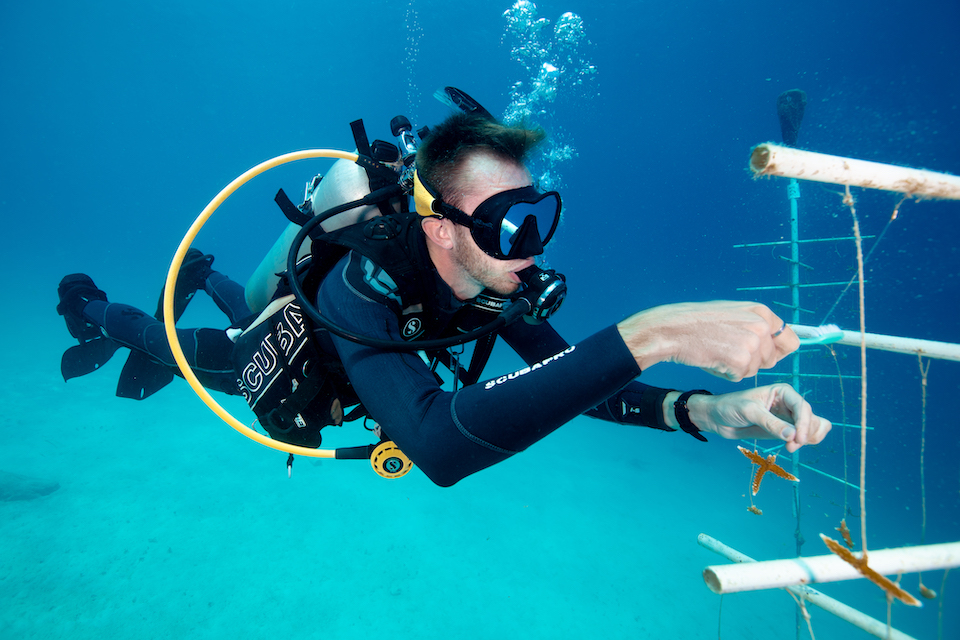
Attaching coral fragments to a restoration structure as part of a marine conservation project.
“I think more than anything else, what drew me to marine biology was the knowledge that we didn’t know everything. I thought it would be incredible to discover something new and gain insight into an area that remains largely unknown,” he recalls.
Fast forward to today, Alex has realised this ambition. He now works as a freelance marine researcher.
Previously he worked for Operation Wallacea (Opwall), a conservation research organisation running scientific expeditions in remote locations worldwide. Here, he was responsible for coordinating their global marine research as well as their diving operations.
For several years, he played a central role in the Honduras expeditions where they collect data on a range of specialist research projects, as well as a central reef monitoring program. He spent much of his time mentoring early career scientists and researchers through practical fieldwork.
Use all your strengths
Alex initially focused on large-scale ecological patterns and modelling in his career, with his dissertation examining the feeding behaviours of gastropods across the shores of Newcastle.
After completing his degree, however, he sought out broader opportunities, including a pilot study on prawn aquaculture in Australia. These experiences shaped his philosophy: every opportunity to broaden one’s skills is valuable, because it’s never clear which path will lead to the next breakthrough.
“I think it’s very important to try different things to break into the industry. If you approach it with the mindset that ‘this is the only thing I want to do,’ you limit yourself to opportunities and connections.
“But recognising the skills you do have, even if it’s not your ultimate passion within the field, and initially getting involved is crucial.
“My first experience with Operation Wallacea was as a staff member delivering lectures and providing educational guidance for participants as a reef ecology lecturer. I am comfortable with public speaking, so I took the chance, and it eventually led me to participate in some truly fascinating projects” he explains.
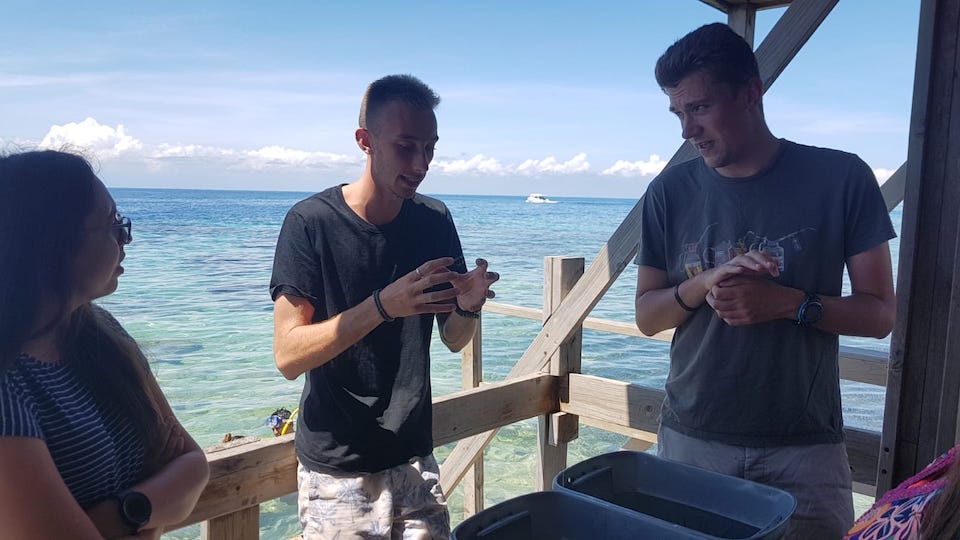
Today, Alex specialises in coordinating research projects and supervising scientists conducting field research, ensuring that operations run smoothly while continuing to contribute directly himself. Much of his work has centred on monitoring marine environments, employing both SCUBA and freediving techniques.
Learn to adapt and stay resilient
When asked about the most important traits for a marine biologist, Alex names adaptability and resilience above all.
“An old mentor of mine told me: if you plan to do five things in field research, six of them will probably go wrong…
“In 2023 I was supervising several researchers that were investigating Tela Bay in Honduras. It was known as one of the healthiest reefs in the Caribbean in regards to hard coral cover.
“The students had prepared extensively, with months of planning and full research proposals written up. Then, less than a week before we flew out to start our expedition, a mass coral die-off occurred – we lost about 85-90% of the coral across our six survey sites.
“This is exactly what field research teaches: even the best-laid plans can be disrupted. You can’t be prepared for all eventualities, but you can prepare yourself to pivot or react to whatever comes your way” Alex says.
In this case, the project design stayed intact, but the focus shifted. Instead of these studies focusing on the consistently high coral cover and the effect that this was having on the surrounding fish and invertebrate communities, they were focusing on quantifying the immediate effects of a mass mortality event on both the benthic makeup and the associated reef species.
The data collection remained the same, but the questions and the perspective evolved.
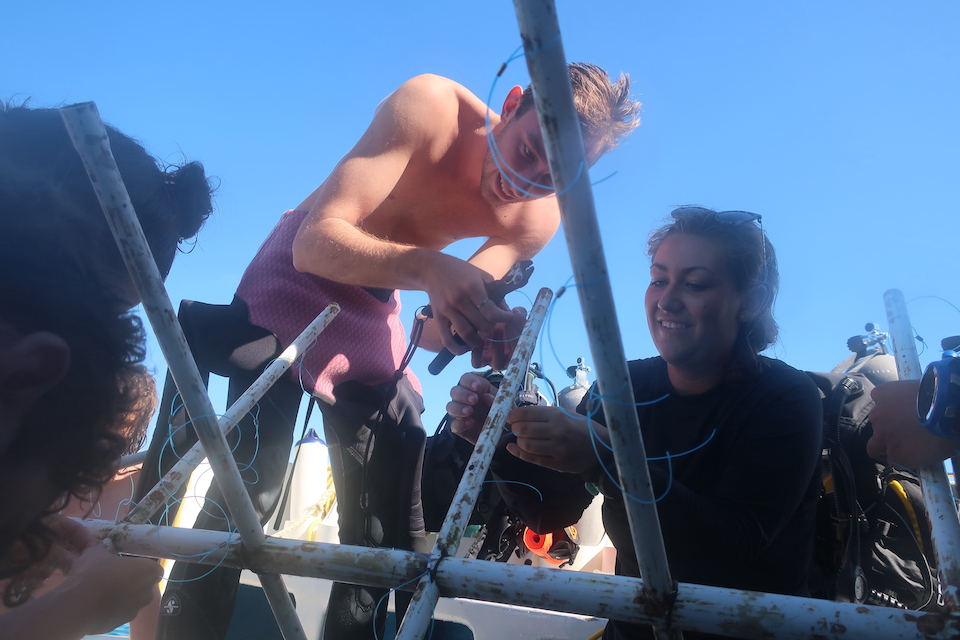
Adaptability in marine biology isn’t just about coping with last-minute changes to fieldwork plans – it’s also about managing the weight of large-scale environmental threats.
For those deeply invested in ocean conservation, it’s hard not to take it personally. Learning to cope with this constant background stress is part of the job – without resilience, sustaining the work would be nearly impossible.
“Prior to my employment with Operation Wallacea I lived in Utila, Honduras working with the dive centres and local NGOs as a Director of Conservation.
“I struggled a lot during this period, the reefs underwent mass bleaching, and then a couple of months later myself and the team discovered Stony Coral Tissue Loss Disease (SCTLD) for the first time on the island. It wiped across the reef and roughly 80% of our hard coral cover was gone in around 12-months. It was a dark time for the reef, and it felt like everything was collapsing under my watch,” Alex recalls.
“I coped by reminding myself that these challenges make our work even more important. Understanding reefs and the marine environment is essential to protecting them. Reminding yourself that the work you are doing is meaningful and necessary. As human beings, we are learning from the mistakes we’ve made and figuring out how to improve and protect the marine environment.”
Alex makes a point of trying to limit his time on social media and follows accounts that share positive news, small-scale successes, and new discoveries about the marine environment. This approach helps him maintain perspective, showing him that alongside challenges, there are always progress and learning opportunities.
Keep your curiosity
Another essential trait for a marine biologist or conservationists is genuine curiosity. For Alex, it’s the very foundation of scientific inquiry. Staying open and curious not only drives research forward, but also uncovers insights that might otherwise be missed.
“Some of my favourite moments working with Operation Wallacea stemmed from a research assistant joining a project. They may have just learned to dive, then completed a week-long crash course in coral reef ecology, and suddenly find themselves helping a PhD student with data collection.
A couple of days in, they ask the researcher or myself a simple, curious question – something like, ‘Are you looking at how this connects to that?’ and just occasionally you can see a researcher’s eyes go wide as they realise, no, we weren’t – but we should, and we already have the data for it, so we can.
That fresh perspective and unfiltered curiosity can uncover connections even seasoned scientists hadn’t noticed,” Alex shares.
Work with communities
At first glance, scientists, and marine biologists in particular, might seem to spend most of their time focused solely on the subjects of their research. In reality, meaningful conservation today depends on constant collaboration, with local communities playing a central role.
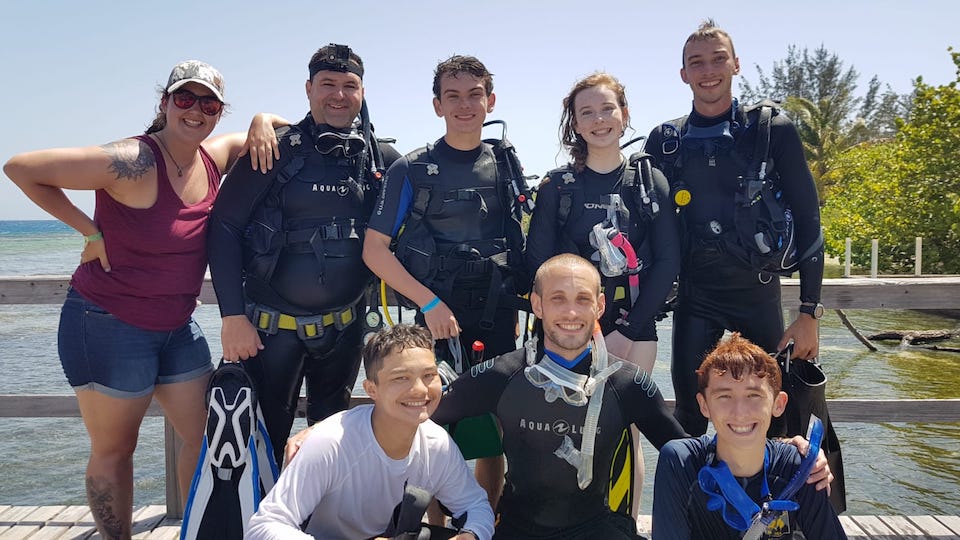
“Every community has its own unique identity. Before starting a research project in any location, it’s essential to involve them with what you are aiming to do.
“Starting by explaining what you are aiming to achieve and what operationally is being proposed. Then asking what matters to them, and exploring how the work you are doing could be useful to them or how your facilities could support them.
“In Utila, for example, SCUBA diving and snorkelling are very popular, but many recreational divers and snorkellers cannot differentiate between coral and sponge. So, we are working with our local partners at the Bay Islands College of Diving (BICD) to offer reef ecology courses to local school students.
“Helping the next generation gain more of an understanding of the reefs on their doorstep and maybe even spark a passion in marine research and conservation. It’s all about outreach, integrating with the community, and understanding how your presence in an area could benefit the people.
“Research has gotten better with this in recent years, however there is still a lot of ground to cover. By engaging with communities, sharing your work, and listening to local perspectives, you not only build trust, you also create opportunities for more informed, inclusive, and lasting conservation efforts.” Alex says.
Soft skills play a pivotal role in shaping how challenges are addressed, how collaboration develops, and how unforeseen situations are managed. The full spectrum of these abilities often extends beyond what is immediately recognised, and qualities that may initially be overlooked can ultimately prove to have the greatest impact.
Professional growth is not solely about mastering technical tasks; it also depends on cultivating the traits that foster curiosity, adaptability, and the capacity to seize opportunities.
Learn more
Want to make a difference for the ocean but lack experience? Find inspiration in this story: A creative leap: From fine art to ocean research.
Interested in more stories that involve diving in conservation? Listen to this podcast episode with the founder of People of the Water: Diving deeper: Cristina Zenato on sharks, conservation & purpose.
Want to learn more about careers in marine conservation? Check out our Ultimate Guide: Marine Conservation Jobs: Protecting the Blue Planet.
Want to learn more about Operation Wallacea (OpWall)? Explore their projects.
Author Profile | Anna Titova
 Anna is a non-fiction writer and environmental communicator with a strong passion for environmental history. She explores a wide range of topics, from the global waste crisis to climate change challenges. Committed to wildlife conservation and climate action, Anna aims to advance the field of environmental communications by helping scientists, environmentalists, and activists amplify their voices and gain the recognition they deserve.