Translating sounds into actions: What It means to be an acoustic oceanographer

From songs sung by marine mammals to the snapping of shrimps, and even the movement of big shipping vessels, the ocean is teeming with a wide array of sounds. Sound is crucial for many marine animals to communicate, mate, feed, and even find a suitable place to live.
To understand how natural and human-made sounds interact and inform management and conservation efforts, one must engage with ocean acoustics, a complex and multidisciplinary field.
Dr Vanessa ZoBell is an acoustic oceanographer and postdoctoral researcher in the Scripps Machine Listening Laboratory at the Scripps Institution of Oceanography, University of California, San Diego. Her research focuses on understanding how human-made sounds interact with wildlife, especially whales, to reduce noise pollution in critical marine habitats.
As a postdoctoral researcher, Vanessa is learning new skills to answer wider management questions. When she was a PhD student in Oceanography at Scripps, she focused on understanding whale acoustics and noise pollution in the Channel Islands National Marine Sanctuary, California.
Now, she is studying a new region, the Gulf of Mexico, to understand its environment, shipping dynamics, policies, and the impact it may have on the whale species that call the Gulf home.
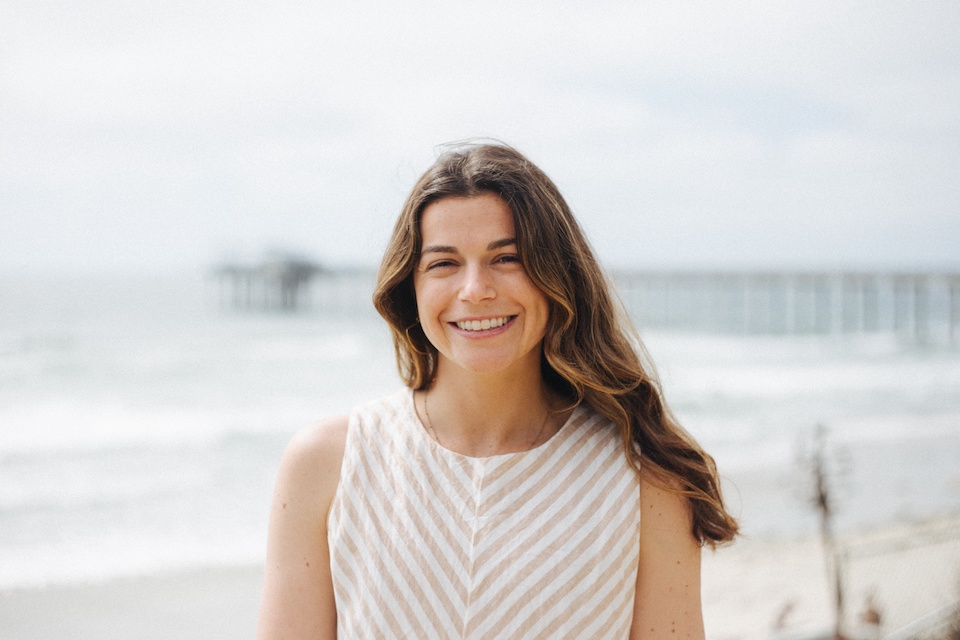
Dr Vanessa ZoBell, acoustic oceanographer and postdoctoral researcher at the Scripps Institution of Oceanography. Credit: Vanessa ZoBell.
Falling in love with acoustics
Even though third grade Vanessa presented her future dream job as an oceanographer on a “Get to Know Me” poster, her journey with acoustics started in the forest studying birds.
Since getting her bachelor’s degree, Vanessa has found herself applying microphones and hydrophones, an underwater device that detects and records ocean sounds, in diverse ecosystems. These devices provide a continuous data stream that records up to 365 days of natural sounds. As Vanessa explains, studying acoustics meant being in the natural world without being invasive:
“You’re just a fly on the wall. You get to hear or be part of their natural world without disturbing the species.”
The science, curiosity and willingness to translate these sounds and compile them into one story is what Vanessa found so fascinating about this field. However, getting hydrophones in and out of the ocean is not as simple or dry as it sounds. It is an activity that requires much effort.
The journey of sound: from below the waves to the surface
A day in the life of Vanessa can look very different depending on the stages of the research she is in. Getting the data from the ocean to the laboratory is the hardest and wettest stage of all the research phases.
Deploying hydrophones in the ocean is a team effort. When Vanessa goes on expeditions, the technicians ensure cables and hydrophones are set up correctly before placing them underwater. Once underwater, they check that the instrument is in the right location or hasn’t been smashed by the pressure of the ocean.
Sometimes, hydrophones can be very attractive to certain animals. Sharks can attack the equipment, or marine mammals will play with it once deployed. As Vanessa shares: “One time, from an Arctic set, my colleagues heard a narwhal poking its tusk into the instrument. It sounded like tick tick tick. You could hear him coming up to the instrument, ticking, poking a little bit, and then swimming away.”
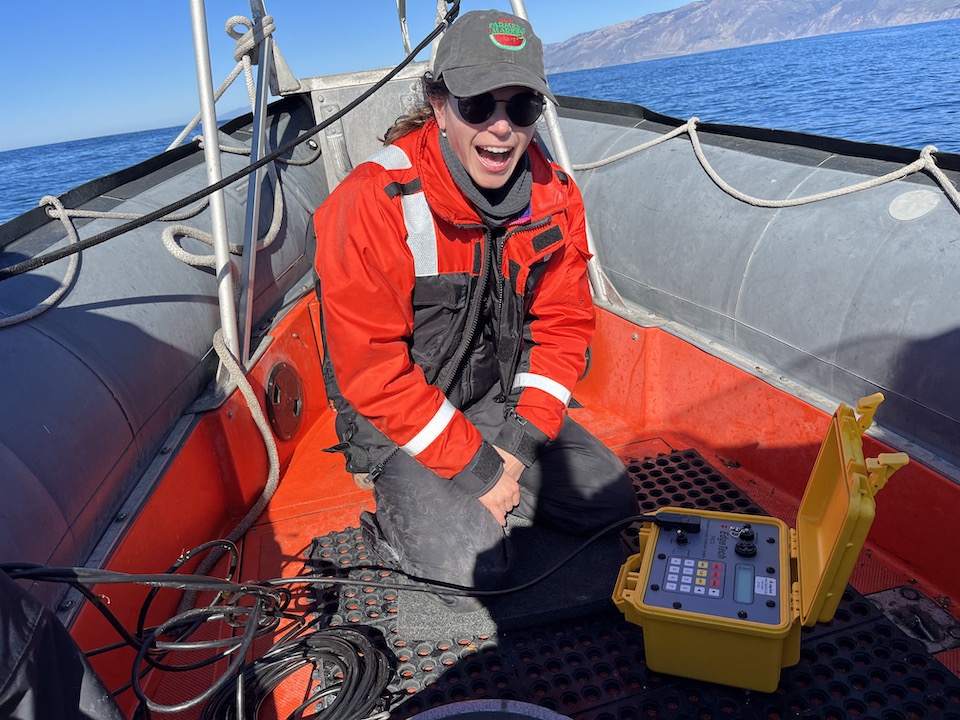
Dr Vanessa ZoBell releasing an instrument from the seafloor and waiting for it to come to the surface. Credit: Vanessa ZoBell.
Once months have passed, Vanessa is ready to recover the instrument. The team goes on another voyage, hoping to find the equipment where they left it. The offshore environment can be hard, but when the equipment is recovered and safe on the boat another phase starts, which requires a drier environment: the laboratory and its computers.
Turn the laboratory’s speakers on: “What! Are there sperm whales here?”
Once the data is out of the recording instrument and into a computer, it has to be processed, meaning the different specialists working with Vanessa would look for sounds to translate into species and meaning. Since she works with whales calls, she will pay closer attention to the low-frequency sounds recorded.
You might be wondering… does she listen to 365 days of data by herself? Since the audio recordings can be large, machine learning algorithms have been helping acoustic scientists to identify specific sounds faster. However, as Vanessa explains, scientists need to listen to their data to double-check the final results and understand the whole picture.
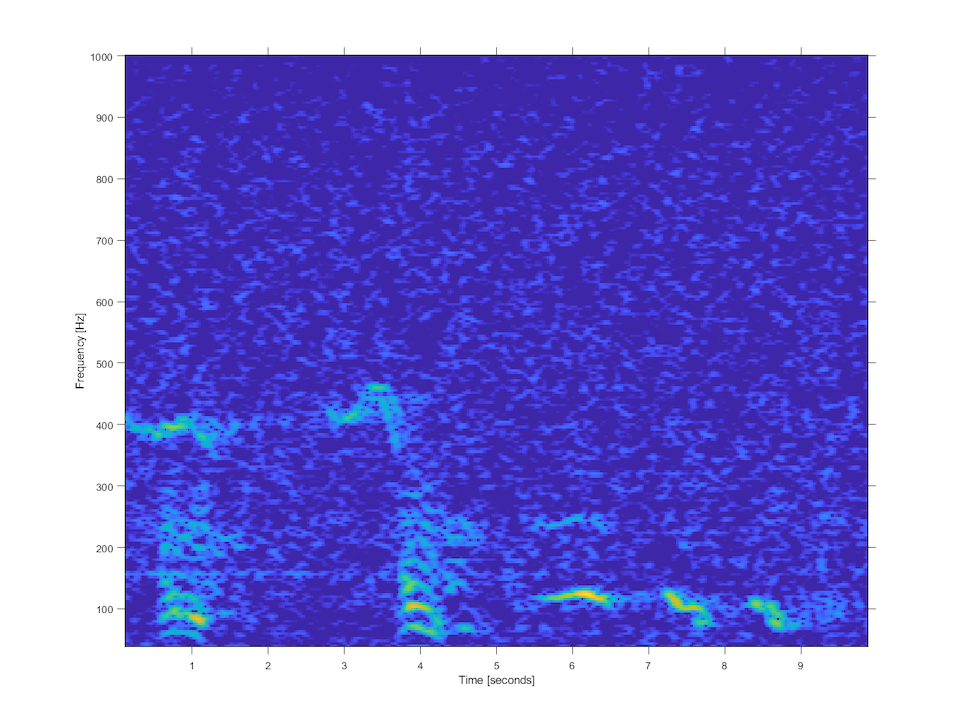
The picture shows a spectrogram of a humpback whale call. Spectrograms are a visual representation of the distribution of acoustic energy across frequencies and time. The y-axis represents the frequency in Hertz, and the x-axis represents time in seconds. The warmer colours represent higher amplitudes when the whale is calling. Credit: Vanessa ZoBell.
Translating sounds into actions
Sound guides life underwater; the big challenge is how to make sure it guides positive actions in whale and marine mammal conservation on the surface.
By understanding which species were heard in a particular space and time, Vanessa and her team can explain how the presence of whales is changing. These results guide policy makers and stakeholders when making decisions to move or expand marine protected areas or implement new noise management and shipping policies.
Vanessa proudly shares, “I’m excited for this data to be used; a lot of efforts have been put in collecting this data and showing it in new ways to find solutions that are helpful to protect the animals that are under pressure from different threats in the modern ocean than ever”.
Becoming an acoustic scientist
Vanessa is also inspiring and guiding a new generation of oceanographers with her post-doctoral position at Scripps Institution of Oceanography. She likes to joke about being “the cool aunt of the lab” since she guides graduate and undergraduate students in setting up their research questions and finding their path in the field.
She is very proud of her “nephews and nieces,” whom she has been mentoring over the years. Curiosity, perseverance, and the willingness to ask questions are what lead her students to greater places.
For Vanessa, her greatest advice involves learning how to deal with rejection. She likes to call it, “memory of a goldfish”, get up and apply again. Don’t let the experience of rejection define you. Rejection makes you harder, and a better scientist.
At the same time, Vanessa believes learning professional and technical skills is crucial to success in the field. Sometimes, the scientific or conservation field may feel less “formal” than other careers. However, knowing how to send a professional email, respecting meeting times and deadlines, and communication skills brings professionalism to the field.
Technical skills such as coding and programming are very handy, especially if you are interested in a career in oceanography. Vanessa would encourage you to “open your heart, open your mind, and you will learn it.” She believes anyone can learn anything if you are patient!
It’s time we listen to the ocean!
Ocean acoustics is one of the many fields within oceanography that provides valuable insights and guidance for marine wildlife conservation. Translating ocean sounds into actionable conservation strategies is not easy, however, Vanessa’s journey and passion show us is a worthwhile endeavour.
As Vanessa hopefully shares: “We really need to put our heads, data, and programs together to find a path that will lead to sharing the ocean as best as possible.”
Are you feeling inspired by ocean acoustics and want to keep listening?
Check Across Acoustic podcast’s episode where Vanessa dives deeper into her research and how her results impact on marine mammal conservation.
Are you interested in starting a career as an acoustic oceanographer? Check out our new ultimate guide: How to become an Oceanographer?
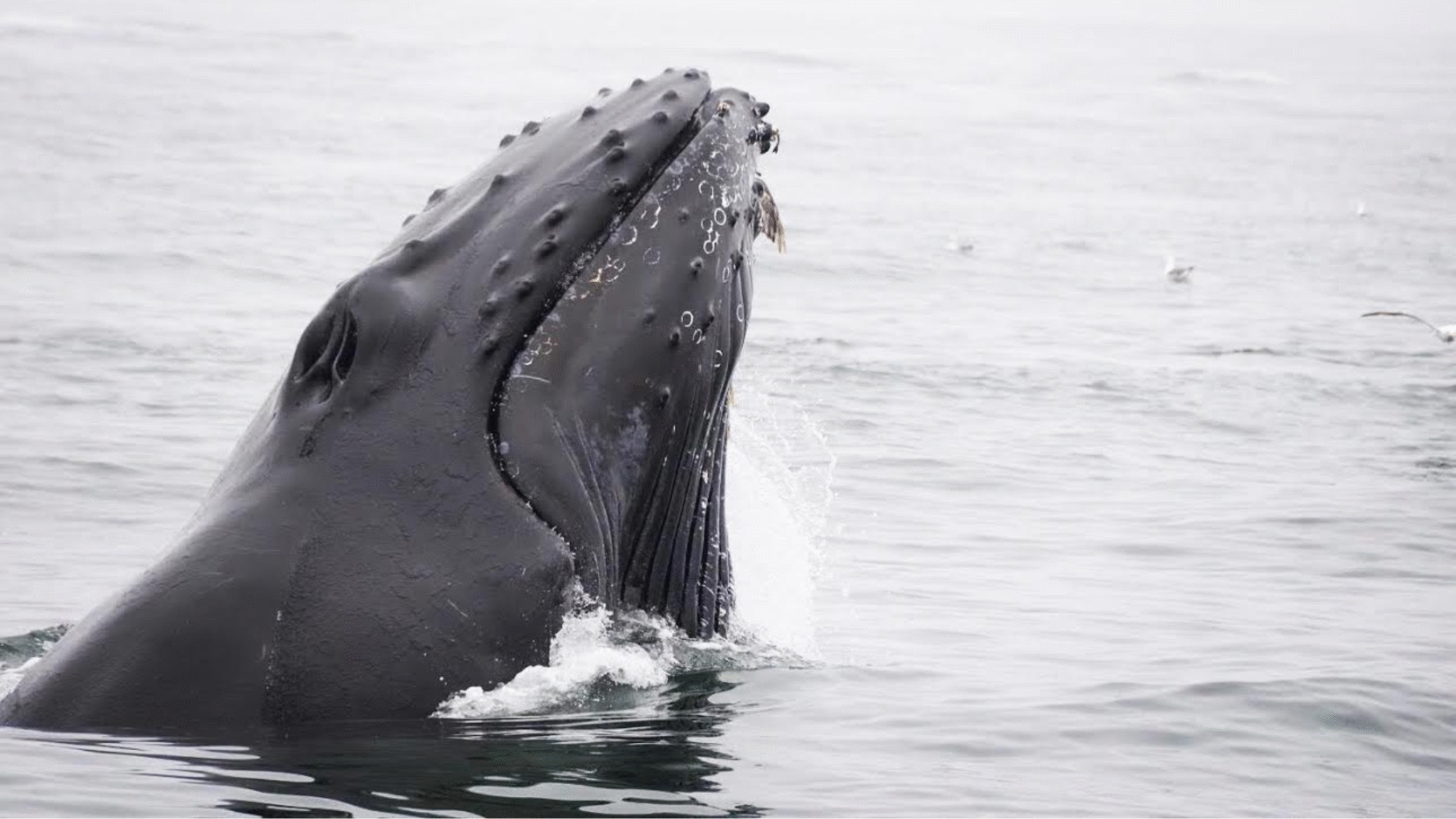
Featured image: A humpback whale surfaces. Credit: Vanessa ZoBell.
Author Profile | Giuliana Vomero

Giuliana is a Marine Biologist born and raised in Uruguay, South America. She is passionate about bridging ocean and marine science with society. She has gathered experience in coordinating environmental outreach projects, events, and networking building. In her free time she loves to write and share the wonders of the ocean and stories behind the work of passionate conservationists worldwide.
 Connect with Giuliana on LinkedIn, follow her on Twitter or Visit her website.
Check out more conservation interviews by Giuliana.