Nick Evans and the Real Work of Snake Conservation

South African conservationist Nick Evans shares his journey from childhood snake enthusiast to renowned snake rescuer, researcher, educator, and advocate for human-wildlife coexistence. Discover career advice, conservation lessons, and the realities of working with some of Africa’s most misunderstood animals.
The Man Behind the Myth
Who chooses to spend a life moving toward the very animals most people run from?
For Nick Evans, the answer did not begin with spectacle. It began in a garage, as a child of three or four, staring at a Brown House Snake in a bucket after his mother had caught it. Add to that the influence of The Crocodile Hunter, countless hours outdoors in Durban and Westville, and a boyhood spent scanning gardens, reserves, and night paths for movement in the grass, and the foundations of a life’s work were quietly laid.
Today, Evans is one of South Africa’s best-known snake rescuers: a field-based conservationist, educator, researcher, and public communicator working primarily in KwaZulu-Natal. But his story is not one of fearlessness, and it is certainly not one of performance. It is a story about learning slowly, working ethically, and staying mentally steady in a profession shaped by danger, public misunderstanding, habitat loss, and chronic financial strain.
For aspiring herpetologists, his journey offers something more valuable than romance. It offers reality.
Where Fascination Begins
Evans’ fascination with snakes did not emerge from thrill-seeking. It came from repeated, intimate exposure to the living world. As a child, he spent as much time outdoors as possible, exploring his mother’s garden, his grandparents’ “jungle” in Westville, and later places like Palmiet Nature Reserve. He caught non-venomous species such as Brown House Snakes and Spotted Bush Snakes when he was still young, and by his early teens he was already building a practical understanding of more dangerous species.
That detail matters. Too often, people imagine wildlife careers as sudden callings or dramatic leaps. In reality, they are usually built on long apprenticeships of observation: noticing behaviour, understanding habitat, learning identification, and discovering that real expertise is formed in patience rather than bravado.
Evans’ path reminds us that conservation often begins not in institutions, but in attention.
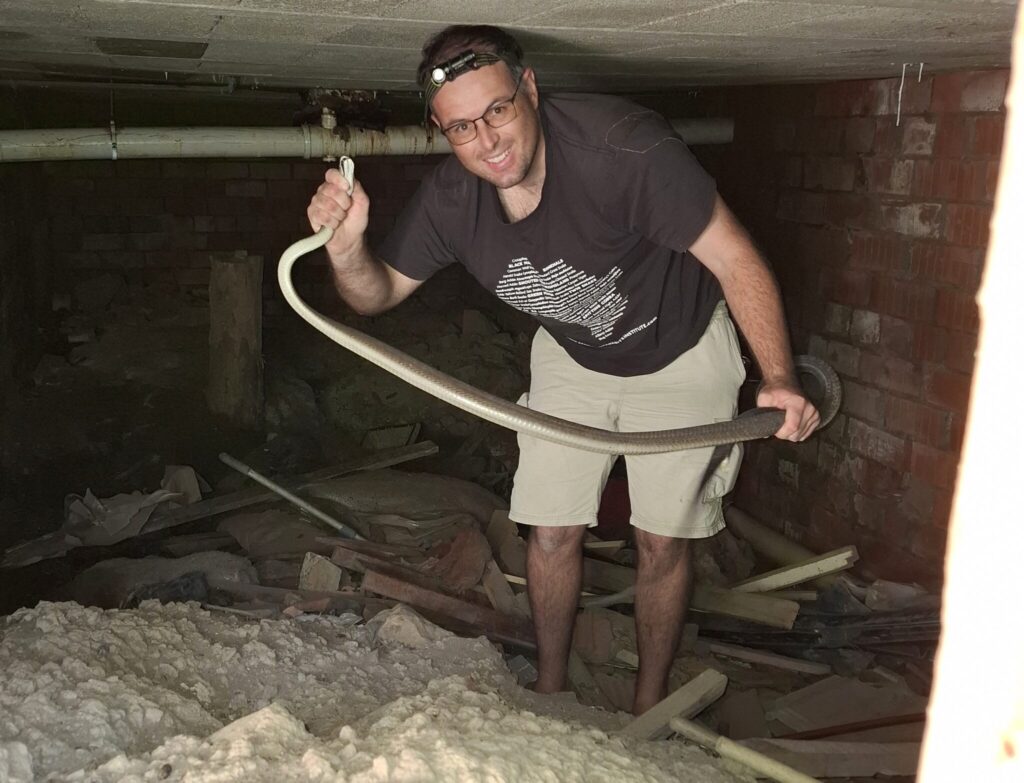
Not every rescue happens in ideal conditions. Nick often finds himself navigating tight spaces, and working in challenging environments to safely remove and release the reptiles.
A Career Built the Hard Way
Evans became a full-time snake rescuer at 21. Before that, he had worked at a snake park for two years after high school and briefly hoped to work in the bush. When that did not materialise, he returned home and made a difficult decision: if he wanted to work with reptiles, he would have to build something himself.
That choice came with uncertainty. Snake rescue, he says plainly, is not work one can comfortably live off on its own. Some clients pay. Many cannot. In informal settlements or rural areas, calls are often attended for free. The result is a profession driven less by profit than by conviction.
That is one of the most important truths in this interview. Conservation is often framed publicly as meaningful work, and it is. But meaningful does not mean easy, stable, or well-funded. In Evans’ case, the work is sustained through a patchwork of rescues, talks, surveys, research collaborations, media work, and relentless persistence.
For early-career conservationists, this is a necessary corrective. Passion matters. But structure, adaptability, and stamina matter too.
The Most Dangerous Myth Is Not the Snake
Spend enough time around snakes, and one thing becomes clear: much of the danger surrounding them is created by people, not by the animals themselves.
Evans repeatedly returns to this point. The most common myths, he says, are that snakes chase people, attack unprovoked, or lie in wait to kill. These falsehoods do real damage. They push frightened people to try to kill snakes, often putting themselves at greater risk of being bitten, spat at, or otherwise injured.
He has seen people pour chemicals through homes, start fires in buildings, and even burn tyres under vehicles in misguided attempts to “smoke out” a snake. None of this is only irrational; it is dangerous.
This is where Evans’ work becomes larger than rescue. He is not simply moving reptiles out of houses. He is intervening in a culture of fear. He is trying to replace myth with literacy.
And that, arguably, is what conservation increasingly requires: not only protecting species, but changing the stories people tell about them.
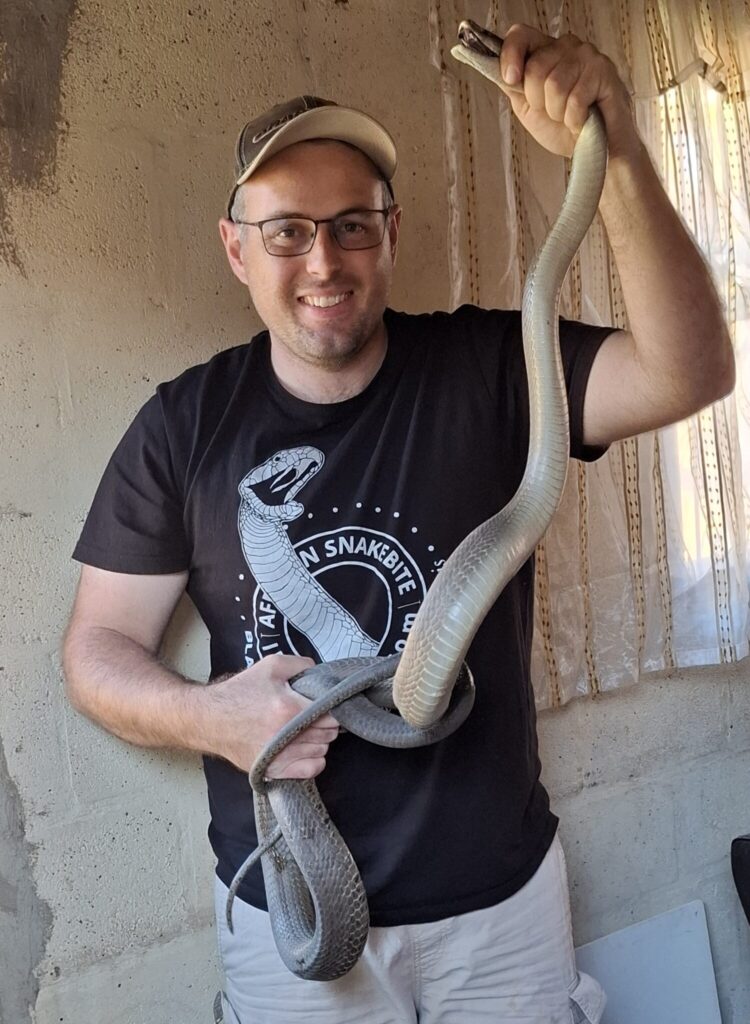
Face-to-face with a Black Mamba, one of the world’s fastest and most formidable venomous snakes.
Why Slow Learning Saves Lives
Perhaps the strongest lesson in the interview is Evans’ insistence on gradual learning.
He is unambiguous: people wanting to work with highly venomous snakes need proper training, should begin with non-venomous and mildly venomous species, and should build experience incrementally. In his words, Black Mambas are “a different animal to work with.” That respect is not theatrical. It is technical, ethical, and survival-based.
This matters in an era where wildlife handling is often flattened into content. Evans directly warns that anyone entering the field for Instagram photos or TikTok clips is unlikely to last long.
That line is striking because it cuts to something deeper than social media criticism. It is a defence of seriousness. Snake work is not an aesthetic. It is a discipline where a moment of ego, complacency, or distraction can end in a hospital bed or worse.
Reading Behaviour, Not Performing Control
What keeps people safe in venomous snake work? Not just equipment. Not just courage. Evans says that while technical skill matters, reading behaviour probably matters more.
That insight should sit near the centre of the article.
To read behaviour is to slow down. To notice body tension, directionality, escape intention, defensiveness, available cover, and the difference between a snake that wants to flee and one being forced into a corner. It means recognising that safe capture is less about domination than anticipation.
It also means accepting that not every situation should end in intervention.
Evans gives a deceptively simple example: a Black Mamba basking on shrubs down a steep embankment. There is no point trying to catch it. The terrain is unsafe, the snake will disappear quickly, and the risk outweighs the benefit.
That answer reveals a great deal about ethical field practice. Good conservation is not about proving capability. It is about judgment.
What Rescue Really Means
Evans often says he is rescuing “snakes, and people,” and the phrase is more complex than it first appears.
The snakes are often in immediate danger from humans, dogs, or the destruction of habitat. But people, too, are protected when a frightened household does not attempt to kill a cobra in a bedroom or corner a mamba in a garage. The real value of rescue is not only removal. It is de-escalation.
Yet Evans is careful not to sensationalise the risk. In his account, bites are extremely rare unless someone is actively trying to catch, handle, or kill the snake. That nuance is important. It resists both panic and complacency.
The best rescuers do more than remove an animal. They restore proportion.
Habitat Loss Is the Real Emergency
One of the most sobering parts of the interview is not about venom at all. It is about land.
Evans describes being called to a greenbelt where a Black Mamba had been seen, only to discover workers clearing the vegetation. To him, the chain of consequence is obvious: destroy habitat, and snakes are pushed into the remaining spaces available to them, including human properties.
This is the deeper conflict beneath “human–snake conflict.” The problem is not merely that snakes enter our spaces. It is that our spaces have steadily overtaken theirs.
That shift reframes the moral conversation. If conservation is only about reacting once wildlife crosses the threshold of a home, it is already too late. The real work begins earlier, in protecting habitat, reducing fragmentation, and challenging the human assumption that every patch of undeveloped land exists to be cleared, built on, or tidied into ecological emptiness.
The Hidden Burden: Mental Health, Money, and the Cost of Caring
This is where the article can become far more powerful than a standard profile.
Evans is unusually candid about the realities most people do not see: finances are often the hardest part; the job is stressful, underpaid, and emotionally draining; and the polished image people see online does not reflect the full picture. He speaks openly about depression and anxiety, about struggling to get out of bed some days, and about relying on focus, medication, and a “never give in” mentality to keep moving.
That honesty should not be treated as a side note. It is central to the story.
Because conservation, especially frontline conservation, is often narrated in heroic terms that leave little room for fatigue, vulnerability, or mental strain. Evans’ testimony pushes back against that. It reminds readers that those doing the work are not symbols. They are people, carrying grief, pressure, bills, and their own histories into the field.
There is courage in rescue. But there is also courage in continuing.
Mentorship, Research, and the Long View
Another strength of Evans’ career is that it resists the false divide between practical rescue work and serious science.
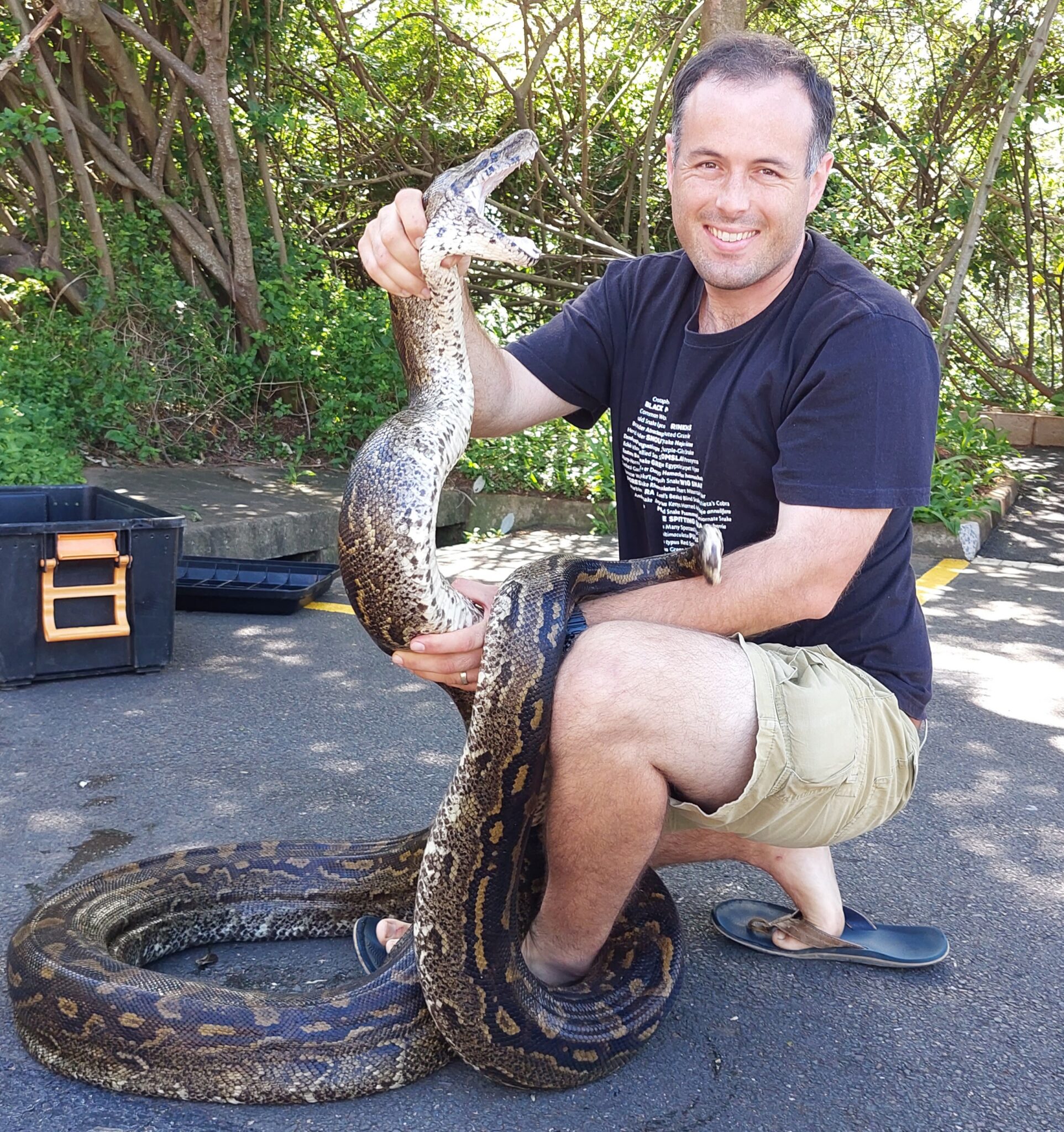
His rescue work feeds directly into research: behavioural observations, measurements, microchipping, recaptures, movement data, and longer-term insight into species such as Black Mambas and Southern African Pythons. He speaks with particular enthusiasm about long-term monitoring, because it reveals what short-term studies cannot: individual growth, home-range familiarity, repeated use of pathways, and life-history patterns that only time can uncover.
His relationship with Professor Graham Alexander also stands out. Evans describes him not simply as a collaborator, but as a phenomenal mentor without whom he would be lost. That is a powerful lesson for aspiring conservationists. Mentorship is not ornamental. It shapes judgment, opens doors, protects against avoidable mistakes, and turns raw field experience into enduring contribution.
Never Out of the Fight
What does success look like after years in the field?
For Evans, it is measured in many ways: thousands of snakes saved, thousands of people educated, research collaborations, published papers, reptile and amphibian surveys, growing professional recognition, and an award from the Zoological Society of Southern Africa. And yet, even alongside these achievements, he speaks frankly about still struggling financially month to month.
That tension is the article’s final truth. Conservation success is rarely neat. It is often partial, hard-won, and shadowed by ongoing precarity.
And still, he continues.
His guiding principle, borrowed and adapted from a military ethos but re-rooted in environmental purpose, is simple: “Never out of the fight.” In lesser hands, that could sound dramatic. Here, it feels earned. It means refusing to surrender in the face of habitat destruction, public ignorance, institutional difficulty, mental strain, and the slow grind of trying to keep both wildlife and people safe.
For aspiring herpetologists, that may be the most valuable lesson of all. This work is not for those seeking glamour, speed, or applause. It is for those willing to keep learning, keep thinking, keep caring, and keep showing up.
Not because it is easy.
Because it is necessary.
Author Profile | Stephanie Nicolaides
 Stephanie Nicolaides is a dedicated PhD candidate in Environmental Management at the University of the Western Cape. Her research delves into the impact of plastic pollution on the Mossel Bay coastline (South Africa), with a particular focus on the effects on marine biodiversity. Her work focuses on assessing plastic presence, local knowledge, and developing sustainable solutions. Stephanie holds an MSc in Life Sciences from the University of South Africa, where her dissertation examined the behavioural ecology of African clawless otters. She also earned her BSc Hons in Life Sciences, graduating cum laude, with an honours project on personality in Leopard Tortoises. Passionate about environmental sustainability, Stephanie is committed to advancing knowledge in marine biology and contributing to efforts to protect and preserve coastal ecosystems. Connect with Stephanie on LinkedIn.