Ink, imagination and impact: How one artist is restoring our relationship with nature through storytelling

Ink, imagination and impact: How one artist is restoring our relationship with nature through storytelling
What if conservation didn’t always begin in laboratories, policy briefs or field stations?
What if it began with a pen, a quiet moment of stillness, and the courage to listen inward?
For Jade Shepherd, founder of The Perpetual Pen, conservation is not a separate pursuit layered onto her creative work. It is the current that runs beneath every line of ink, every pause of the hand, and every story she chooses to tell. Her art exists not simply to be seen, but to be felt, as an invitation back into relationship with the living world.
At the intersection of art, spirituality and stewardship, Jade’s journey reminds us that while science helps us understand what is happening to our planet, it is often storytelling that helps us carry that understanding with care, humility and hope. This is the story of how returning to art as a means of survival became a pathway into conservation, and how creativity itself can become a form of ecological healing.
Returning to art, returning to Earth
Art was always part of Jade’s life. But like many people, she lost touch with it somewhere between childhood and adulthood. “Art was always part of me,” she reflects, “but I lost touch with it as life got louder.”
Even as creativity faded into the background, her connection to animals, ecosystems and the natural world grew stronger. Long before she had the language of conservation, she felt a deep, instinctive pull toward protecting the Earth, not as an abstract concept, but as something intimate and relational.
In September 2023, that pull brought her back to art, not as a career move, but as a lifeline.
“I wasn’t trying to build anything,” she explains. “I was creating in order to exist, to process the world, and to cope with the weight of reality.” As she shared her work and slowly re-entered the art world, something unexpected happened. She began crossing paths with artists whose work was deeply embedded in conservation, people who were using creativity not as decoration, but as advocacy and meaning-making.
That was the moment of recognition. “Art wasn’t separate from conservation for me,” Jade says. “It was the doorway.” Conservation was not something she would add onto her work later. It was the reason her creativity existed at all.
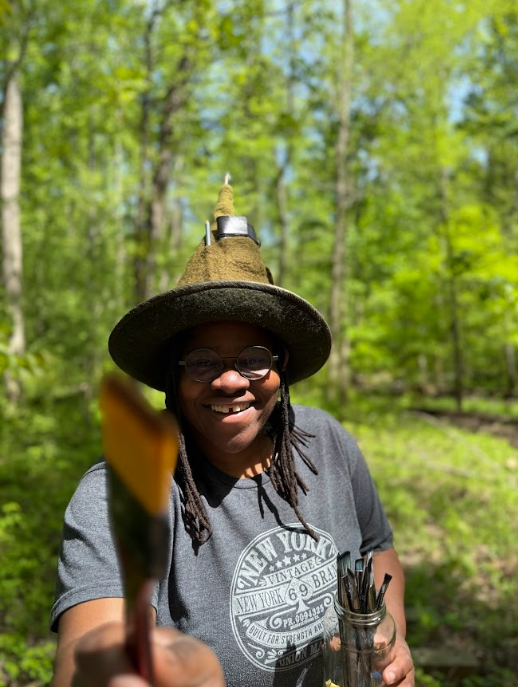
Jade in her element, paintbrush in hand, forest at her back. Creation begins outdoors, where stillness, observation, and wild spaces shape the stories that later unfold in ink.
Why storytelling holds what science cannot
Jade’s engagement with conservation came not through formal science, but through curiosity. As she began encountering the data, statistics and realities of environmental loss, she realised she needed art as a way to process what she was learning. “Science tells us what is happening,” she says. “Storytelling helps us feel it, understand it, and hold it.” For Jade, art became the bridge between knowledge and emotion, between information and care. Data could inform her, but storytelling allowed the truth to settle somewhere deeper, somewhere human.
In a world saturated with facts yet starving for meaning, her work asks an important question: What happens when we allow ourselves to feel what we know?
An inner ecosystem: stillness, spirituality and the wild
When asked what shapes her creative voice, Jade does not begin with technique or aesthetics. She begins with stillness. Her daily meditation practice forms the foundation of her work, a process of inward listening that helps her discern what wants to be expressed rather than what feels performative. From there, the natural world flows in seamlessly.
“Landscapes, animals and ecosystems feel inseparable from my inner life,” she explains. “We are nature.” Books, documentaries, quiet moments outdoors, and long periods of observation all weave together into what she describes as an ecosystem of influences, one that eventually emerges as ink on paper.
The Perpetual Pen: persistence as stewardship
The name The Perpetual Pen is not symbolic by accident. To Jade, “perpetual” means persistence, continuing even when consistency feels difficult, choosing hope when apathy would be easier, and showing up again and again for the future we want to build. “Perpetual stewardship looks like small, repeated acts,” she says. “Recycling even when it’s inconvenient. Staying mindful even when it would be easier to disengage.” Her philosophy reframes conservation not as a grand gesture, but as a daily practice, accessible, imperfect, and human.
When philosophy becomes ink
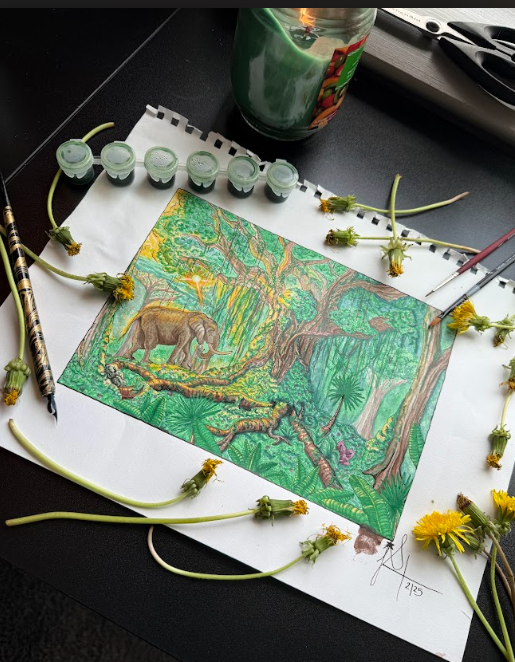
Jade’s creative process does not begin with a sketchpad. It begins in silence. Meditation allows her to access emotional and energetic layers beneath conscious thought. From there, intuition takes over. She does not force meaning onto the artwork; she allows it to surface. “The philosophy lives in the pauses,” she says. “In the lines, the pressure of the pen, and the energy I bring.” Each piece becomes a physical record of an internal truth, an emotional ecology rendered visible.
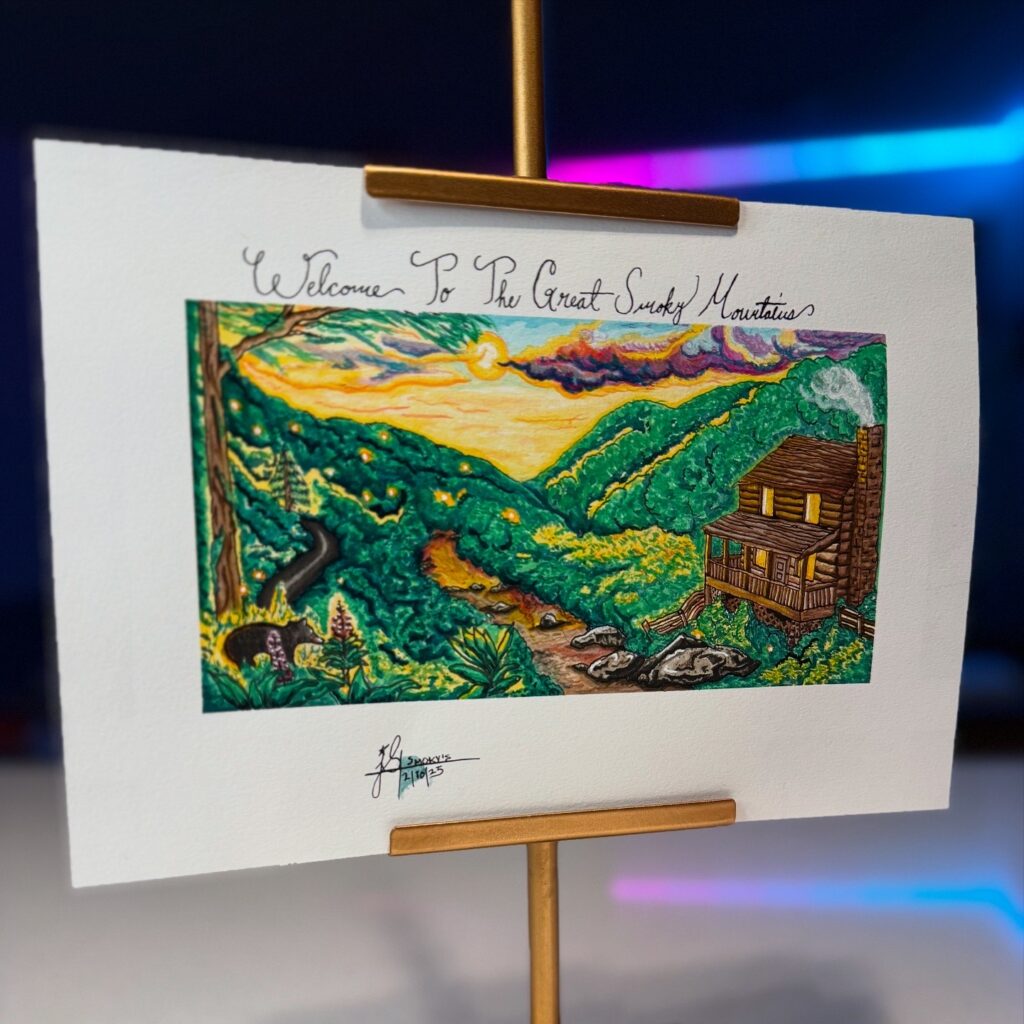
“Welcome to the Great Smoky Mountains” a hand-inked landscape where colour, light, and wilderness meet.
Art as resistance, art as healing
Does Jade see art as ecological resistance or ecological healing? Her answer is both. Art, she believes, holds living energy. Like ecosystems, it evolves over time, shifting meaning as people encounter it in different moments of their lives. A single piece can challenge harmful narratives while simultaneously offering solace and reconnection. In this way, art does more than reflect the world, it reshapes how we relate to it.
Why conservation needs creativity
Jade does not position art against science. She places it beside it. “Science speaks through data,” she explains. “Art speaks through emotion, metaphor and spirit.”
When science, art and meaning work together, something powerful happens:
- Data informs us
- Art helps us care
- Meaning gives us a reason to act
This integration, she believes, is essential for conservation to truly take root.
How art changes people
One of the most consistent responses Jade observes is emotional resonance. Art creates a shared emotional space, one that predates language. Before words, humans communicated through imagery, symbol and energy. Somewhere along the way, that capacity faded. Her work aims to reawaken it. “Conservation begins when people feel the value of the Earth,” she says, “not when they’re told they should care.” Her illustrations seek to transfer awe, reverence and curiosity onto the page, so others can rediscover those feelings within themselves.
A different conservation future
In Jade’s dream world, art is not an optional extra in conservation organisations. It is central. Not decoration, but meaning-making. Art helps people comprehend complexity, feel emotional stakes, and form lasting connections. Excluding creativity, she believes, leaves empathy behind. For conservation to succeed, it must speak not only to the intellect, but to the soul.
Daily practice, living magic
Jade’s creative practice is intentionally fluid, evolving as she evolves. But one commitment remains constant: at least fifteen minutes of creation every day. Some days that becomes hours. Other days it is quiet exploration. “The only rule,” she says, “is that the pen stays moving.” Each piece, she adds, develops its own presence. Sometimes the artwork leads her rather than the other way around. She listens, responds, and allows it to become what it needs to be. Art, for Jade, is a relationship, not a product.
Holding grief without losing wonder
Environmental grief is not something Jade avoids. She translates it. “The magic lives in the creation itself,” she explains. “Each artwork holds the energy of the moment it was made.” Art becomes how her soul transforms emotion into meaning, a way to honour reality without being consumed by it.
Ethics, sustainability and intention
Jade’s practice is shaped by mindfulness, longevity and intention. She uses materials thoughtfully, chooses supplies designed to last, buys locally where possible, and works with eco-conscious suppliers. Importantly, she ties creativity directly to action. Ten percent of all proceeds are donated to conservation initiatives, ensuring that her work remains anchored in tangible stewardship.
Collaboration and wholeness
Meaningful collaboration, for Jade, requires alignment of values, mutual respect, and long-term intention. She is increasingly drawn toward projects that explore balance, restoration and interconnected systems, moving beyond categories and into wholeness. Her global dream is expansive yet grounded: to travel the world illustrating relationships between people, land, ecosystems and culture, creating site-specific works that honour both nature and community.
Advice for aspiring creative conservationists
To artists who doubt whether their work “counts,” Jade offers reassurance: “Art has always mattered.” Cave drawings were not perfect, but they carried immense meaning. What matters is intention and consistency. Her advice is simple, practical and powerful:
Commit to fifteen minutes a day. Belief grows. Skill grows. Identity grows. The mindsets she values most are consistency, curiosity, humility and patience. Her guiding sentence remains: “Fifteen minutes of creation a day can change your relationship with yourself, your art, and the world.”
The world her ink is helping to build
When Jade imagines the world her work contributes to, she envisions a living, breathing ecosystem, one where humans remember they are nature, not separate from it. A world of awe, reverence, complexity and shared belonging. And perhaps that is the quiet power of her work: It does not ask us to save something “out there.” It invites us to remember who we are.
Author Profile | Stephanie Nicolaides
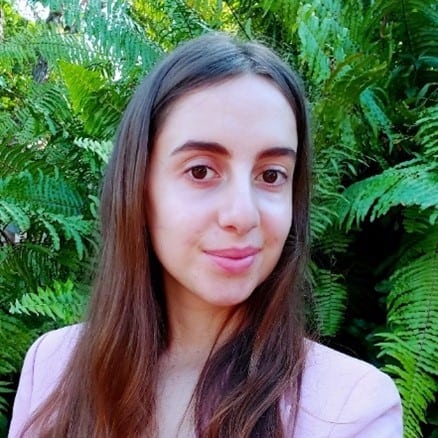 Stephanie Nicolaides is a dedicated PhD candidate in Environmental Management at the University of the Western Cape. Her research delves into the impact of plastic pollution on the Mossel Bay coastline (South Africa), with a particular focus on the effects on marine biodiversity. Her work focuses on assessing plastic presence, local knowledge, and developing sustainable solutions. Stephanie holds an MSc in Life Sciences from the University of South Africa, where her dissertation examined the behavioural ecology of African clawless otters. She also earned her BSc Hons in Life Sciences, graduating cum laude, with an honours project on personality in Leopard Tortoises. Passionate about environmental sustainability, Stephanie is committed to advancing knowledge in marine biology and contributing to efforts to protect and preserve coastal ecosystems. Connect with Stephanie on LinkedIn.