
Oceanographers are a specific type of Conservation Scientist – one of the 11 Key Conservation Roles.
Here’s how most Conservation Scientist roles compare with other conservation roles. We’ve given each role a rating from 1 (lowest) to 5 (highest) for pay, popularity (how many applicants roles receive) and availability (how many jobs are available at a given time). Keep in mind that this is a general guide, and that pay, popularity and availability can vary with employer type, location and job level.

If you plan to work as an oceanographer in the UK, you can review the National Careers Service’s guidance for oceanographer careers. If you plan to work as an oceanographer in the USA, you can read the U.S. Bureau of Labour Statistics guidance for Life, Physical, and Social Science Occupations, such as Environment Scientists and Specialists.
To research salaries for general Oceanographer roles in your region, we recommend searching the Economic Research Institute’s Compensation Hub. To research salaries and availability for Oceanographers in your region, we recommend searching our Conservation Job Archive.
There are many societies and professional organisations for oceanographers worldwide that can support you to become an oceanographer. Here are just a few to get you started:
- Association for the Sciences of Limnology and Oceanography (ASLO)
 : Aims to foster a diverse, international scientific community that creates, integrates, and communicates knowledge across the full spectrum of aquatic sciences.
 - Marine Biological Association (MBA)
 : Promotes scientific research into all aspects of life in the sea and disseminates the knowledge gained to the public.
 - The Oceanography Society (TOS)
 : Disseminates knowledge of oceanography and its application through research and education.
 - Intergovernmental Oceanographic Commission (IOC) of UNESCO
 : The only UN body specialised in ocean science and services, facilitating international cooperation and coordinating programs in marine research.
 - Australian Marine Sciences Association (AMSA)
 : A professional association dedicated to promoting marine science in Australia.
 - Partnership for Observation of the Global Ocean (POGO)
 : A consortium of major oceanographic institutions worldwide, aiming to promote global oceanography.
 - African Marine Environment Sustainability Initiative (AFMESI)
 : Aims to promote the sustainable use of the African marine environment through research and advocacy.
 - International Coral Reef Society (ICRS)
 : Founded in 1980, the ICRS promotes the acquisition and dissemination of scientific knowledge to secure coral reefs for future generations.
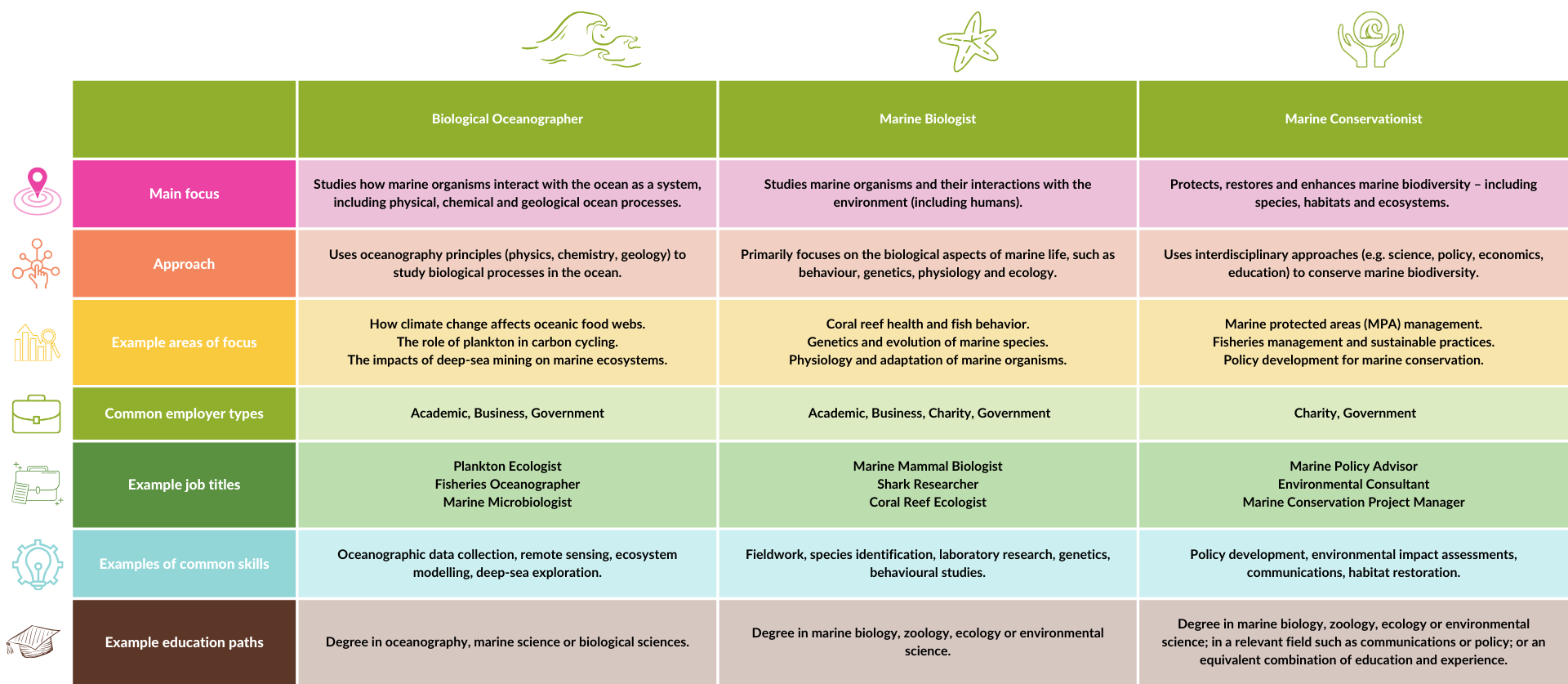
Explore societies and professional organisations for marine biologists (scientists who study marine organisms and their interactions with the environment) in our guide How to become a marine biologist.
 Oceanographer interviews
- How can oceanography and data science save marine wildlife?
- Translating sounds into actions: What It means to be an acoustic oceanographer
- A creative leap: From fine art to ocean research
- Ocean colour with Oliver Clements: Analysing our oceans with satellites
- Marine conservation and changing arctic oceans – An interview with Stephanie Sargeant
You might also like to explore examples of how oceanographers can apply their expertise across the 11 Key Conservation Roles, such as:
Ultimate Guides for oceanographers
Explore all oceanographer resources.
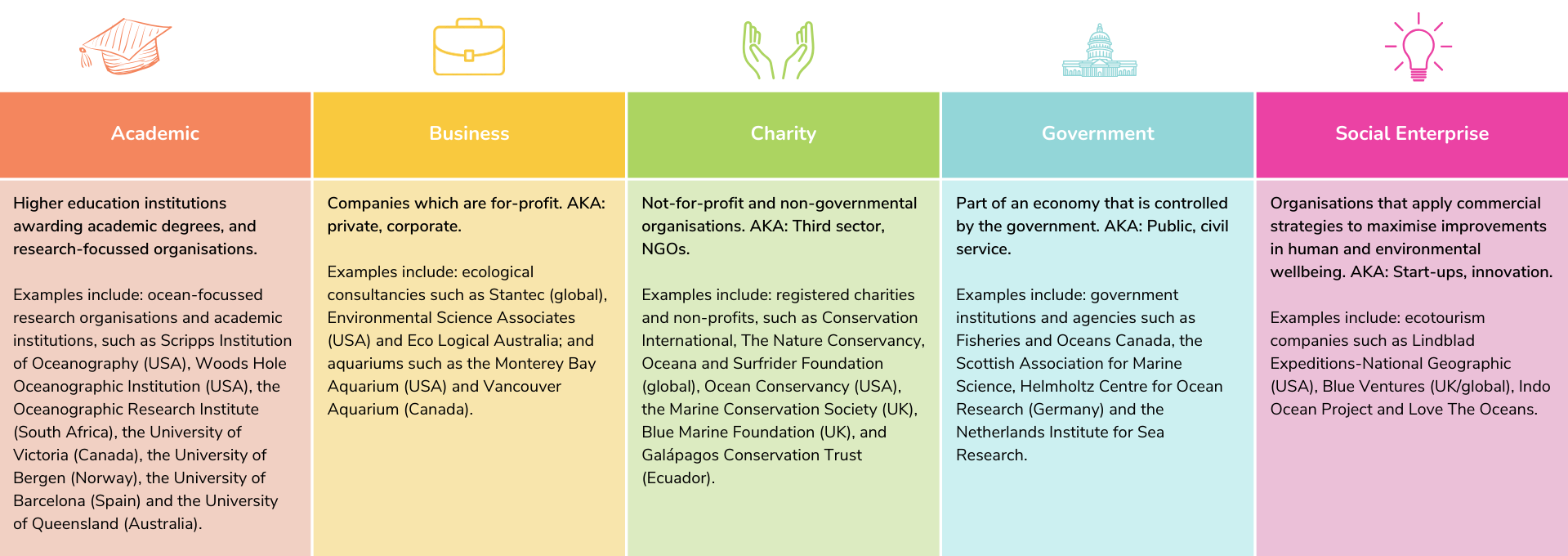
To help illustrate oceanographer roles, here are several job descriptions that represent (real) entry level oceanographer jobs. Pay particular attention to the selection criteria (specifications) to learn more about what conservation employers are looking for when they hire oceanographers.
.
 Ocean Scientist – Rothera | British Antarctic Survey | Rothera, Antarctica and Cambridge, UK (2025)
British Antarctic Survey (BAS) is looking for an early career Ocean Scientist to join our team based in Antarctica. BAS delivers and enables world-leading interdisciplinary research in the Polar Regions. We employ experts from many different professions to carry out our Science as well as keep the lights on, feed the research and support teams and keep everyone safe!
Working at BAS is rewarding. Our skilled science, operational and support staff based in Cambridge, Antarctica and the Arctic, work together to deliver research that uses the Polar Regions to advance our understanding of Earth as a sustainable planet. Through our extensive logistic capability and know how BAS facilitates access for the British and international science community to the UK polar research operation. Numerous national and international collaborations, combined with an excellent infrastructure help sustain a world leading position for the UK in Antarctic affairs. British Antarctic Survey is a component of the Natural Environment Research Council (NERC), which is part of UK Research and Innovation www.ukri.org
What we offer:
You’ll be joining BAS at an exciting time with the role spanning over two science teams. The first being the polar oceans team which explores the physics, chemistry and biochemistry of the Southern Ocean and high arctic waters. The second team is Biodiversity, Evolution and Adaptations which looks at ecology and physiology of biodiversity in the shallows.
You’ll help us to deliver the ongoing biological and oceanography times series which will include taking a leading role in maintenance of aquaria and chemistry lab maintenance; CTD profiling; sea water profiling; diving to measure iceberg scouring and make biological collections.
Within the role, there will be an opportunity to develop role specific skills alongside standard training provided for those living and working in the extreme polar environment. There are also opportunities to progress into other areas such as lab manager, environment advice, diving officer and station support/management roles.
Current projects the team are working on include an environmental impact assessment of a proposed runway extension at Rothera alongside the BAM team. This will be supporting the possibilities of acquiring a new long range aircraft link with the Falkland Islands and South America.
You’ll be joining a world-leading interdisciplinary research organisation, that is committed to recruiting talented people like you, progressing your career and giving you the support, you need to thrive at BAS.
Some of your main responsibilities will include:
- Maintenance of aquaria
- Sea water sampling
- SCUBA diving to make observations and collections
- Ice observations
- Support of marine biology programmes
For the role of Rothera Ocean Scientist we are looking for somebody who:
- Holds a BSc 2:1 or equivalent;
- Is an experienced SCUBA diver (CMAS 3* equivalent, minimum 80 logged dives. Including 40 cold water dives <12֯C / 25 drysuit dives).
Ideally you will have HSE or equivalent qualifications and full face mask experience. You will possess a good knowledge of small boat handling and a flexible approach to problem solving. Proficient in written and spoken English language, you will have the ability to get on in a small, tightly knit team for extended periods. You will live and work within a small team at Rothera which integrates with a larger team in Cambridge. In addition, you will need to be physically fit enough to cope with the working environment in Antarctica and pass a BAS medical.
Oceanographic Data Specialist 1 | Ocean Associates | Maryland, USA (2025)
Ocean Associates Inc. (OAI) is seeking a full-time Oceanographic Data Specialist 1 to support the NOAA Center for Operational Oceanographic Products and Services (CO-OPS) Engineering and Design Branch and the Products and Services Branch in Silver Spring, MD. The individual will be responsible for ensuring the integrity and accuracy of water level stations and their associated metadata and data to support CO-OPS datums partnerships. OAI is a Virginia corporation established in 2003 that provides consulting and technical services to the U.S. government, non-governmental organizations, international organizations, and the private sector. We specialize in scientific program and project management, strategic planning, professional and technical services and stakeholder engagement, supporting government contracts.
CO-OPS is the authoritative source for accurate, reliable, and timely tides, water levels, currents, and other coastal oceanographic and meteorological information. Offering services that support safe and efficient maritime commerce and transportation, help protect public health and safety, and promote robust, resilient coastal communities. CO-OPS maintains ocean observing infrastructure, including more than 200 permanent water level stations on the U.S. coasts and Great Lakes, an integrated system of real-time sensors concentrated in busy seaports, and temporary meters that collect observations for tidal current predictions. Through these systems, CO-OPS provides the nation with historic and real-time data, forecasts, predictions, and scientific analyses that protect life, the economy, and the environment on the coast.
Key Responsibilities May Include:
- Documentation and Data Input: Support the submission, review, and input of metadata for water level, meteorological, and oceanographic sensors, ensuring all data aligns with CO-OPS standards and SOPs.
- Data Stability and Datum Assurance: Monitor and assess the stability of water level stations and ensure they are correctly on datum, performing necessary adjustments and updates to maintain accuracy. Analyze oceanographic data pertaining to the transition of CO-OPS observing systems from legacy sensors to microwave water level technology and assist in coordinating the review and approval of such transitions.
- Data Loading and Quality Assurance: Load preliminary data into the database as needed and conduct quality assurance and quality control checks on water level data to detect and resolve discrepancies. Assist in the development of revised tidal datum determination procedures, including an error budget analysis.
- Data Product Development and Dissemination: Produce essential data products such as hourly heights, highs and lows, monthly means, tidal and geodetic datums, harmonic constituents, and tidal predictions. Assist in the development and presentation of technical training and procedural workshops for NOAA stakeholders seeking to understand CO-OPS oceanographic data analysis.
- Data Tracking and Project Updates: Track data throughout the metadata and data pipeline, providing regular updates to project and partnership leads regarding the status and progress of data handling.
- SOP and Guide Updates: Assist in updating standard operating procedures (SOPs) and guides when necessary to align with evolving practices and technologies.
- Station Evaluation and Decision Support: Participate in the evaluation process to determine which two FLDEP stations will be maintained long-term by CO-OPS, contributing to strategic decision-making based on comprehensive data analysis.
- The contractor will ensure that all metadata and data are integrated into our network correctly and will be generating all downstream data products, thereby supporting CO-OPS’ mission and Datums Partnership operational needs.
Location: Silver Spring, MD
Salary and Benefits: Full time. Salary commensurate with experience. $19 – $24 / hr. Generous employee benefits.
Required Qualifications/Skills:
- Master’s degree in oceanography, meteorology, hydrology, physics, physical science, geophysics, civil engineering, or a bachelor’s degree and 2 years of experience is required.
- Knowledge of physical oceanographic principles, especially those related to tides and tidal currents is preferred.
- Undergraduate or graduate coursework in oceanography, marine engineering, meteorology, and related subjects is preferred.
- Strong oral and written communication skills, as well as a demonstrated ability to work well independently and as part of a team, are required.
- Knowledge and experience with MATLAB, spreadsheets, statistics databases, and Structured Query Language (SQL) preferred.
- Experience with Geographic information Systems (GIS) and with the ESRI suite of GIS products or other commercial GIS software preferred.
- Ability to work effectively both individually and collaboratively in a team/group setting.
- Ability to receive constructive feedback and implement appropriate action.
 Research Assistant I – Bioacoustic Data Analyst | Woods Hole Oceanographic Institute | Woods Hole, Massachusetts, USA (2025)
Woods Hole Oceanographic Institution is currently seeking a Research Assistant I, Bioacoustic Data Analyst to join the Biology Department. This is a regular fixed-term, full-time, non-exempt position and is eligible for full benefits. This position offers an exciting opportunity to contribute to cutting-edge bioacoustics research in a world-renowned oceanographic institution. If you are passionate about marine acoustics, data analysis, and research, we encourage you to apply!
Reporting to the Research Team Lead, the Research Assistant will be responsible for conducting fine-scale analyses of acoustic recordings of bottlenose dolphins, contributing to the development and maintenance of a systematic MATLAB-based database. Additionally, the Research Assistant will analyze various marine acoustic datasets, including sounds from marine mammals, fish, and anthropogenic noise sources. Soundscape analyses and data annotation will be key components of this role. The position may also involve analyzing drone video collected from acoustic playback experiments, as well as examining acoustic and movement data from digital tags. While fieldwork opportunities may arise, they are limited and not guaranteed.
JOB DESCRIPTION
Essential Functions:
- Conduct detailed acoustic data analysis using software such as Raven and MATLAB.
- Maintain, update, and curate a MATLAB-based database of acoustic recordings.
- Perform annotation and classification of marine animal sounds and anthropogenic noise sources.
- Conduct soundscape analyses, including characterization of ambient noise levels and detection of biological and anthropogenic sources.
- Assist in the analysis of drone video footage to evaluate behavioral responses during acoustic playback experiments.
- Analyze digital tag data, incorporating both acoustic and movement data to assess animal behavior.
- Document findings and contribute to research reports, presentations, and potential scientific publications.
- Collaborate with team members to improve data processing methodologies and ensure data quality control.
- Participate in periodic team meetings and discussions to present findings and receive feedback.
- Perform other duties as required.
EDUCATION & EXPERIENCE:
- Bachelor’s degree in a relevant field (e.g., computer science, marine biology, oceanography, bioacoustics, acoustics, environmental science, or a related discipline).
- Exceptional attention to detail and strong organizational skills.
- Ability to work independently while also collaborating effectively within a team.
- Strong analytical and problem-solving skills with a keen interest in marine bioacoustics.
PREFERRED QUALIFICATIONS:
- Candidates with quantitative backgrounds are preferred, including experience with computer programming and machine learning.
- Experience with the acoustic analysis software program Raven and with drone video analysis are also a plus.
SPECIAL REQUIREMENTS:
- Willingness to work full-time at a computer, analyzing and processing acoustic datasets.
- Potential for limited fieldwork opportunities, though not guaranteed.

 To help you navigate your options, please select which best describes you:
- You want to work in conservation but you’re feeling lost, disillusioned or confused?!? Check out our Kick-Starter training designed to help you understand the job market, to navigate your career options, and to get hired more quickly. It’s designed for students, graduates, job-seekers and career-switchers. We’re proud to say it also has 100% satisfaction and recommendation ratings. We know you’ll love it. Find out more about our Kick-Starter – Online Course.
- You need answers to top questions about working in conservation? Check out our free Ultimate Guides covering topics like the Top Conservation Skills, Top Conservation Internships | Paid or Free and Marine Conservation Jobs, and answering questions like How to Switch Careers into Conservation, Do I need a Master’s Degree? and much more! Or download our free guides to keep and read later!
- You feel ready to be applying for jobs in conservation? Check out our membership packages for job seekers which provide access to the world’s biggest conservation job board – with over 15,000 conservation jobs shared each year – plus a range of other benefits. Check out our monthly memberships here.
- You’re submitting applications, but failing to get many interviews? Check out our FREE eBook Conservation Jobs: The Step-by-Step System to Get Hired as a Wildlife Conservationist – available on Kindle, EPUB and PDF. We can also review your applications, and provide 1:1 advice on how to improve them. Check out our application support here.
- You’ve got an interview (well done!) and would like our help to prepare for it? We know what employers want, and have helped many people prepare for and deliver successful interviews. Check out our interview preparation here.